

Niranjani Ghat
Neighbourhood GhatNiranjani Ghat is a small ordinary ghat.


Type
Neighbourhood Ghat
Boat Fare
1x base fare
Best Time
5-9 AM
History
This ghat belongs to the Niranjani Akhada, one of the ancient akhadas of Kashi. It remains a centre of spiritual practice and bathing.
Highlights
- Tradition of the Niranjani Akhada
- Centre of spiritual practice
- Peaceful bathing atmosphere
Festivals & Events
How pricing works in the NaviX app
No haggling at the ghat — everything is fixed in the app first
- 1
Fixed price before you board
The fare is shown in the app upfront — no bargaining at the ghat
- 2
Sharing or private — your choice
Share with fellow travelers or take the whole boat for your group
- 3
Pay only after the ride
UPI, card or cash — with an instant receipt
🕉️
Aarti details not available for this ghat yet
Complete Guide
Niranjani Ghat — The Complete Guide
History, mythology, rites and practical details — everything in depth.
On this page
- 1.Niranjani Ghat — The Ash-Smoked Heart of Ascetic Kashi
- 2.The Niranjani Akhara — A Warrior Order of Renunciates
- 3.The Nagas and Sanyasis — Life in Ash and Ochre
- 4.Festivals of the Akhara — Maha Shivratri and the Great Processions
- 5.Bathing at Niranjani — Rituals of the Morning Ganga
- 6.Stone Steps and Monastery Walls — The Ghat's Architecture
- 7.The River and the View — Ganga from Niranjani
- 8.Behind the Ghat — Lanes of the Old City
- 9.Neighbouring Ghats — Lalita, Rajendra Prasad and Manikarnika
- 10.Atmosphere — Austerity and Devotion on the Stone Steps
- 11.Visiting with Respect — Etiquette Among the Sadhus
- 12.Practical Notes — Reaching Niranjani Ghat
📅 Updated: 21 Aug 2026 · Author: NaviX Field Team (field research 2024-26) · 12 sections · 12 photos
Niranjani Ghat — The Ash-Smoked Heart of Ascetic Kashi
Niranjani Ghat stands on the northern stretch of Varanasi's riverfront, between the bustling southern ghats and the quieter reaches that climb toward Panchganga. It is a wide, open landing of old stone steps, without the palaces and pavilions that ornament its southern neighbours, and its character is set not by a raja but by the monks of the Niranjani Akhara, the ancient Shaivite order that bears the same name and has made this stretch of the Ganga its own. Where Dashashwamedh seethes with vendors and pilgrims, Niranjani keeps an older, sterner temper: the air smells of ash and incense, ochre cloth hangs from lines, and the chant of Hara Hara Mahadeva rises from the water's edge at dawn. The boatmen of the northern stretch tie up here for their midday rest, and the flag of the akhara snaps from its tall staff above the steps, marking this landing as the property of an order rather than of any prince.
The name of the ghat is the name of the order. The Niranjani Akhara, one of the great Dashanami fraternities of renunciates, is said to have had its earliest home in this quarter of Kashi, and the ghat became its doorway to the river. Its sadhus — the ash-smeared Nagas and the ochre-robed sanyasis — still gather here in processions at festivals, when conches blow and saffron flags are carried down the steps to the water. Bathing at Niranjani is held to be especially auspicious during the great Kumbh-era festivals, when the akhara's spiritual power is believed to be at its height and pilgrims from across India come to share the river with the monks. The monks themselves come down to the water in the dawn hours in their hundreds, their wooden sandals ringing on the stone, and their presence fills the landing with a gravity that no other ghat on the river can quite match.
For the traveller, Niranjani is one of the most atmospheric landings on the whole riverfront, precisely because it offers no spectacle. There are no fireworks here, no evening crowds, no riverside drama; there is only the river, the wide worn steps, the occasional sadhu lost in meditation, and the thin smoke of Manikarnika drifting from the ghats to the south. Visitors who sit quietly on the steps for an hour come away with a rare sense of what Kashi was like before tourism — a city of faith, discipline and fire, where the holy river has always been approached with austerity as much as with celebration. As evening falls, the chillum smoke rises blue in the fading light, the bhajan begins on the akhara terrace, and the ghat takes on the still, watchful mood of a place where prayer has outlasted every dynasty that ever ruled the city.
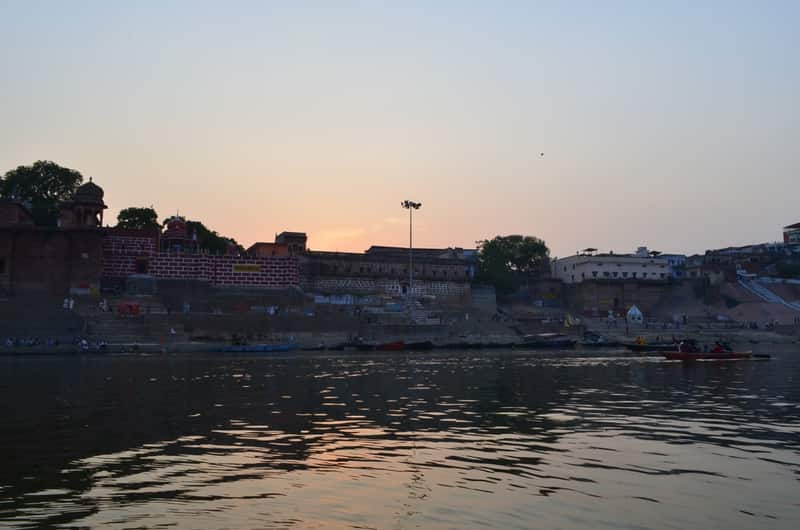
The Niranjani Akhara — A Warrior Order of Renunciates
The Niranjani Akhara is one of the most venerable orders in the Dashanami tradition, the monastic family founded by the great philosopher Adi Shankaracharya more than twelve centuries ago. Shankaracharya established four monasteries at the four corners of India and organised his renunciate followers into ten named orders, and out of this system grew the akharas — monastic fraternities that combined spiritual discipline with martial training, for in medieval India the monks of Kashi were also its guardians. The word akhara means a wrestling ground, and it was deliberately chosen: the order was to be an arena in which the warrior-saint was trained in body, mind and devotion. The Niranjani Akhara is among the greatest of these fraternities, and its name carries the meaning of one who is without stain — niranjana, free of illusion, spotless in discipline.
The history of the order is written in fire and ash. For centuries the akhara's Naga warriors, naked and ash-smeared, armed with swords and spears, defended the temples of Kashi, protected pilgrims on the roads, and fought in the periodic gatherings of the akharas at the great melas, where disputes over precedence were settled by strength as well as scripture. In time the martial duties receded and the processional pageantry took their place, but the discipline never left: even today the akhara is governed by its mahants and acharyas, its traditions are passed from guru to disciple, and its sadhus maintain the same vows of celibacy, poverty and obedience that bound their predecessors. The order keeps its principal seat in Kashi, and its bond with this stretch of the river has never been broken.
Life inside the akhara's compound beside the ghat is a living school of renunciation. Young aspirants are initiated with great ceremony, their heads shaved and their old names exchanged for new ones; they are taught the scriptures, the rituals of worship, the arts of yoga and breath control, and the discipline of begging alms with the kamandalu and the staff. The elders sit in the courtyard reading the Puranas, the kitchens feed the poor on festival days, and at dawn the whole order descends to the Ganga for the first bath of the day. To stand at the gates of the akhara is to look into a world that has changed remarkably little in a thousand years — a world of vows, austerities and unbroken tradition. The whole compound breathes the rhythm of the Ganga — its floods, its festivals, its dawns — and the men who live within it have made that rhythm the very shape of their lives.
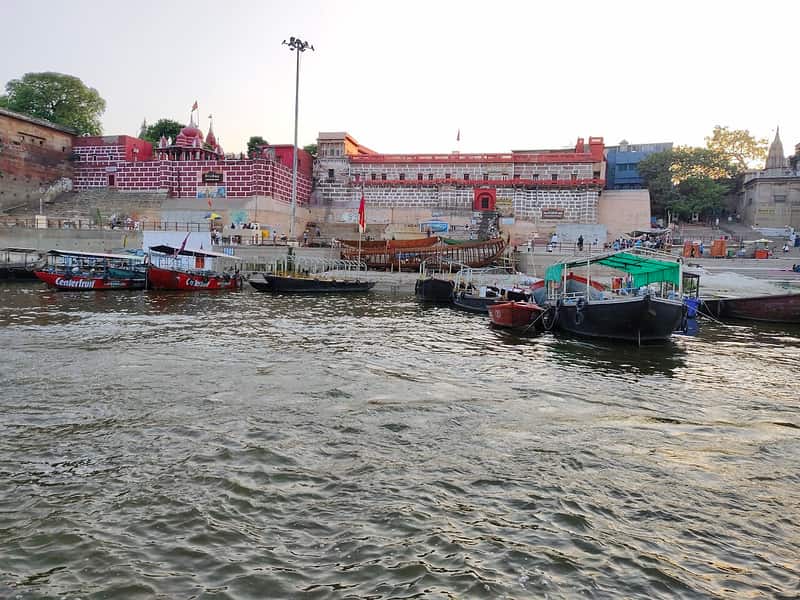
The Nagas and Sanyasis — Life in Ash and Ochre
The sadhus of the Niranjani Akhara are among the most arresting sights on the riverfront. The Nagas, the warrior ascetics of the order, wear nothing but ash: their bodies are smeared from head to foot with the sacred bhasma taken from the fires of their rituals, their hair is matted into long jata or shaved clean at initiation, and their eyes are ringed with kohl from years of meditation. In their hands they carry the trishul, the trident of Shiva, the kamandalu, the water pot of the renunciate, and often a rudraksha mala for their endless counting of the name of the god. The ochre-robed sanyasis are quieter in appearance, but their austerity is no less deep — years of celibacy, fasting and penance lie written in their calm faces.
Their life is built on vows that most people would find unimaginable. They rise before the sun, bathe in the cold Ganga, and pass the morning in japa, the silent repetition of divine names, and in yoga and meditation. Many observe long fasts, some eating only once a day, some only on particular days of the moon; many have taken a vow of silence for years at a time; and all of them have renounced family, wealth and home, possessing nothing but what they carry. Alms are their livelihood and devotion their work. When they walk in procession — as they do at the great festivals — the whole spectacle is transformed: conches blow, drums beat, saffron flags rise above the crowd, and the ash-smeared Nagas stride forward in ranks, their tridents gleaming, the oldest order of ascetics on earth on the march.
For the visitor, the encounter with these men is often the most memorable part of a visit to Niranjani. They sit by the water in groups, discussing scripture, smoking the clay chillum in quiet comradeship, or meditating alone with the river before them. Some are renowned for their learning, others for their powers of endurance; all of them belong to a tradition of renunciation that reaches back more than a thousand years, to the very founding of the order. Their presence makes the ghat feel less like a tourist destination and more like what it truly is — the front porch of a monastery, where the world meets the men who have left the world. Their speech is a mingling of old Hindi and Sanskrit phrases, their laughter is sudden and warm, and their advice to a curious visitor is given freely, as to a younger brother or a student.
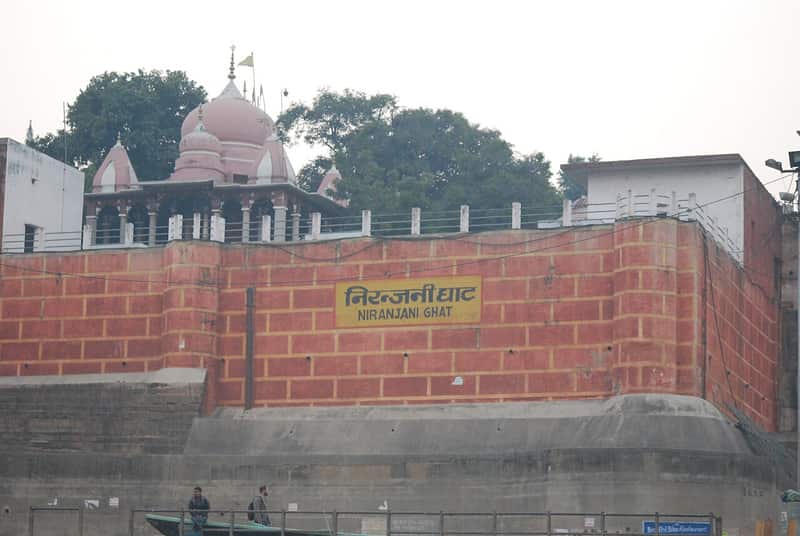
Festivals of the Akhara — Maha Shivratri and the Great Processions
No festival belongs to Niranjani Ghat as deeply as Maha Shivratri, the great night of Shiva. Through the lanes of the old city and down the ghat's wide steps, processions of sadhus make their way to the river — the ash-smeared Nagas in their ranks, the ochre-robed sanyasis chanting, conches and drums and bells marking the passage of the saffron flags. On this night the whole riverfront is awake; temples blaze with lamps, the akhara's halls resound with bhajans, and pilgrims who have walked for days bathe at dawn in the cold Ganga before the day of fasting and vigil begins. For the sadhus of the akhara, it is the holiest night of the year, a night of unbroken worship dedicated to the god whose name they carry on their lips.
The Kumbh-era festivals bring a different kind of gathering. Every twelve years, and at the great ardh and purna kumbh melas held across India, the akharas march to the river for the shahi snan, the royal bath, and the Niranjani Akhara holds a place of honour in that order. When such a mela is in its cycle, the ghats of Kashi fill with sadhus from every order, and Niranjani becomes the heart of the ascetic presence in the city: thousands of monks camp around the akhara, processions move through the old streets day after day, and bathing at the ghat is held to be extraordinarily auspicious. Even in ordinary years, the akhara marks the phases of the moon with special worship, and the days of Amavasya and Purnima bring added crowds to the steps.
The other seasons of the akhara's year are marked with the same devotion. Kartik Purnima, when the river is most beloved and the whole city keeps festival, brings great numbers to the northern ghats; the akhara holds its own gatherings, with music, discourses and feasts for the poor. The birthdays of the great saints are celebrated in the compound, the tenth day of the month is observed with special rites, and on the appointed days the akhara's banner is raised and carried to the water in procession. For the visitor, the best chance to see the full pageantry of the order is on Maha Shivratri, when the old city and the ghat together become a stage for the oldest monastic tradition of Kashi. The akhara's own calendar adds its private festivals to the public ones, and on any given day of the year, some observance, some procession or some rite is likely to be in motion at the ghat.
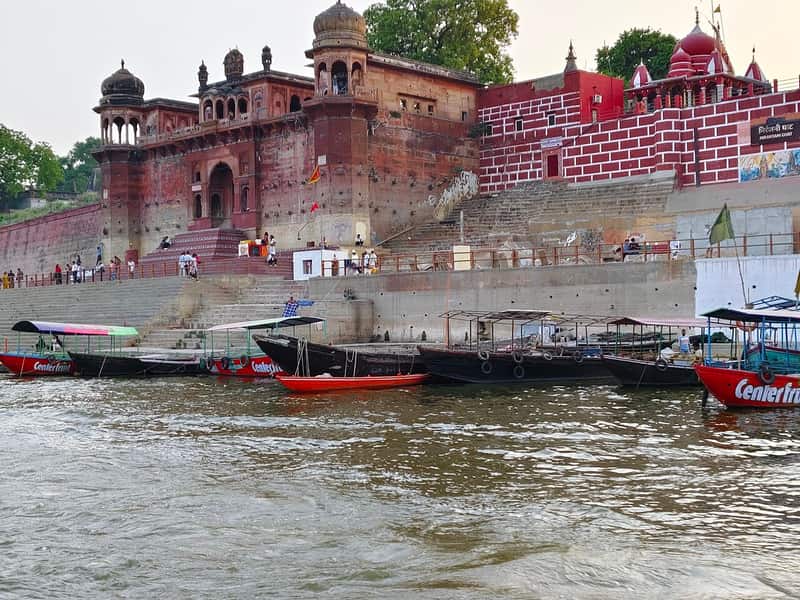
Bathing at Niranjani — Rituals of the Morning Ganga
Bathing at Niranjani is a quieter and more austere ritual than at the great bathing ghats of the south, and in that austerity many pilgrims find its special virtue. The wide stone steps carry a steady stream of bathers from before dawn until mid-morning: old men with sacred threads and prayer beads, women in groups carrying brass pots and flowers, and always the sadhus of the akhara, who enter the water with a precision born of a lifetime of practice. The ritual itself is ancient and unvarying — the triple immersion, the cupped hands pouring water toward the rising sun, the whispered Gayatri, the offerings of marigold and rice that ride away on the current, the final dips for the ancestors with sesame and water trickling through the fingers. The whole morning has the character of a long, silent rite, performed by hundreds of separate hands yet somehow in unison, like a chorus without a leader.
The timing of the bath matters as much as the rite. The most auspicious days are those of the new moon and the full moon, when the northern ghats take on a festival air; the greatest of all are the days of the Kumbh-era festivals, when bathing at Niranjani is believed to carry the merit of the great mela itself. Pilgrims plan their visits around these dates, walking through the lanes before sunrise with their bundles of clothes and offerings, eager to be in the water as the first light touches the temples across the river. Local tradition holds that the akhara's presence sanctifies the whole stretch of water before the ghat, and that the monk who bathes here at the appointed hours carries a blessing into the rest of his life.
For the traveller who only watches, the bathing scene is one of the great morning sights of Varanasi. From the upper steps, the whole ritual unfolds like a slow dance of devotion: the splash of immersion, the glint of brass pots in the low sun, the murmur of mantras, the wet bodies glistening as bathers climb out and wring their cloths, the sadhus seated waist-deep in the current chanting their japa. It is the same scene that has played here for a thousand years, unbroken by any empire, and watching it at Niranjani — away from the crowds of the southern ghats — is to see the religion of the river in its most ancient and unaffected form. Standing there in the quiet, with the water lapping at the lower steps and the sadhus chanting behind, one understands why so many pilgrims describe the northern ghats as the true heart of Kashi's everyday faith.
Stone Steps and Monastery Walls — The Ghat's Architecture
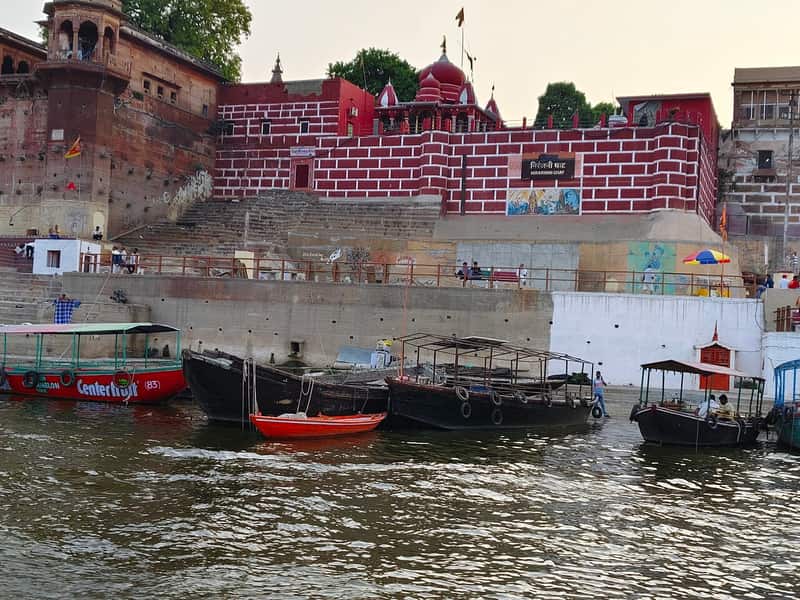
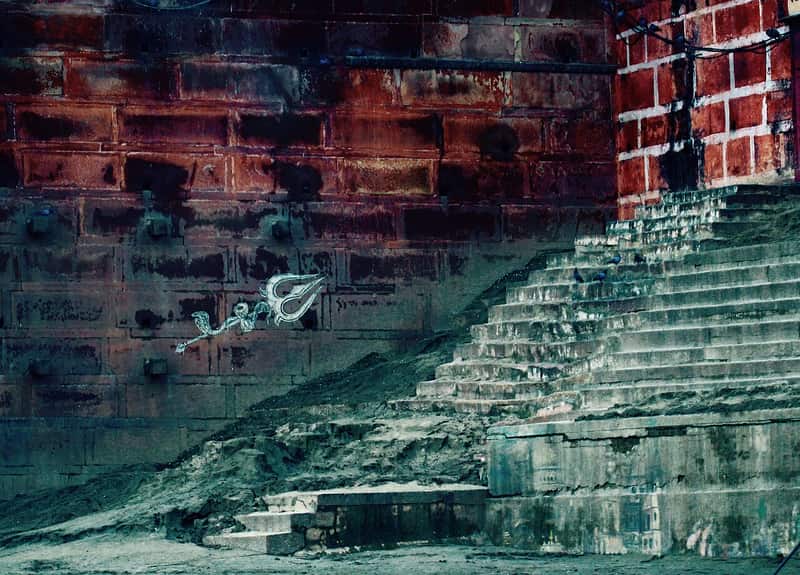
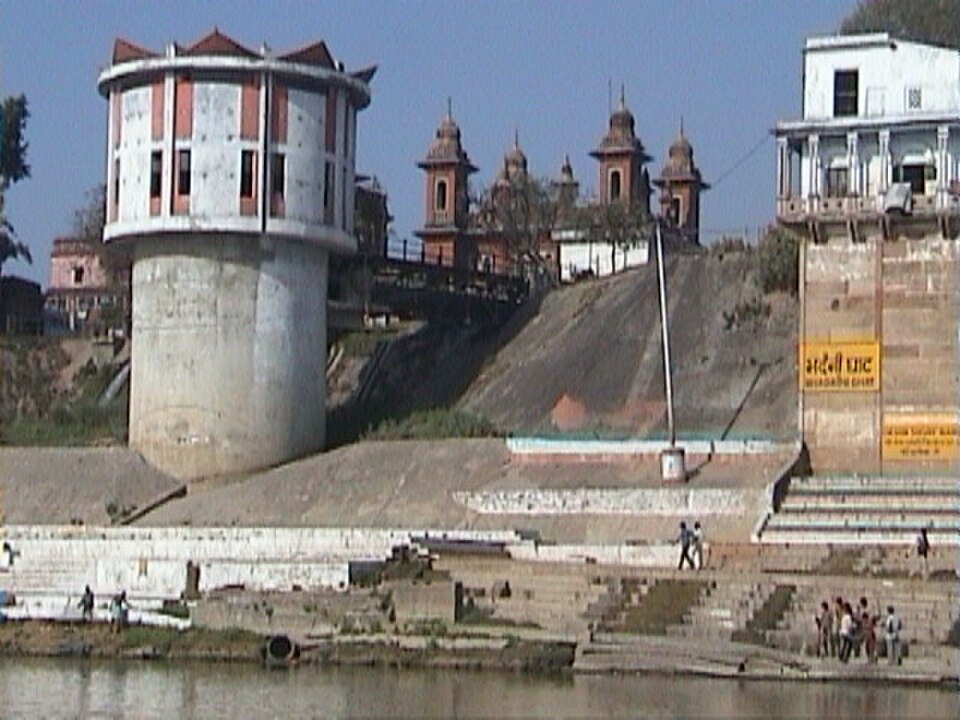
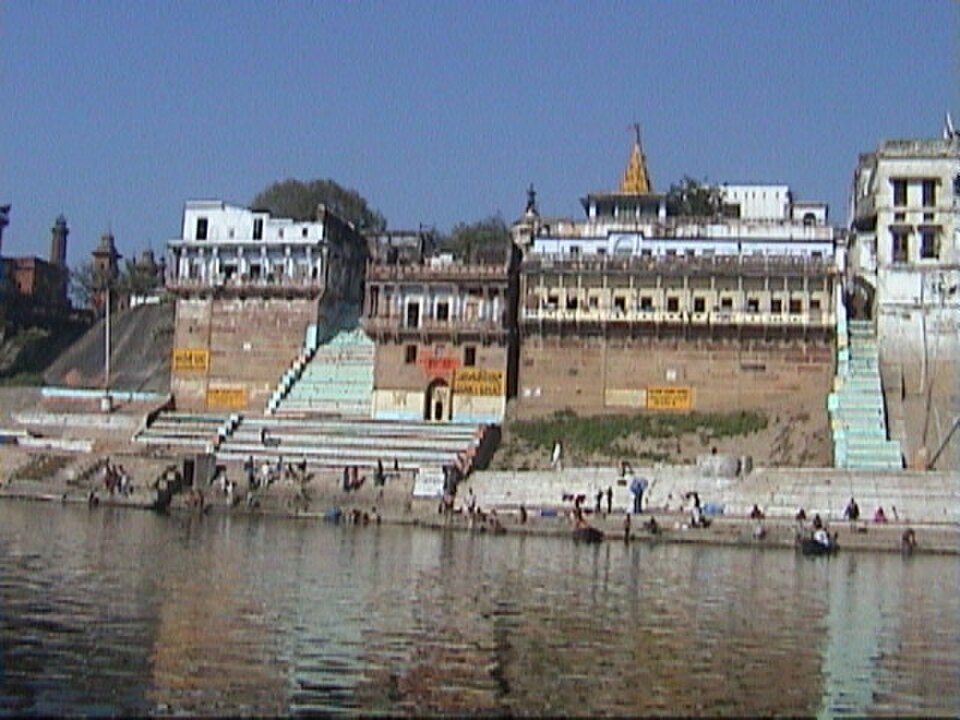
The architecture of Niranjani Ghat makes a deliberate statement of austerity. Where the southern ghats display pavilions, domes, balconies and princely palaces, Niranjani offers a broad sweep of plain stone steps — wide, worn, unornamented — descending in a single grand gesture to the water. The steps were built and repaired over centuries by the akhara and by generations of donors, and their very simplicity is the point: this is the landing of renunciates, and its form follows the discipline of its order. There are no monuments here to princes, only to the river and to the god; the architecture speaks of endurance rather than display, of a faith that measures itself in centuries of repeated worship rather than in carved ornament. It is an architecture that expresses its creed in the open air, where a single glance tells the pilgrim that this is the ghat of men who measure wealth in renunciation, not in stone.
Behind the steps rise the buildings of the akhara: the monastery quarters where the sadhus live, the great halls used for worship and discourse, the kitchens that feed pilgrims and the poor on festival days, and the shrines that form the devotional heart of the compound. The temple of Shiva that stands close to the ghat follows the traditional style of North Indian temple architecture — a plain sanctum, a pyramidal shikhara, a flagstaff bearing the akhara's colours — and its walls carry the patina of centuries of incense and monsoon rain. Nearby stand smaller shrines to the goddess and to Hanuman, and the whole complex is bound together by courtyards where the sadhus sit, read and receive visitors, as their predecessors have done since the order settled on this bank.
The details reward a slow eye. The flagstaffs of the akhara rise above the rooftops, their saffron banners snapping in the river wind. In the compound, the great bells hang in wooden frames, struck at the hours of worship; the cooking hearths are massive, built to feed hundreds at a time; and the steps themselves, patched and repatched with different stone over the centuries, tell the history of the ghat in their very fabric. It is not a beautiful architecture in the way of the palaces of the south, but it has a beauty of its own — the beauty of function, of centuries of use, of a monastic order that built for permanence and for prayer rather than for show. Looking up from the water, the whole composition — steps, bells, banners, temple — reads like a single unbroken sentence of faith, spoken in the plainest language that stone can manage.
The River and the View — Ganga from Niranjani
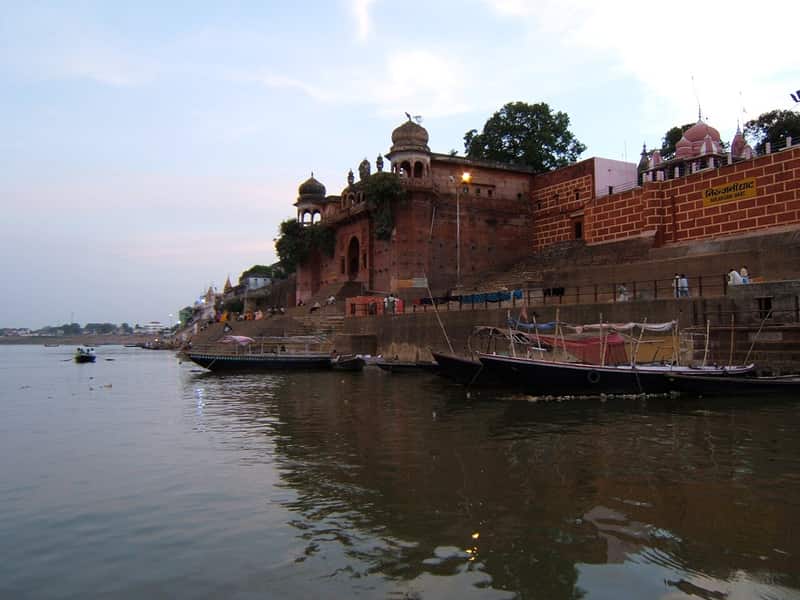
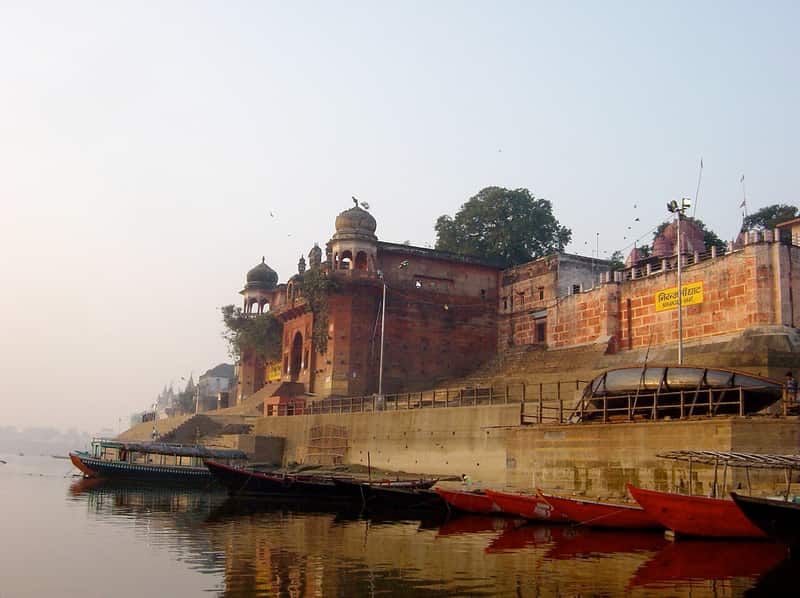
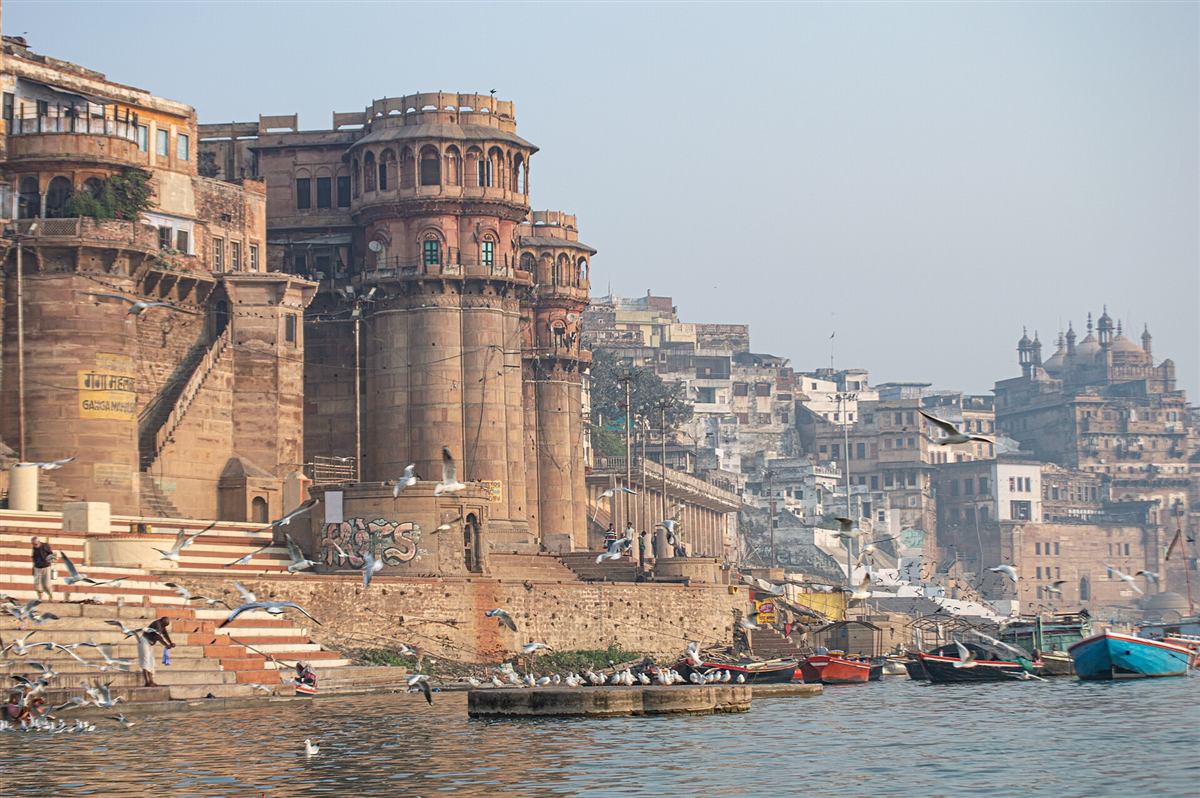
From Niranjani, the Ganga reveals herself in one of her broadest and most beautiful moods. The river here is wide and open, uncluttered by the ghats' great buildings, and the current runs deep and slow past the steps, carrying the boats and the morning light southward in an unhurried procession. At dawn the water turns rose and gold, the temples on the far bank stand dark against the brightening sky, and the whole scene has the stillness of a painting; at evening the surface darkens to indigo while the smoke of Manikarnika drifts across it, and the last boats come home with lamps lit at their bows. It is a river that asks to be watched, and the steps of Niranjani are among the finest places on the whole riverfront from which to watch it.
The view from the ghat tells the story of Kashi in a single glance. Looking south, the eye passes over the clustered ghats toward the distant smoke of Manikarnika, where the eternal flames of the burning ghat rise day and night; looking north, the riverfront becomes quieter and greener, the city thinning toward the sandbanks and the confluence of the Varuna beyond Panchganga. Boatmen pass on their daily rounds, carrying pilgrims from ghat to ghat, and the occasional ferry glides across with its load of passengers and bicycles. The river itself is worshipped here as a goddess, and the sadhus of the akhara address her with the same reverence as any pilgrim — pouring water back to her, offering flowers, greeting her with the morning mantra. The ghat's position, set back slightly from the river's main channel, gives the water before it a calm expanse that deepens the sense of peace, so that even the busiest festival mornings keep a core of stillness here.
A boat ride from Niranjani completes the experience of the river. Drifting northward, the traveller passes the quiet steps of Rajendra Prasad and the great spread of Panchganga, with its five-river mythology; turning south, the ghats come alive with their palaces and processions, ending at the teeming grandeur of Dashashwamedh. The boatmen of the northern stretch are unhurried men who know the river's moods, and they will pause midstream if asked, letting the current hold the boat steady while the whole panorama of Kashi turns slowly in the morning light. From the water, the ash and the ochre of Niranjani, the smoke of Manikarnika, and the white palace of Lalita form a single composition — the three faces of the holy city, visible at once from the river that gives them life.
Behind the Ghat — Lanes of the Old City
Behind Niranjani Ghat begins the labyrinth of the old city, and no visit to the ghat is complete without an hour lost among its lanes. The alleys here are narrow and deep-shadowed, their stone walls lined with the doors of ancient houses, their air carrying the smells of woodsmoke, incense, frying oil and marigolds in a mixture that is unmistakably Banaras. Temples stand at every turn — some grand, some no larger than a cupboard, each with its own bells, its own lamps, its own daily story of offerings and prayer. The neighbourhood lives at the rhythm of the ghat: in the mornings the lanes pour people toward the river, and by evening the same lanes carry them back, laden with brass pots, wet clothes and flowers. The houses lean toward each other overhead, and the sun reaches the ground only at noon, so that the lanes keep their own cool, secret climate through the hottest months.
The life of the quarter is woven around the akhara. On festival days the lanes fill with pilgrims and with the bhandara, the great open-air feast that the order offers to all comers, when pots of dal and rice are carried through the alleys and the poor and the monk sit down together. The shopkeepers know the sadhus by name, the tea stalls know their orders, and the barbers who shave the heads of new initiates ply their trade in the side lanes, their chairs set out under the lintels of old houses. It is a neighbourhood of extraordinary social memory: families have lived here for generations, their histories tangled with the akhara's festivals, the floods of the Ganga, and the slow changes of the holy city around them. Their devotion is the quiet currency of the neighbourhood, spent daily at the shrines and repaid in the blessing of a life lived near the river.
For the visitor, the lanes are a lesson in the real texture of Kashi. The great sights of the city are splendid, but here — among the haveli gates, the water pumps, the flower sellers, the paan shops, the washing hung across the alleys — the ancient city is lived rather than exhibited. The people are patient with lost travellers, and a stranger asking the way to the ghat will be led, or walked, all the way to the steps, often with the offer of tea on the way. The lanes are also the practical route between the ghats: from Niranjani, a short walk inland and back brings the traveller to the neighbouring landings without ever seeing the river, a reminder that the old city was built around water but lives by its streets.
Neighbouring Ghats — Lalita, Rajendra Prasad and Manikarnika
Niranjani Ghat sits at the heart of one of the most interesting stretches of the riverfront, and the neighbouring ghats make a natural day's walk. To the north, past a short line of steps, lies Rajendra Prasad Ghat, a plain and recent landing named for Dr. Rajendra Prasad, the first President of India, who bathed here during his visits to Kashi; it is one of the quietest ghats on the river, used by local residents and by the occasional politician honouring the memory of the man who gave it his name. To the south, within a few minutes' walk, stands Lalita Ghat with its white Nepali palace rising above the water, a fragment of the Himalayan kingdom set down beside the Ganga, and beyond it the grander landings of the old city begin.
A little further south along the riverfront lies the ghat that gives the whole northern stretch its gravity: Manikarnika, the great cremation ghat, where the sacred fire has burned for centuries and where death is treated as a holy passage rather than a sorrow. The contrast is instructive. From the ash and austerity of Niranjani, past the quiet steps of Rajendra Prasad and the white facade of Lalita, the traveller walks into the smoke and chanting of Manikarnika — and understands in one stretch of riverfront the whole span of Hindu faith, from the daily discipline of the monks to the final fire that releases the soul. The walk between these ghats is among the most profound river walks in the world. For those new to Kashi, the walk is also a lesson in scale: what seems from a boat like a string of small landings becomes, on foot, a mile of continuous sacred architecture, each ghat with its own crowd, its own incense, its own story.
The three ghats together form a complete portrait of Kashi's river. Rajendra Prasad offers the modern city's homage to its own history; Lalita speaks of the foreign kingdoms that have loved this river; Manikarnika holds the eternal promise that draws the dying here; and Niranjani itself preserves the living tradition of the ascetics. Pilgrims who walk the stretch bathe at Niranjani, bow at Lalita's temples, and carry their prayers past Manikarnika; travellers who walk it in the early morning, when the smoke hangs low and the boats move quietly on the water, carry away an impression of the holy city that no other itinerary can match. It is a single, unbroken narrative of faith, written in stone, ash and water. And because the stretch is little visited by tour groups, the walk retains the unhurried character of a pilgrimage made for its own sake, the way these steps have been walked for centuries.
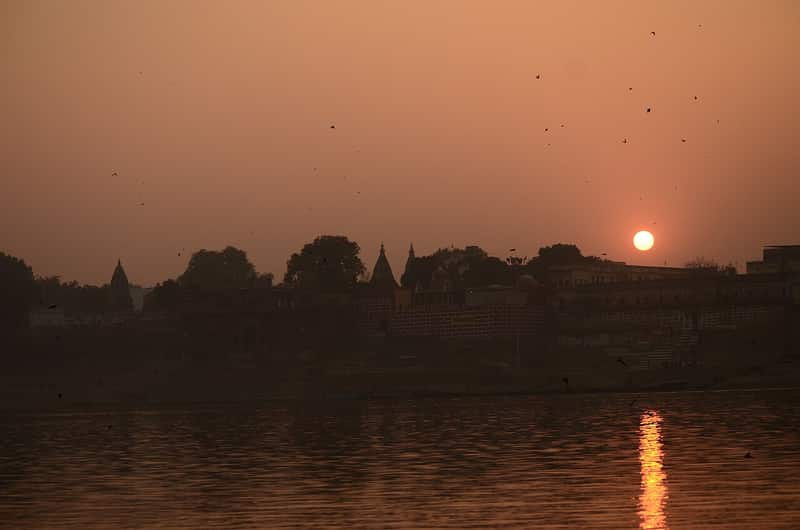
Atmosphere — Austerity and Devotion on the Stone Steps
The atmosphere of Niranjani Ghat is unlike any other on the riverfront, and it is created by a single thing: the presence of the akhara. Where the southern ghats are theatres of sound and light, Niranjani is a place of quiet intensity. The air is scented with ash, incense and the smoke of the chillum; the colours are the browns and greys of stone, the saffron of robes and flags, the white of smeared bhasma; and the sounds are the murmur of mantras, the splash of the river, the occasional bell. It is the atmosphere of a monastery carried down to the water's edge, and even a visitor who knows nothing of the order feels it at once — a sense of discipline, of centuries, of a faith practised with a seriousness that the bustling ghats have long since softened.
The austerity of the place is not coldness. The sadhus, for all their vows, are famously open with visitors, and the ghat has a warmth beneath its stern surface: a monk will share his chillum with a stranger, a Naga will sit for a photograph after his puja is finished, a group will invite a traveller to join their evening bhajan. But there is always the underlying seriousness — the understanding that this is not a performance but a way of life, that the ashes on these bodies are the ashes of real penance, that the discipline being watched has cost these men everything they once owned. That tension, between openness and severity, is the true atmosphere of the ghat, and it gives Niranjani a depth that the more photogenic ghats cannot match.
The mood changes with the hours, and each is worth experiencing. At dawn the ghat is at its purest — the water still, the bathers few, the sadhus at their japa, the whole landing bathed in soft light. By mid-morning the life of the quarter flows across the steps, and at festival times the ghat transforms into a field of saffron, ash and celebration. At dusk the chillums glow in the shadows, the lamps are lit at the shrines, and the chant of Hara Hara Mahadeva carries across the water; the ghat settles into its evening quiet, and the traveller who stays to the end, sitting on the worn steps as the lights of the far bank come on one by one, has felt the oldest pulse of Kashi — austere, devoted and utterly alive.
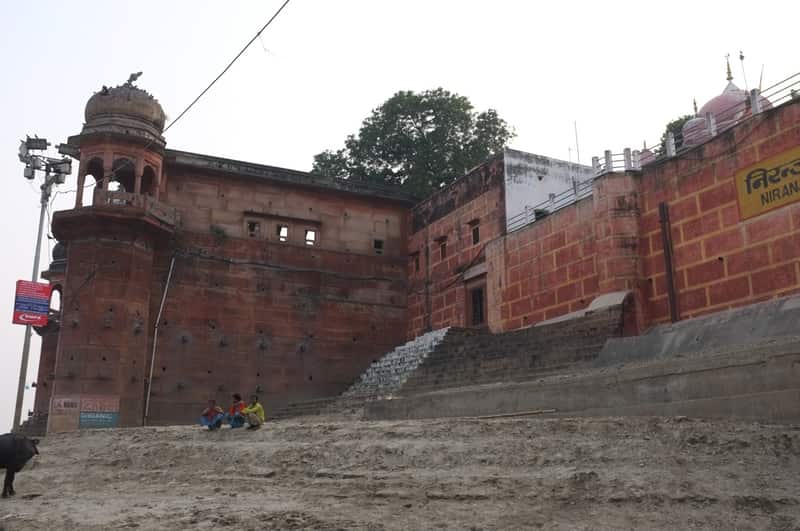
Visiting with Respect — Etiquette Among the Sadhus
A visit to Niranjani Ghat is a visit to a living monastery, and it asks of the traveller the courtesy that one would offer in any place of worship. Dress modestly, covering the shoulders and knees; remove shoes before entering the akhara's temple courtyards; and keep the tone low and respectful. The sadhus are approachable and famously warm, but they are also men who have taken vows of austerity, and the visitor who treats them with simple, unhurried respect will be received as a guest, while one who treats them as a spectacle will be politely ignored. A folded hand in greeting — namaste, with the palms pressed together — is the language they understand best. Above all, give the place time; the sadhus' day is long, and a traveller who lingers from the morning bath to the evening aarti will be remembered kindly long after a hurried visitor is forgotten.
The rules of conduct among the sadhus are few but firm. Do not touch a sadhu, his rosary, his trident or his offerings without permission; do not photograph them without asking first — many will agree, and some will expect a small donation, but the question must always be asked. Never offer money directly to a Naga in a way that feels like payment for a blessing; if you wish to give, place the offering respectfully before him or give it to the akhara's office. Do not bring meat, alcohol or cigarettes to the ghat, and do not stare at the naked Nagas or make remarks about their appearance; their nakedness is a vow, not a costume, and it is honoured with the same seriousness as their penance. And if a sadhu offers you something — a flower, a pinch of ash, a word of blessing — receive it with both hands and with gratitude, as you would receive a gift from any elder.
A little knowledge makes the encounter richer. The ash smeared on the sadhus' bodies is the sacred bhasma, the product of their own ritual fires, and it is offered to visitors as a blessing if they are present at the right moment; accepting it with the right hand and touching it to the forehead is a courtesy that is deeply appreciated. Questions about their vows and their life are welcomed — these men are teachers as much as ascetics, and they speak readily about their practices to a respectful listener. What they ask in return is what every monastery asks: a quiet demeanour, a genuine interest, and the understanding that this ghat, with its ash and its discipline, is not a stage for the curious but a home for the faithful. Visitors who honour that home leave with a blessing; those who do not, leave with nothing but photographs.
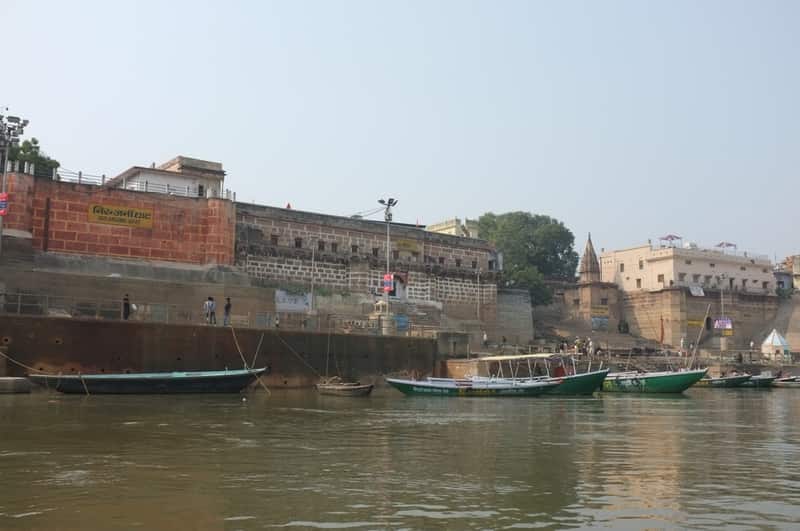
Practical Notes — Reaching Niranjani Ghat
Niranjani Ghat lies on the northern stretch of the riverfront, about halfway between Dashashwamedh Ghat and Panchganga Ghat, and it is reached most pleasantly by boat or on foot. A boat from Dashashwamedh takes twenty minutes along the river and delivers the traveller to the ghat's own steps; a walk from Godowlia or Chowk, through the lanes of the old city, takes a little longer but passes through some of the most atmospheric streets of Kashi. The nearest point on the main road is close to Manikarnika, from where the ghat is a short walk along the river or through the alleys; rickshaws and cycle-rickshaws ply as far as the lanes allow, and the rest is on foot. Whichever way one comes, the ghat announces itself from a distance by the saffron flags above its roofs, the surest landmark of the akhara's long presence on this stretch of the river.
The best times to visit are early morning, when the bathing rituals and the sadhus' japa fill the ghat with quiet life, and late afternoon, when the light turns golden and the monks return to the water for their evening rites. The great days are Maha Shivratri in late winter, when processions of sadhus take over the old city; the full moon and new moon days, when the bathers crowd the steps; and the Kumbh-era festivals, when the ghat becomes the centre of the ascetic presence in Kashi. The monsoon months bring the river high and the steps crowded with bathers; the winter months, from October to March, bring the clearest skies and the most comfortable walking. Whenever one comes, the advice is the same: arrive early, leave the camera in the bag for the first hour, and let the ghat reveal itself at its own unhurried pace.
A practical visit needs little preparation. Carry water and modest clothes, keep cameras respectful and discreet, and allow at least two hours for the ghat and its lanes. The ghat has no entry fee and no fixed visiting hours; it is simply there, as it has been for centuries, part of the daily life of the river. The natural companion to the visit is the walk along the neighbouring ghats — Rajendra Prasad to the north, Lalita to the south, and Manikarnika a little further on, best seen in the early morning light. Combining the ghat with a boat ride back to Dashashwamedh at sunset completes a day that shows the visitor the three faces of Kashi: the monastery, the palace and the flame. And a word to the wise: the steps grow slippery after rain, the current is stronger than it looks, and the boatmen's rates are best settled before the journey begins.
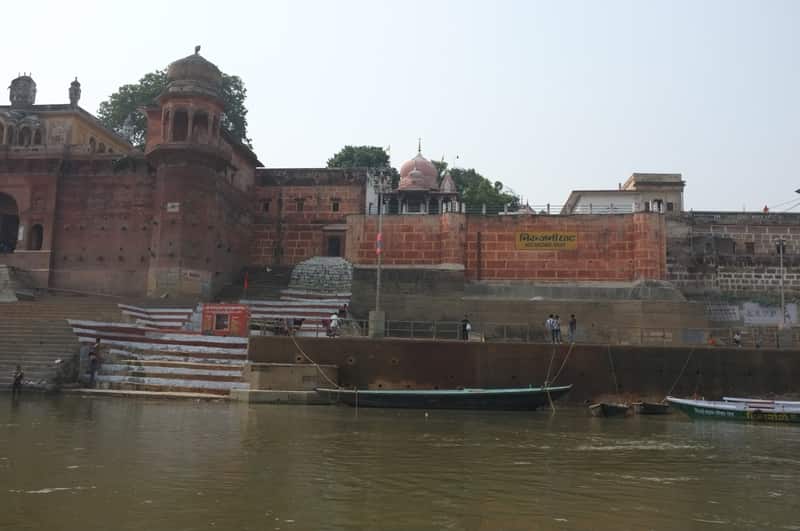
Niranjani Ghat — Gallery (12 Photos)
Image Credits
niranjani-01.jpg · niranjani-02.jpg · niranjani-03.jpg · niranjani-04.jpg · niranjani-05.jpg · niranjani-06.jpg · niranjani-07.jpg · niranjani-08.jpg · niranjani-09.jpg · niranjani-10.jpg · niranjani-11.jpg · niranjani-12.jpg — Wikimedia Commons, under free licenses.
Continue exploring
Similar Ghats Nearby
Book This Ghat — Get Notified
Download the app now and book a boat ride to Niranjani Ghat