

Chet Singh Ghat
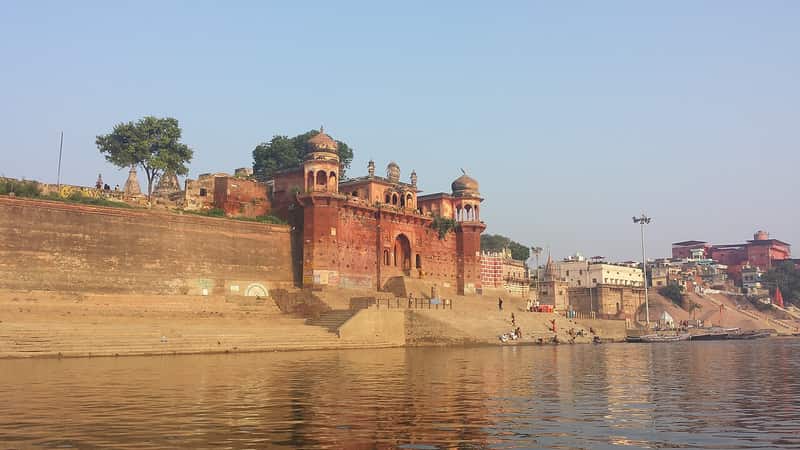
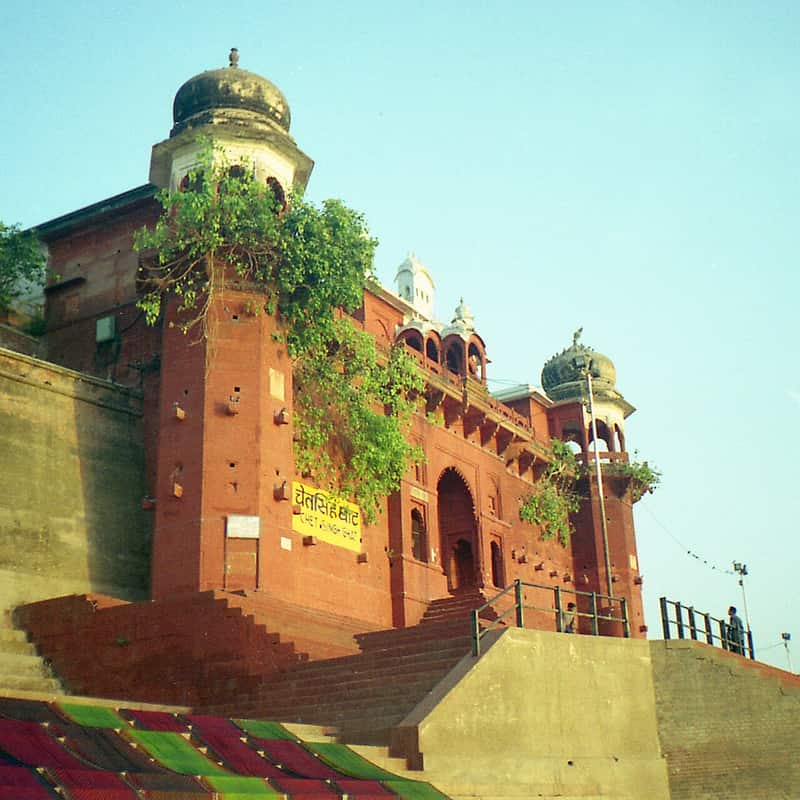
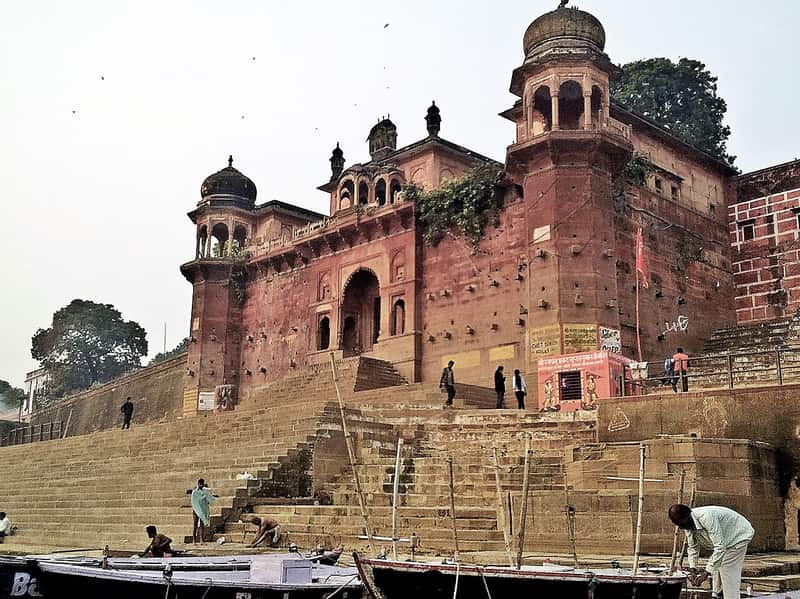
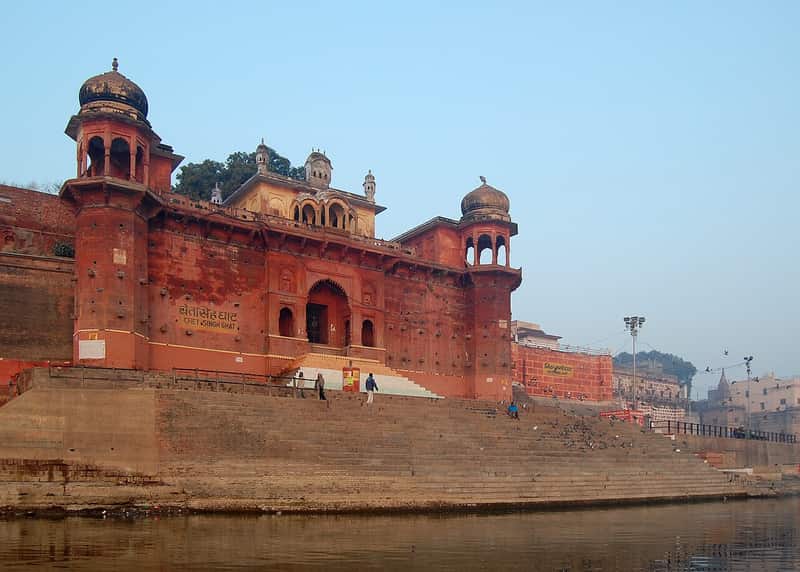
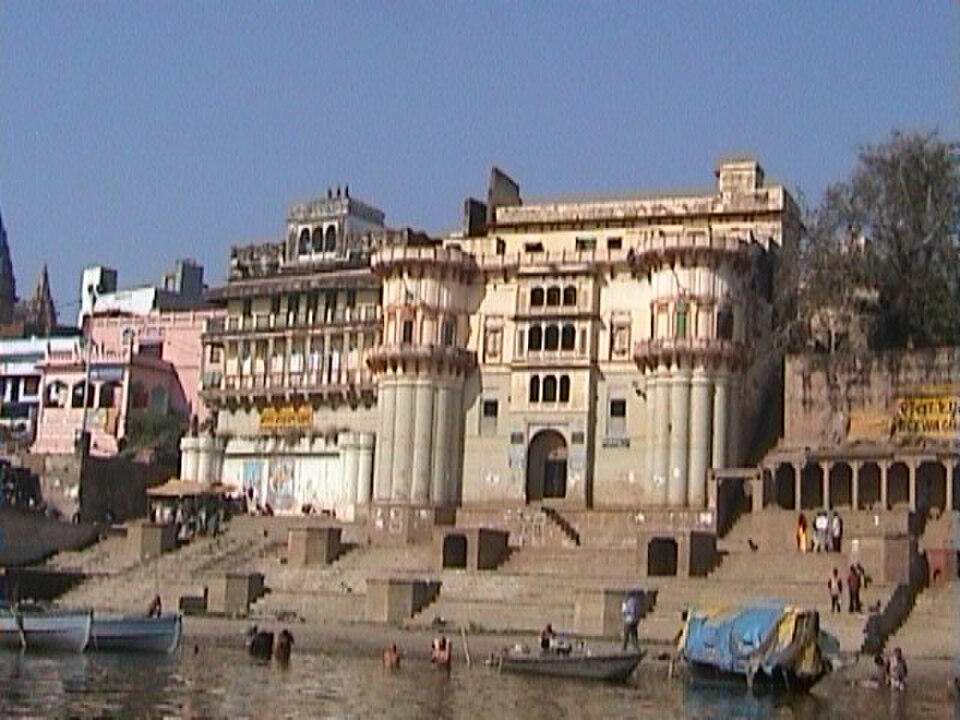
Heritage GhatChet Singh Ghat has a solid fort-palace perched above the river. Named after Raja Chait Singh, who built this ghat in 1762. The palace has thick walls and a grand hall with chhatris.


Type
Heritage Ghat
Boat Fare
1.2x base fare
Best Time
5-7 PM for sunset views from the fort walls.
History
Originally named Shivala Ghat, it was rebuilt as a fort-palace by Raja Chait Singh in 1762. The ghat played a key role in the 1857 revolt against British rule. A complex network of lit streets ran below the ghat. During the 1857 rebellion, a flag was raised atop this ghat. The palace has survived centuries of neglect and stands as a testament to Kashi's military history.
Highlights
- 200-year-old fort of Raja Chet Singh
- Memory of the first battle for freedom (1781)
- Grand view of the Ganga from the fort
- Must-visit for history lovers
Festivals & Events
How pricing works in the NaviX app
No haggling at the ghat — everything is fixed in the app first
- 1
Fixed price before you board
The fare is shown in the app upfront — no bargaining at the ghat
- 2
Sharing or private — your choice
Share with fellow travelers or take the whole boat for your group
- 3
Pay only after the ride
UPI, card or cash — with an instant receipt
🕉️
Aarti details not available for this ghat yet
Complete Guide
Chet Singh Ghat — The Complete Guide
History, mythology, rites and practical details — everything in depth.
On this page
- 1.Chet Singh Ghat — A Fortress on the Sacred River
- 2.Maharaja Chet Singh — The Rebel King of Banaras
- 3.The Revolt of 1781 — Arrest, Escape and Flight
- 4.The Fort Above the Ghat — A Palace in the Sky
- 5.Ramparts, Bastions and Carved Stone
- 6.The Hidden Ghat — A Secret Corner of Kashi
- 7.Moorings and Landings — Life at the Water
- 8.The Panorama from the Water
- 9.Sunset at the Fort — Golden Silhouettes
- 10.The Quiet Quarters Behind the Ghat
- 11.Etiquette at Chet Singh — Respect and Grace
- 12.Practical Guide — Reaching Chet Singh Ghat
📅 Updated: 21 Aug 2026 · Author: NaviX Field Team (field research 2024-26) · 12 sections · 12 photos
Chet Singh Ghat — A Fortress on the Sacred River
Chet Singh Ghat is one of the most romantic and least crowded of all the ghats of Varanasi, a hidden, fortress-like landing that stands midway along the great crescent of stone steps that curves with the Ganga. While the crowded name-ghats of the south draw the pilgrim crowds, this northern stretch of the riverfront keeps a quieter, stranger character. Here the river wall is crowned not by temple spires alone but by the massive silhouette of the Chet Singh Fort, a great crenellated palace that gazes down over the water as if it still expected an enemy fleet to appear around the bend. The river here is wide and the old city falls away behind the ramparts, so that the fort seems to stand alone above the water, keeping its own counsel. Everything about the place whispers of defence and defiance.
This ghat is tied to one of the most dramatic chapters of Varanasi history, the collision between the last great Raja of Banaras and the British East India Company. In 1781 the fort above the landing was the scene of an arrest, a rebellion and an escape that left the Governor-General of India humiliated and made the Raja a folk hero across northern India. The stone of its walls still shows the pockmarks of the August cannonade, and old men in the lanes still tell the story of that day as though it happened last monsoon. Yet the visitor who arrives today finds no battlefield. Instead there is a placid stretch of river, a cluster of bobbing boats, a half-abandoned palace with peacocks on its terraces, and the feeling of having stepped through a gap in time into an older, prouder Varanasi.
To walk down the steep lane to the ghat, or to approach it by boat along the water, is to enter a different world from the tourist bazaar. Fishermen mend their nets on the platforms, boatmen nap in the shade of the fort walls, and the only music is the river lapping against the stones. From the water the landing looks almost Italianate, its weathered terraces stepping down to the current, and it is easy to understand why filmmakers and artists seek it out at every hour of the day. The ghat is a favourite of photographers and of travellers who have grown weary of crowds, drawn by its grand decay and by the memory of a king who dared to say no to an empire. It remains, in every sense, the rebel ghat of Kashi, a place to sit, to breathe, and to let the river do the talking.
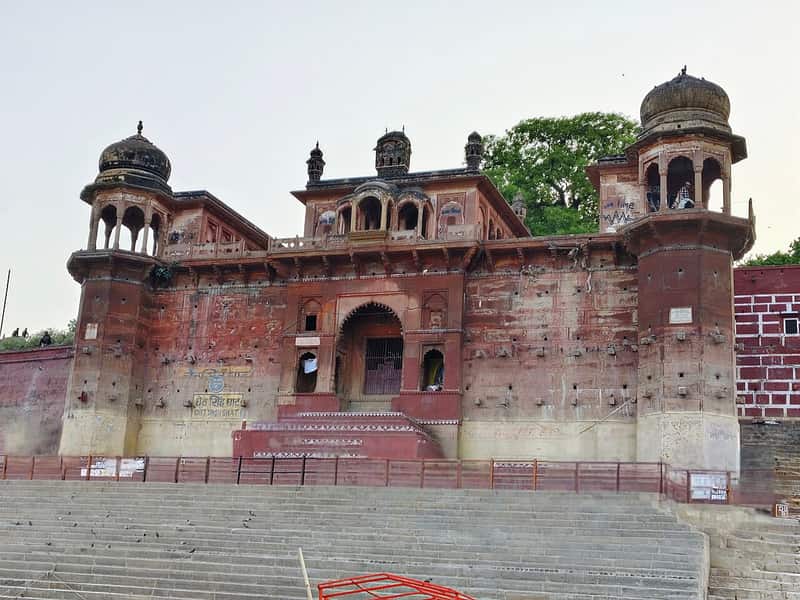
Maharaja Chet Singh — The Rebel King of Banaras
Maharaja Chet Singh ruled the kingdom of Banaras from 1770 to 1781, and in those eleven years he earned a place in the memory of his people that few kings have ever matched. He was not born to the throne but adopted by his uncle, Balwant Singh, the founder of the Banaras Raj, who had carved a wealthy state out of the chaos of the declining Mughal empire. Chet Singh inherited a domain that stretched across the fertile plains of eastern Uttar Pradesh and Bihar, rich in grain, sugar and river trade, and he governed it with an independence that increasingly irritated the British East India Company, which regarded the Raja as its tributary. He was a man of his age — proud, generous to his priests and poets, and utterly unwilling to be treated as a servant of Calcutta.
The quarrel came to a head with Warren Hastings, the Governor-General of India. Hastings demanded ever larger sums of tribute, first two lakh rupees and then double that amount, and when Chet Singh delayed and protested, the Governor-General decided to make an example of him. In his own capital, at his own fort above the river, the Raja was ordered to appear before the British Resident and his sepoys. The confrontation was not merely about money; it was about pride, about whether an ancient Indian kingdom would bow to the new masters of Calcutta, about whether the British could treat a reigning prince as a defaulting tax farmer. Chet Singh chose defiance, and in that single choice he changed the meaning of his ghat forever.
The events that followed on this very ghat made the Raja a legend. Modern historians note that Chet Singh was neither the first nor the last Indian ruler to resist the Company, but his revolt struck at a moment when the Company was busy elsewhere, fighting the Marathas and the French, and it exposed how thin the British grip on the interior really was. It also led to Hastings being tried, though eventually acquitted, on charges connected to his handling of the affair. For the people of Banaras, the Raja became a symbol of their own refusal to be ruled, and his story has been told on these steps ever since, each generation adding its own embroidery to the tale of the king who stood firm on the banks of the Ganga.
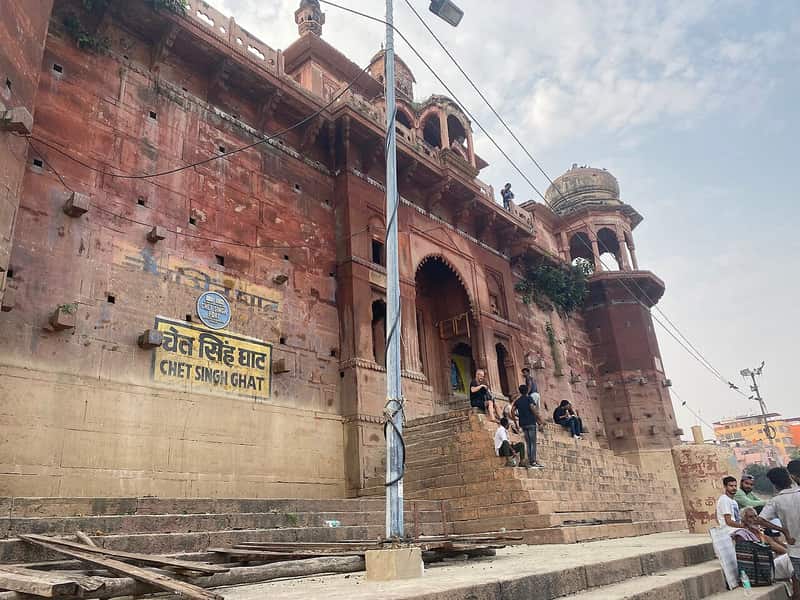
The Revolt of 1781 — Arrest, Escape and Flight
In August 1781 Warren Hastings travelled to Banaras in person, determined to break Chet Singh. The Raja was summoned to his own fort on the fifteenth of August, where Hastings and the British Resident, Mr Markham, awaited him with a guard of sepoys. Chet Singh came, but when he refused to surrender his person and his treasure, Hastings ordered his arrest. At the same instant, in a pre-arranged signal, a distant gun was fired, and the Raja's followers — a fierce body of armed men who had been hiding in the palace and the lanes around the ghat — burst out from every door. The British sepoys found themselves surrounded and cut down where they stood, while Hastings himself barely escaped with his life through a window and down to the river.
In the confusion Chet Singh, who had been held in an inner room, made his legendary escape. With a handful of loyal men he slipped out by a secret stairway and a narrow passage that ran down through the fort's walls toward the river, emerging at the water's edge below the ghat. A boat was waiting, and as the shots and cries echoed above him the Raja pushed off into the Ganga and vanished downstream. He crossed to the far bank and fled overland toward the safety of Gwalior, where the Maratha prince Mahadji Scindia offered him refuge and gave him the dignity of an honoured guest in exile. The people of Banaras say that the very river that fed and blessed the city had risen to carry their king away.
The aftermath was savage. Hastings, who had escaped the fort through a window and fled by boat to a village downstream, returned with troops and put the city to ransom. Banaras was looted, hundreds were executed, and the Raja's brother was made the new ruler on humiliating terms. But the memory of the escape endured, and the fort above the ghat kept its name and its story. To this day boatmen point to the passage in the wall and tell of the king who slipped from the grip of the British in the space of a single monsoon evening, and visitors stand on the very steps where the secret door once opened to wonder at the speed and daring of that flight.
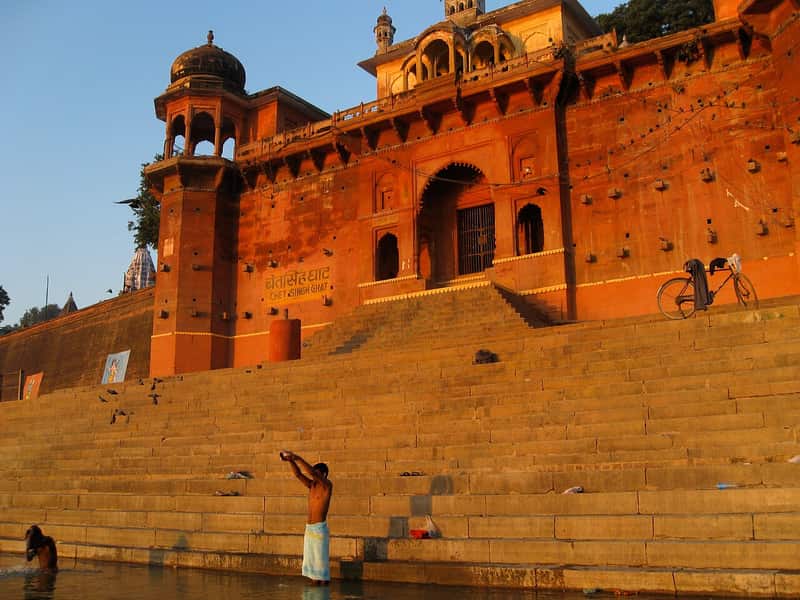
The Fort Above the Ghat — A Palace in the Sky
The Chet Singh Fort is not a military citadel in the usual sense but a grand fortified palace, built in the eighteenth century by the rulers of Banaras as their riverside residence and state house. It rises directly from the ghat itself, its massive stone walls climbing in tiers until they reach a crenellated crown that commands an immense view over the Ganga. The main gate, set high above the landing, is a sturdy arched portal flanked by heavy bastions, and within it a series of courtyards, halls and staircases climb toward the terraces where the Raja once held his durbars and watched the river traffic of his own kingdom. It was a palace designed to be seen from the water, a statement of power written in stone for every passing boat.
Today the fort has the particular beauty of a great building in repose. Much of it is semi-abandoned, portions of the complex given over to residences and small institutions, and the visitor who climbs to the roof finds a maze of crumbling chambers, dust-laden stairways and open terraces where peacocks roost and grass grows between the stones. The grand halls are silent now, their painted ceilings faded, but the strength of the structure remains untouched — these walls were raised to withstand cannon and siege, and the centuries have only made them seem more massive. There is a deep stillness in these upper rooms, broken only by the cry of birds and the murmur of the river far below.
The rooftop is one of the finest vantage points in all of Varanasi. From it the river unfolds below like a living map, the ghats of the city trailing away in either direction, boats no bigger than leaves on the water, and the far green bank of Ramnagar across the stream. The fort is a place of dramatic light: at midday the white stone dazzles, toward evening it turns to honey, and at dusk the whole mass becomes a black silhouette against the burning sky. For those who take the trouble to climb, the reward is a view that few visitors to Banaras ever see, and the rare privilege of standing where a king once stood and watching the same river carry the same light toward the sea.
Ramparts, Bastions and Carved Stone
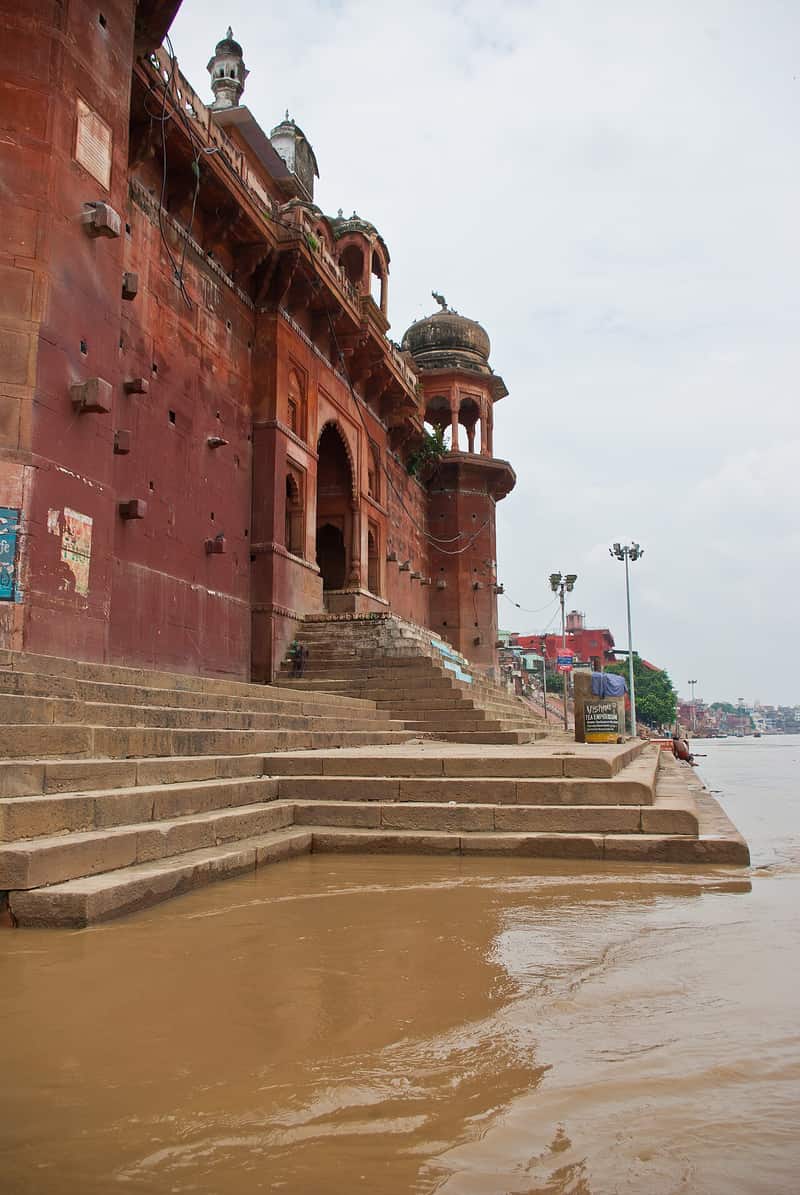
The architecture of Chet Singh Ghat is that of a defensive river palace, and every element of it speaks the language of power. The ramparts that crown the fort walls are not decoration but real battlements, designed for archers and musketeers to fire from behind stone teeth. Heavy round bastions bulge out at the corners, their curved faces built to deflect cannonballs, and loopholes pierce the lower walls so that defenders could rake the river approaches with fire. The ghat steps themselves are part of the defence: broad and slow near the water, they narrow and rise steeply toward the gate, forcing any attacker into a killing corridor. Standing at the landing and studying these details, one understands why the British found the fort so hard to storm.
Yet the fort is equally a work of beauty. The stone is local chunar sandstone, carved with the elaborate brackets and mouldings of eighteenth-century Indian palace craft, and where the plaster has fallen away the masonry shows the precision of the builders. Small shrines sit within the complex — modest temples to Shiva and other deities, with their own little towers — evidence that this was not a barracks but a king's home, complete with its private gods. Doorways are framed with carved lintels, the great gate is decorated with bold relief work, and even the ruined chambers retain the grace of their original proportion. The same hand that built the cannon platforms also built the altars, and both survive the centuries with equal dignity.
What makes the fort so striking is the way it combines both faces without contradiction. It was built at a moment when the Banaras Raj had to be both a court and a fortress, a place of ceremony and a refuge in war. Standing at the water's edge and looking up, the visitor sees a building that is at once a palace and a citadel, beautiful and forbidding. The broad platform at the top of the ghat, where the Raja kept his guard, is still the best place to study the whole composition — the stairways, the bastions, the gate — and to appreciate how completely the stone, the river and the history belong to one another. Every arch and angle of the building tells the same story, of a kingdom that was both a temple and a sword.
The Hidden Ghat — A Secret Corner of Kashi
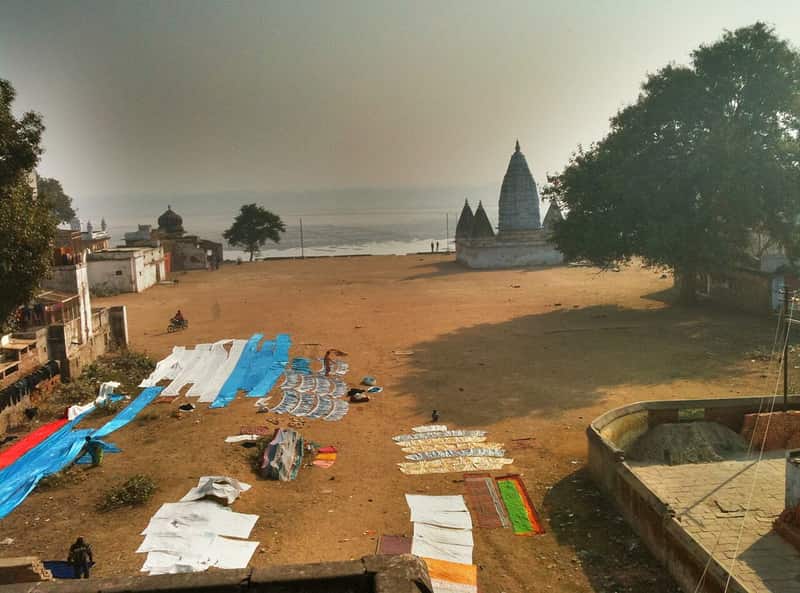
Part of the magic of Chet Singh Ghat is that it is genuinely hard to find. It does not announce itself from the street like the great ceremonial ghats; there is no broad boulevard, no line of waiting pilgrims, no chorus of hawkers calling to passing tourists. Instead the ghat is reached down a narrow, steep lane that drops away from the residential quarter behind it, a lane so inconspicuous that even lifelong residents of the city will sometimes hesitate and ask directions. The first-time visitor, following the sound of water or a helpful rickshaw driver, turns a final corner and finds the whole river suddenly opening before them — the wide brown Ganga, the boats, and the great wall of the fort rising like a cliff against the sky.
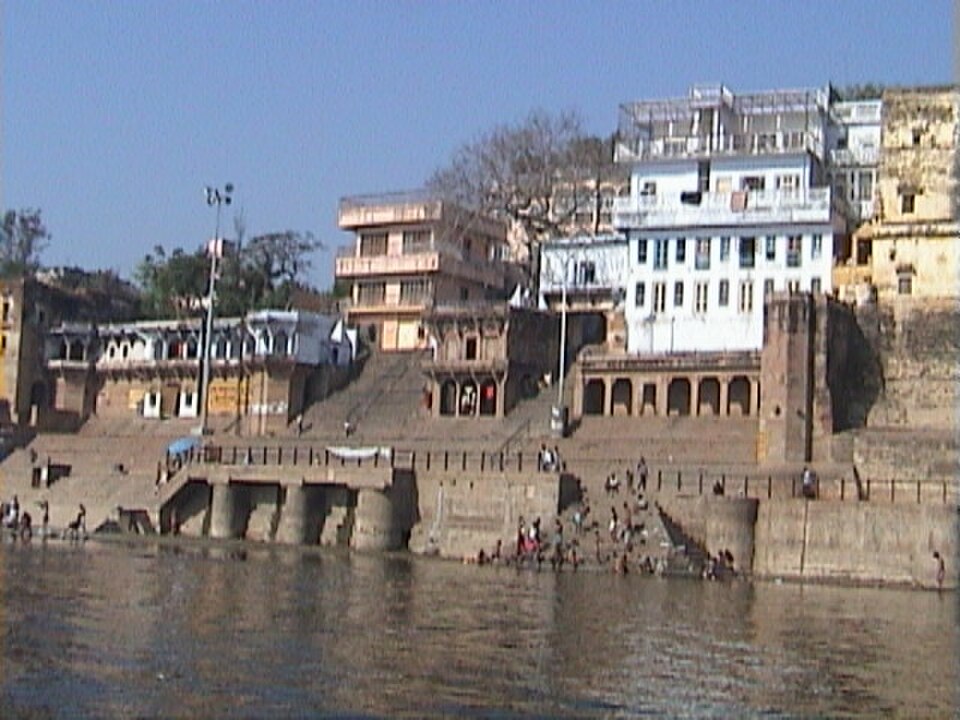
Once down on the landing, the feeling of discovery deepens. The ghat forms a sheltered courtyard of stone, cupped between the high fort wall and the water, protected from the wind and from the noise of the city. Here the world operates at a different rhythm. A woman washes clothes on the steps, a sadhu meditates on a platform, children play cricket with a tennis ball, and nothing seems hurried. The shelter of the walls gives the place a strange acoustic intimacy — voices carry, the river laps, and the bustle of Varanasi might as well be a hundred miles away rather than a few lanes above the ghat. Time moves slowly in this hidden hollow, and the visitor finds the minutes stretching into a long, unhurried peace.
This sense of secrecy is part of what the older residents of Kashi love about the place. In a city that is one of the oldest continuously inhabited on earth, there are still corners that feel undiscovered, and Chet Singh Ghat is one of them. It is a place for the visitor who has already seen the great sights and wants something more private, more atmospheric, closer to the hidden heart of the city. It rewards patience, rewarding those who find it with the best secret in Banaras — a ghat of one's own, where the river, the stone and the silence belong to the moment. Those who come to it once tend to return, again and again, as to a private chapel of the Ganga.
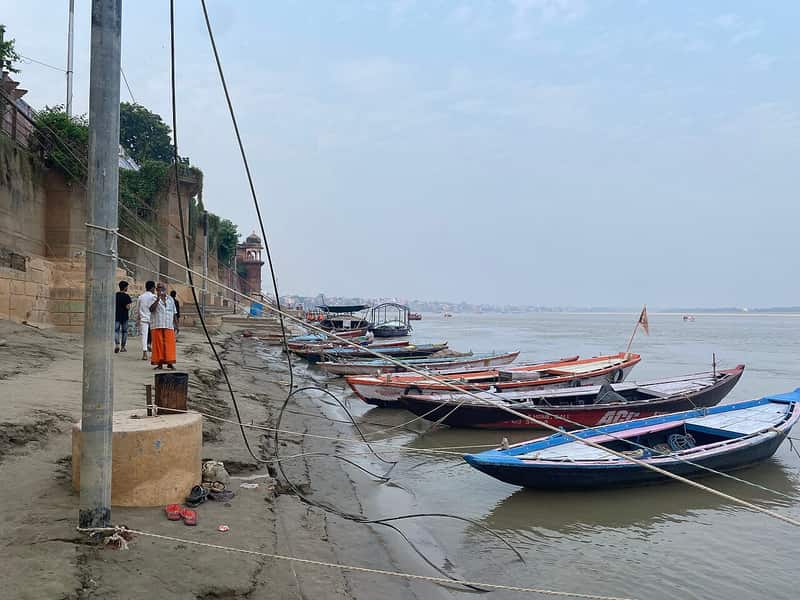
Moorings and Landings — Life at the Water
Chet Singh Ghat has always been, first of all, a place of boats. In the eighteenth century the landing was a working port for the Banaras Raj, a place where grain boats and salt boats and travellers' barges tied up beneath the fort, unloading their cargoes up the steep stone stairs. Today the traffic is quieter but the tradition lives on: this is a favoured mooring for the boatmen of the northern ghats, who bring their wooden craft here to rest out of the current, their oars slung, their hulls rising and falling gently on the river's swell. Whole families of boatmen live within the shadow of the fort, and a child born on these steps learns to row before he learns to write.
Fishermen too make the ghat their own. Nets are strung between poles at the water's edge, drying in the sun, and in the early morning the catch is sorted on the stone platforms — glittering piles of small silver fish that will be carried into the lanes of the city and sold by the basket. The wide reach of river before the ghat is ideal for fishing, deep enough for big nets yet sheltered from the strongest current, and the men who work it know every eddy and sandbank between here and the far bend. Theirs is a life that would be recognisable to their ancestors of a thousand years ago, and in their patience and skill there is a continuity as old as Kashi itself.
For the traveller, the boats of Chet Singh are an invitation. From this quiet landing one can hire a boat for the classic northern cruise, drifting upriver past the ghats of Bhonsale, Ganga Mahal and Panchganga to the confluence at Raj Ghat, or simply push out into midstream to watch the fort from the water, where it looks its most imposing — a great stone ship riding at anchor above the river. Evening brings the boats home in a straggling line, silhouettes dipping their oars, and the landing fills with the low murmur of voices and the smell of cooking fires, the day's work done on the doorstep of an old king. It is the oldest commerce of the city, still going about its business beneath the rebel's walls.
The Panorama from the Water
Some of the most memorable views in Varanasi are taken from a boat on the river, and the stretch before Chet Singh Ghat is among the most beautiful on the whole crescent of ghats. From the water the fort is at its most majestic, its cliffs of masonry rising sheer from the landing, crowned by battlements that break the skyline in a rhythm of stone teeth. The ghat itself lies at a bend in the river, and this position gives the onlooker a sweeping view both upstream and down — a continuous ribbon of steps, temples and palaces curving away to the horizon in either direction. Few places on the river communicate the sheer scale of Kashi so completely in a single glance.
Looking upstream, toward the north, the eye follows the ghats of Bhonsale and Panchganga and the far towers of Raj Ghat, where the Varuna joins the Ganga and the great river finally leaves the city behind. Looking across the water, the low green bank of Ramnagar stretches for miles, dotted with palms and village houses, its flatness a perfect contrast to the packed stone city on this side. The river itself is enormous here, a mile or more of moving water in the rains, and from a boat in midstream the sense of scale is humbling — the fort, so vast on land, becomes one element in a landscape that dwarfs everything. To float here is to feel the whole geography of the holy city at once.
The best time for this panorama is the golden hour of the late afternoon, when the western sun throws the fort into deep relief and turns the river into a sheet of hammered copper. Boatmen on this stretch know the moment intimately, and they will often pause mid-river so that passengers can absorb the view in silence. It is a view that has hardly changed in two and a half centuries — the same bend, the same fort, the same great river — and floating there, the traveller can feel close to every pilgrim and every rajah who ever made the same crossing. The light, the water and the stone combine into a scene that is at once a photograph, a painting and a memory, all in one.
Sunset at the Fort — Golden Silhouettes
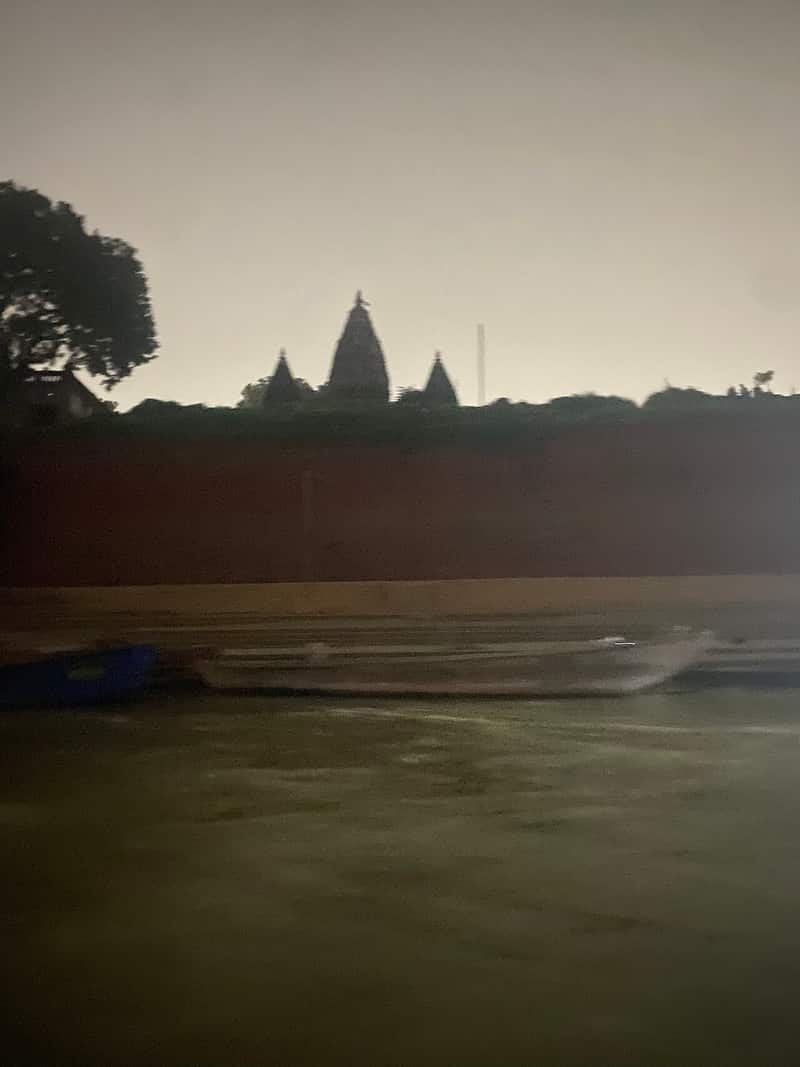
Chet Singh Ghat has a reputation among photographers and painters that most ghats of Varanasi would envy: it is widely considered the finest sunset point on the entire riverfront. The reason is the fort. As the sun sinks behind the western horizon, the great mass of the palace is thrown into a perfect silhouette, every crenellation and bastion etched in black against a sky that runs through gold, rose, orange and violet by turns. The river catches the colour and mirrors it back, and the boats moored below the fort become dark cut-outs floating on fire. No camera, say the old boatmen, has ever truly captured the moment, which is why they never tire of watching it.
The daily ritual of the sunset draws a small, unhurried audience. Couples arrive on hired boats and sit facing the west in silence; photographers set up their tripods on the platforms; a few sadhus perform their evening worship on the water's edge, their lamps flickering in the growing dusk. There is a particular hush that settles on the ghat at this hour, as if the whole city has paused to watch the day end. The boatmen, who have seen this spectacle ten thousand times, still stop their rowing and turn their faces to the west like everyone else — a tradition of wonder that passes from father to son on these very steps. The last aarti of the day begins somewhere far off, its bells drifting down the water.
The sunset here is also the hour of stories. In the long twilight the boatmen tell the tale of the fort again — the arrest, the secret passage, the flight downriver — and the history becomes inseparable from the light. When the last colour drains from the sky and the fort turns black against the stars, the lamps of the far bank begin to glow along the Ramnagar shore, and the ghat settles into its night-time calm. It is the moment the traveller will remember above all others from Banaras, the image of the rebel king's home burning against the dying day, and the surest proof that the city's beauty is not in its monuments alone but in the marriage of stone, water and light.
The Quiet Quarters Behind the Ghat
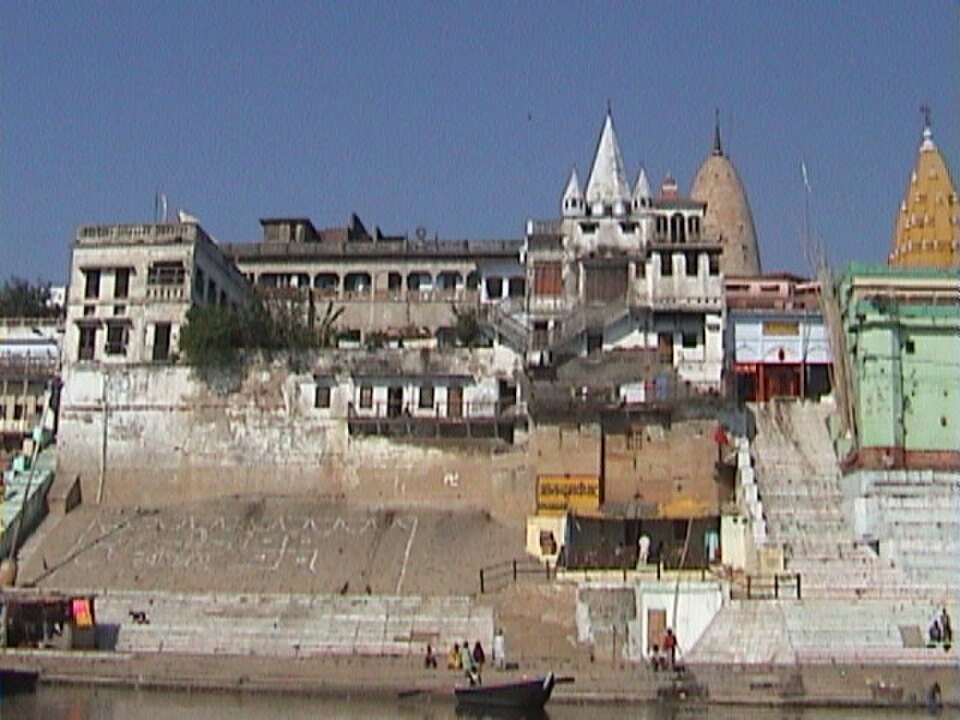
Behind Chet Singh Ghat lies a neighbourhood that belongs to an older Varanasi, a warren of narrow lanes where daily life has been going on for centuries with little regard for the grand events that once unfolded at the water's edge. The houses crowd together in the classic Banarasi manner, their upper storeys leaning toward one another across the lanes, their facades painted in the fading pastel colours — blue, green, ochre — that are the trademark of the old city. Here are small sweet shops, paan stalls, tailors at their machines, and the ever-present fragrance of incense and frying food that defines the lanes of Kashi. To wander here is to leave the twentieth century behind entirely.
To the north of the ghat the lanes take on a more solemn character, for this is the route by which funeral processions approach the cremation ghats of the city. Mourners carrying their dead pass along these streets on their way toward the burning ground, chanting the familiar words of farewell, and the neighbourhood responds with a quiet gravity that has its own beauty. Just beyond, the ghats of the north begin — Panchganga, with its five rivers of legend, and then the long stretch of ghats that lead down toward Raj Ghat and the Varuna. The quiet of this quarter is not emptiness but a kind of holding of breath, the city's oldest profession of respect, and the visitor who walks gently here will feel its dignity without needing to be told.
Within the fort itself there are residential corners too, and the life of the neighbourhood spills into the palace grounds. Clothes dry on lines strung between battlements, buffaloes are tethered in old guard chambers, and children race across courtyards where durbars were once held. The fort's semi-abandonment has allowed it to become an organic part of the quarter rather than a museum, a living ruin shared between the past and the present. For the walker who wanders these lanes, the reward is the sense of a city that has absorbed everything — kings, armies, revolutions — and carried on sweeping its doorsteps, exactly as it has done for the past three thousand years.
Etiquette at Chet Singh — Respect and Grace
Chet Singh Ghat is a lived-in place, not a stage set, and a visitor who treats it with courtesy will find the neighbourhood generous in return. The first rule is simply to be gentle with the space: the fort precincts are partly in private or institutional use, and while the lower ramparts and courtyards are generally open, it is both polite and safe to ask before wandering into the more residential parts of the complex. A smile, a folded hands greeting, and a few words of halting Hindi open doors that no fee could ever buy. The people who live here are proud of their ghat, and they respond to genuine interest with remarkable warmth.
Photography deserves particular care. On the ghat itself and on the open platforms, photographing the architecture, the river and the general scene is welcome and there is no need to feel shy. But the fort houses people who live there, and the neighbourhood includes private homes and, nearby, the roads used by funeral processions. Photographing residents without permission, or aiming a lens at a funeral cortege, is deeply intrusive in Banarasi culture and can cause real distress. The courteous approach is to ask first, accept a refusal with grace, and to put the camera down entirely when the mood of the moment asks for it. The finest photographs of the ghat are taken with permission and patience, not with surprise.
A few further courtesies complete the picture. As with all ghats, be alert to touts and self-appointed guides who may offer incense, blessings or inflated boat prices; a firm but friendly refusal is the best defence. Wear modest clothing, remove shoes before any small shrine, and never refuse a blessing offered by a sadhu — accept it and give a small offering if you wish. And finally, remember that this is a place of history and of people living their daily lives; treat the ruins as you would any temple, and the residents as you would your own neighbours. To arrive with respect is to leave with the deepest memory the ghat has to offer.
Practical Guide — Reaching Chet Singh Ghat
Chet Singh Ghat lies on the northern half of the riverfront, about halfway between the crowded ceremonial ghats and the far northern tip of the city's crescent. The most pleasant way to arrive is by boat. From Dashashwamedh Ghat, the great hub of the river, a boat ride of roughly twenty to thirty minutes carries the visitor upstream past the most famous ghats of Varanasi — Lalita, Manikarnika, Scindia — before the fort of Chet Singh rises on the left bank. Boatmen know the ghat well and will happily include it in a longer tour of the northern ghats, pausing long enough for photographs and a quiet stroll on the landing.
For those who prefer dry land, the ghat can be reached on foot from Manikarnika Ghat by walking north along the riverfront and through the lanes, a journey of about fifteen to twenty minutes that passes Bhonsale Ghat and Ganga Mahal before the narrow descent to Chet Singh. The path is uneven and the way is easy to miss, so asking locals for the ghat's name — Chet Singh Ghat, or simply Chet Singh Ka Kila — is wise. Auto-rickshaws from the centre of Varanasi can reach the neighbourhood behind the ghat, from which the steep lane leads down. There is no entry fee at any point, and the ghat is open throughout the day and night, free to all who come to it.
The best time to visit is the late afternoon through sunset, when the light transforms the fort and the river is at its calmest; mornings are also lovely and quieter still. Dress for stairs and dust, carry water, and consider combining the visit with a broader boat tour, since the same stretch of river holds the ghats of Panchganga to the north and Manikarnika and Scindia to the south. A sensible circuit is a dawn or sunset cruise along the northern ghats, landing for an hour at Chet Singh, and then continuing — for this is the rebel ghat of Kashi, and no visit to the city is complete without standing once where a king defied an empire and escaped down the same river that will carry you home.
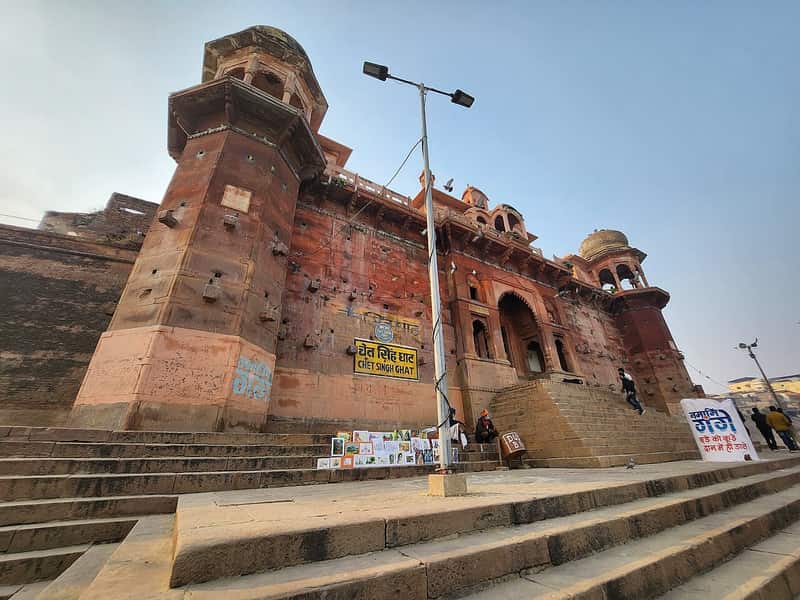
Chet Singh Ghat — Gallery (12 Photos)
Image Credits
chet-singh-01.jpg · chet-singh-02.jpg · chet-singh-03.jpg · chet-singh-04.jpg · chet-singh-05.jpg · chet-singh-06.jpg · chet-singh-07.jpg · chet-singh-08.jpg · chet-singh-09.jpg · chet-singh-10.jpg · chet-singh-11.jpg · chet-singh-12.jpg — Wikimedia Commons, under free licenses.
Continue exploring
Similar Ghats Nearby
Book This Ghat — Get Notified
Download the app now and book a boat ride to Chet Singh Ghat