

Harishchandra Ghat
Cremation GhatKashi's oldest cremation ghat, also called 'Adi Manikarnika' (the First Manikarnika). Named after the truthful King Harishchandi, this is one of the most inspirational places of truth in Hindu tradition.


Type
Cremation Ghat
Boat Fare
1x base fare
Best Time
Early morning 5-9 AM for quiet darshan; twilight 7-11 PM for solemn rites. Photography strictly prohibited.
History
The legend of King Harishchandi is among the most inspiring tales of truth and dharma in Hindu tradition. When Sage Vishwamitra stripped the king of his kingdom, Harishchandi came to Kashi and took service as a Dom (cremation worker). When his own son died, Queen Taramati brought the body to the ghat, but bound by duty Harishchandi refused cremation without the fee. Honoured by his unwavering commitment to righteousness, the gods restored his son's life and his kingdom. Mahatma Gandhi drew moral lessons from this story of unwavering truth (satya).
Archaeological evidence suggests this ghat predates even Manikarnika and is called 'Adi Manikarnikka' — the first cremation ground. Sati memorials from the 15th-16th centuries confirm its long history. The ghat was renovated under Peshwa patronage in the 18th century and later saw India's first electric crematorium installed in the 1980s.
India's first electric crematorium was installed here in the 1980s, offering an alternative to the traditional wood pyre. The electric chamber heats to 1,000°C, completing cremation in ~1.5 hours versus 4 hours for wood pyres, drastically reducing wood consumption and Ganges pollution. A major redevelopment project (Rs 18 crore) is underway to modernize facilities while preserving the sacred essence.
The Dom community are the traditional custodians of the sacred flame here. They keep the eternal fire burning day and night, manage all cremation rituals according to ancient tradition, and handle 20-25 cremations daily (2,500-3,000 annually). Their role is considered sacred and their knowledge of rites passed down through generations.
A temple on the ghat is dedicated to King Harishchandi, Queen Taramati/Chandramati and Prince Rohitashwa/Rohitasva, along with a Shiva temple and a stone Mahadeo shrine. The Shri Chintamani Ganesh Temple is also located in the lanes nearby.
The ghat operates 24/7 for cremation rites. The electric crematorium (upper level) runs 7 AM-5 PM, while traditional wood pyres burn day and night. Best for respectful observation is early morning (5-9 AM) or late evening. Photography is strictly prohibited at cremation ghats. Common scam: beware of individuals soliciting donations for 'wood for poor families' — politely decline.
Highlights
- Memory of Raja Harishchandi's story of truth
- One of Kashi's two main cremation ghats
- Sacred ground of moksha
- Best seen from a boat from the Ramnagar side
Festivals & Events
How pricing works in the NaviX app
No haggling at the ghat — everything is fixed in the app first
- 1
Fixed price before you board
The fare is shown in the app upfront — no bargaining at the ghat
- 2
Sharing or private — your choice
Share with fellow travelers or take the whole boat for your group
- 3
Pay only after the ride
UPI, card or cash — with an instant receipt
6:00 AM & 6:00 PM
Second cremation ghat aarti
Complete Guide
Harishchandra Ghat — The Complete Guide
History, mythology, rites and practical details — everything in depth.
On this page
- 1.Harishchandra Ghat — The Ghat of the Truthful King
- 2.Raja Harishchandra — The King Who Served the Fire
- 3.A Name Written in the Sun
- 4.The Burning Ghat at Work, Day and Night
- 5.The Firewood Trade of the Ghat
- 6.The Order of the Rites — From Bath to Ash
- 7.The Doms — Guardians of the Funeral Fire
- 8.The Mood of the Ghat
- 9.Harishchandra and Manikarnika — Two Fires, One Promise
- 10.Between the River and the Old City
- 11.Etiquette for Visitors
- 12.Practical Guide for the Traveller
📅 Updated: 21 Aug 2026 · Author: NaviX Field Team (field research 2024-26) · 12 sections · 12 photos
Harishchandra Ghat — The Ghat of the Truthful King
Harishchandra Ghat is the second great cremation ghat of Varanasi, standing in quiet dignity on the southern curve of the sacred crescent, a short walk downstream from the burning platform of Manikarnika. In legend it is older than the city itself, for here the truthfulness of a king was tested against the fire of destiny. Where Manikarnika is vast, crowded and ceaseless, Harishchandra is smaller, calmer and strangely intimate, its pyres burning at the water's edge beneath a ragged line of ancient buildings and the watchful spires of Shiva temples. The faithful who come to Kashi to spend their last days regard it as a rare blessing to be consigned to the flames on this particular ground, for the ghat carries the name of Raja Harishchandra, the king who surrendered his kingdom, his family and finally his own freedom rather than break a single promise. To walk down its steps is to step into the oldest story of honesty that India tells itself, and to see the fires of that story still burning.
The ghat is often described as the quieter sister of Manikarnika, and the comparison holds in almost every way. Its platforms are narrower, its crowds thinner, and the smoke that rises from its pyres seems to climb more lazily into the sky. Yet for many Hindus the quieter ghat is the more moving one, because its legend is personal rather than cosmic. Manikarnika promises moksha through the eternal flame and the grace of Shiva; Harishchandra promises salvation through the power of truth. The two beliefs are not opposed, and pilgrims honour both, but the atmosphere at Harishchandra has always felt more like a chapel than a cathedral. The river here runs calm, the boats drift past slowly, and the whole scene, the fires, the mourners and the smell of sandalwood smoke, seems to belong to a different, older pace of life.
This guide will take you through twelve faces of the ghat: the legend of the truthful king, the solar mysteries of his name, the daily working of the cremation ground, the vast trade in firewood that feeds its flames, the ordered sequence of the rites, the community of Doms who guard the sacred fire, the peculiar mood of the place, how it differs from its greater neighbour Manikarnika, what lies in the lanes around it, and how a traveller should behave with respect and understanding. Every section is paired with a photograph and a complete Hindi translation, so that the story of Harishchandra Ghat may be told in both of the languages that have always been spoken on its steps, and so that no reader, in any tongue, is left outside the circle of its quiet blessing.
Raja Harishchandra — The King Who Served the Fire
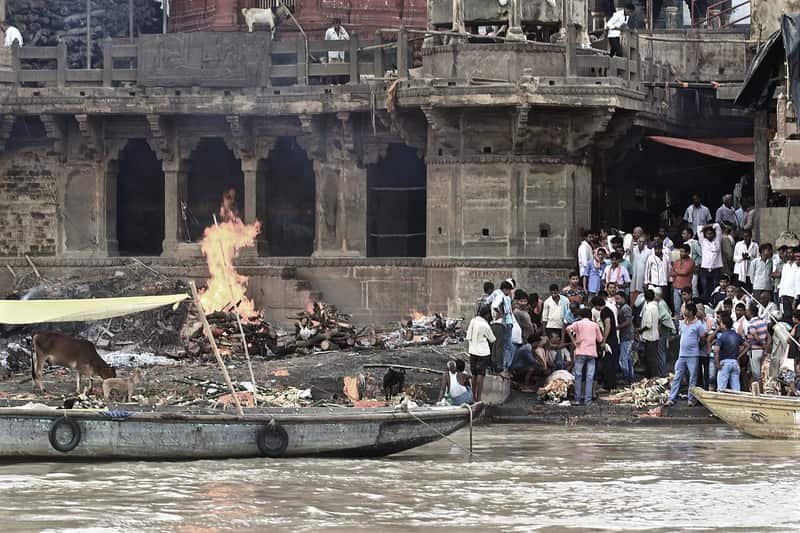
The ghat takes its name from Raja Harishchandra, the king of Ayodhya whose story is told in the Aitareya Brahmana, the Mahabharata and, above all, in the moving katha of the Bhagavata Purana. Harishchandra was renowned above all kings for his absolute truthfulness, the satyavadi ruler whose word was so firm that it could not be broken by wealth, by loss, by pain, or even by the threat of death. The great sage Vishwamitra, stung by the king's fame and jealous of his virtue, decided to put that word to the test. He appeared before the court and demanded that the king renounce his throne, his kingdom, his treasury and his army. Harishchandra bowed and agreed without a moment's hesitation, giving everything away until nothing remained but the ragged clothes on the backs of his wife Shaivya and his young son Rohit. When Vishwamitra demanded a final payment, the king had nothing left to offer, and so he sold his wife, his son and finally himself into slavery.
The buyer of the king's liberty was a dom of the burning ghat, a keeper of the funeral fire at the very cremation ground that would one day bear the king's name. Harishchandra, the king of Ayodhya, became a servant at a cremation ghat, collecting the fees paid by the mourners for the fire and the wood. His duty was humble and cruel, for the work of a dom was considered the lowest of the low. Yet the king performed it without complaint, never once lying, never once raising his voice, even when the people of the ghat mocked the fallen ruler. He served so faithfully that in time he came to be known as the king of the burning ground, and the ghat itself, where he worked, came to be called Harishchandra Ghat.
The tragedy of the story is that the king's own son was destined to suffer at his hands. When Rohit was bitten by a snake and died, his mother Shaivya, penniless and alone, could not pay the cremation fee. She carried the boy's body to the burning ghat and begged the keeper to light the pyre, promising to pay with her own ornaments. The keeper, her own husband, unrecognised beneath the ashes and years of sorrow, demanded his fee first. When she could not pay, he refused, and so she stood weeping on the bank with her dead son in her arms. It is at this terrible moment that the king's truthfulness meets its final test, and the story resolves in a way that has comforted and instructed India for three thousand years.
A Name Written in the Sun
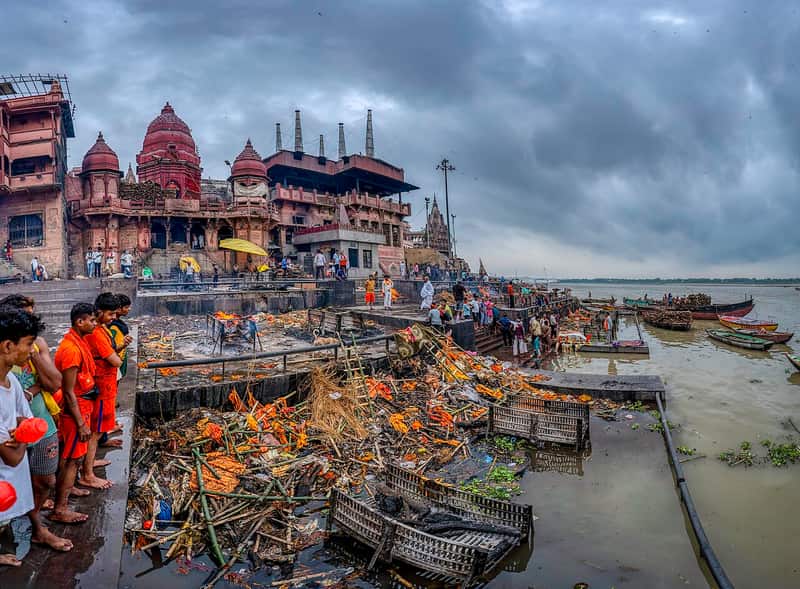
The name Harishchandra carries a double meaning, and the second is written in the sky. The name may be read as the moon of Hari, but it is more commonly understood as the sun king, for harisha, one who takes away grief, is an epithet of the sun, and chandra, the moon, was the crown of the solar dynasty of Ikshvaku to which the king belonged. The royal line of Ayodhya traced itself to the sun himself, Surya, and Harishchandra was counted among its brightest jewels. In the hymns and the genealogies he is the son of Satyavrata, also called Trishanku, the king whom Vishwamitra tried to lift bodily into heaven, a story that ties the family of Harishchandra directly to the celestial fire. The sun was not merely a symbol for these kings; it was the witness of their oaths, the eye that saw every truth and every lie, and the deity to whom the first fire of the morning was offered.
The solar connection runs deep in the funeral rites themselves. Hindu cremation is, at its heart, a solar sacrifice: the pyre is a replica of the ritual fire altar, and the fire is the messenger that carries the body to the gods, the same Agni who has carried offerings since the age of the Rigveda. The dying person is placed so that the head points toward the south, the direction of Yama, while the final flames leap toward the sun in the eastern sky. Some texts add that cremation is a fourth oblation, in which the body itself is offered into the fire as the concluding gift of a life that began at the first sunrise. This is why the ghat of the sun king is an appropriate home for the fire of the last offering, because both king and ritual are children of the same celestial flame.
The scriptures give the solar theme an even more specific form. The Markandeya Purana describes the funeral sacrifice of the sun king in detail, and it notes that the king's own name was derived from the great solar hymn. Other Puranas connect Harishchandra to Vishnu in his form as the sun, the radiant one, who descends to the cremation ground as the witness of every last rite. Modern scholars have pointed out that the ghat's position on the southern bank of the Ganga, where the setting sun is seen directly over the water, gives the solar symbolism a physical reality: at dusk the river is turned to gold exactly over the burning platforms, as if the sun itself were keeping the king's promise. To stand on Harishchandra Ghat at sunset is to watch the oldest symbolism of the place come alive.
The Burning Ghat at Work, Day and Night
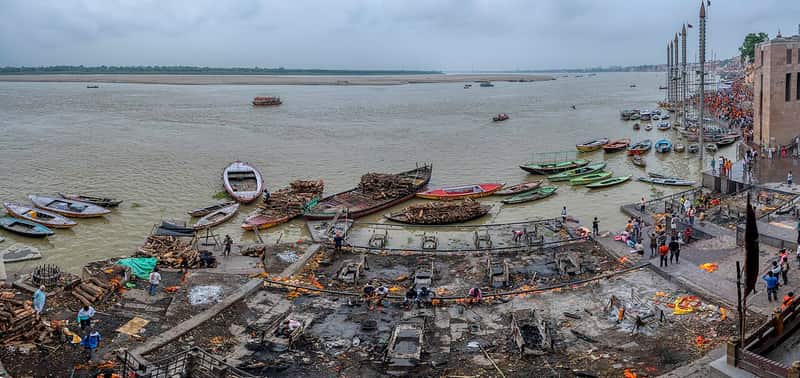
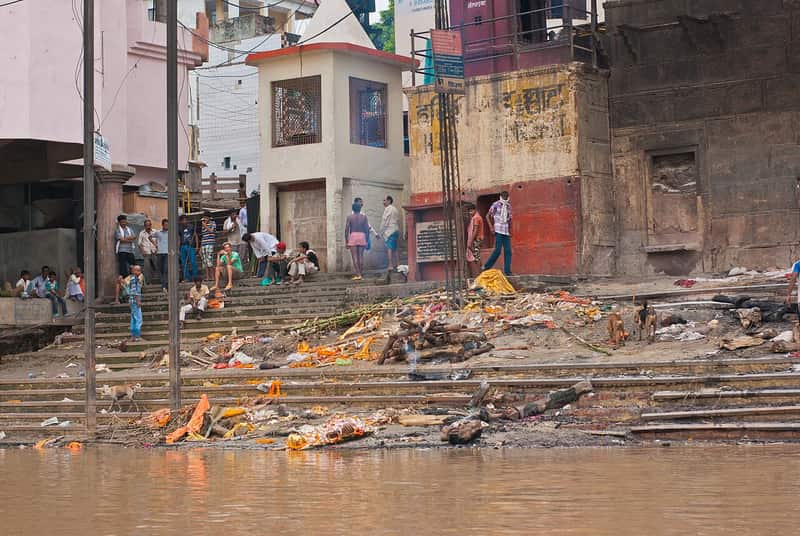
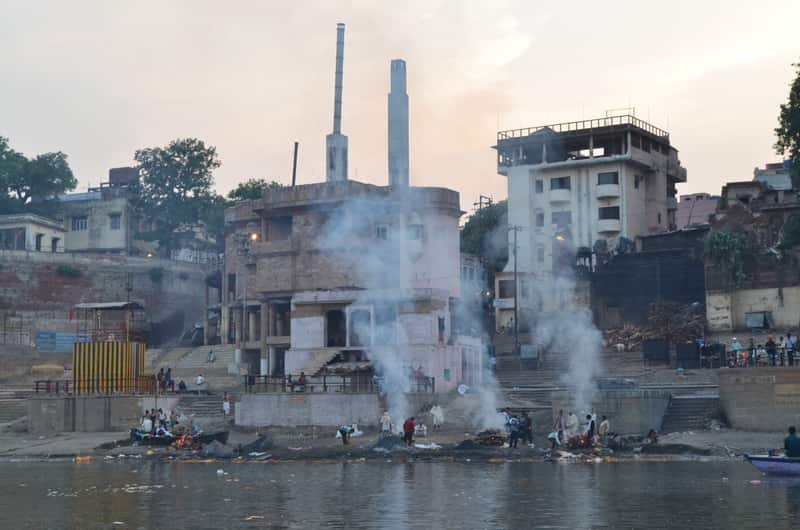
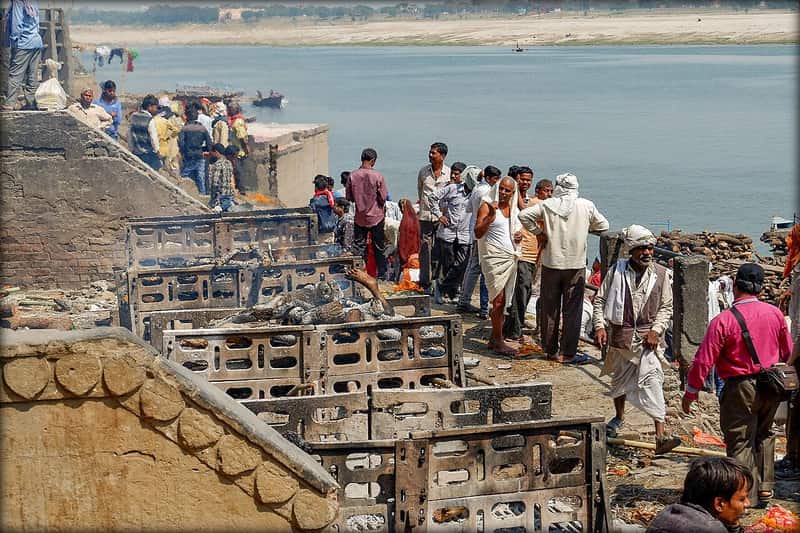
The burning of the dead at Harishchandra never stops. Day and night, on the two stone platforms that run down to the water, the pyres are laid and lit, and the smoke rises in a slow column that can be seen from far across the river. The routine is at once ancient and practical. When a body arrives, the bearers lower it into the Ganga for the final bath, sometimes the feet only, sometimes the whole body, and then carry it dripping to the platform, where the wood has been stacked and measured by the attendants. The wood is arranged in a careful lattice, roughly the shape of the body, and on it are placed the offerings: ghee, camphor, sandalwood paste, dried leaves, sweets and grains. Nothing in this arrangement is accidental; every layer has its place, and every substance has its purpose.
The chief mourner, usually the eldest son, then performs the central act. Having been shaved and bathed, dressed in simple white, he carries the burning torch and walks three times around the pyre, holding the fire to his left; on the third circuit he touches the flame to the wood, and the last rites begin. The attendants add ghee to feed the fire, and the family and friends stand apart, reciting the Ram naam and the funeral mantras. The pyre burns for three to four hours, and during that time the duty of watching passes among the mourners; the body is turned with long poles so that it burns evenly, and the sound of cracking wood mingles with the chanting. When the flame dies down and the pyre is reduced to ash, the scene is once again still, and the next family steps forward to claim their place at the fire.
There is an important difference between the two great ghats in how this work is organised. Manikarnika is the vast, ceaseless burning ground of the city, handling hundreds of cremations every day in a state of permanent urgency. Harishchandra is smaller, slower and more intimate, and many families who choose it do so precisely because of that calm. It is the place where the cremation of an ordinary household is performed with the same dignity as the funeral of a king, and where the attendants, drawn from families who have worked on the ghat for generations, treat each rite with the same careful patience. The crowd is thinner, the priests less hurried, the smoke softer, and for many mourners that gentleness is the deepest comfort of all.
The Firewood Trade of the Ghat
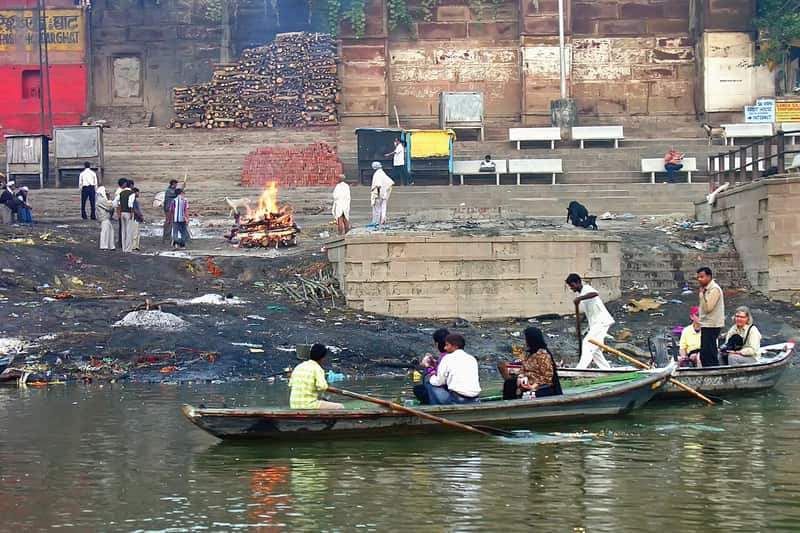
Along the upper terraces of Harishchandra Ghat, the firewood trade is impossible to miss. Huge stacks of logs rise like small mountains behind the burning platforms, mango, neem, sheesham and other woods, cut, dried and stacked by weight. At the far end of the ghat stand the weighing scales, great beam balances where the wood is weighed in kilos and priced by grade. The cheapest wood, soft and quick to burn, is offered to families of modest means; the costliest is sandalwood, whose sweet smoke is said to carry the soul gently and whose use is reserved for those who can afford the highest offering. Between these extremes lies a whole hierarchy of timber, and the price of a funeral can range from a few hundred to many thousands of rupees, a fact of life that has shaped the economy of this ghat for centuries.
There is a deep belief attached to this wood, one that the wood sellers will explain to any visitor who asks. The firewood of Kashi, and especially of Harishchandra Ghat, is called moksha ki lakdi, the wood of liberation, and it is held that a body burned with it is burned for good, its soul released from the wheel of birth. Some of the wood is even counted in the pilgrimage itself: the faithful buy a few logs in their lifetime and store them for their own funeral, and families have been known to hand down a small store of sacred wood from one generation to the next. The ghat's wood sellers are thus not mere merchants; they are keepers of the material half of a promise, the fuel that the fire consumes in order to set the soul free.
The wood trade was brutally tested in the summer of 2024, when the Ganga rose in devastating floods and thick silt covered the lower platforms of the ghat. For weeks the cremations were pushed to higher ground, the pyres burning on temporary platforms while the old stones lay buried under the mud. The doms and the wood sellers worked through the crisis, and the city rallied to clear the ghat, but the episode was a sharp reminder of how fragile and how vital the infrastructure of this place really is. When the silt was finally cleared and the fires returned to their old platforms, the ghat reopened as if nothing had happened, but everyone who works here knows that the river gives and the river takes, and that the wood of the ghat will be measured and burned on this bank as long as the Ganga herself chooses to flow past it.
The Order of the Rites — From Bath to Ash
The ritual of a funeral at Harishchandra unfolds in a sequence so old that it is performed almost without thought, yet so precise that every step carries a meaning. It begins at the water: the body is bathed in the Ganga, the last bath, washing away the dust of life and cooling the fever of the soul. Then the corpse is laid on a flat stone beside the platform, still wet, and the chief mourner, shaved and barefoot, pours the water from the dead person's cupped hands — a symbolic severance of the soul from the body, an offering of the last handful of the river that will carry the soul onward. The priests and the attendants arrange the body upon the pyre, feet toward the south, head to the north, and the first fuel is laid.
The lighting of the fire is the centre of the rite. The chief mourner takes the sacred flame and circles the pyre three times, the final circumambulation, and at the third pass sets the wood alight. From this moment the fire itself becomes the priest, and the gathered family chants the Ram naam as the smoke climbs. The most solemn moment comes some time later, when the skull bursts open with a soft crack in the heat: this is the kapal kriya, the rite of the skull, performed by the chief mourner with a bamboo pole, opening the gate through which the soul is said to escape. It is done once, quickly, with the utmost gravity, and the onlookers bow their heads.
The rites continue beyond the pyre. On the third day the family returns to the ghat, sweeps the ash, and gathers the bones that the fire has left — a handful of pale fragments, white and fragile. These are washed in the Ganga and offered to the river with flowers, milk and honey, an offering called the asthi visarjan, the immersion of the bones. The river takes them, and the soul, freed of its last anchorage, is believed to travel on. For thirteen days the family keeps mourning rites at home, and on the thirteenth day the priests are fed and the period of impurity ends. Many families also perform a final rite at the very spot where the pyre burned, so that the ghat holds not only the memory of the fire but the completion of every farewell.
The Doms — Guardians of the Funeral Fire
No account of Harishchandra Ghat is complete without the Doms, the community who have guarded the funeral fire of Kashi for as long as anyone can remember. Their hereditary chief, the Dom Raja, is one of the most powerful figures in the ritual world of the city, for without his permission, and his fee, no cremation may be held on either of the great burning ghats. The Doms supply the fire, manage the pyres, measure the wood, and guide the mourners through every step of the rites. Their status is paradoxical: they are excluded from the hierarchies of caste and temple, yet they hold the key to the city's greatest promise, and they are treated with an awe that borders on reverence.
The legend that explains their authority is told at Harishchandra itself, and it is the same legend that names this ghat. When the king Harishchandra served as a dom at this burning ground, he showed that the lowly keeper of the fire could be the most truthful soul on earth. The dom's work, the story teaches, is not a curse but a sacred service, and the ghat that bears the king's name has been tended ever since by the king's spiritual heirs. The Dom Raja of Varanasi holds his court near the ghat, settles disputes, grants permissions, and receives the traditional tribute that makes the cremation economy turn. In the past the Maharaja of Banaras himself paid homage to the Dom Raja, acknowledging that in matters of death the lowliest servant holds the highest authority.
The Doms are also the caretakers of the dying. Near the ghat stands the Muktibhavan, the house of liberation, a shelter where those who come to Kashi to die are received with kindness, fed, and cared for in their last days. The Doms attend to the dying with a gentleness that belies their grim trade, and they are paid to do so by families who can afford it; for those who cannot, the service is given without question. This quiet mercy, more than the fire itself, explains why the Doms are respected and feared in equal measure. They are the gatekeepers of the threshold between this world and the next, and the legend of Harishchandra, the king who became a dom, remains the clearest statement the city makes about who, in the end, serves whom.
The Mood of the Ghat
The atmosphere of Harishchandra Ghat is unlike anything a traveller has felt before, and it is best approached with an open mind and a quiet heart. The first thing that strikes the visitor is the smoke — thin, grey-blue ribbons rising from the pyres, carrying the smell of burning wood, ghee and incense, a scent that settles on the clothes and stays for hours. The second is the sound: not the noise of a tourist city but a low, continuous murmur of chanting, the Ram Naam Satya Hai of the bearers, the bells of nearby temples, the lapping of the river. There is grief here, but there is also a strange and steady peace, because the people of Kashi have long learned to see death not as an ending but as a release.
For those who understand its purpose, the ghat is not a place of horror but of compassion. The mourners are not actors in a show; they are families in their most private moment, and the ritual they perform is the last thing they can do for someone they loved. The fires burn on, one after another, and the attendants work without ceremony, and the whole scene proceeds with a kind of ordinary grace that is deeply moving. Many travellers report that a few hours spent sitting quietly on the steps of Harishchandra, watching the smoke and the river, changed the way they thought about death — not because the ghat is frightening, but because it is honest. It shows life's end plainly, without masks, and in that plainness there is a strange comfort.
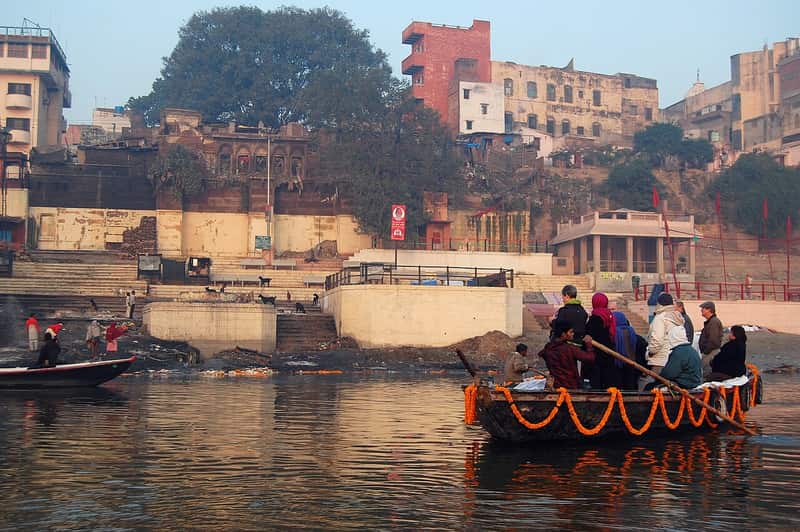
The ghat is busiest at dawn and at dusk, when the light turns the smoke golden and the river glassy. At night the glow of the pyres reflects on the water, and the whole crescent of the city seems to hold its breath. Visitors should remember that this is a sacred working place, not a spectacle; grief here is real, and the bereaved are not curiosities. The right response is not to stare but to be present — to stand or sit a little apart, to bow the head if a funeral passes, to speak softly or not at all. Those who do so will find, as so many before them, that Harishchandra repays their respect with a gift of its own: a few hours of silence in which the meaning of the place, and of the city around it, becomes quietly clear.
Harishchandra and Manikarnika — Two Fires, One Promise
The visitor who has seen Manikarnika will find Harishchandra both familiar and different, and the contrast between the two ghats is one of the great lessons of Kashi. Manikarnika is the bigger, the older, the grander — the eternal flame that never dies, the busiest cremation ground in the world, a place of cosmic mythology and ceaseless fire. Harishchandra is smaller, quieter, and in the eyes of many of the faithful, gentler. Both grant the same promise: a death here is a death that ends the cycle of rebirth, and the soul that is cremated on either bank of the river rises free. The difference lies not in the goal but in the mood. Families who choose between them often weigh practical matters, the crowd at Manikarnika, the waiting time, the fees, but many also speak of feeling, of a pull toward one ghat or the other, and those who feel drawn to Harishchandra describe it as the choice of the heart.
The practical differences are real and visible. Manikarnika handles hundreds of cremations each day and works at a breathless pace; its platforms are crowded, its doms move quickly, and the smoke is dense and constant. Harishchandra burns perhaps a tenth as many, at a rhythm that allows each rite its full time, and the ghat can feel almost deserted between funerals. Its platform is smaller, its wood sellers fewer, its priests less harried. Many Varanasi families with deeper roots in the old city prefer Harishchandra for precisely this reason: it is the ghat where the funeral can be conducted as it should be, without hurry, with dignity, at a scale that the family itself can hold in view.
In legend, the two ghats are also bound together. Manikarnika is the ghat of the gods, where Vishnu dug the sacred kund and Shiva granted liberation; Harishchandra is the ghat of men, where a mortal king earned salvation through truth. One is a promise from heaven, the other a proof from earth, and pilgrims often visit both on the same day, bathing and praying at Manikarnika, then walking down to Harishchandra to sit with its quieter fire. Both ghats end in the same river and the same liberation, and the choice between them is less a matter of doctrine than of temperament. Kashi holds room for both, and the soul of the city is made richer by the two burning grounds it keeps.
Between the River and the Old City
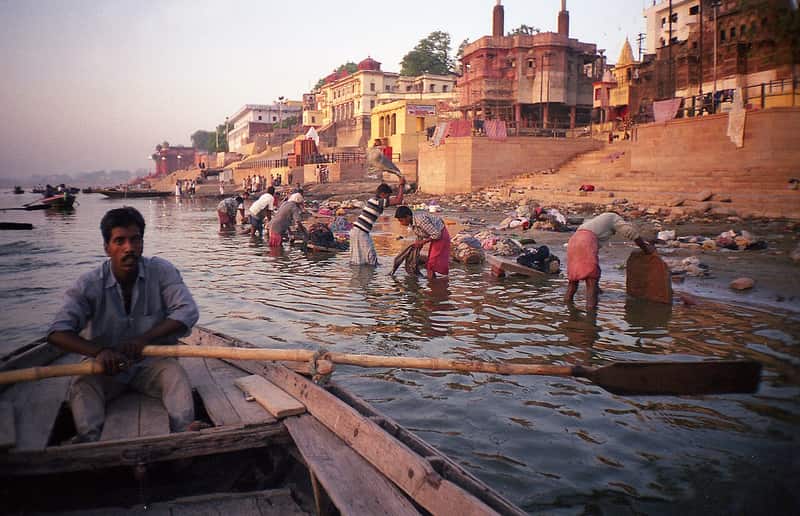
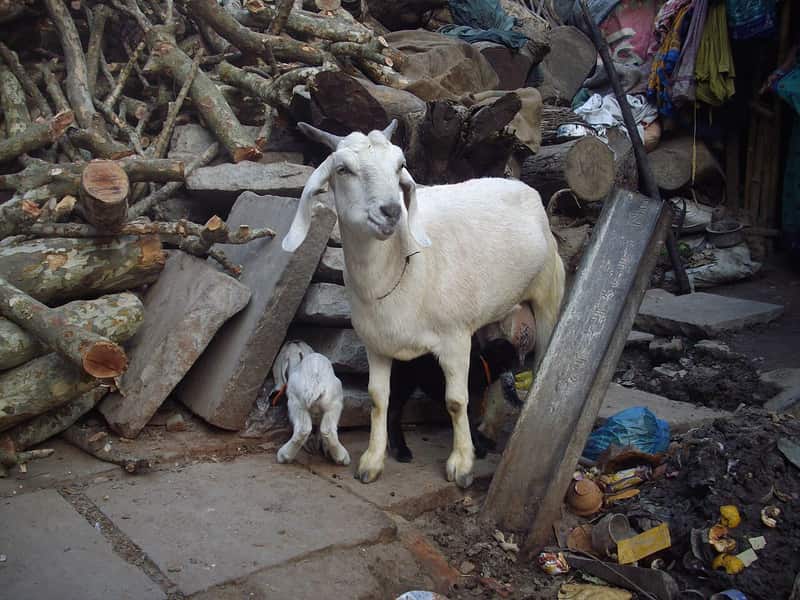
Harishchandra Ghat sits in the southern half of the great crescent of Varanasi's ghats, roughly midway between the chaos of Manikarnika and the quieter reaches of the old city. It is a place of thresholds, where the river meets the lanes, where the city's noise fades into something older. To the north, a short walk along the bank leads past the smaller ghats and the crowded temples to Manikarnika; to the south, the river road continues toward Kedar Ghat and the great temples of the southern city. Immediately behind the ghat rise the dense lanes of the old town — chowkis, houses, tea stalls and shops squeezed between ancient walls, where the smell of the ghat mingles with the smell of food and incense.
Within a few minutes' walk lie some of Kashi's most venerated temples. The Kashi Vishwanath Temple, the holiest shrine of the city, stands in the lanes not far above the ghat, its golden spire rising over the rooftops. Nearer still are the smaller temples of Annapurna, Kal Bhairav and Dattatreya, and a short walk inland brings the visitor to the sprawling lanes of Godowlia, the commercial heart of the pilgrimage. The ghat itself is flanked by the Ganga Mahal, an imposing palace built by a Maratha nobleman, whose great walls and balconies look down on the burning platforms — a silent witness to the fires that have burned beneath its windows for centuries.
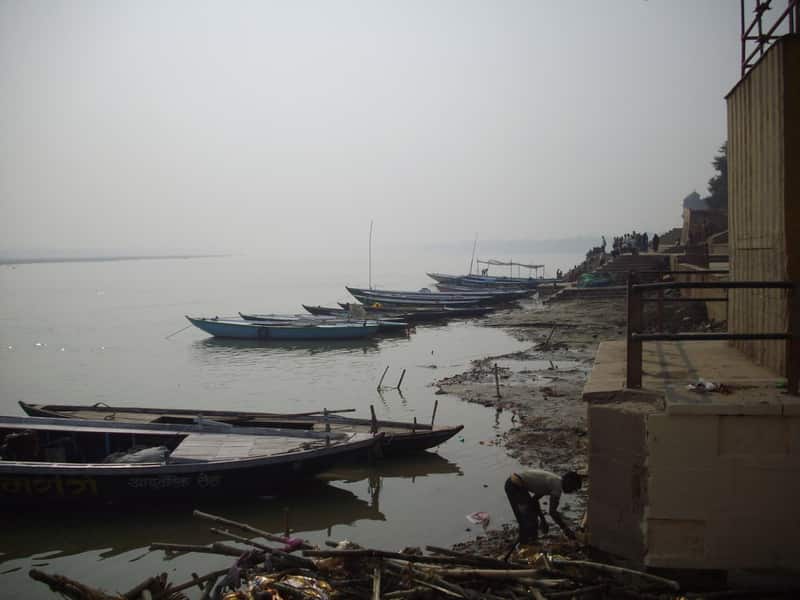
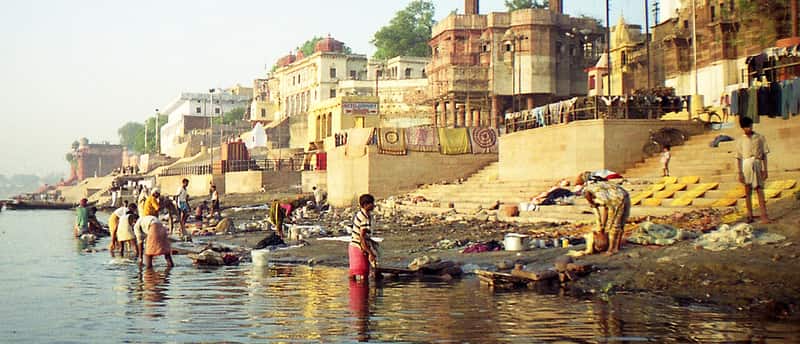
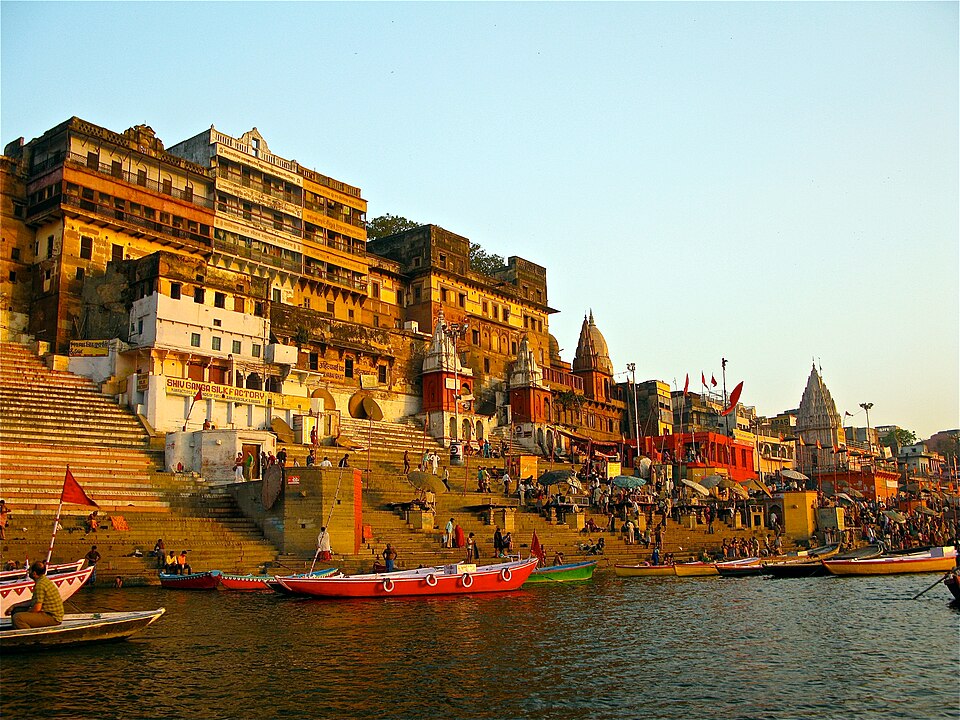
The best way to arrive is by boat. From the river, Harishchandra appears as it must have appeared to travellers for a thousand years: a row of tall old buildings, a sprawl of wooden platforms, columns of smoke rising between the towers. The boatmen of Varanasi know the ghat well, and a slow passage along the water in the early morning gives the visitor the full sweep of the scene — the ghats climbing one after another, each with its own temple, its own crowd, its own story. Coming by water, the traveller lands on the steps of the ghat itself, and steps from the boat into the oldest story of the city's southern bank.
Etiquette for Visitors
Harishchandra Ghat is a place of intense private grief, and the first rule of visiting it is to remember that. This is not a museum or a film set; the rituals performed here are the most sacred acts of mourning, and the families present deserve every protection from the curiosity of strangers. The single most important rule is that no photographs may be taken of the ghat while a cremation is in progress. Cameras and mobile phones should remain firmly packed away — to photograph the bereaved, the bodies or the burning pyres is a grave offence to the faith and to the families, and it is both disrespectful and, in some cases, illegal.
Dress and manner matter. Visitors should wear simple, modest clothing — nothing revealing, nothing loud — and should keep their heads covered if they wish to follow local custom. Speech should be soft and restrained; there is no place for laughter, joking or loud conversation on the burning ground. When a funeral procession passes, the visitor should stop, step aside, and bow the head in silence. It is also wise to decline the services of the touts who may approach with offers of explanations, blessings or donations; the ghat has its own codes, and giving money to the touts who crowd the lanes does nothing for the families but does a great deal of harm to the sanctity of the place.
There are also ways to show respect that cost nothing. If a pilgrim wishes to pay respects, it is proper to fold the hands in namaste, to bow toward the river, or to offer a few flowers and a diya on the water's edge, away from the pyres. One may sit quietly on the upper steps, well away from the burning platforms, and simply be present — this is welcomed, even appreciated, so long as it is done without staring. Do not ask the mourners questions, do not block the path of the bearers, and do not comment on what you see. Above all, remember that every flame on this ghat represents a human life and a family's love, and that the respect shown in silence is the only respect this place truly asks for.
Practical Guide for the Traveller
Reaching Harishchandra Ghat is easy, for it lies at the heart of Varanasi's sacred geography. From the Kashi Vishwanath Temple the ghat is a walk of ten to fifteen minutes through the crowded lanes of the old city; from Godowlia the same walk begins past the temple's golden spire. The nearest major landmark is the Ganga Mahal, and taxi and auto-rickshaw drivers know the ghat well. The best approach, however, is by water: a boat from Dasaswamedh Ghat, the great burning ghat's neighbour, takes twenty minutes downstream and delivers the visitor directly to the steps of Harishchandra in the calm of the early morning.
A visit is best made early in the day, when the light is soft, the river is quiet and the ghat's work proceeds at its gentlest pace. Visitors should dress modestly, wear comfortable shoes, and carry water and a light scarf — the ghat has no tourist facilities of the usual kind. There is no entry fee, but it is customary to leave a small offering: a flower, some grains, or a coin given to the ghat's attendants rather than to the touts. A good visitor gives no money for photographs, which are not to be taken at all, avoids the busy platforms, and spends perhaps an hour sitting on the upper steps, watching the smoke, the river and the boats, and offering a quiet prayer for the souls whose fires rise from the water's edge.
What a visitor should not do is as important as what he should. Do not attend the ghat as a spectacle, do not crowd the mourners, do not engage the touts, do not photograph or film anything near the pyres. What a visitor should do is simple: come in a spirit of respect, stay briefly and quietly, and leave the ghat as it was — with the fires burning, the families in their grief, and the river unchanged. Nearby, the traveller may walk on to Kedar Ghat and the temples of the southern city, or float back upstream to Dasaswamedh for the evening aarti. The ghats of Kashi are many, but there is only one Harishchandra, and those who visit it with reverence leave with a memory that no other place on earth can give.

Harishchandra Ghat — Gallery (12 Photos)
Image Credits
harishchandra-01.jpg · harishchandra-02.jpg · harishchandra-03.jpg · harishchandra-04.jpg · harishchandra-05.jpg · harishchandra-06.jpg · harishchandra-07.jpg · harishchandra-08.jpg · harishchandra-09.jpg · harishchandra-10.jpg · harishchandra-11.jpg · harishchandra-12.jpg — Wikimedia Commons, under free licenses.
Continue exploring
Similar Ghats Nearby
Book This Ghat — Get Notified
Download the app now and book a boat ride to Harishchandra Ghat