

Tulsi Ghat
Heritage GhatKashi's literary ghat. Tulsidas composed the Ramcharitmanas here. Adjacent to the famous Tulsi Manas Temple. The steps are engraved with verses from the epic.


Type
Heritage Ghat
Boat Fare
1.1x base fare
Best Time
6-10 AM when morning light bathes the steps and temple.
History
Built in 1670 by Raja Narendra Deva of the Paramara dynasty. The temple behind houses a marble structure with engraved verses of Tulsidas. The ghat steps feature beautiful inlay work with Ramcharitmanas verses. Rebuilt after WWII. Tulsi Ghat is one of the few ghats linked to the city through a wide street.
Highlights
- Sacred site where Ramcharitmanas was written
- Lolark Kund — believed to remove doshas and bless children
- Sankat Mochan Hanuman Temple nearby
- Atmosphere steeped in saintly history
Festivals & Events
How pricing works in the NaviX app
No haggling at the ghat — everything is fixed in the app first
- 1
Fixed price before you board
The fare is shown in the app upfront — no bargaining at the ghat
- 2
Sharing or private — your choice
Share with fellow travelers or take the whole boat for your group
- 3
Pay only after the ride
UPI, card or cash — with an instant receipt
6:00 AM & 6:00 PM
At nearby Tulsi Manas Temple
Complete Guide
Tulsi Ghat — The Complete Guide
History, mythology, rites and practical details — everything in depth.
On this page
- 1.Tulsi Ghat — The Poet-Saint's Riverside
- 2.Goswami Tulsidas — The Saint of the Ghat
- 3.The Ramcharitmanas — A Poem for a Whole People
- 4.A History Written in Stone
- 5.Palaces and Pavilions — The Built Heritage
- 6.The Calm of the Ghat
- 7.The River Before the Ghat
- 8.Sankat Mochan — The Temple of the Troublesolver
- 9.The Lanes Behind the Ghat
- 10.Neighbours on the River
- 11.Conduct at a Sacred Ghat
- 12.Planning Your Visit
📅 Updated: 21 Aug 2026 · Author: NaviX Field Team (field research 2024-26) · 12 sections · 12 photos
Tulsi Ghat — The Poet-Saint's Riverside
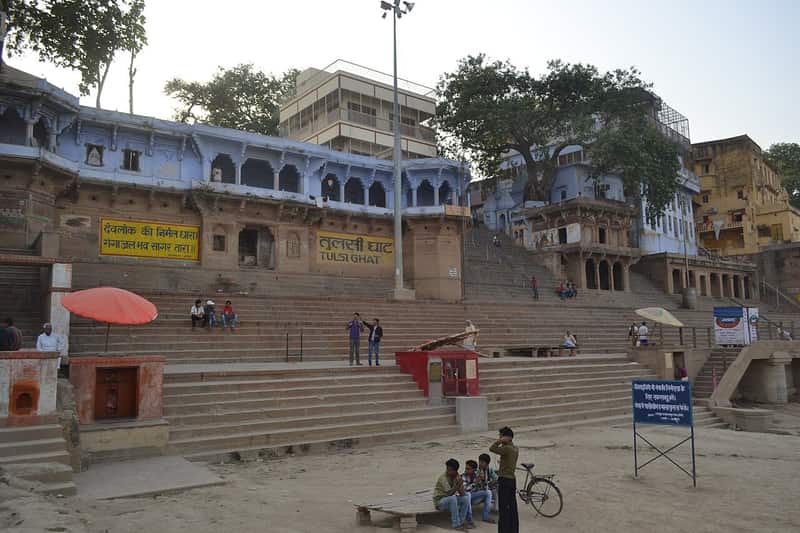
Tulsi Ghat stands near the southern end of Varanasi's old city, a broad and gentle staircase descending from the quiet lanes of Shivala toward the Ganga. Unlike the clamorous burning ghats farther north or the packed tourist steps of Dashashwamedh, Tulsi Ghat keeps a dignified calm that has survived for four centuries. Its long, wide steps are built to accommodate the slow rhythms of morning bath and evening prayer, and the stone is worn smooth by the feet of countless pilgrims. The ghat takes its name from Goswami Tulsidas, the great poet-saint of the sixteenth century, who is believed to have lived and prayed here while composing his masterpiece. For Hindus across northern India this alone makes the place sacred, for Tulsidas gave the common people the Ramayana in their own language, turning scripture into song that any villager could carry in the heart.
The ghat is modest in appearance yet rich in memory. There is no towering temple, no vast pavilion, nothing that announces its importance to the passing traveller. Instead there are plain stone steps, an old well, a scatter of small shrines and the serene presence of the river itself. The sense of the past hangs over the place like the morning mist on the water. Pilgrims come here in surprising numbers to bathe, to meditate, and to touch the water that once touched the feet of the great saint. Boatmen pass by with knowing smiles, pointing out the ghat to visitors; local pandits read their texts in the morning light; and the whole atmosphere speaks of a quieter, older Varanasi, one that has not changed its ways in generations. It is the kind of place that rewards patience and punishes hurry.
Because Tulsi Ghat lies at the southern edge of the old city, it is often the final station on a walk south from the busier ghats, and the last glimpse of sacred Kashi before the open river bends away. Many travellers find that the calm here is exactly what they had been seeking — a place where the Ganga is close, the crowds are thin, and the spiritual weight of the city can be felt without distraction. Whether one comes for devotion, for history or simply for the beauty of the river, Tulsi Ghat rewards the visitor with a rare stillness. It is, in every sense, a ghat of remembrance: the memory of a saint, of a poem that changed a language, and of the eternal river that heard it all and still carries its blessings toward the sea.
Goswami Tulsidas — The Saint of the Ghat
Tulsidas was born in 1532, most likely at Rajapur in present-day Uttar Pradesh, in a year that tradition links to the constellation under which the sage Valmiki was born. His early life was marked by hardship and loss; legends tell that he was abandoned as an infant and raised by a wandering woman, and that he left home as a young man in search of knowledge and truth. He studied the Vedas and the Sanskrit scriptures, mastered grammar and astrology, and took initiation from his guru in the tradition of Ram devotion. In time he settled in the region of Kashi, and it is here, beside the Ganga on the ghat that now bears his name, that he is said to have spent his most productive years, immersed in prayer, fasting and the composition of poetry that would make him immortal.
The tradition of Varanasi holds that Tulsidas lived in a small hermitage near this ghat, and that Hanuman himself watched over the saint. One of the most famous legends tells how Tulsidas, seeing a Brahmin carrying a corpse and being taunted by the ghosts of the dead man, was told of a deeper truth — that the body is but a vessel. Another recounts how, when the saint was once troubled by thieves in the night, a band of apes drove them away, and how a boy with a small stick guarded his hut; the boy was Hanuman in disguise, come to protect his devotee. Because of these stories the ghat was named Tulsi Ghat, and the neighbourhood around it came to be filled with temples to Hanuman, the faithful servant of Ram.
Tulsidas remained in the region of Kashi for decades, and his later years were spent in the deep absorption that produced the works which would outlive every monument of the age. He wrote of his own struggles, of the vision of Ram that transformed him, and of the longing for the divine that fills his poetry with both tenderness and power. He is said to have left his body in 1623, on the banks of the Ganga, surrounded by disciples who had come from across northern India to be near him. For the visitor to Tulsi Ghat, the saint is not merely a name from a textbook. Standing on the steps where he stood, watching the same river he watched, it is easy to feel the presence of the man who turned devotion into the greatest poetry of northern India.
The Ramcharitmanas — A Poem for a Whole People
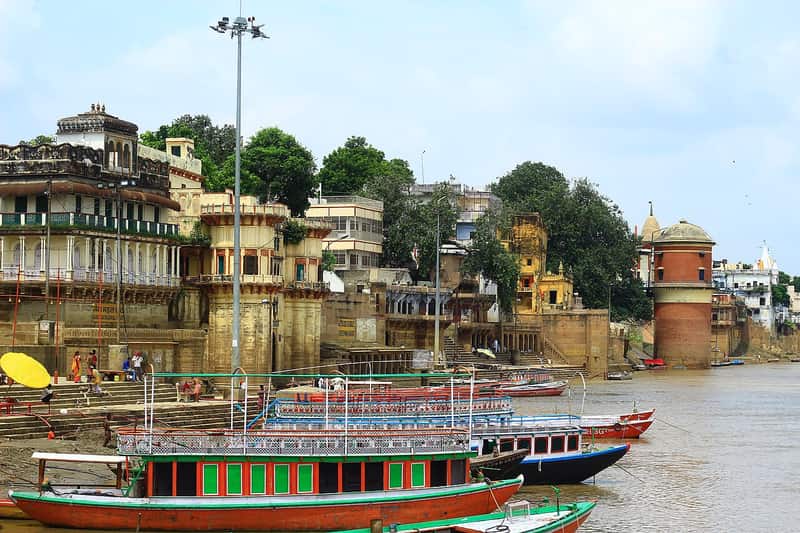
The Ramcharitmanas, the Awadhi retelling of the Ramayana that Tulsidas composed in the sixteenth century, is among the most beloved books ever written in any language of India. It tells the story of Ram, the prince of Ayodhya, his exile, the abduction of his wife Sita, his alliance with Hanuman and the armies of the forest, and his triumphant return as king. But the Manas, as it is affectionately called, is far more than a story. Written in simple, musical Awadhi rather than classical Sanskrit, it placed the epic within the reach of every villager, woman and child who could not read the learned scriptures. It is recited, sung and enacted across northern India to this day, and its verses are known by heart in countless households, passed from grandmother to grandchild like a family treasure.
The tradition of Kashi declares that much of this poem was composed on the banks of the Ganga at the very ghat that bears the poet's name. It is said that Tulsidas wrote in a state of inspiration, and that the river herself blessed his words. One legend recounts that when thieves once robbed the saint's hut, he fled to the ghat and passed a night in prayer; a vision of Hanuman reassured him, and the very next morning the stolen goods were returned by unseen hands. Another story tells that a great scholar of Varanasi who doubted the worth of a poem in a rustic tongue had his pride humbled when he heard the Manas recited and wept at its beauty. The ghat therefore became a place where devotion and literature met, and where the divine word was given to the common tongue.
The Manas has had an influence that is difficult to exaggerate. It gave the Hindi-speaking world its greatest literary monument and its most accessible scripture, blending theology with poetry in a way that ordinary people could carry in their hearts. It shaped festivals, theatre, song and moral life across the Gangetic plain, and its couplets are quoted in courts, kitchens and classrooms alike. Scholars continue to study its art; pilgrims continue to chant it; and somewhere on the steps of Tulsi Ghat, the visitor can still imagine the poet pausing over a line, watching the river, and writing the words that would outlast every empire of his age. To stand here is to stand at the birthplace of one of the world's great books, in the very air that once held its verses.
A History Written in Stone
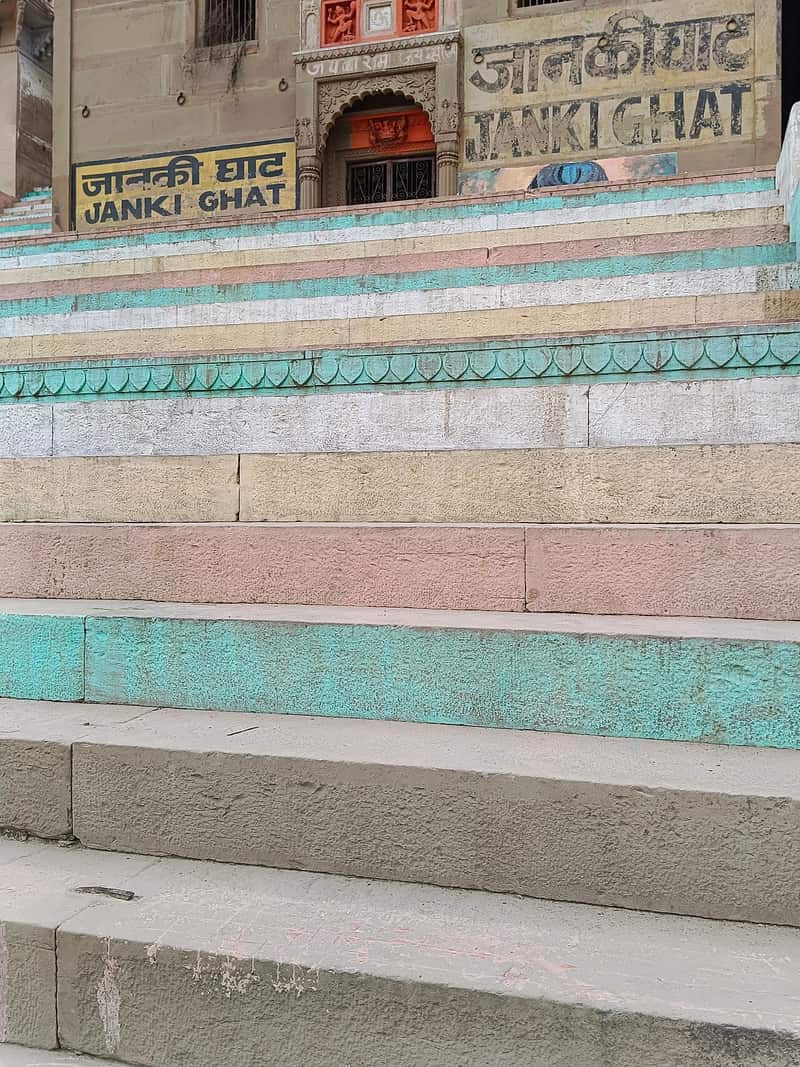
The ghat came to be called Tulsi Ghat in honour of the saint who made it famous, but its story as a place of worship is far older. In earlier centuries the site was simply part of the long southern stretch of bathing steps, and its sanctity was taken for granted by the people of the neighbourhood. By the time of the poet's residence in the sixteenth century, Kashi was already an ancient city, and the riverbank below the Shivala quarter had been used for pilgrimage and cremation for more than a thousand years. The ghat's documented history as a named place, however, begins with Tulsidas himself, whose presence drew pilgrims and students to the spot and gave the simple stone steps a significance they had never had before.
In the centuries that followed, the ghat was repaired and improved on several occasions. The original earth and brick steps were rebuilt in dressed stone, and the riverside was strengthened against the annual rise of the Ganga. During the eighteenth century, when many of Varanasi's ghats were being rebuilt under the patronage of Maratha rulers and the kings of Kashi, Tulsi Ghat too received its share of restoration, and the pavilions and facades that frame the stairs today date largely from that period. In the modern era, under the programmes of the Varanasi Development Authority and the state government, the ghat was cleaned, repaved and given proper lighting and approach ramps, ensuring that the ancient stonework remains safe and dignified for the pilgrims who continue to use it day after day.
Among the heritage features preserved at the ghat are an old well, traditionally said to have served the saint and his disciples, and a series of markers that announce the ghat's identity to arriving boatmen and pilgrims. These modest inscriptions and shrines are the quiet record of a place that has never needed a grand monument, because its own history is monument enough. Walking the length of the ghat, one notices the layers: medieval brick beneath later stone, inscriptions in faded scripts, small temples added generation by generation. Each layer testifies to the enduring devotion of a neighbourhood that has kept faith with its saint for four hundred years, and to the patient labour of the many hands that built the broad, calm staircase the visitor sees today.
Palaces and Pavilions — The Built Heritage
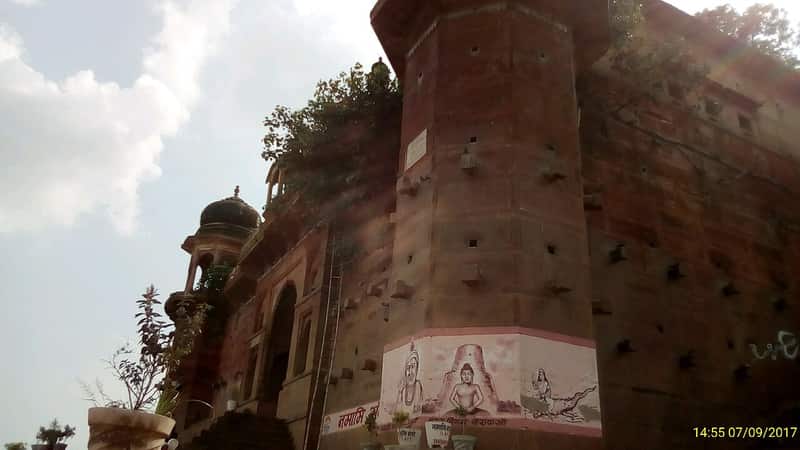
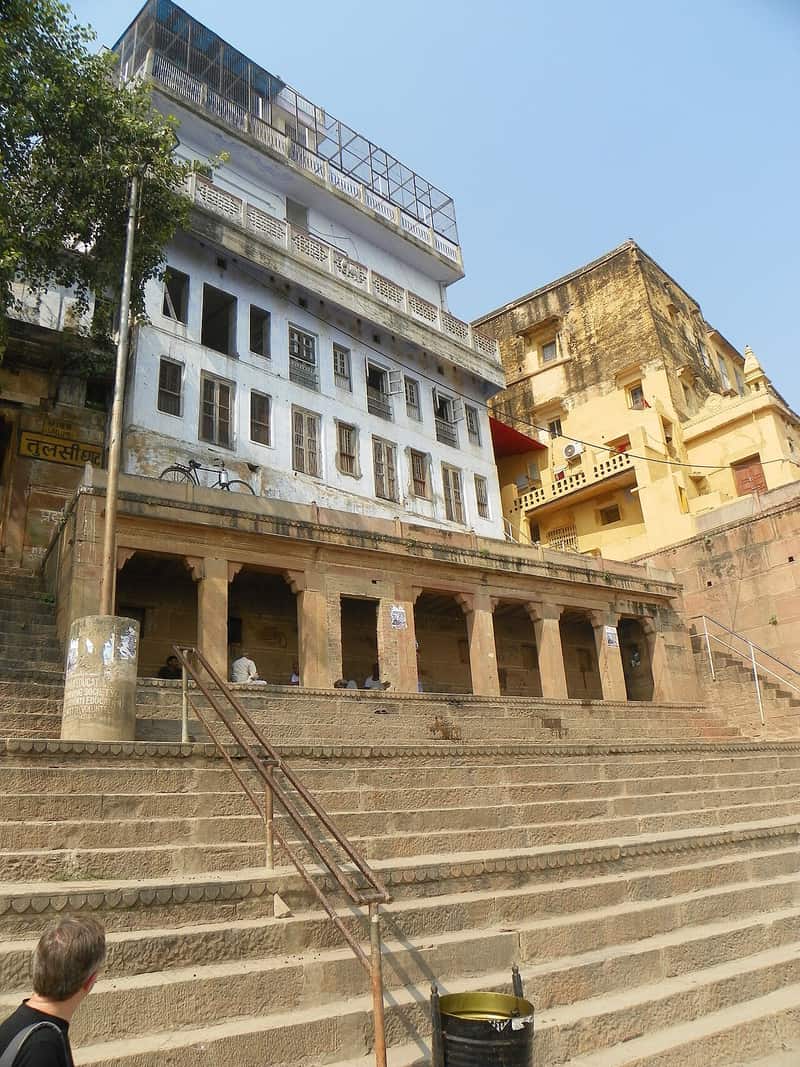
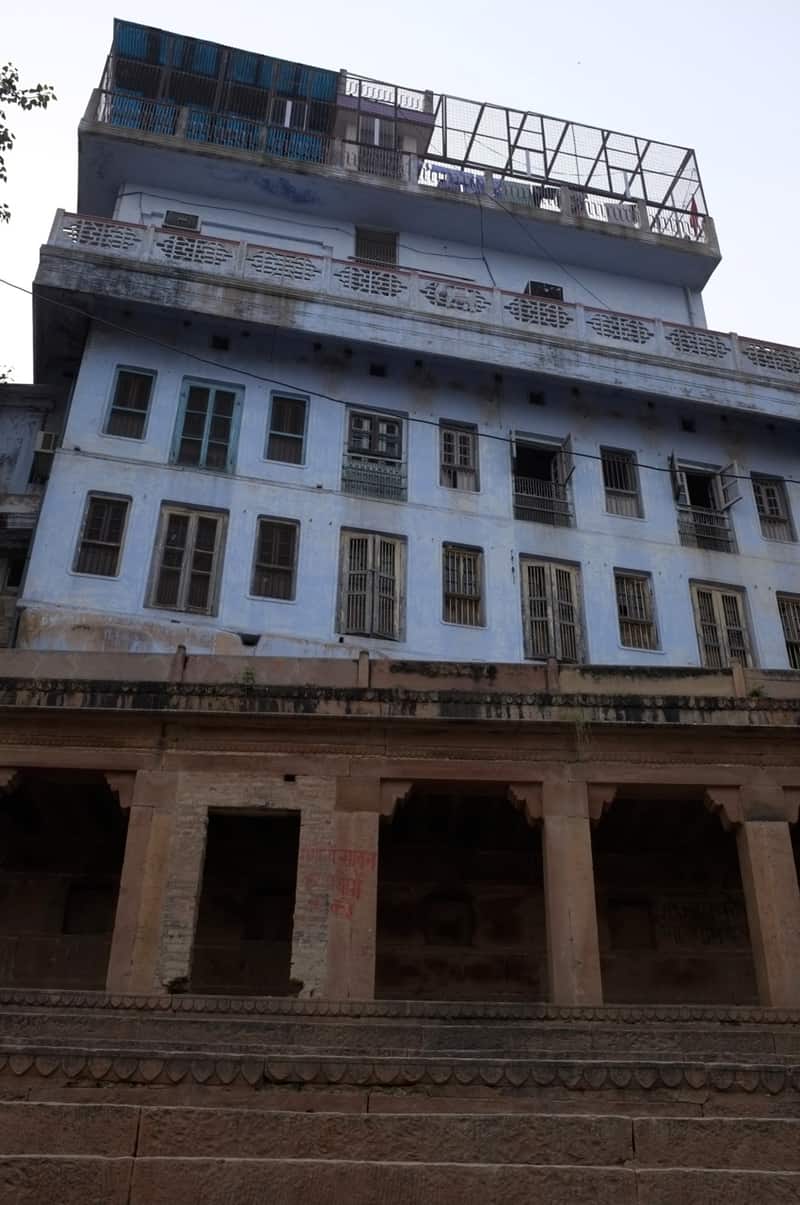
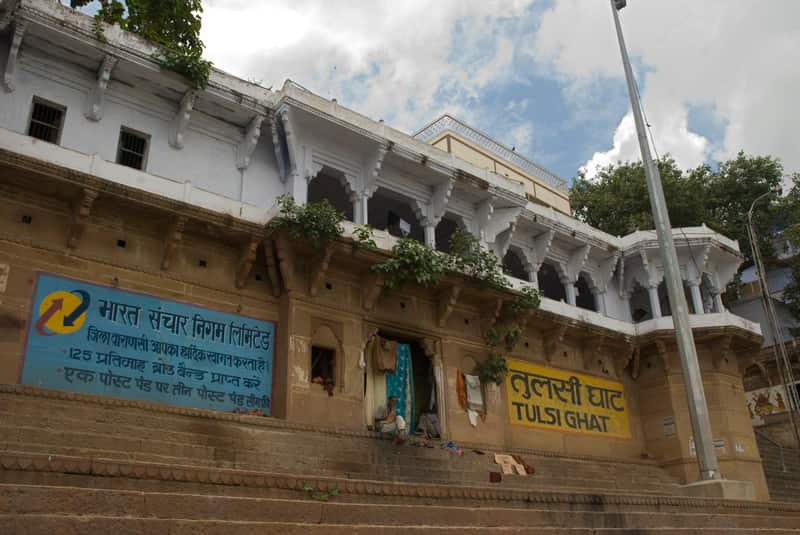
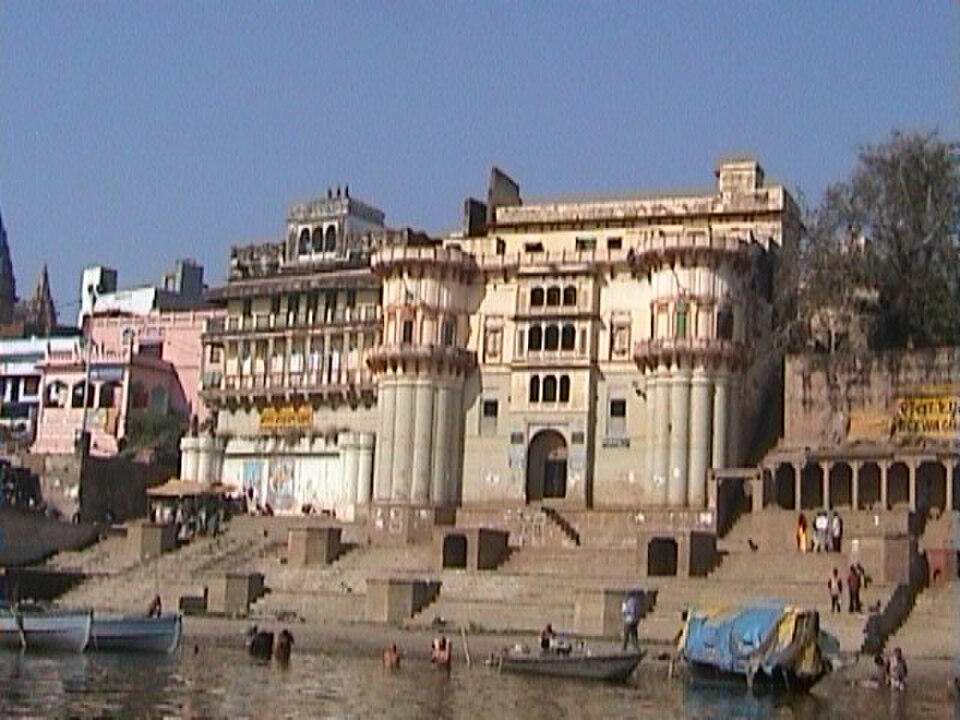
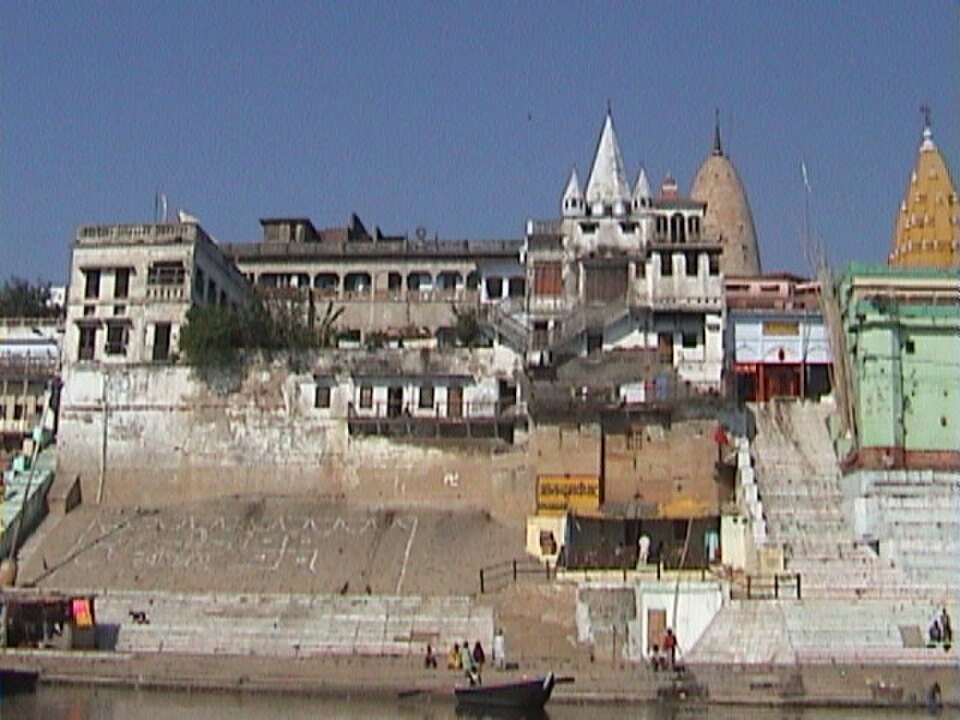
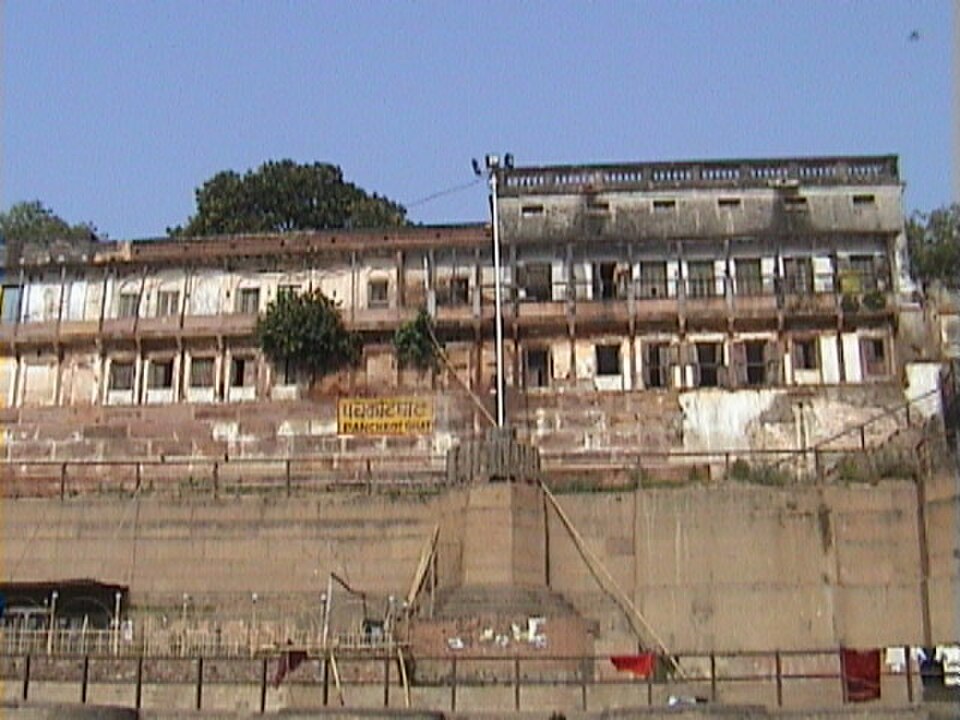
Behind the calm of the steps, Tulsi Ghat has a built heritage that repays a careful look. Rows of old stone buildings rise from the water's edge, their weathered facades bearing the ornament of a past age. Some of these structures follow the style of the Ganga Mahal — the grand river palaces of Kashi, whose balconied fronts and carved brackets were designed to be seen as much from the river as from the lane. Though smaller than the great palaces of the northern ghats, the houses above Tulsi Ghat share the same family of architecture, with courtyards, arched windows and temples tucked into their ground floors. Walking the narrow lanes behind the ghat, one passes walls of ochre and terracotta that have stood through the rise and fall of empires.
Much of this built form dates from the eighteenth century, when the patronage of Maratha rulers, the Mysore king and the Maharajas of Kashi transformed the southern ghats. Restoration campaigns over the years have cleaned and strengthened these structures, and the heritage markers erected by the authorities identify the principal buildings for the visitor. The most imposing presence is the group of facades that rise above the central steps — three- and four-storeyed blocks whose pillared balconies look out over the river with the quiet confidence of old Banaras aristocracy. These were homes of prosperous merchant and priestly families, and some still serve their descendants today, their ground floors open to the gods, their upper rooms looking out upon the holy water as generations of residents before them have done.
The heritage of the ghat is not confined to palaces. It includes the small shrine to Hanuman at the top of the steps, the old well in the courtyard behind, and the stone platform at the water's edge where the morning aarti is performed. It includes, too, the intangible inheritance: the hereditary priests who trace their service to the ghat across centuries, the boatmen whose families have plied the river since before memory, and the reciters of the Manas who gather in the evenings to chant the verses of the saint. A heritage listing can mark a wall or a well, but the living heritage of Tulsi Ghat is the community itself, which continues the very practices that Tulsidas would have known, in the very buildings that sheltered his generation.
The Calm of the Ghat
The first thing a visitor notices at Tulsi Ghat is the quiet. The southern ghats of Varanasi are gentler than the northern ones, and Tulsi is among the calmest of them all. The steps are wide and easy, made for sitting as much as for descending, and people do sit — for hours — watching the water, reading, praying or simply being still. There are no touts here demanding money, no crowds pushing toward a fire, no loudspeakers except at festival time. The morning aarti is performed modestly by local pandits, its lamps and bells pitched to a human scale. The atmosphere is that of an old river town at its best: patient, unhurried and deeply peaceful, a quality that has drawn poets and pilgrims here for centuries.
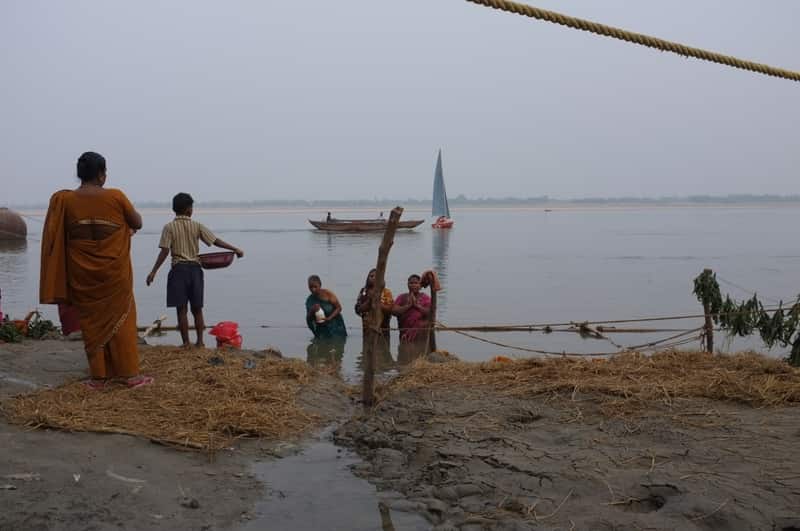
This calm is not emptiness. The ghat is used every day by the people of Shivala and the lanes beyond: women rinsing pots, pilgrims bathing and pouring their offerings into the river, priests reciting Sanskrit by the water's edge, children playing on the lower steps when the river is low. Bathers move through their ablutions with a practiced serenity, and the whole scene has the rhythm of a place that has performed these same acts for centuries. What strikes the visitor is how ordinary and how sacred the place feels at once. There is no theatrical display of piety; faith here is woven into daily life as naturally as the river flows past the stone, and that unforced quality is precisely what makes the ghat so moving.
Late afternoon is perhaps the best time to feel the ghat's temperament. The sun slants across the water, the boats return from their trips, and the light turns the old facades to honey. Pandits gather for the evening recitation, and the smell of incense and marigold drifts down the steps. It is easy to understand, at such a moment, why Tulsidas chose to live here, and why the poets and painters of modern Varanasi love this ghat above all others. Tulsi Ghat offers what the traveller to Kashi most secretly hopes for: a place where the sacred is not a spectacle but a presence — close, familiar and calm, like a hand laid gently on the shoulder in the middle of a noisy world.
The River Before the Ghat
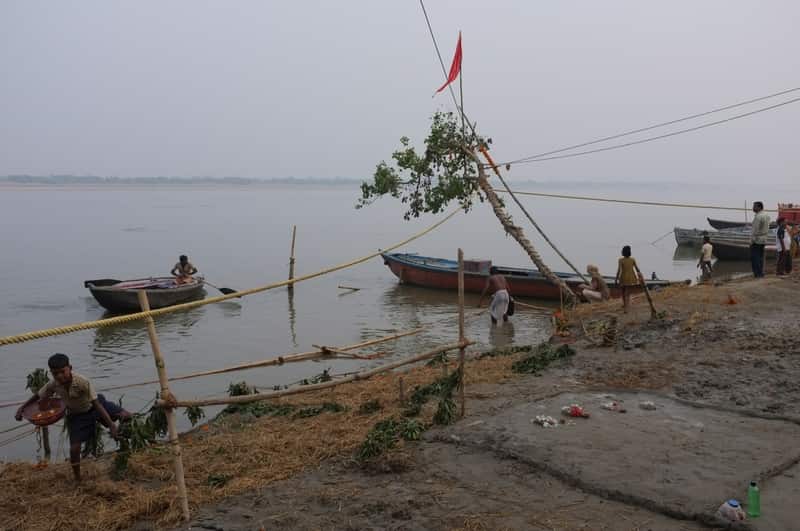
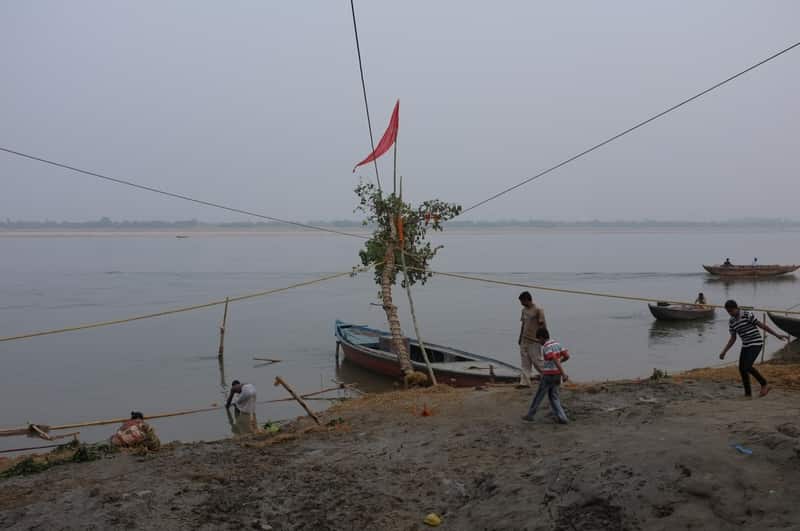
The river in front of Tulsi Ghat changes face with the seasons, and no two visits are quite alike. In winter, when the Ganga withdraws from its monsoon flood, great banks of pale sand emerge from the falling water, spreading flat and clean before the steps. These sandbanks become a playground for pilgrims and a highway for walkers, who cross them to bathe in the deeper channel beyond; dogs and cows wander there, and the smoke of small cooking fires rises in the clear air. Children race across the sand, and the whole foreground of the ghat is transformed from water to land — a strange, beautiful reversal that only the winter months can bring. The horizon seems to widen, and the far bank of the river draws visibly nearer.
In the summer the river is at its lowest, reduced to a modest stream far out on the sand, and the ghat looks out over a wide, pale expanse that seems more desert than river. Boats sit on the dry beds, propped on their sides, waiting for the rains. Yet the pilgrims still come, walking the long way across the sand to reach the sacred water, and the morning aarti is held at the water's edge wherever that edge may be. The changing shoreline is a living calendar, marking the season as surely as the flowering of the trees on the bank, and the people of the ghat read the river as they would a familiar text. It is a relationship of give and take, the river and the city settling into their old and patient bargain.
Looking across the water from Tulsi Ghat, the visitor sees the wooded far bank of the Ganga and, rising above the trees on the opposite shore, the long silhouette of Ramnagar Fort, the seventeenth-century palace of the Maharajas of Kashi. In the evening its walls turn gold in the setting sun, and in the winter mist it floats like a castle from a story. Ferries and small boats ply the channel, carrying passengers between the ghat and the fort's landing, and occasionally a wedding procession glides past with music and lights. The river before Tulsi Ghat is wide, slow and companionable — the same river the saint knew, still carrying its burden of worship toward the sea, unchanged in its faithfulness and in its beauty.
Sankat Mochan — The Temple of the Troublesolver
Not far from Tulsi Ghat, in the heart of the old southern quarter, stands the Sankat Mochan Hanuman temple, one of the most loved temples of Varanasi. Its name means the reliever of troubles, and the great monkey-god enshrined there is worshipped across the city as the remover of obstacles and the protector of the anxious. Tradition holds that the temple was founded by Tulsidas himself, who is said to have established it at a spot where Hanuman appeared to him in a dream and blessed his mission of composing the Ramcharitmanas. From its founding the temple has been a living link between the poet-saint and the neighbourhood he made sacred, and the crowds that throng it bear witness to his continuing hold on the city's heart.
The life of the temple revolves around the congregation of Tuesday and Saturday, the days sacred to Hanuman. On those days the long processions begin, with devotees carrying the image or simply walking in crowds to the temple, chanting the Hanuman Chalisa — a hymn traditionally attributed to Tulsidas — and raising clouds of vermilion-tinted dust as they approach. Within the temple, offerings of yellow flowers, sweets and sindoor are made to the great idol, whose face is often blackened with generations of devotional contact. The atmosphere is one of joy rather than solemnity, for Hanuman is the god of strength, courage and loyal love, and the temple of Sankat Mochan celebrates those virtues with song and dance and endless bells. Priests move through the crowd distributing the prasad that every devotee carries home as a small treasure.
The saint's legacy lives on all around. The temple maintains a deep connection with classical music, hosting the famous Sankat Mochan Sangeet Samaroh, a festival of North Indian music held every spring, where the finest vocalists and instrumentalists of the country perform to packed audiences under the trees. The monkeys of the temple, from which the surrounding neighbourhood takes its character, are fed by devotees as an act of merit, and the whole quarter hums with the presence of Hanuman — in doorways, on walls, in the names of shops. For the visitor, a walk from Tulsi Ghat to Sankat Mochan is a pilgrimage in miniature, tracing the footsteps of the saint through the living faith he left behind, and it belongs on any itinerary that takes in the ghat itself.
The Lanes Behind the Ghat
Behind Tulsi Ghat lies a network of narrow lanes that has changed little in centuries. The streets climb gently away from the river, past old houses with carved wooden doors, past shrines tucked into walls, past courtyards where the smell of cooking mingles with the smoke of evening lamps. Hanuman imagery is everywhere — painted on walls, printed on signs, carved in stone — a reminder that this is the neighbourhood of the saint who gave the monkey-god his greatest hymns. Many of the houses date from the eighteenth and nineteenth centuries, their balconies leaning over the lanes so closely that neighbours could almost shake hands across the street. The lanes are cool even in the fiercest summer, and their shade is one of their quiet gifts.
The saintly associations of the quarter run deep. Besides the great temple of Sankat Mochan, the lanes are dotted with smaller shrines and maths, the hermitages and monasteries where ascetics and priests have long been housed. Names carved on lintels and read in the daily prattle of shopkeepers recall families who have served these temples for generations. It is a residential quarter first and foremost — a place of schools and small businesses, of milkmen and flower sellers — and its piety is the quiet, unshowy piety of people for whom the ghat is simply the backyard, the place where the washing is done and the evening prayers are said. Life here is conducted at a human pace, and it is easy to spend an entire afternoon without hearing a single horn.
For the traveller, the lanes offer an antidote to the busy riverfront. Here one can walk without being accosted, browse the small shops, watch a game of carrom in a tea stall, or simply absorb the texture of daily life in old Varanasi. The quiet residential character of the quarter means that visitors are a curiosity rather than a target, and most receive the gentle courtesy that Banaras reserves for its guests. Wandering these lanes, one begins to understand that Tulsi Ghat is not an isolated monument but the front door of a whole living district — a district whose faith, labour and memory are all bound to the river and to the saint who once walked these very streets. Give the lanes an hour and they will give back a lifetime of impressions.
Neighbours on the River
Tulsi Ghat sits in a close-knit family of ghats, and the short walk between them is one of the most rewarding along the river. To the south, within a few minutes, lies Assi Ghat, the southernmost and most cosmopolitan of the bathing places, where the Assi rivulet meets the Ganga and where students, artists and long-stay travellers gather at dawn for the famous sunrise aarti. To the north, barely a stone's throw away, stands Kedar Ghat, one of the oldest and most atmospheric of the ghats, its small temples and shrines clustered along a narrow and ancient stretch of steps that feels almost medieval. Between the two, Tulsi holds its own quiet middle ground, and the walk that links them passes a string of smaller ghats, shrines and boat landings.
The walk south from Tulsi to Assi takes barely ten unhurried minutes. The path follows the river past a handful of smaller ghats and bathing platforms, where fishermen mend their nets and dhobis beat clothes against the stones. As the buildings thin out, the trees close in, and the open spaces around Assi come into view — the pipal trees, the temple complex, the broad stone apron where hundreds gather each morning. The walk north to Kedar is shorter still and more atmospheric, squeezing between ancient walls and past shrines that seem to grow from the very rock. Between them, these two short walks frame Tulsi Ghat as the calm centre of a rich and varied riverscape, and each direction offers a different flavour of the city.
For the pilgrim and the curious traveller alike, these three ghats combine naturally into a single walk — the Assi–Kedar–Tulsi trail. Begin at Assi in the morning light, watch the aarti, then drift north along the water's edge, bathing or pausing at the smaller ghats as the mood takes you. Kedar rewards the attentive with its ancient charm and its links to the god Shiva, and Tulsi brings the walk to its quiet close, its long steps offering rest and its hermitage memories a final blessing. The whole circuit takes a gentle morning, and it is the best possible introduction to the character of the southern ghats — varied, sacred, human-scaled and profoundly unhurried. The three ghats are best seen together, and together they tell the story of Kashi at its most intimate.
Conduct at a Sacred Ghat
Tulsi Ghat is a working place of worship, not a museum, and the courtesy a visitor shows is repaid tenfold in welcome. Dress modestly — shoulders and knees covered — whether or not you plan to bathe, for the ghat is used by pilgrims who have come from great distances for a sacred act. Remove shoes before entering the shrines and before sitting near the priests during prayer. Photography of the general scene is usually welcome, but ask before photographing individuals, especially women and sadhus, and never aim a lens at someone in the middle of an intimate rite. The rule of thumb is simple: treat the ghat as you would treat a place where your own grandmother worships, and you cannot go far wrong.
The morning aarti, held quietly at dawn, deserves special respect. Arrive early, sit quietly, and do not speak over the chanting. If you wish to participate, you may, but follow the lead of the pandits and the regular worshippers rather than improvising. During prayer, mobile phones should be silent and out of sight; the soft ring of a phone is jarring in a space where voices are raised only in devotion. Should you see pilgrims performing a ritual — a birth blessing, a shraddha for the departed, a fast being observed — give them room and time. The ghat belongs to them first, and the visitor is always the guest. Watching respectfully is welcome; crowding and commenting are not.
Two further points of conduct matter at Tulsi Ghat. The first concerns the river: treat the Ganga with reverence, do not throw litter or plastic into the water, and if you bathe, keep your ablutions in the flow of tradition — modest, unhurried and mindful of those around you. The second concerns the offerings you may see at the water's edge: do not disturb or remove flowers, lamps or food set out by worshippers, and do not step on the small altars made in the sand. These little gestures of respect cost nothing and mean everything in a place whose whole character is built upon the memory of a saint. To leave Tulsi Ghat having been kind is to leave it blessed, and to leave it as its own gentle traditions would wish.

Planning Your Visit
Tulsi Ghat is easy to reach and free to enter, as are all the ghats of Varanasi. The simplest approach is on foot: walk south from Dashashwamedh Ghat along the riverfront, a gentle forty-minute stroll that passes many of the city's most famous ghats, or take a shorter walk from the Shivala quarter, whose lanes open onto the ghat from the land side. A boat is the most atmospheric arrival — from the river, the ghat rises slowly out of the haze with its palatial facades and long steps, and many visitors choose to begin or end a morning boat ride here. Cycle-rickshaws and e-rickshaws reach the top of the ghat from the main road, though the last stretch is always on foot.
The best time to visit is early morning, before the sun is high. The light is soft, the river is at its most beautiful, the air carries the sound of bells and Sanskrit, and the ghat is at its most authentic — pilgrims bathing, priests praying, boats setting out. Winter mornings can be misty and cool, summer mornings bright and warm; either way, arrive by six for the full effect. Late afternoon is the second-best moment, when the light mellows and the evening prayers begin. Avoid the middle of the day in summer, when the stone steps radiate heat and the riverfront is at its quietest. Festivals such as Hanuman Jayanti and the spring recitations of the Ramcharitmanas bring crowds but also the most moving atmosphere of the whole year.
Because the ghat is small, combine it naturally with its neighbours. The Assi–Kedar–Tulsi trail described above makes a perfect morning: begin at Assi for the sunrise, walk north through the smaller ghats, pause at Kedar for its ancient shrines, and finish at Tulsi for rest and reflection. Several city walks and heritage tours include all three, and guides can be hired at Dashashwamedh or Assi. For those staying in the south of the city, near BHU or Assi, Tulsi Ghat is barely a ten-minute walk away; for those in the north, the boat ride or the riverside stroll is part of the pleasure. Allow an hour or two, carry water, keep your shoes in hand for the shrines, and let the calm of the ghat set the pace of your whole day.
Tulsi Ghat — Gallery (12 Photos)
Image Credits
tulsi-01.jpg · tulsi-02.jpg · tulsi-03.jpg · tulsi-04.jpg · tulsi-05.jpg · tulsi-06.jpg · tulsi-07.jpg · tulsi-08.jpg · tulsi-09.jpg · tulsi-10.jpg · tulsi-11.jpg · tulsi-12.jpg — Wikimedia Commons, under free licenses.
Continue exploring
Similar Ghats Nearby
Book This Ghat — Get Notified
Download the app now and book a boat ride to Tulsi Ghat