

Mansarovar Ghat
Neighbourhood GhatMansarovar Ghat is a small ordinary ghat.


Type
Neighbourhood Ghat
Boat Fare
1x base fare
Best Time
5-9 AM
History
This ghat carries the memory of Kailash Mansarovar. For Shiva devotees, the very name Mansarovar is a symbol of penance and purity.
Highlights
- Memory of Kailash Mansarovar
- Faith of Shiva devotees
- Peaceful bathing site
Festivals & Events
How pricing works in the NaviX app
No haggling at the ghat — everything is fixed in the app first
- 1
Fixed price before you board
The fare is shown in the app upfront — no bargaining at the ghat
- 2
Sharing or private — your choice
Share with fellow travelers or take the whole boat for your group
- 3
Pay only after the ride
UPI, card or cash — with an instant receipt
🕉️
Aarti details not available for this ghat yet
Complete Guide
Mansarovar Ghat — The Complete Guide
History, mythology, rites and practical details — everything in depth.
On this page
- 1.Mansarovar Ghat: An Introduction
- 2.Maharaja Sawai Jai Singh and the Founding of the Ghat
- 3.The Mansarovar Water Tank
- 4.The Himalayan Lake: Name and Symbolism
- 5.Architecture: Steps and Structures
- 6.The Daily Bathing Scene
- 7.Boats and the Boatmen of Mansarovar
- 8.The River and the View
- 9.Lanes and the Mohalla Behind the Ghat
- 10.Nearby Ghats: Narad and Chowki
- 11.Etiquette: How to Visit with Respect
- 12.Practical Guide: Reaching the Ghat, Best Time, Nearby Ghats
📅 Updated: 21 Aug 2026 · Author: NaviX Field Team (field research 2024-26) · 12 sections · 12 photos
Mansarovar Ghat: An Introduction
Mansarovar Ghat rests on the southern stretch of Varanasi's great riverfront, a graceful staircase of stone set between Narad Ghat and Chowki Ghat. Built in the early decades of the twentieth century under the patronage of Maharaja Sawai Jai Singh of Jaipur, it carries the name of the most sacred lake of the Himalayas, Lake Mansarovar, which lies far away at the foot of Mount Kailash in Tibet. Unlike the roaring crowds of Dashashwamedh Ghat upstream, Mansarovar keeps an unhurried elegance: wide stone steps, a broad water tank at its head, and a calm that belongs to an older and quieter Kashi. Pilgrims, bathers and boatmen share the space in an easy daily routine, and the river opens before the ghat like a page of holy water waiting to be read.
The ghat is really two places joined by one staircase. At its top stands the Mansarovar tank, a wide rectangular basin ringed by its own steps, where pilgrims wash and prepare before they descend to the river. At its bottom the Ganga waits, broad and unhurried, catching the first light of the sun. Between the two, the flights of the ghat carry a constant gentle traffic: women with brass pots and marigolds, old men with cotton towels over their shoulders, sadhus in saffron, and children who slip past everyone and leap into the water. Laundry-wallahs beat cloth on the stones, barbers set up their mirrors and stools, and the bells of the small shrines ring without pause through the morning. Everything here moves at the pace of habit rather than haste.
For the traveller, Mansarovar offers the devotional life of Varanasi without spectacle. No great festivals are staged on its steps and no touts crowd its landings; the rituals are performed for their own sake, exactly as they have been for a century and more. The spiritual character of the ghat is quiet but unmistakable. A single morning spent here, watching the sun climb over the far bank while the bathers enter the water one by one, reveals more of the city's soul than a week of hurried sightseeing. The ghat asks nothing of its guests but stillness, and it repays them with the most intimate view of Kashi's oldest habit, the daily meeting of body, water and prayer. It is the perfect introduction to the southern riverfront.
Maharaja Sawai Jai Singh and the Founding of the Ghat
The story of Mansarovar Ghat is bound to one of the most remarkable princes India has produced, Maharaja Sawai Jai Singh of Jaipur. Born in 1688, this scholar-king founded the planned city of Jaipur, built the great stone observatories known as Jantar Mantar in five Indian cities, and devoted his life to mathematics, astronomy and the patronage of sacred places. Varanasi held a special place in his affections; the observatory raised at Man Mandir Ghat, with its monumental instruments gazing at the stars above the Ganga, remains the proudest memory of his reign on the riverfront. The Mansarovar Ghat, raised in the early twentieth century by the house of Jaipur, belongs to that older tradition of royal benefaction which once covered the banks of the Ganga with staircases, tanks and temples.
Ghat building was long considered both a duty and a glory of Indian kings. To raise a flight of stone steps on the river's edge, to open a tank or a shrine for pilgrims, was an act of merit that honored the ancestors and pleased the gods. The rajas of Jaipur maintained a residence and a long presence in Kashi, and they took up this work with particular devotion. Mansarovar Ghat was their gift to the holy city, a landing place for boats, a bathing place for the faithful, and a doorway from the crowded lanes of the old town to the wide freedom of the river. Even today the association with the Jaipur house lends the ghat a certain courtly dignity that its quieter neighbors do not quite share.
The names and deeds of the Jaipur house now survive mostly in old records and in the weathered inscriptions of the riverfront, but the ghat they left behind continues to live with undiminished purpose. Every dawn, when the first bathers descend the steps built by their generosity, the memory of Sawai Jai Singh and his successors is renewed in the only way that matters in Kashi, through use, through devotion, through the daily turning of the city's sacred life. The stone lasts, the river lasts, and the act of giving to the Ganga outlasts every empire. A visitor who knows this history will read the quiet stone steps of Mansarovar with fresh eyes, seeing in them not merely a staircase but the signature of a prince and the gratitude of a city.
The Mansarovar Water Tank
At the head of Mansarovar Ghat, set back a little from the river, lies the water tank that gives the ghat its second identity. The Mansarovar Talaab is a broad rectangular basin lined with stone steps on every side, built to serve the thousands of pilgrims who move along the southern riverfront. Here they wash before prayer, sprinkle their heads with the blessed water, rest in the shade of the trees that frame its edge, and prepare themselves, body and mind, before descending the long stairs to the Ganga. In the monsoon the tank drinks the rain, and in years of high flood the river itself enters it; in the dry months it holds its own still mirror of the sky, ringed by the murmur of the old city.
The life of the tank follows the rhythm of the ghat. At dawn it is surrounded by men and women performing their first ablutions, cupping the water in their hands and letting it fall back with a murmur of mantras. Through the day it serves the neighborhood in a dozen small ways: children splash at its shallow edges, washermen rinse bundles of cloth, and water is drawn in brass pots and plastic buckets for household use. The elderly say that in earlier times a dip in the tank carried nearly the same merit as a dip in the Ganga herself, and many pilgrims still make it their first station, pausing at the water's edge for a single reverent touch before moving on to the river.
The tank has known years of neglect as well as care. The waters of Kashi have faced growing pressure from the crowding city, and the tank's level and purity have depended at every turn on the devotion of the neighborhood and the vigilance of the municipality. Yet the Mansarovar tank endures, dredged, repaired and restored again and again by hands that refuse to let it vanish. For the visitor it is the most distinctive sight of the ghat, a pool of still water that gathers the morning light, the circling pigeons and the quiet prayers of the old city into a single serene square, and that gives the whole ghat its name, its identity and much of its charm.
The Himalayan Lake: Name and Symbolism
No name in the sacred geography of India carries a deeper music than Mansarovar. The lake lies more than four thousand meters above the sea on the Tibetan plateau, at the very foot of Mount Kailash, the eternal abode of Shiva. Hindu scripture teaches that the lake was born from the mind of Brahma, the creator, and so it is called Manasa-sarovar, the lake of the mind. Its water is counted among the purest on earth, capable of washing away the sins of a lifetime, and the pilgrim fortunate enough to bathe there is considered blessed for the rest of his days. To pronounce the name at a ghat of Kashi is to summon that far, freezing, sacred shore into the middle of the warm plains of the Ganga.
To give a Varanasi ghat the name of that Himalayan lake is to place a promise of purity within reach of every devotee. The riverfront of Kashi is a living map of India's sacred geography, repeating the names of mountains, rivers, forests and shrines from the Himalayas to Kanyakumari. The pilgrim who cannot travel to the icy roof of the world may stand on the steps of Mansarovar Ghat, lower himself into the Ganga, and feel that he has touched the same holy water that encircles Kailash. The name is a doorway, the Ganga is the path, and the ghat is the threshold where the two meet. Distance collapses in a single act of faith, and the far lake becomes a near blessing.
The symbolism runs deeper still. Lake Mansarovar is the home of the hamsa, the swan, which in Indian thought stands for the soul that separates the pure from the impure, and its stillness is likened to the mind turned wholly toward the divine. The ghat that carries its name invites the bather not only to wash the body but to quiet the mind, to step out of the hurry of the world into the mirror-still water of contemplation. In this sense Mansarovar Ghat is more than a place on a map; it is an instruction spoken in stone and water, a lesson about the proper approach to the holy. Those who bathe here in silence are said to receive not only the blessing of the Ganga but also the echo of Kailash itself.
Architecture: Steps and Structures
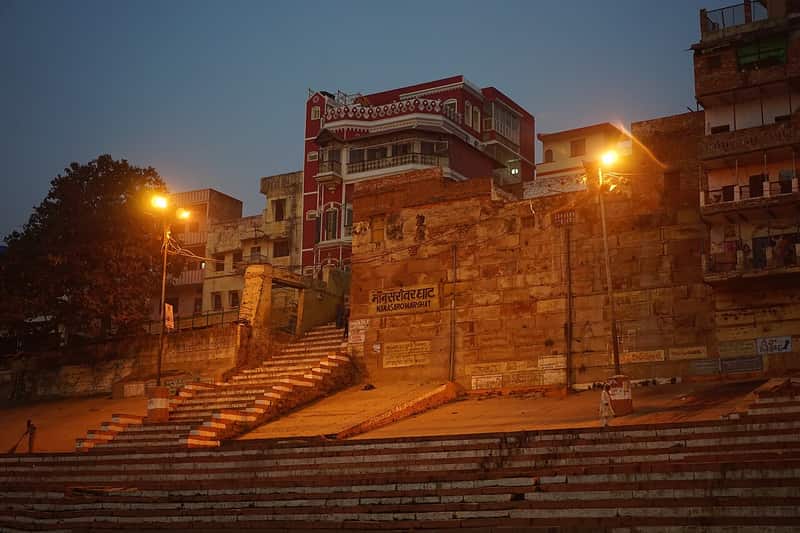
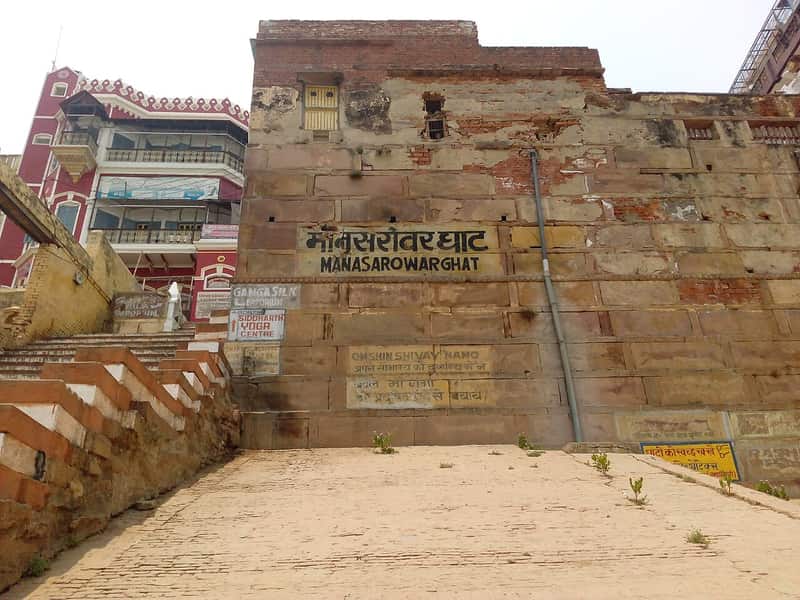
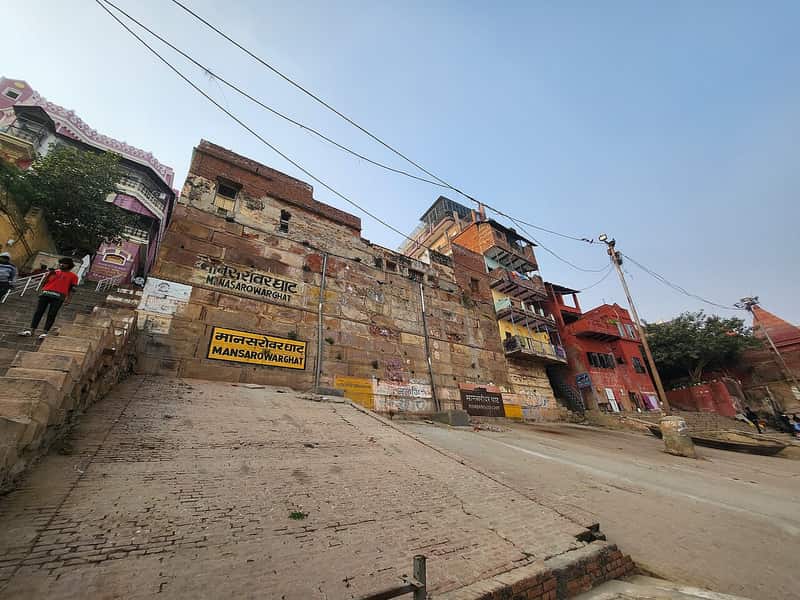
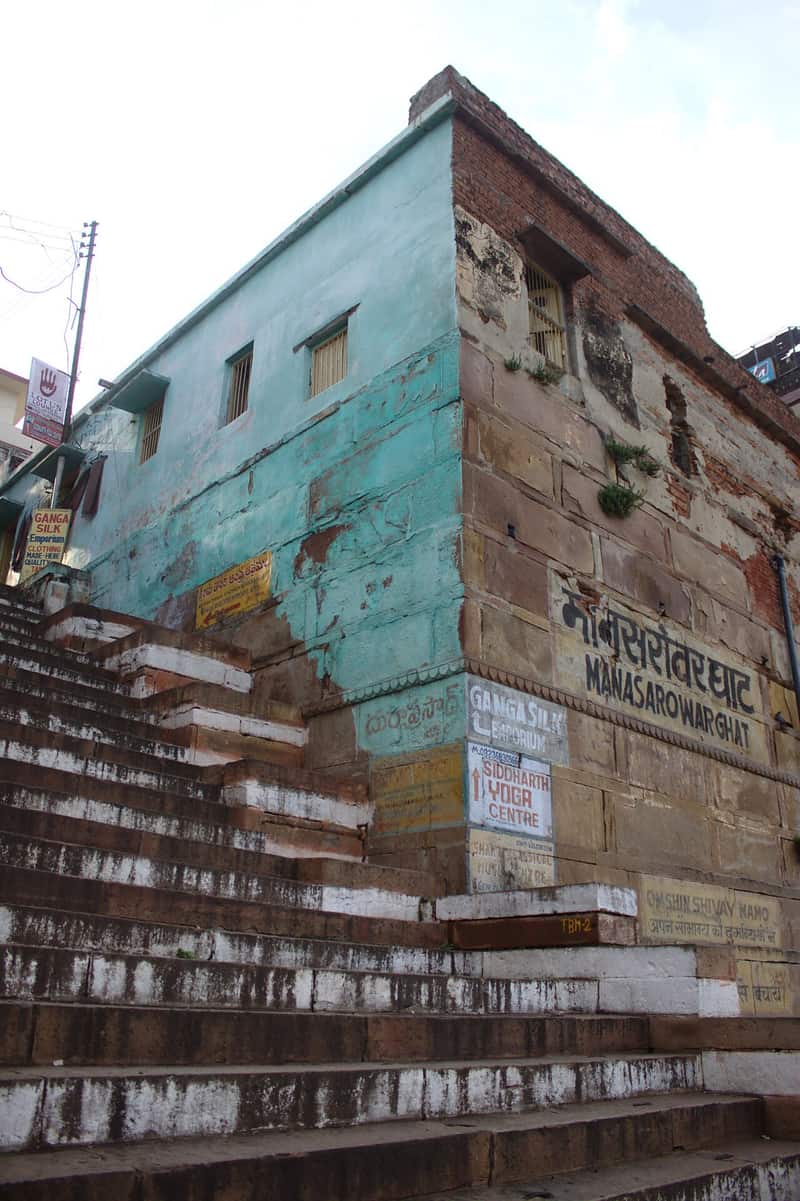
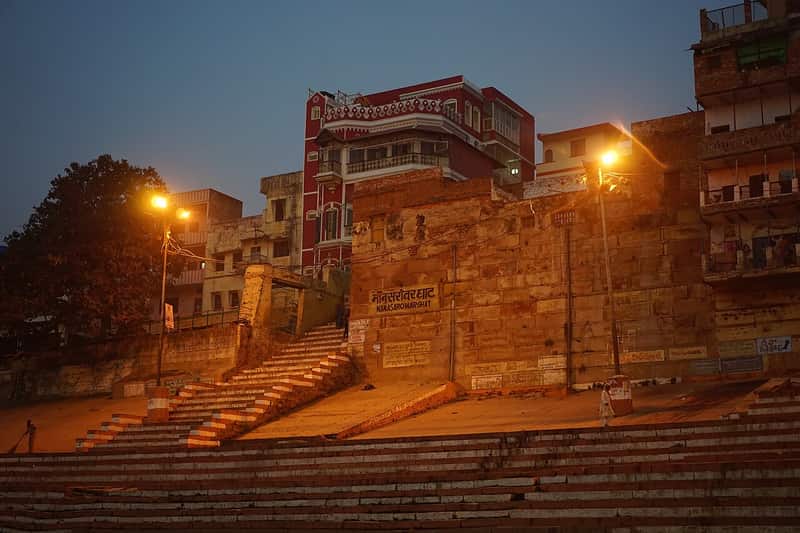
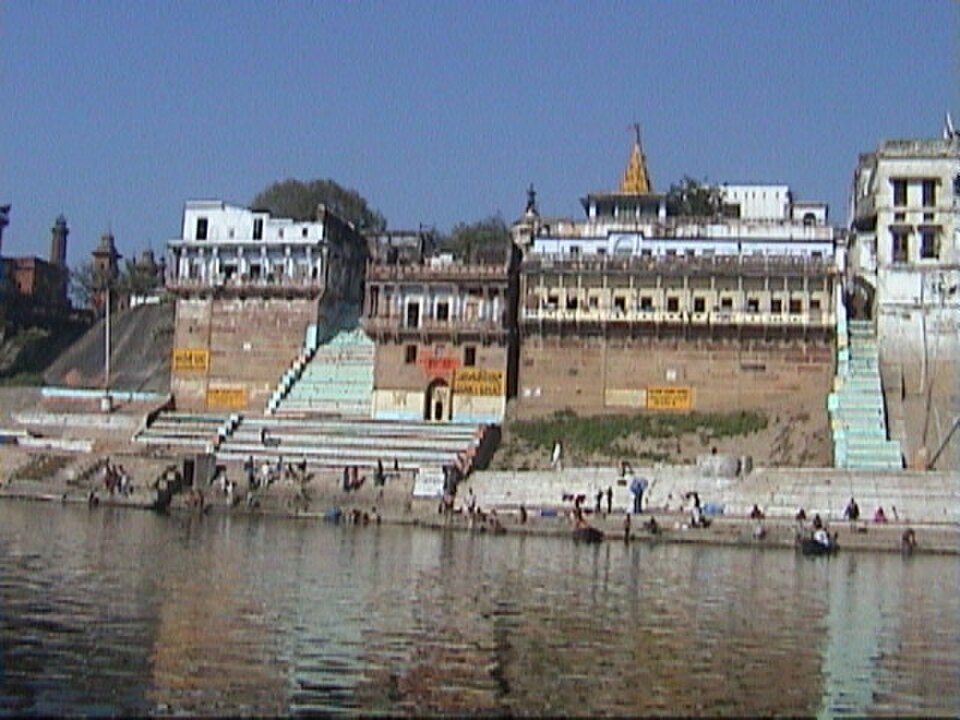
Mansarovar Ghat follows the classical grammar of Varanasi riverfront architecture. Long flights of dressed stone, quarried and cut by generations of masons, descend from the level of the old town to the water in an unbroken cascade, broken at intervals by broad landings that catch the feet and the eye alike. Low parapets run along the upper edges, studded with iron rings and stone bollards where the boats are moored. The steps are wide and gently sloped, comfortable for the slow descent of elderly pilgrims and sure-footed for children who race down to the water. In the older sections the original sandstone blocks still show their chisel marks, darkened by a century of sun, flood and prayer.
At its head the ghat is built like a small fortress of devotion. The Mansarovar tank occupies the center, cased in dressed stone and ringed by its own stairways. Around it stand shrines and small temples with tiled roofs, a veranda or two supported on simple columns, and the deep verandahs of old residential houses whose upper floors look down over the river. Several doorways open into the lanes behind, each framed by carved arches and painted lintels. Tea stalls and flower sellers tuck themselves into the hollows of the walls, and by evening the chai smoke drifts up the steps like a second incense. The whole composition is at once sturdy and delicate, the work of craftsmen who understood that a ghat is a building to be used hard for a thousand years.
The architecture of the ghat is also a lesson in survival. The foundations sink deep below the waterline, so that when the river rises in the monsoon the steps do not move; they simply disappear, one by one, and emerge again in the dry months without complaint. Lime mortar, iron cramps and stone so well fitted that the joints have outlasted the memory of the masons all testify to a building tradition refined over centuries. Seen from the water, at dawn, the ghat reveals its most graceful aspect, a soft curve of steps rising from the river like a staircase of the gods. Conservation work in recent years has cleaned and re-pointed the old stone, ensuring that this quiet masterpiece of riverfront engineering will receive its bathers for generations yet to come.
The Daily Bathing Scene
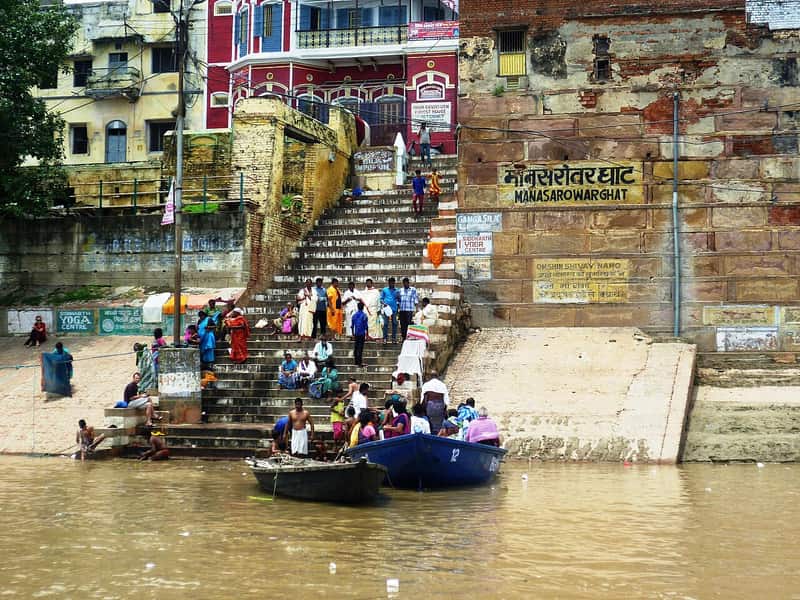
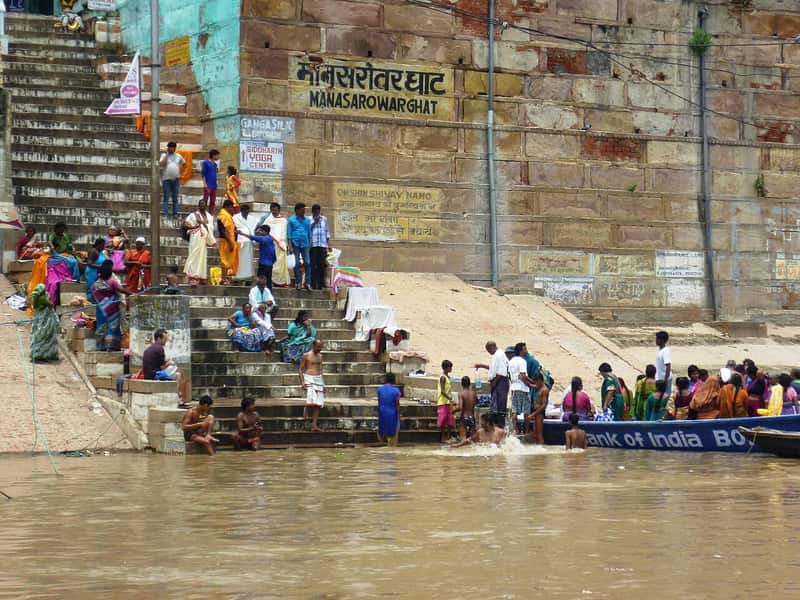
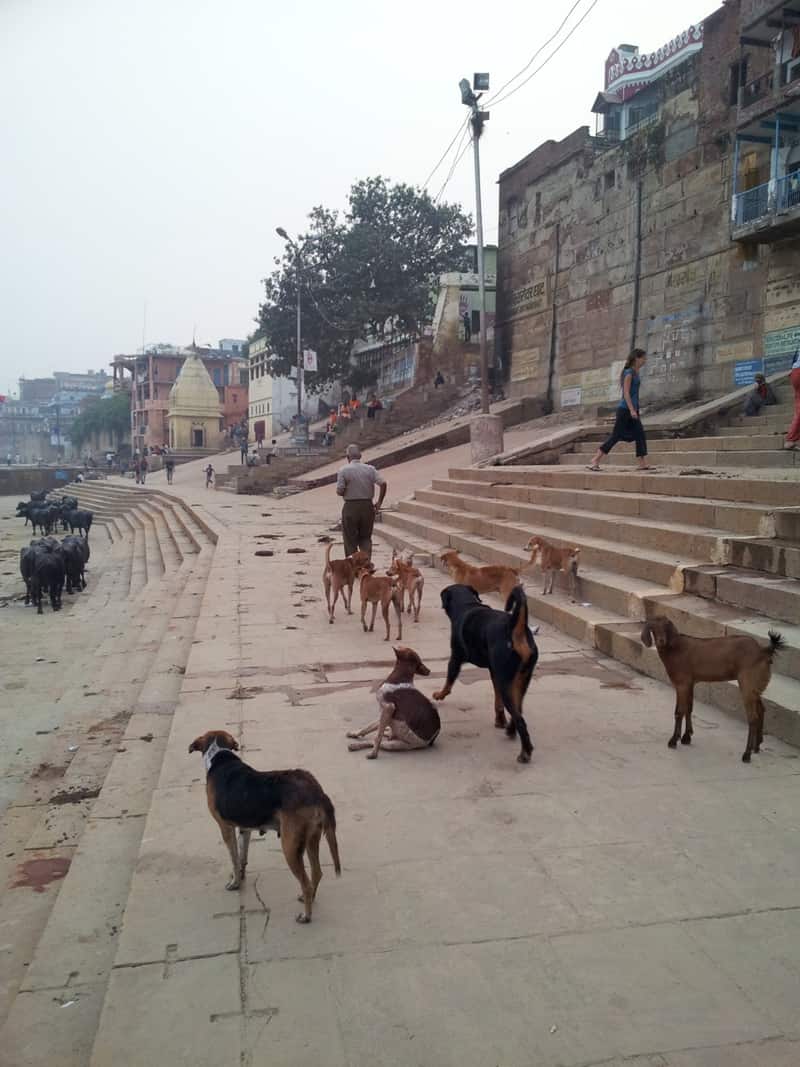
The day at Mansarovar Ghat begins before the sun. In the grey hour of dawn, when the water is still dark and the far bank is only a line of shadow, the first bathers come down the steps carrying their towels, their lotas and their marigolds. Men in dhotis wade out until the water reaches their waists, then dip, rise, and dip again while the mantras rise in the morning air. Women in saris enter with careful modesty, their blouses bright against the dark water, their cupped hands offering the Ganga back to herself. Some turn to the east and pour out a few drops of water to the rising sun; others close their eyes and let the river hold them for a moment of stillness before they wade back, dripping and blessed, up the long steps.
Around the bathers, the ghat performs its supporting ritual. Dhobis beat wet cloth against the stones with a rhythm like a distant drum. Barbers set up stools at the water's edge and work through the morning, their mirrors glinting. Flower vendors sit behind pyramids of marigold and rose, threading garlands for the temples and for the offerings that will be set adrift. Here and there a priest receives a small offering, a coin, a handful of rice, a flower, and murmurs a blessing. Children splash at the shallow edges, mothers scold, old friends exchange the news of the mohalla, and the bells of the shrines keep time above it all. The scene is crowded, orderly and entirely at peace with itself.
What the visitor sees is not spectacle but continuity. This exact scene, the same postures, the same sounds, the same shiver of the first contact with cold water, has been enacted on these steps for a century and more, and in nearly the same form for far longer along the riverfront of Kashi. Bathing here is at once a bodily pleasure, a social habit and an act of worship, and the three are so woven together that no one can say where one ends and the other begins. A traveller who descends to the water and joins the bathers, even for a single cautious dip, is folded into this ancient rhythm without ceremony or fuss, simply accepted, as the river accepts everything that comes to it.
Boats and the Boatmen of Mansarovar
The foot of Mansarovar Ghat is a harbor in miniature. A scatter of wooden boats rides at the moorings, their hulls painted in bands of green, red and blue, each with its name lettered on the bow in Hindi script. They tug gently at their ropes, which are tied to iron rings set in the steps and to great stones sunk in the riverbed. There are passenger boats with awnings and low seats, slender fishing craft, and the heavier ferries that carry pilgrims and their bicycles across to the eastern bank. Bells hung from the masts make a small music in the breeze, and at dawn the whole flotilla turns its bows toward the rising sun, bobbing in the long green swell of the current.
The boatmen are the aristocrats of the river. Many of them belong to families that have worked these waters for generations, and they know the Ganga the way a farmer knows his fields: the deep channels that change with the season, the sandbanks that appear overnight, the swirls above the sunken ghats. They row standing, with a long slow stroke that eats the distance without visible effort, or punt with poles in the shallow water. Their calls carry across the river, bargaining over fares, greeting friends in other boats, singing snatches of bhajans when the mood takes them. Ask a boatman about the river and you will hear the true history of Varanasi, told from the water's point of view.
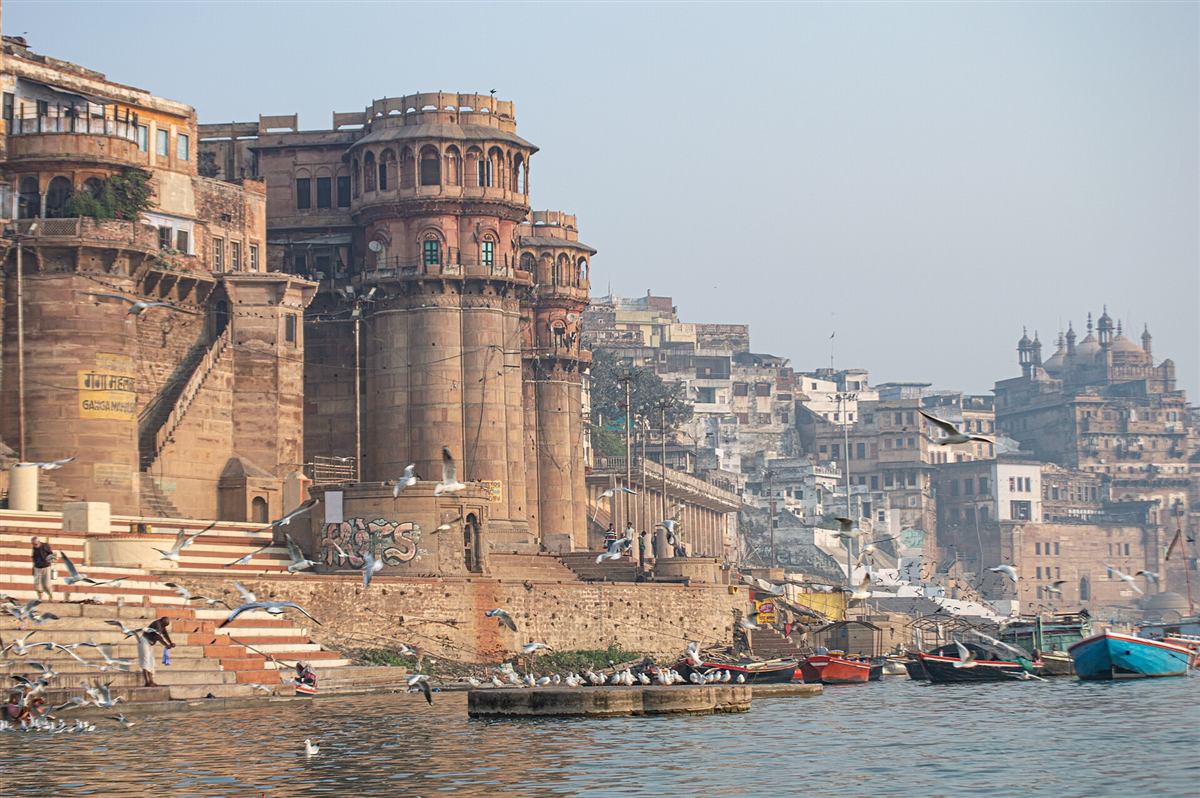
A boat trip is the classic way to see Mansarovar Ghat, and the hour before sunrise is the classic time to take it. From the river the ghat reveals its full elegance, the long cascade of steps, the tank-house and shrines above, the rows of windows watching the water like patient eyes. To the north the procession of ghats rises toward Dashashwamedh and beyond; to the south the shore relaxes into greenery near Assi. In the evening the boats return and are drawn up on the sand, tarpaulins are spread over the seats, and small cooking fires bloom along the shore. The boatmen sit in circles, talking and singing, and the river rocks their boats like a mother with her children.
The River and the View
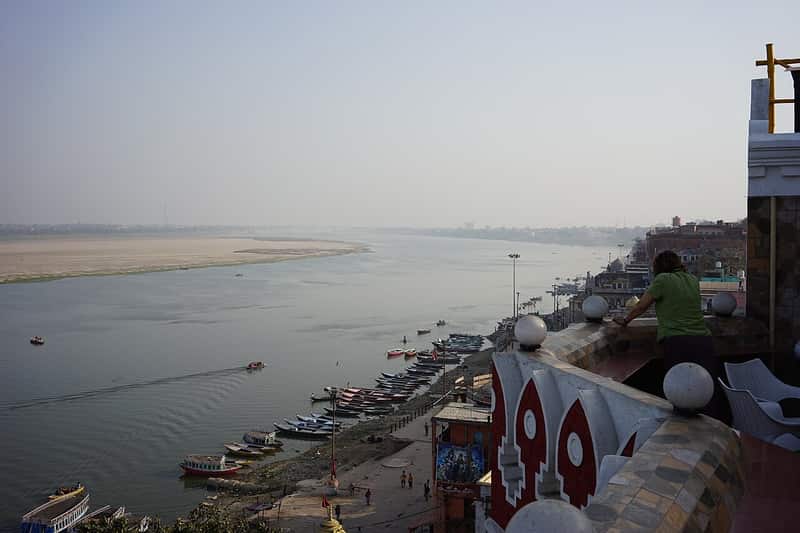
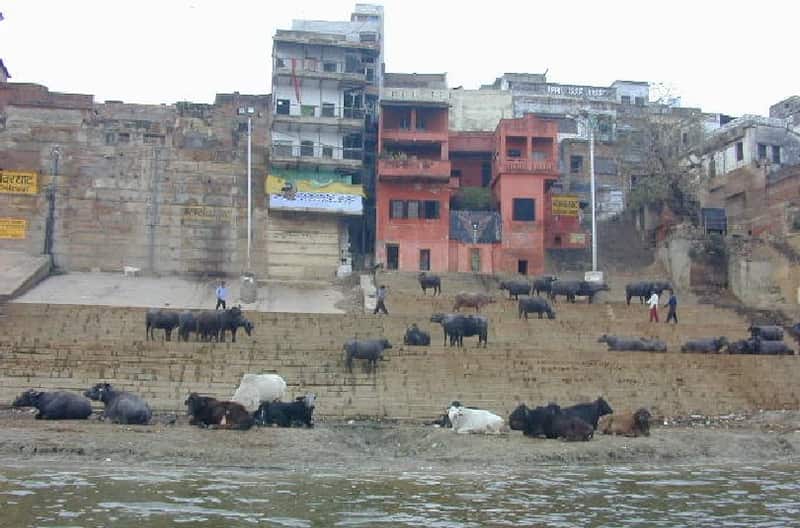
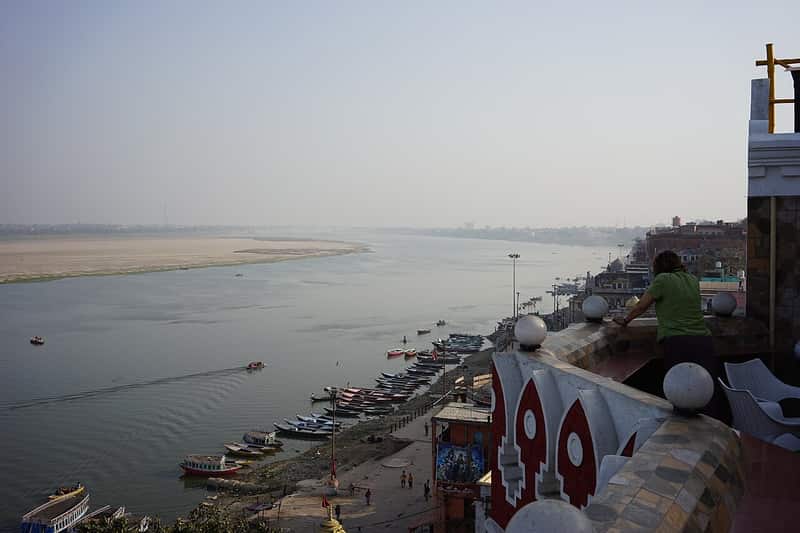
The Ganga at Mansarovar is a river in full confidence of itself. It flows wide here, several hundred meters from bank to bank in the rainy season, and even in the dry months it keeps a deep, deliberate channel. The current moves with a muscular slowness, curling around the ghat's foundations, and the water, cleaner than in the crowded northern stretches, runs the color of tea touched with sunlight. In winter the river withdraws and leaves long sandbanks on the eastern shore; in summer it turns swift and brown with the melt of the mountains; in flood years it rises until the lower steps of the ghat are gone and the boats ride level with the tea stalls.
Every direction offers a view worth a painter. Upstream, the riverfront unrolls in a long crescent of steps, temples and palaces toward Dashashwamedh, whose evening lights scatter across the water like gold dust. Downstream, the shore turns green and low, the temples thinning out toward Assi and the old forest. Across the river the flat eastern bank runs in fields, palm groves and the white walls of the ashrams of the far shore, and beyond them the sun lifts out of the haze. In December the morning mist lies on the water like a second river, and ghat, boats and bathers appear and vanish in it by turn, as if the whole scene were being dreamed.
For the people of Kashi, sitting on the steps and watching the water is itself a form of prayer. The Ganga is not merely a river here; she is the great witness, the goddess who has seen every sorrow, every joy, every death and every birth that this oldest of cities has offered her. The visitor who sits quietly on the steps of Mansarovar, doing nothing at all, is therefore performing the most traditional act available on the riverfront. The current moves, the birds pass, the boats glide, the light changes, and the water tells the same story it told a thousand years ago. There is nothing to photograph that is not beautiful, and nothing to understand that is not already visible.
Lanes and the Mohalla Behind the Ghat
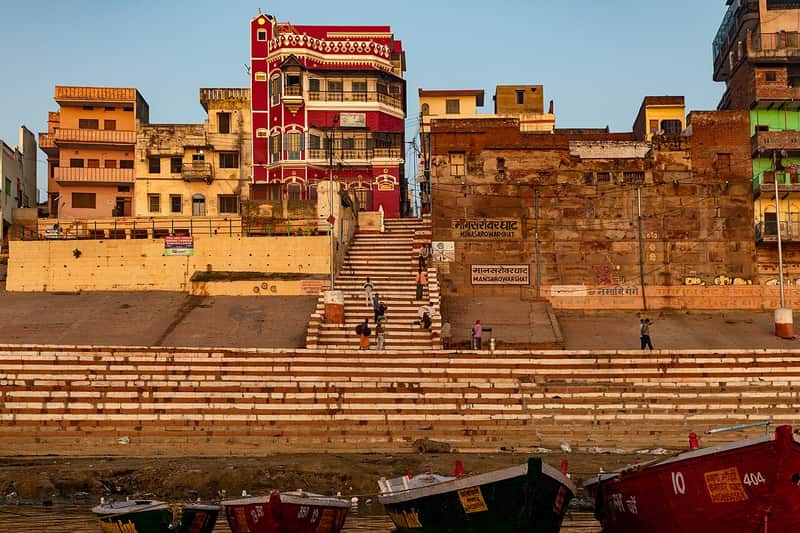
Behind Mansarovar Ghat the old city climbs away in a labyrinth of lanes. The alleys are narrow, often too narrow for two people with baskets to pass, and their walls are a layered palimpsest of brick, plaster and painted signs. Carved wooden doors open onto deep inner courtyards where grandmothers sit in the shade, where mango trees grow in unlikely corners, and where washing lines cross the sky like rigging. Balconies lean over the lanes, and from them, at any hour, someone is calling down to someone else, buying milk, asking the time, gossiping. The lanes are clean in a way that surprises first-time visitors, swept daily by hands that treat them as the front rooms of the city.
The mohalla behind the ghat is a complete small world. Brass and copper shops gleam with pots and lotas; incense stalls send up clouds of sandal and jasmine; sweet shops fry jalebis and kachoris from dawn onward; flower sellers weave the day's garlands at their thresholds. Between the shops are the shrines, a Ganesh temple with a perpetually ringing bell, a cluster of Shiva lingas under a pipal tree, a tiny Hanuman shrine no bigger than a wardrobe. The residents are a mixture of priestly families, boatmen, weavers, brass workers and shopkeepers, and the whole quarter runs on an old and exact rhythm of bells, school hours, shop shutters and the calls of the aarti.
The lanes behave like tributaries of the river they serve. Every path leads down, through decreasing noise and increasing light, to the ghat, and every burden of the quarter, milk cans, flower baskets, wedding gifts, temple offerings, moves toward the water in the morning and back into the warren in the evening. A walk through these lanes is a walk through the working life of Kashi, and no visitor should miss it. The people are used to strangers and are gently curious rather than suspicious; a folded hands greeting, namaste, will open most doors, and the offer of a chai will open the rest. In the lanes, as on the ghat, the city of Shiva lives as it has always lived.
Nearby Ghats: Narad and Chowki
Just north of Mansarovar, a short walk along the riverfront, stands Narad Ghat, named for the wandering sage Narada, the celestial messenger who moves through the epics strumming his veena and telling tales. The ghat is smaller and steeper than its southern neighbor, a modest staircase of old stone with a small shrine near the top. It has the quality of an afterthought in stone, quiet, uncelebrated, and beloved precisely for that. At sunrise a handful of bathers use its steps, and old men sit on the parapet watching the river, as they have done for a lifetime. Narad Ghat is the sort of place that appears in no itinerary and is remembered by everyone who passes it.
To the south of Mansarovar lies Chowki Ghat, smaller still and even quieter. Its name is said to come from the watch-post, the chowki, that stood here in earlier times, and something of that vigilance lingers in its alert, tidy steps. Few boats call at Chowki; a few fishermen mend their nets on its stones, a few women draw water, and the ghat keeps its own unhurried time. It is the least visited of the three, and for that reason the purest specimen of an old riverbank habit, a place where the Ganga, the stone and a handful of people simply coexist, without ceremony and without need of an audience.
The three ghats together, Narad, Mansarovar and Chowki, form a short, gentle section of the riverfront that can be walked in fifteen minutes and remembered for a lifetime. Each has its own character: Narad contemplative, Mansarovar elegant, Chowki bare and honest. Beyond them the riverfront continues south through Shivala and Pishachmochan to the gardens of Assi, and north through the crowded steps back toward the great squares of Dashashwamedh and Manikarnika. A morning spent moving slowly between Narad and Chowki, stopping at the tank, sitting on the steps, taking a boat to the far bank and back, is the most complete introduction possible to the southern soul of Varanasi.
Etiquette: How to Visit with Respect
Varanasi is generous with strangers, but its generosity flows toward those who approach it with respect. At Mansarovar Ghat, modest dress is the first courtesy; shoulders and knees covered, both for men and women. Footwear should be removed at the shrines and temple steps, and many pilgrims leave their shoes at the top of the ghat before descending to the water. Bathing, for most of the people on the steps, is an act of devotion rather than display, and the visitor should watch it as one watches any prayer, with quiet attention and without staring. Silence is the most flattering compliment a visitor can pay to the dawn on the river.
Photography requires care. The ghat itself, the boats, the water, the light are freely yours; people are not. Ask before photographing anyone at close range, especially women, sadhus and children, and accept a refusal with a smile and a folded hand. Leave the offerings alone; the flowers and lamps set on the water are prayers in motion, not litter. Do not throw anything, not a wrapper, not a coin, not a flower, into the tank or the river, and take your trash back up the steps with you. Leather articles are traditionally kept away from the tank and the shrines, and smoking is avoided in the immediate vicinity of the water by most of the people who use the ghat.
A few practical courtesies will smooth the visit. When hiring a boat, settle the price before boarding and pay what you agreed; the boatmen are honest but they expect to bargain, and both sides enjoy the ritual. Sadhus and priests may approach with blessings and requests for alms; give what you choose, or refuse politely, and move on without embarrassment. At the temples, a small offering and a folded hand will be received with a blessing. Above all, remember that you are a guest in a city that has been receiving pilgrims for three thousand years. The ghat rewards patience, humility and a quiet voice with the most generous welcome in India.
Practical Guide: Reaching the Ghat, Best Time, Nearby Ghats
Mansarovar Ghat lies on the southern riverfront of Varanasi, a few hundred meters upstream from Assi and a gentle stroll downstream from the great squares of Dashashwamedh. The simplest approach is to walk south along the riverfront from Pandey Ghat or Shivala; the ghat is unmistakable, marked by the tank that crowns its steps. From the old city, a cycle rickshaw can reach the lane leading down to the ghat, and from the water, boats from any ghat will put you ashore at its foot. For those coming from the railway station or the bus stands, a taxi or auto to Pandey Ghat followed by a fifteen-minute walk along the river is the most pleasant route.
The best season for a visit runs from October to March, when the mornings are cool, the skies clear and the river at its most photogenic. Arrive before sunrise if you can; the bathing hour, between six and eight, is the ghat at its fullest and most moving. December and January bring a romantic mist that veils the whole riverfront in soft white. The monsoon months, from July to September, are best avoided, for the river rises over the lower steps and the ghat loses half its surface; and the very hottest weeks of May and June call for an early start and a hat. Kartik Purnima and Dev Deepawali, in November, transform the entire riverfront into a sea of lamps, and Mansarovar offers a quieter vantage than the crowded center.
Once you are at the ghat, the day arranges itself. Walk north past Narad Ghat toward Shivala and Assi, or take a boat south along the crescent of ghats to Dashashwamedh for the evening aarti, which is the great spectacle of the riverfront. The ghat itself offers tea, flower sellers and shade but little else, so carry water and wear comfortable shoes for the lanes. Photographers will find the ghat quiet at midday and dramatic at dawn, and the tank's still surface gives beautiful reflections in the early light. Bring small change for offerings and alms, keep the ghat as clean as you found it, and let the river set the pace. Mansarovar Ghat rewards the unhurried traveller with the truest face of Kashi.
Mansarovar Ghat — Gallery (12 Photos)
Image Credits
mansarovar-01.jpg · mansarovar-02.jpg · mansarovar-03.jpg · mansarovar-04.jpg · mansarovar-05.jpg · mansarovar-06.jpg · mansarovar-07.jpg · mansarovar-08.jpg · mansarovar-09.jpg · mansarovar-10.jpg · mansarovar-11.jpg · mansarovar-12.jpg — Wikimedia Commons, under free licenses.
Continue exploring
Similar Ghats Nearby
Book This Ghat — Get Notified
Download the app now and book a boat ride to Mansarovar Ghat