

Man Mandir Ghat
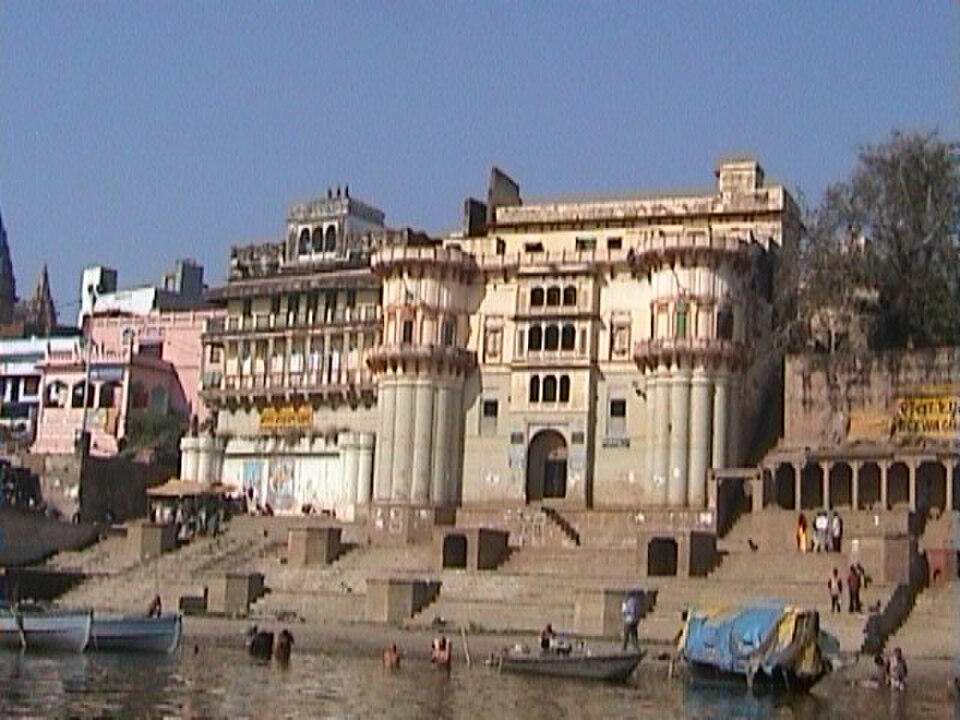
Heritage GhatMan Mandir Ghat was built by Maharaja Jai Singh II in 1770. It features a famous jharokha window and an astronomical observatory.


Type
Heritage Ghat
Boat Fare
1.2x base fare
Best Time
6-10 AM when morning light illuminates the jharokha.
History
Built by Maharaja Jai Singh II in 1770. The ghat features a famous jharokha and astronomical instruments. A beautiful ghat is near the Bada imambara.
Highlights
- Ancient Jantar Mantar observatory
- Unique collection of astronomical instruments
- Palace windows facing the Ganga
- Meeting point of history and science
Festivals & Events
How pricing works in the NaviX app
No haggling at the ghat — everything is fixed in the app first
- 1
Fixed price before you board
The fare is shown in the app upfront — no bargaining at the ghat
- 2
Sharing or private — your choice
Share with fellow travelers or take the whole boat for your group
- 3
Pay only after the ride
UPI, card or cash — with an instant receipt
🕉️
Aarti details not available for this ghat yet
Complete Guide
Man Mandir Ghat — The Complete Guide
History, mythology, rites and practical details — everything in depth.
On this page
- 1.Man Mandir Ghat — A Palace and an Observatory Above the Ganga
- 2.Raja Man Singh of Amber — The General Who Built a Ghat
- 3.The Observatory — Reading the Heavens from the Rooftop
- 4.The Palace — Balconies, Galleries and the Craft of Stone
- 5.Four Centuries of History — From 1600 to the Present
- 6.The Balcony View — The Whole City Laid Out at Your Feet
- 7.The Riverside — Steps, Bathers and the Life of the Water
- 8.The Aarti View — The Best Elevated Seat in Varanasi
- 9.The Neighborhood — Lanes Leading to the Heart of Kashi
- 10.Heritage — Preserving the Observatory and the Palace
- 11.Etiquette — A Few Courtesies for the Ghat and the Observatory
- 12.Practical Notes — How to Reach, When to Visit, What to Combine
📅 Updated: 21 Aug 2026 · Author: NaviX Field Team (field research 2024-26) · 12 sections · 12 photos
Man Mandir Ghat — A Palace and an Observatory Above the Ganga
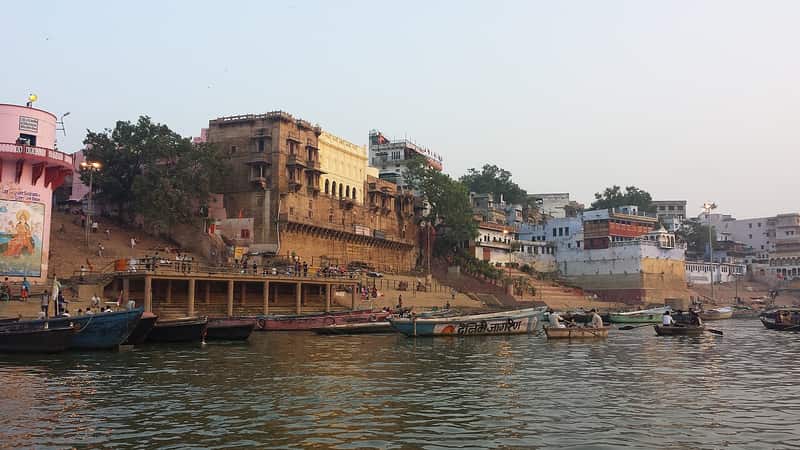
Man Mandir Ghat is one of the most handsome and distinctive ghats of Varanasi, a place where the dignity of a Rajput palace and the wonder of an open-air observatory meet on the edge of the holiest river in India. It stands on the western bank of the Ganga, just a short walk north of the crowded spectacle of Dashashwamedh Ghat, yet it feels like an altogether different world, quieter, more stately, more deliberate. The ghat is crowned by one of the few rooftop observatories in the entire country, a Jantar Mantar of the old school, with carved stone instruments still pointed at the heavens as they have been for more than four centuries. From the river, the silhouette is unmistakable, a tiered palace rising behind the bathing steps, its balconies overhanging the water, and above everything the stone disks and shadow-calibrating arcs of an observatory that once told time by the sun.
What makes Man Mandir remarkable is that it is not a monument kept for tourists alone; it is a living ghat where bathers still climb down at dawn, where boats still moor against the worn stone, and where the palace, though partly residential and partly museum, still belongs to the rhythm of the river. The observatory above was built in the tradition of the great astronomer-king Jai Singh II, though the site itself is older, linked to Raja Man Singh of Amber, who gave the ghat its name and its first palace in the late sixteenth century. Visitors today climb the long flights of steps to the rooftop, where a guard sells tickets, and are rewarded with one of the finest elevated views of the river bend in all of Kashi.
For the traveller, Man Mandir offers a rare combination, the intimacy of a small, uncrowded ghat and the drama of a rooftop from which the entire sweep of the city along the Ganga can be seen at once. It is a ghat to visit slowly, in the late afternoon, when the light turns golden and the observatory instruments cast long shadows across the parapet, and it rewards those who pause to imagine the astronomers, priests and princes who once stood on this very spot reading the sky.
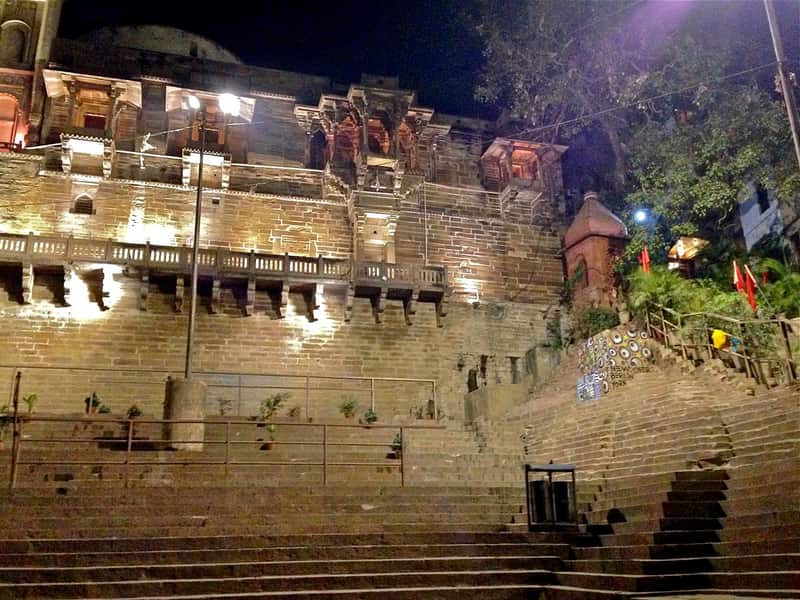
Raja Man Singh of Amber — The General Who Built a Ghat
The ghat takes its name from one of the most celebrated figures of Mughal India, Raja Man Singh I of Amber, the kingdom that later became Jaipur. A Rajput prince of the Kachhwaha clan, Man Singh rose to become one of the most trusted generals of the Emperor Akbar, commanding vast armies in the Deccan, Bengal and the Afghan frontier, and earning a place among the emperor's closest allies. His career spanned the reigns of three Mughal emperors, and his power stretched across northern India, but his heart, as many records suggest, remained attached to the sacred places of his own faith, and among these no city mattered more than Varanasi.
It was Man Singh who gave Varanasi several of its grandest structures, building palaces, temples and ghats along the Ganga, and Man Mandir is among the finest of his works. The palace he raised here was meant partly as a residential base for his family and retainers during their visits to the holy city, and partly as a statement of Rajput presence on a river that belonged to every Hindu soul. Yet the ghat is famous less for the residence than for the observatory that Man Singh is traditionally credited with having envisioned, a rooftop of astronomical instruments set above the domestic life of the palace, so that worship of the gods and study of the stars could go on side by side.
Raja Man Singh's legacy survives vividly in the memory of Kashi. He is remembered as a builder of unusual ambition, a warrior who used the spoils and prestige of Mughal service to adorn the sacred geography of his ancestors, and the ghat that bears his name still carries the imprint of his character, bold, refined and turned toward the sky. To climb the steps of Man Mandir today is to walk in the shadow of a sixteenth-century Rajput prince who, for all his years of battle, left his most enduring mark not with a sword but with a palace and an observatory on the bank of the Ganga.
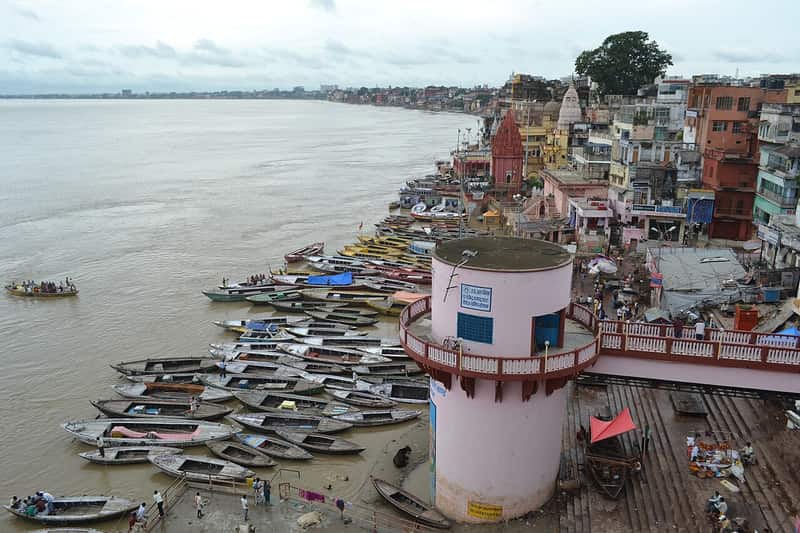
The Observatory — Reading the Heavens from the Rooftop
The observatory is the crown of Man Mandir Ghat, a rooftop collection of masonry instruments designed to observe the sky with the naked eye, long before telescopes were common in India. In the tradition of the great Jantar Mantars built by Sawai Jai Singh II of Jaipur, this observatory uses massive stone forms to achieve what instruments of wood and brass did elsewhere, measuring time, tracking the positions of the sun and moon, and charting the movement of the zodiac. The instruments include large circular disks and raised stone arcs with finely incised scales, calibrated in the divisions of Hindu astronomy, and they were intended to be read directly by an astronomer standing on the parapet with nothing more than a keen eye and a steady shadow.
Why does the observatory sit above the ghat rather than beside it? The answer lies in the nature of such instruments. Sundials and zodiacal markers need an uninterrupted view of the horizon and a clean, level platform where shadows can fall accurately, and the flat roof of the palace, clear of the crowded lanes below, offered exactly that. The height also gave the astronomer a commanding view of the river bend and the open sky, while keeping the delicate instruments safe from the floods and the bustle of the ghat. The observatory was thus not a whim but a practical necessity, astronomy lifted literally above the everyday life of Kashi.
Today the observatory lives on as a heritage attraction and a beloved viewpoint. Visitors pay a small entry fee, climb to the roof, and walk among instruments that still, on a sunny day, cast the measured shadows for which they were built. Signage and local guides explain the function of each instrument, and the rooftop has become a favourite spot for photographers at sunset, when the stone glows amber and the scales are thrown into sharp relief. For many travellers, standing among the instruments of Man Mandir is a quiet revelation, proof that in Kashi the sciences were never exiled from the sacred, but raised up beside it on the same rooftop.
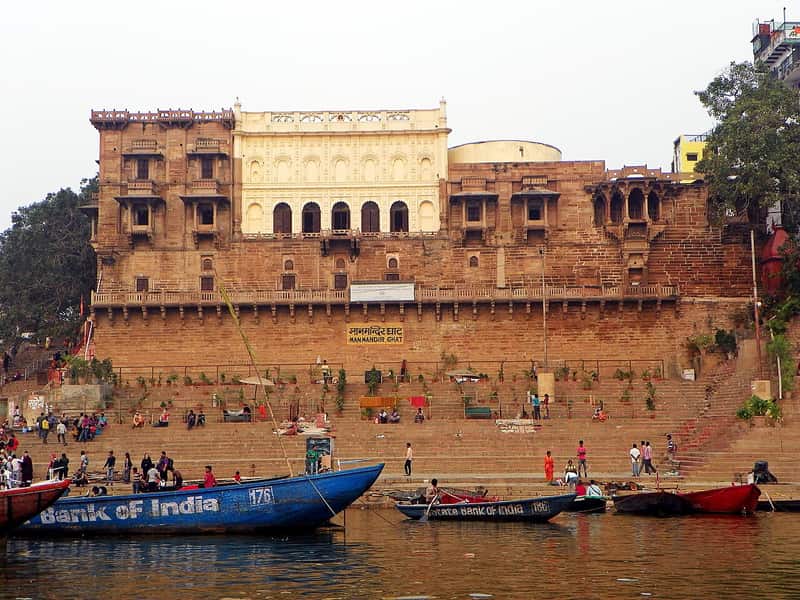
The Palace — Balconies, Galleries and the Craft of Stone
Behind the observatory and below its rooftop platform spreads the palace itself, a rambling structure of sandstone and plaster whose balconies project over the river like the arms of an old nobleman greeting the dawn. The facades are arranged in tiers, each storey marked by rows of carved windows and balconies supported on stone brackets, in the style of Rajput domestic architecture adapted to the crowded geometry of a riverbank site. Unlike the formal Mughal palaces of the plains, Man Mandir was built to fit the narrow strip of land between the lanes and the water, and so its rooms climb upward instead of spreading outward, stacking courtyards, galleries and chambers one above the other.
Within these walls, the craftsmen of Amber left the mark of their extraordinary skill. Brackets are carved with floral scrolls and elephant heads, doorways are framed with cusped arches, and screens of pierced stone, the jali work beloved of Rajput builders, filter the harsh northern light into patterns that move slowly across the floors as the day passes. The palace was once enriched with mural paintings, and traces remain of the celestial murals and zodiacal markings that linked the house to the observatory above, medallions of the planets and the signs of the zodiac painted into the plaster of inner chambers, so that the family lived, in a literal sense, beneath a painted sky.
The materials themselves tell the story of prestige. Sandstone was quarried and floated or hauled to the site, while marble, where it appears in thresholds and platforms, was a statement of royal favour, the same stone that adorned the palaces of Amber. The craftsmanship is precise and confident, the joints close, the carving deep, and though centuries of monsoon and neglect have softened some details, the palace remains one of the most intact examples of Rajput building on the ghats of Kashi. To walk its galleries is to understand that Man Mandir was never merely a residence; it was a small court of stone and sky, built to receive princes, priests and the heavens alike.
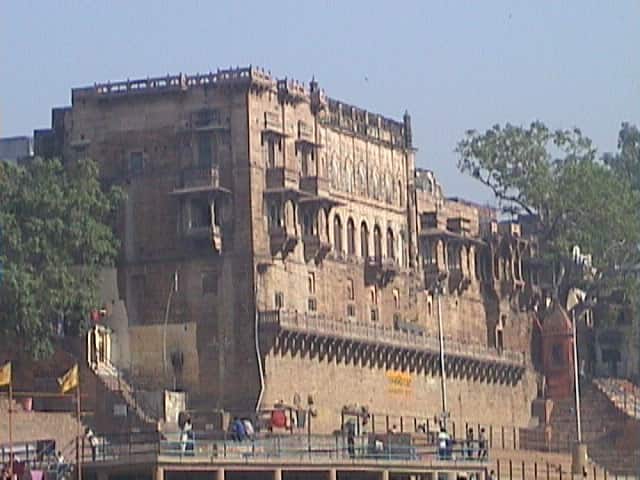
Four Centuries of History — From 1600 to the Present
The history of Man Mandir Ghat reaches back to the closing years of the sixteenth century, when Raja Man Singh of Amber, at the height of his power under Akbar, raised his palace on this stretch of the Ganga. The palace and its observatory are generally dated to around 1600, making Man Mandir one of the older ghats of Varanasi, older than the elegant eighteenth-century structures farther south and contemporary with the great flowering of building that marked the late Mughal age. For the first generations, the ghat was a private enclave of the Amber house, a retreat where princes and their families could perform their devotions in comfort, guarded from the press of the crowd.
In the eighteenth century the observatory passed into a new chapter of its life. The great astronomer-king Sawai Jai Singh II of Jaipur, a descendant of Man Singh, is traditionally associated with the enlargement and reconditioning of the instruments, and it is in his time that the rooftop assumed the form travellers know today. The Jaipur rulers maintained the ghat through the centuries, repairing the palace after floods and fires, and the structure appears again and again in the accounts of European travellers and artists, who were endlessly fascinated by the sight of an observatory floating above the holiest river in India. Their engravings and sketches, from the late eighteenth century onward, document the palace and its instruments with an affectionate precision that modern photographs still echo.
The twentieth century brought neglect and then a slow return of attention. The palace suffered from the general decline of princely patronage, and portions of it were partitioned among families or fell into disrepair, while the observatory, never entirely abandoned, was increasingly appreciated as a scientific and architectural treasure. Today Man Mandir Ghat is protected and promoted as one of the jewels of the Varanasi riverfront, its palace partially restored, its observatory cared for, and its history retold to every visitor who climbs the steps. From a Rajput prince's retreat to a living heritage monument, the ghat has held its ground beside the Ganga for more than four centuries, and its stones carry the whole memory of that long passage.
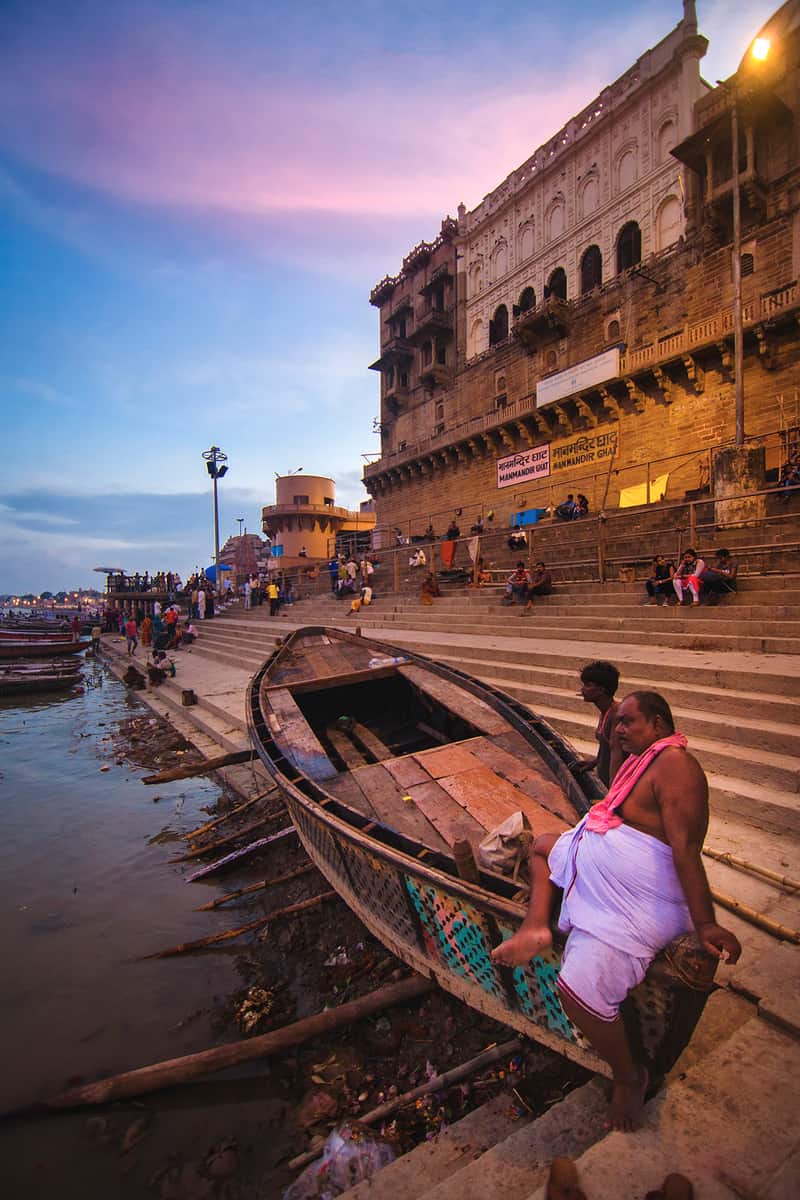
The Balcony View — The Whole City Laid Out at Your Feet
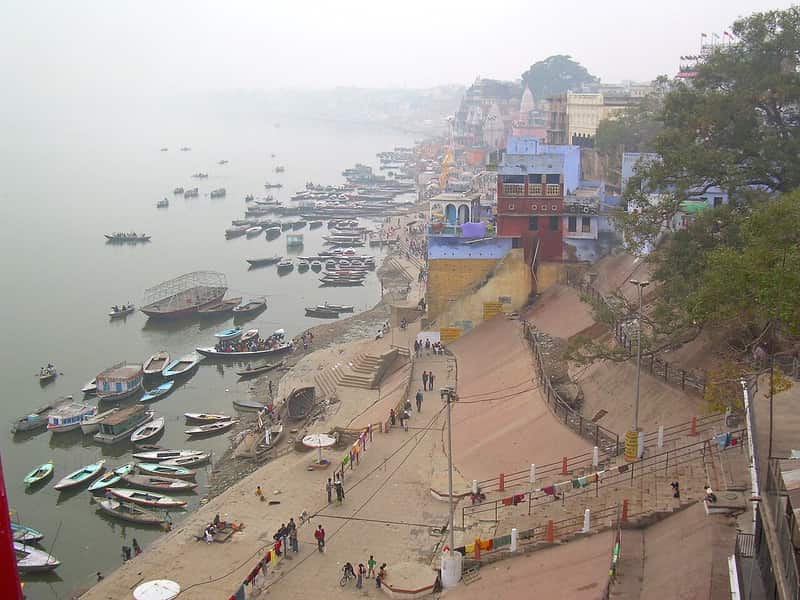
Some views in Varanasi are so famous that travellers climb for them, and the view from the balconies and rooftop of Man Mandir is among the finest in the city. From the height of the palace, the eye is drawn first to the river, where the Ganga bends in a slow, shining arc, the current carrying boats and the evening ferries past the successive ghats, each step and platform of stone growing distinct as the light falls. Southward, the sweep reaches all the way to Dashashwamedh and beyond, the great stage of the evening aarti and the busiest stretch of the waterline, while to the north the river opens out toward the quieter reaches where the city thins into fields and temples.
Turn the gaze the other way, away from the water, and the old city unrolls its own astonishment, a dense sea of rooftops and terraces, water tanks, satellite dishes, temples and pigeon lofts, all jostling under the smoke of a thousand cooking fires. From the balcony the lanes that seem so dark and confining below are revealed as an intricate pattern of shadowed chasms and unexpected courtyards, and the domes and spires of the major temples rise above the mass like islands in a stone ocean. In the late afternoon, when the light turns golden and then amber, this panorama becomes one of the most photographed scenes in India, and the Man Mandir balconies offer it from a position that no street-level view can match.
The balcony itself is a place to linger rather than hurry through. Its carved screens and projecting bays create framed views, so that the river is seen through the geometry of Rajput stone, and the afternoon breeze off the water keeps the height cool even when the lanes below are stifling. Photographers wait here for the changing light, couples sit close in the deep shade, and pilgrims pause to look out over the city they have come so far to see. It is one of those rare vantage points where the whole meaning of Kashi, holy river, ancient city, unbroken centuries of human devotion, seems to arrange itself into a single, comprehensible picture.
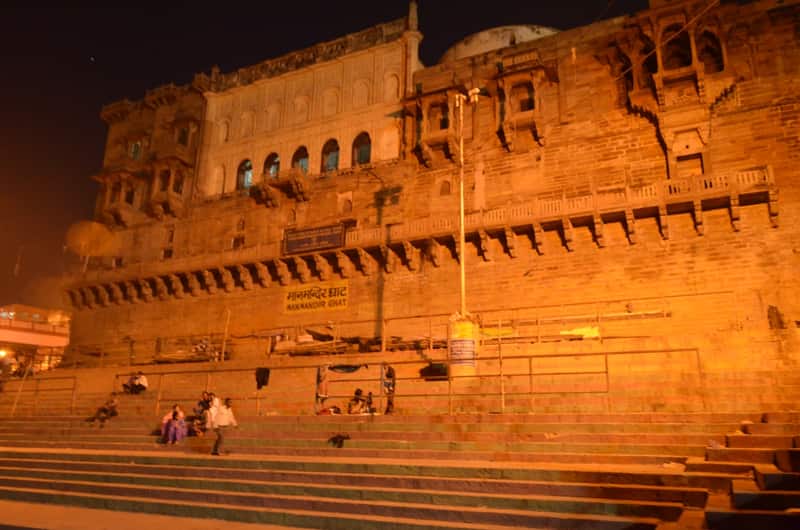
The Riverside — Steps, Bathers and the Life of the Water
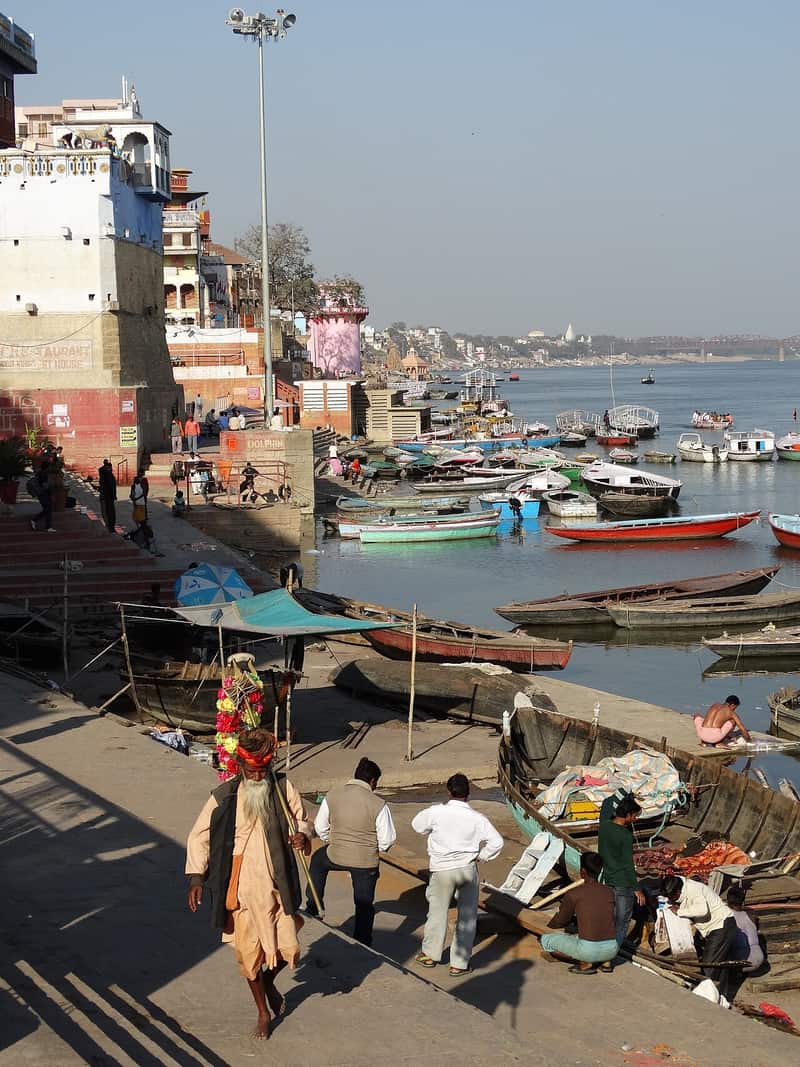
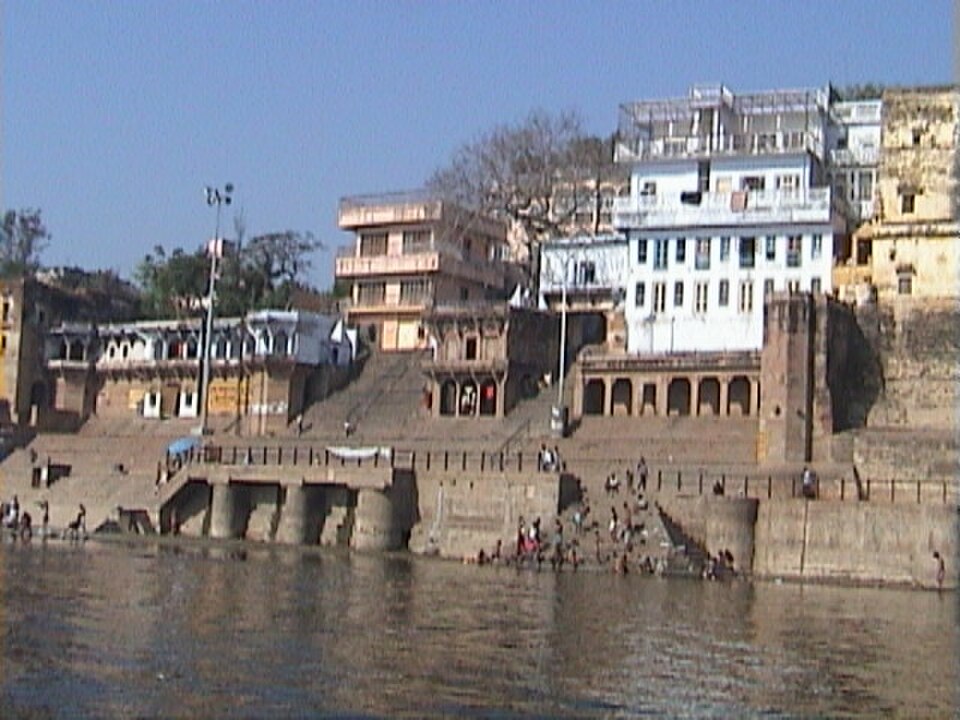
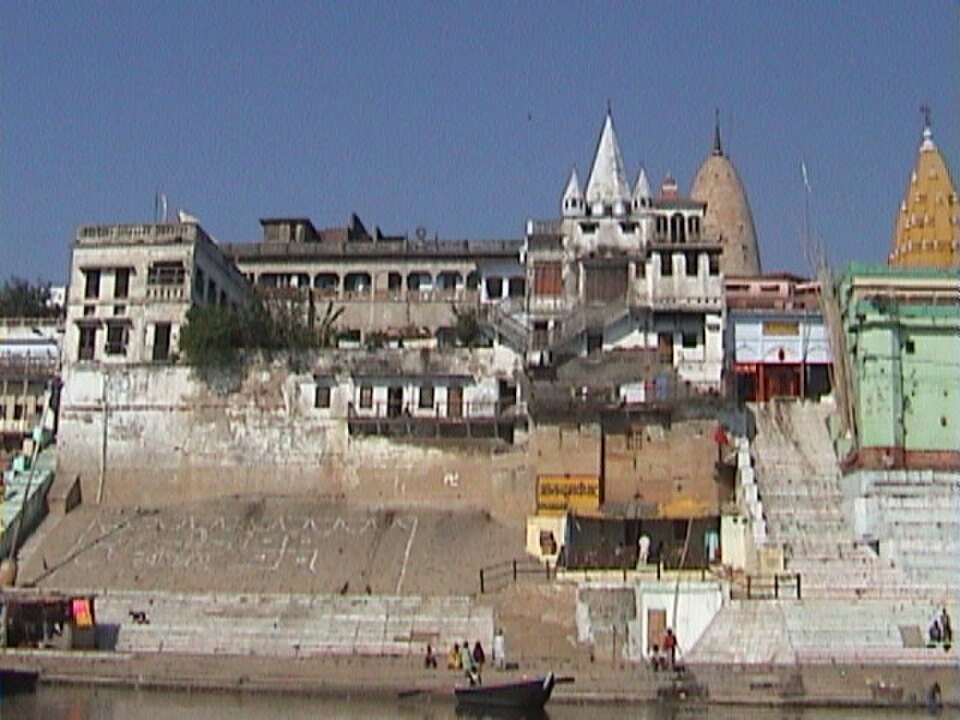
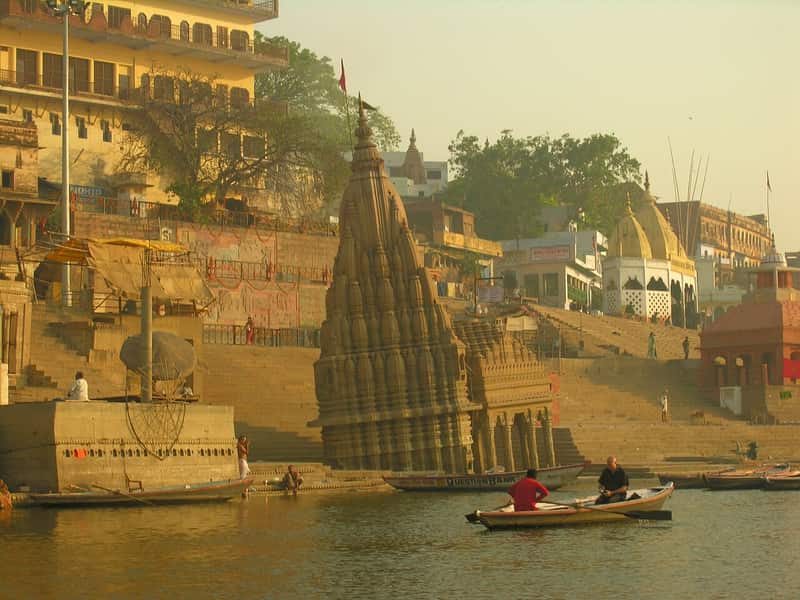
Below the palace, Man Mandir Ghat is a working ghat, a place where the waterline belongs as much to the everyday as to the sacred. The steps descend in broad, worn flights to the river, and at their foot the life of Kashi gathers in its oldest forms, men and women bathing at dawn, pilgrims offering flowers to the current, children splashing and shouting in the shallows. The stones are polished by the feet of centuries, each step hollowed by the passage of barefoot worshippers, and the waterline shifts with the season, high and brown in the monsoon, low and clear in winter, when broad sandbanks emerge and the whole character of the shore changes.
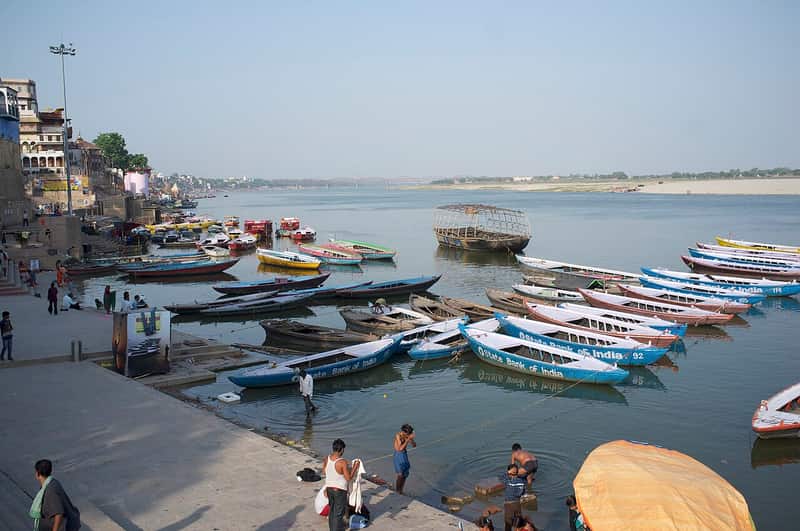
Boats are an inseparable part of the scene. Wooden vessels of every size are moored along the steps and in the shallows, their owners calling out for passengers in a chorus of invitations, ferrying pilgrims to the other bank or setting out on the long, slow rides up and down the river. The ghat is a favourite mooring for the rowboats that drift past at dusk, their lamps trembling on the water, and on festival mornings the boats gather by the dozen, decorated with marigolds and flags. Alongside the boatmen, the dhobis work at the waterline, beating laundry against the stone with the rhythmic, wet slap that is one of the unmistakable sounds of Varanasi.
In winter the scene acquires a fourth element, the sandbanks that appear as the river falls. On these stretches of new land, dogs nap, boys play cricket, pilgrims sit to rest and eat, and strollers walk out far beyond the ghat to a vantage from which the whole row of palaces and ghats is seen from the river's own level. The boats, the dhobis, the bathers and the winter sands together make the riverside of Man Mandir a living portrait of the city, a ghat that is at once a monument, a workplace and a stage for the unchanging rituals of the Ganga.
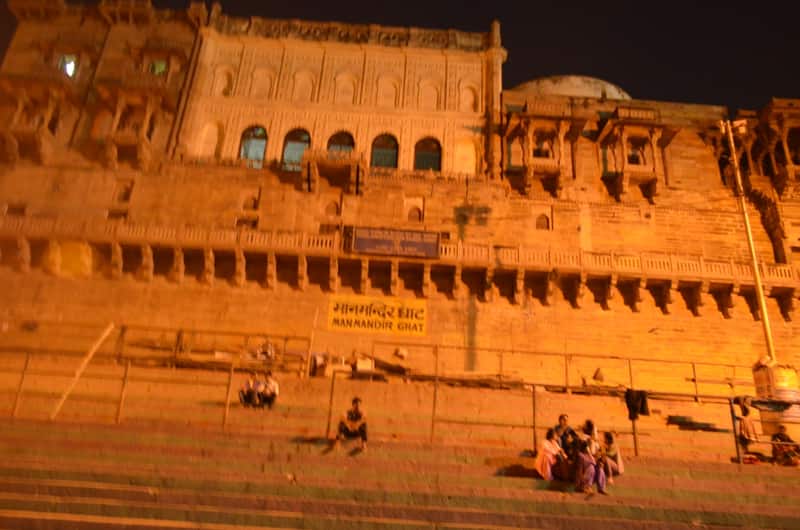
The Aarti View — The Best Elevated Seat in Varanasi
Every evening, as darkness gathers over the Ganga, the famous Ganga Aarti begins at Dashashwamedh Ghat, a short distance south of Man Mandir, and the thousands of spectators who crowd the steps and the boats look up and across to see it. Most of them watch from the waterline, pressed among the crowds, but a fortunate few watch from the high balcony of Man Mandir, and it is from this elevation that the aarti reveals its full theatre. The rows of brass lamps on tiered stands, the incense smoke, the synchronised raising and lowering of flames, all are seen in their true pattern from above, as if the ceremony were a dance performed for the whole river.
The rooftop of Man Mandir is one of the few places in Varanasi where the aarti can be seen without the crush, in comparative quiet, and the view transforms the ritual into something almost cinematic. The dome and steps of Dashashwamedh glow in the firelight, the boats ring the performance with their own small lamps, and the reflection of the flames stretches across the water toward Man Mandir itself. On festival nights, when the aarti is larger and the river is covered with floating lamps, the view from the palace roof becomes unforgettable, a city of light written upon a river of darkness.
The evening is worth attending for more than the aarti alone. As the sun sets, the waterline glows amber, the gulls wheel home, and the rooftop fills slowly with photographers and travellers who have discovered this secret vantage. The aarti itself lasts perhaps half an hour, and afterwards the crowds below disperse as the river darkens, but those who remain on the Man Mandir balcony are rewarded with the most peaceful sight in the city, the Ganga running silent and black through the heart of Varanasi, the lamps of the ghats dwindling one by one. It is a conclusion to the day that no other seat in Kashi offers.
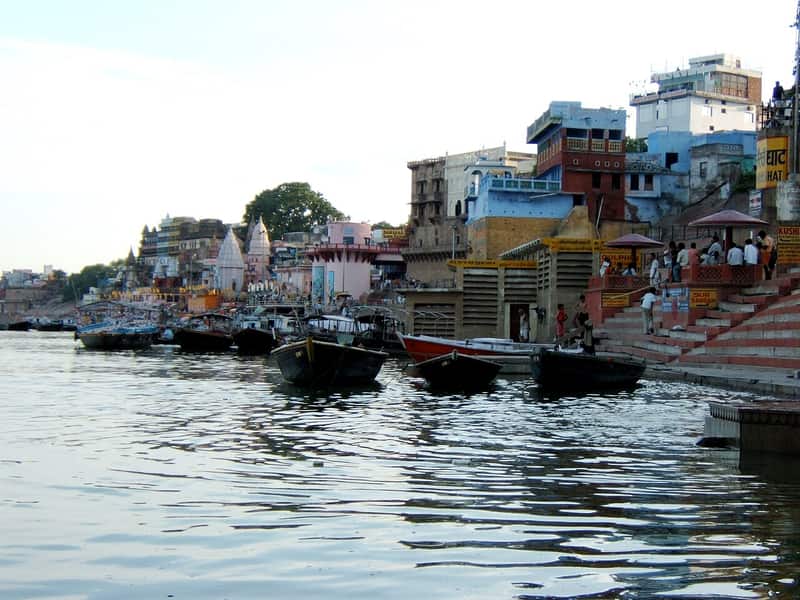
The Neighborhood — Lanes Leading to the Heart of Kashi
Behind Man Mandir Ghat, the city closes in around the visitor with a density that is both astonishing and intimate. A few paces from the water, the light dims and the world narrows, and the lanes of the old city take over, alleys so narrow that the sky becomes a pale strip overhead and the walls brush the shoulders on either side. These are the famous galiyan of Varanasi, centuries deep in damp stone, incense and the smell of cooking, and they form the connective tissue that ties the ghat to the greater city of temples and bazaars that lies inland.
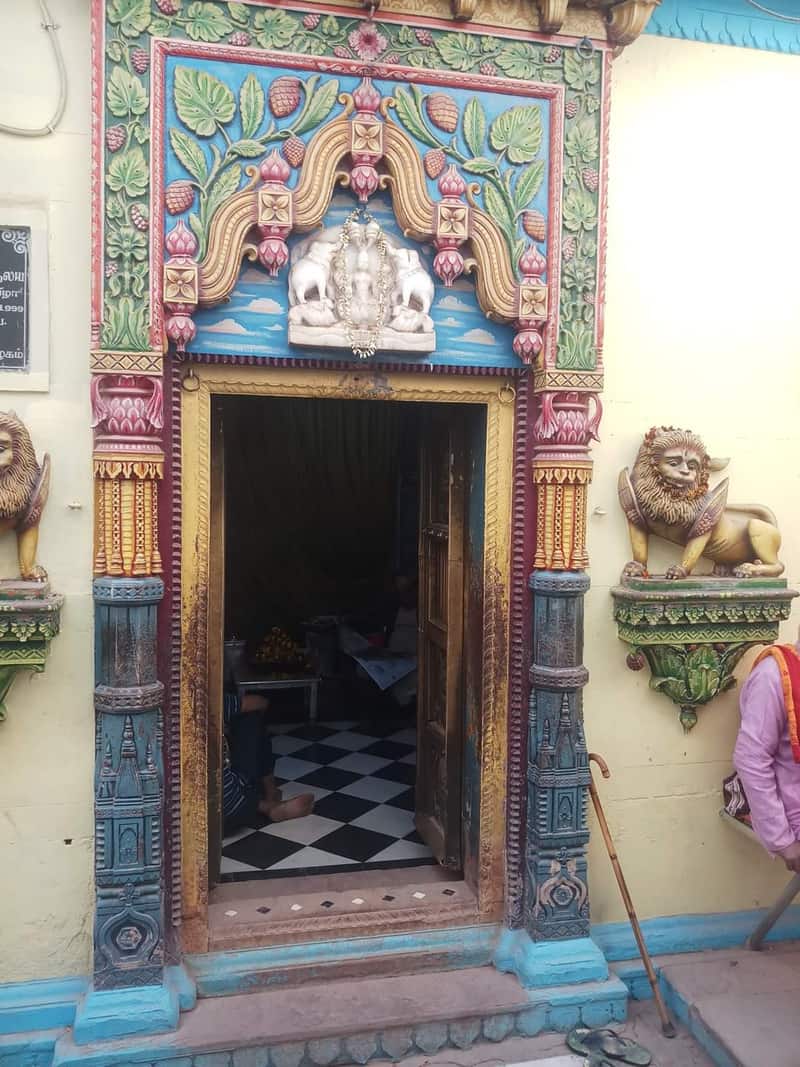
The lanes behind Man Mandir lead, in their winding, irresistible way, toward the great monuments of the old city. To the north and inland runs the route that pilgrims take toward Kashi Vishwanath, the most sacred temple in Varanasi, and the whole neighborhood is threaded with smaller shrines, the temple clusters for which this quarter is famous, doorways opening on carved deities, silent courtyards, and little images garlanded with marigolds. The streets are a living museum of religious life, where the sacred is not confined to grand buildings but lives in every niche and wall, and where priests, mendicants and devotees move among the shopkeepers and the cows with an ease born of centuries.
The neighborhood also opens onto the commerce of Godowlia, the great market that lies a short walk inland. Here the lanes widen into the bazaars of the old city, dense with shops selling silk, brass, sweets and the countless small objects of worship, and the crowds thicken with pilgrims and traders alike. For the visitor, the walk from Man Mandir through these lanes is as much a part of the experience as the ghat itself, a journey through the beating heart of Kashi, where every turning offers a new temple, a new smell, a new face of the eternal city.
Heritage — Preserving the Observatory and the Palace
The observatory of Man Mandir Ghat is not only a tourist attraction; it is a monument of genuine scientific and archaeological importance, and it has been treated as such by the custodians of Indian heritage. The Archaeological Survey of India has taken a protective interest in the rooftop instruments, recognizing in them a rare survival of pre-telescopic astronomy built in the tradition of the great Indian observatories. The zodiac markings carved into the stone, along with the calibrated arcs and disks of the instruments, are valued as both scientific artifacts and works of craftsmanship, and they are studied, measured and documented with the care that such fragile surfaces demand.
The palace itself has received the attention of conservationists as well. As an example of Rajput palace architecture adapted to the ghats, it is significant beyond its beauty, and efforts have been made to stabilise the structure, repair the carved balconies and protect the surviving mural fragments and painted zodiacal decorations. The building is a palimpsest, carrying the marks of the sixteenth century and of every generation since, and the challenge of preservation is to hold all those layers without letting any one of them be lost. Walkways, railings and controlled access help protect the most delicate stonework while allowing the public to enjoy the monument.
The heritage status of Man Mandir has quietly changed the way the ghat is seen. Information boards explain the instruments, guides tell their story, and a small entry fee helps sustain the upkeep, transforming what might have decayed into an urban ruin into a carefully tended monument. For the visitor, this means the rare pleasure of walking through history that is still alive, of touching stone that has measured the sun for four hundred years, and of knowing that the same hands of custodianship that once belonged to Rajput princes now belong to the nation. The observatory, in its care, has become a bridge between the astronomy of the past and the heritage tourism of the present.
Etiquette — A Few Courtesies for the Ghat and the Observatory
Man Mandir is a sacred ghat as well as a monument, and the small courtesies that make a visitor welcome anywhere in Varanasi apply here with particular force. Modest dress is appreciated, especially for those who wish to approach the water and the bathers, and shoes should be removed before entering the small shrines that cluster near the steps. Photography is generally welcome at the ghat, but it is always courteous to ask before photographing individual bathers, sadhus or priests, who are often happy to oblige but deserve the respect of being asked. The ghat is also a place of private devotion, and a visitor who moves quietly and does not intrude on prayer will find the people of Kashi generous and friendly.
At the observatory, the rules are those of any fragile heritage site. The instruments are irreplaceable and the parapet walls are low, so it is wise to keep children close, to avoid climbing on the stone, and to walk only on the permitted paths. A small entry fee is charged, and it is worth paying willingly, since it goes toward the maintenance of the very treasure one has come to see. Guides are available and often excellent, and the small investment in a guide transforms the instruments from puzzling stones into a comprehensible story of science and devotion. Reading the information boards, staying within the roped areas and refraining from touching the carved scales will keep the observatory safe for the centuries to come.
Finally, the ghat rewards a certain slowness. Varanasi has its own rhythm, and the visitor who hurries through will miss what makes Man Mandir special, the evening light on the stone, the conversations of the boatmen, the quiet of the observatory above the busyness of the city. Carry water, wear shoes that are easy to remove, and keep valuables secure in the crowded lanes, but above all arrive with patience and leave with respect. In a city where the sacred and the everyday are woven together on every street, courtesy is not a formality; it is the very language of Kashi.
Practical Notes — How to Reach, When to Visit, What to Combine
Man Mandir Ghat is easy to reach because it sits in the very heart of the Varanasi riverfront. The simplest approach is on foot, a short walk of only a few minutes north along the waterline from Dashashwamedh Ghat, following the lane that runs beside the river and passing Lalita Ghat before Man Mandir appears. It can also be reached by boat, and many visitors prefer to arrive on the water, disembarking at the ghat's own steps after a ride that reveals the whole sweep of the riverfront. For those coming by rickshaw or car, the journey ends at the edge of the old city, and the last few hundred metres through the lanes must be walked, which is part of the pleasure of visiting Kashi.
The best time to visit Man Mandir is the late afternoon, when the observatory is open and the light is at its most beautiful. Aim to arrive an hour or two before sunset, climb to the rooftop, and watch the river turn gold as the evening approaches; from this vantage the sunsets over the Ganga are among the finest in India. The observatory has visiting hours during the day and charges a small entry fee, and it is wise to check the current schedule locally, as hours can vary with the season. After dusk, the view of the Dashashwamedh aarti from the Man Mandir balcony is the evening's great reward, and the ghat empties enough by nightfall that a final quiet stroll is a memorable end to the visit.
Man Mandir is best seen as part of a longer walk along the ghats. To the south lie Dashashwamedh Ghat, the great ceremonial centre, and Lalita Ghat, a peaceful neighbour; to the north, a short walk brings the visitor to Manikarnika Ghat, the most sacred and solemn of all the cremation ghats of Varanasi, and beyond it the reach continues toward Scindia and the further ghats. A morning walk from Dashashwamedh to Manikarnika, pausing at Man Mandir for the observatory and the balcony views, covers the heart of the riverfront, and a second visit at sunset for the aarti completes the day. Man Mandir, in short, rewards both the hurried glance and the long stay, and gives every visitor its own particular memory of Kashi.
Man Mandir Ghat — Gallery (12 Photos)
Image Credits
man-mandir-01.jpg · man-mandir-02.jpg · man-mandir-03.jpg · man-mandir-04.jpg · man-mandir-05.jpg · man-mandir-06.jpg · man-mandir-07.jpg · man-mandir-08.jpg · man-mandir-09.jpg · man-mandir-10.jpg · man-mandir-11.jpg · man-mandir-12.jpg — Wikimedia Commons, under free licenses.
Continue exploring
Similar Ghats Nearby
Book This Ghat — Get Notified
Download the app now and book a boat ride to Man Mandir Ghat