

Durga Ghat
Neighbourhood GhatNamed after Devi Durga — a centre of shakti worship.


Type
Neighbourhood Ghat
Boat Fare
1x base fare
Best Time
6-9 AM
History
This ghat is named after Devi Durga and holds special faith among devotees of the goddess.
Highlights
- Worship of Durga Shakti
- Centre for goddess devotees
- Peaceful bathing site
Festivals & Events
How pricing works in the NaviX app
No haggling at the ghat — everything is fixed in the app first
- 1
Fixed price before you board
The fare is shown in the app upfront — no bargaining at the ghat
- 2
Sharing or private — your choice
Share with fellow travelers or take the whole boat for your group
- 3
Pay only after the ride
UPI, card or cash — with an instant receipt
Daily at dusk
Short and unhurried, sung in the homespun style of the old city
Complete Guide
Durga Ghat — The Complete Guide
History, mythology, rites and practical details — everything in depth.
On this page
- 1.Durga Ghat — A Protective Landing on the Northern Riverfront
- 2.Goddess Durga — The Protecting Mother of Kashi
- 3.The Name and the Deity
- 4.The Morning Bath
- 5.Daily Life at the Ghat
- 6.The River and the View
- 7.The Lanes Behind and the Durgakund
- 8.The Neighbouring Ghats — Rama and Brahma
- 9.Visiting with Respect — Etiquette at the Ghat
- 10.Practical Notes — Reaching Durga Ghat
📅 Updated: 21 Aug 2026 · Author: NaviX Field Team (field research 2024-26) · 10 sections · 10 photos
Durga Ghat — A Protective Landing on the Northern Riverfront
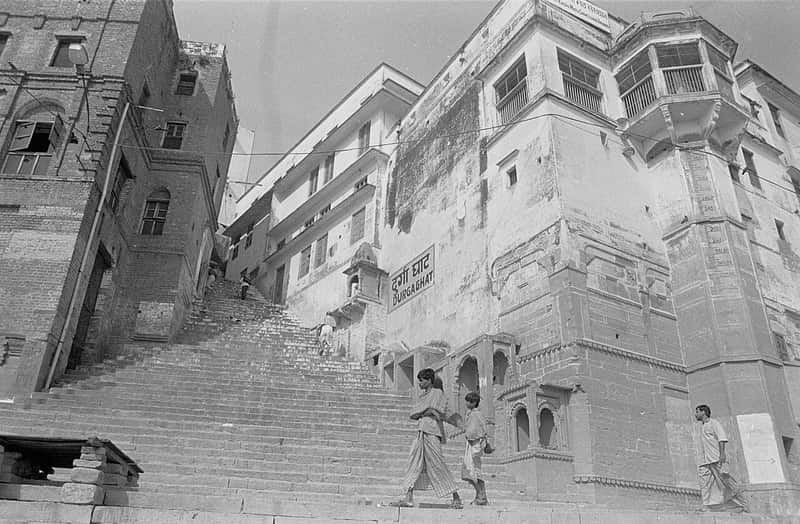
Durga Ghat is a small and unassuming river landing on the northern stretch of Varanasi's great chain of ghats, tucked quietly between Rama Ghat and the open ground that leads toward Raj Ghat. It takes its name from Goddess Durga, the fierce and protective mother of the Hindu pantheon, and although it lacks the monumental stone palaces of the southern ghats, it carries a sanctity that the neighbourhood holds in deep reverence. The steps are plain and worn smooth by generations of bare feet, and the stonework shows the gentle, unhurried patina of centuries. At the head of the ghat stands a modest shrine where the goddess is honoured, and on festival mornings the air fills with the scent of incense and the sound of bells. Yet for most of the day the ghat belongs not to ceremony but to everyday life — bathers, boatmen, washermen and children use the same stones without drawing any line between the sacred and the ordinary.
The northern riverfront is the quieter face of Kashi, far from the crowds of Dashashwamedh and the solemn processions of Manikarnika. Here the chain of minor ghats continues northward with little fanfare, and each one serves its own mohalla with a plain devotion that never advertises itself. Durga Ghat is one such link in that chain, a working landing where fishing boats are beached, laundry is beaten on the flat stones and neighbours greet one another across the water. Because so few visitors find their way this far north, the ghat keeps an intimacy that the celebrated riverfront has long lost. To stand on its steps is to see the Ganga as the people of northern Kashi see it — not as a spectacle, but as a daily companion, a source of water, work and blessing that has shaped their lives for as long as memory can reach.
For the faithful, the goddess's presence makes this stretch of river especially protective. Durga is the slayer of the demon Mahishasura, the mother who guards her children, and a ghat consecrated to her is understood to shield all those who bathe in its waters. Pilgrims heading north from the great ghats often pause here before continuing toward Raj Ghat and the river's more remote reaches, and the modest shrine above the steps receives its morning offerings without fail. The ghat makes no claim to grandeur; its gift is different — a sense of shelter, of being watched over by a fierce and loving mother, and a reminder that even the smallest landing on this holy river is a doorway to the divine. That quiet assurance is what brings the bathers back morning after morning, and it is what the patient visitor takes away from this unremarked corner of Kashi.

Goddess Durga — The Protecting Mother of Kashi
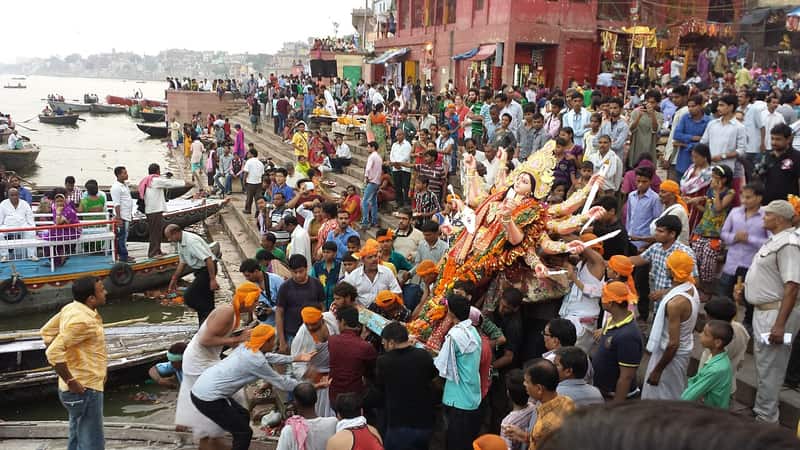
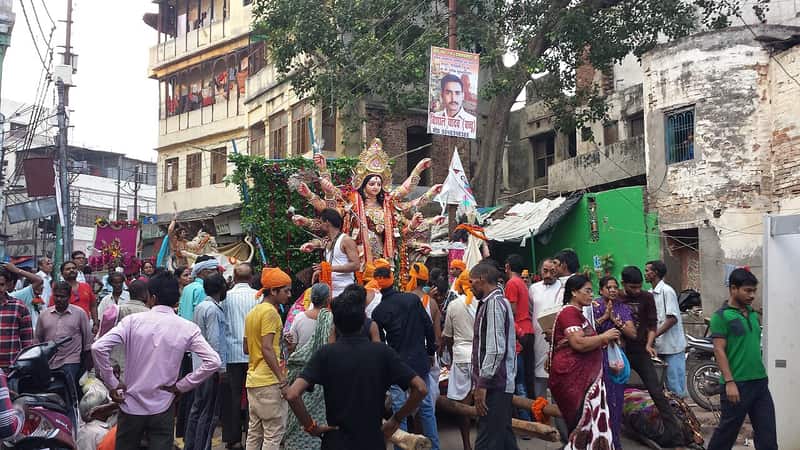
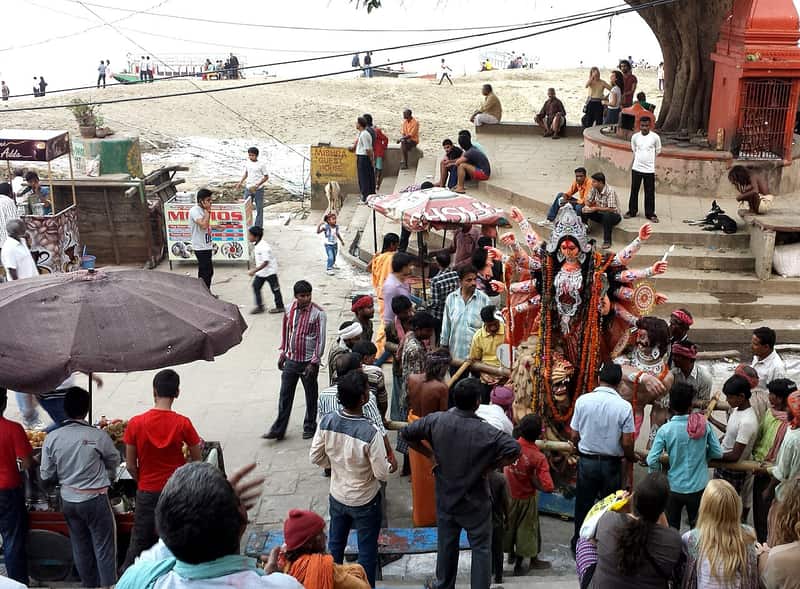
Durga is the goddess of power and protection, the great mother who rides the lion and carries weapons in her ten hands to defend the world against the demons of chaos. In Kashi, where Shiva reigns as the lord of the city, Durga holds a place of almost equal eminence as his consort in her fierce forms and as the beloved mother of the common people. Her worship fills the city through the autumn festival of Navaratri and the days of Durga Puja, when the northern mohallas resound with drums and the air thickens with the smoke of a thousand lamps. But at Durga Ghat her presence is quieter and far more intimate — a small shrine, a few fresh garlands, a single lamp that burns each evening at dusk. The goddess who slays demons with a sword, the faithful believe, also listens to the smallest prayer whispered at her feet.
The worship at the ghat follows the gentle rhythm of the northern neighbourhoods rather than the elaborate theatre of the great temples. Before dawn a priest or a senior woman of the mohalla bathes the image, applies fresh vermilion, and offers flowers, incense and a handful of rice. The evening aarti is short and unhurried, sung in the homespun style of the old city, and the bell rings softly rather than clanging. On Tuesdays and Saturdays, the traditional days of Durga's worship, the shrine sees more visitors, and the steps gather a small crowd of women who come with baskets of flowers and offerings of sweet rice. There is no crowd of guides, no queue of tourists and no entrance fee — only the continuous, unforced devotion of people for whom the goddess is not a monument but a mother living in the house above the river.
The protective character of Durga runs deep in the life of this neighbourhood. Mothers bring their newborn children to the shrine for the first blessing; students touch the goddess's feet before examinations; boatmen offer the first flowers of the day before casting off. When the monsoon swells the Ganga and the river presses against the lowest steps, the whole mohalla prays at Durga's shrine, trusting that the mother who crushed the demon of chaos will hold back the destructive water. The goddess of the ghat is thus not the distant, majestic figure of the temple posters but a living protector woven into the daily anxieties and hopes of the people. It is this faith — simple, practical, unbreakable — that gives Durga Ghat its quiet power, and no visitor leaves without feeling that some protective presence has noticed their arrival.
The Name and the Deity
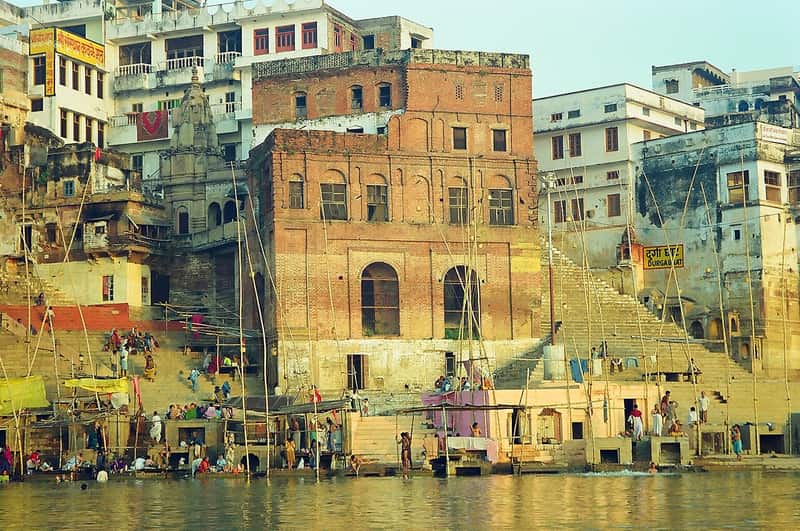
Among the ghats that Varanasi counts along its crescent of riverfront, most are named for the kings, ministers and merchants who built them, but a special few carry the names of deities, and Durga Ghat belongs to that sacred company. Its naming follows the old logic of the city: a ghat that served a neighbourhood was often dedicated to the goddess most beloved by that community, and in the northern reaches of Kashi, where the Durgakund quarter rises behind the river, the fierce mother Durga has always been the natural patroness. The ghat's name is thus not merely a label but an invocation; every time a boatman calls it out across the water or a traveller asks the way through the lanes, the goddess's name passes through the air as a small, repeated prayer. Naming, in Kashi, has never been a simple act of record.
The same devotion that named the ghat fills the lanes behind it, where the Durgakund — the ancient tank of the goddess — stands at the heart of the neighbourhood. According to local tradition, the Durgakund marks the very spot where Durga manifested herself to protect Kashi, and the tank's waters are held to possess the same protective power as the river itself. The temples around the kund draw worshippers from all over the city, yet the connection between the tank and the ghat is easily missed by outsiders: the goddess's blessing, the faithful say, flows in a single current from the shrine at the kund down through the lanes to the landing on the river. To bathe at Durga Ghat is to receive that blessing at its furthest reach, where the sacred water of the tank and the sacred water of the Ganga meet in the person of the bather.
The name Durga means the inaccessible one, she who is difficult to approach, and yet the whole character of this ghat contradicts that meaning — the goddess here is close at hand, standing at the head of a few plain steps in a quiet northern mohalla. This is the paradox of Kashi itself, where the most transcendent deities are worshipped in the most ordinary places. The naming of the ghat thus holds a double teaching: the great mother is both beyond all human grasp and present on the humblest landing, ready to hear the prayer of anyone who comes down to the water with clean hands and a trusting heart. For the people who live above the ghat, the name and the deity are one, and they would not trade their small, fierce, protective goddess for any grander patron in the whole city.
The Morning Bath
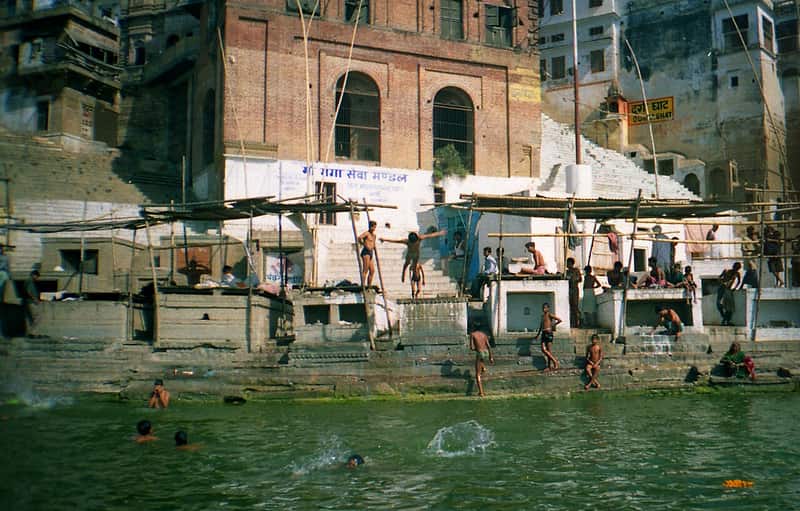
The day at Durga Ghat opens with the same ritual that has opened here for centuries: the morning bath. The earliest arrivals come while the sky is still the colour of ash, stepping carefully down the uneven stones with towels, lotas and small vessels of oil. The water at this northern reach of the city is clean and cold, and the first immersion is a shock that the old bathers welcome like a yearly visitor. Men and women keep to their own hours and their own corners of the ghat, and the whole scene unfolds with a quiet gravity that has nothing theatrical about it. There is no priest to preside and no fixed procedure beyond the ancient one of water, hands and prayer; the river herself is the officiant, and she has been performing this ceremony without error since long before the city was built.
The bath itself follows the timeless grammar of the Ganga. Water is poured from the lota over the head in three slow streams, cupped hands are lifted toward the rising sun, and a little water is sipped with a murmur of the goddess's name. Some bathers stand chest-deep in the current with their eyes closed, letting the cold river do its work on body and mind; others scrub their vessels clean on the stones and fill them again for the household's day. Marigold petals float past, carried down from the shrine above, and now and then a small lamp set on a leaf goes bobbing toward the open river. The conversation, when it happens, is low and unhurried — the shared weather, a greeting, the memory of a dream. Everything is addressed to the river, and the river answers with nothing more than its endless, even current.
By eight o'clock the peak of the morning bath is past, and the ghat settles into its daytime self. Wet footprints dry on the stones, towels are spread over the rails, and the first boats push off into the current. Yet the bathers carry the morning with them — a copper pot filled at the ghat for the home shrine, a leaf of flowers for the household god, and the quiet satisfaction of having begun the day in the presence of the goddess and the river. The faithful hold that a bath at Durga Ghat, beneath the shrine of the protective mother, carries an especial merit that guards the bather from harm through the whole day. Whether or not one shares that belief, the discipline of the morning bath is plain to see: a whole neighbourhood, day after day, meeting the dawn at the water's edge with patience and grace.
Daily Life at the Ghat
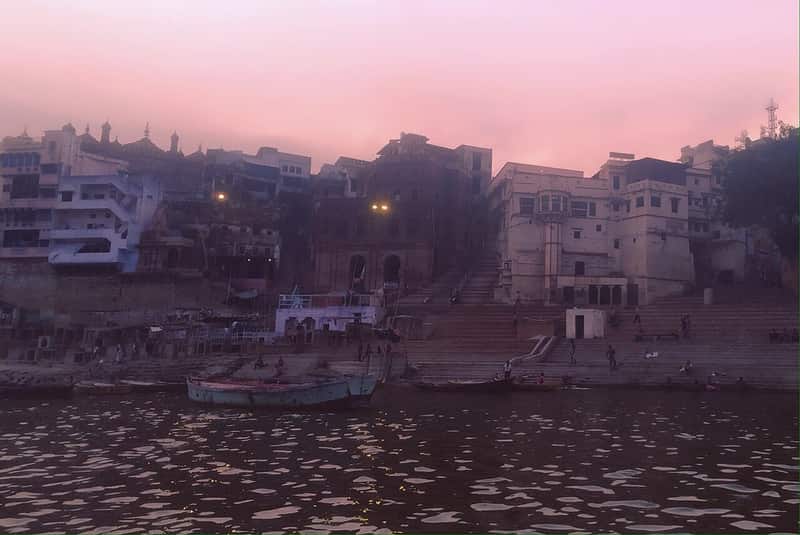
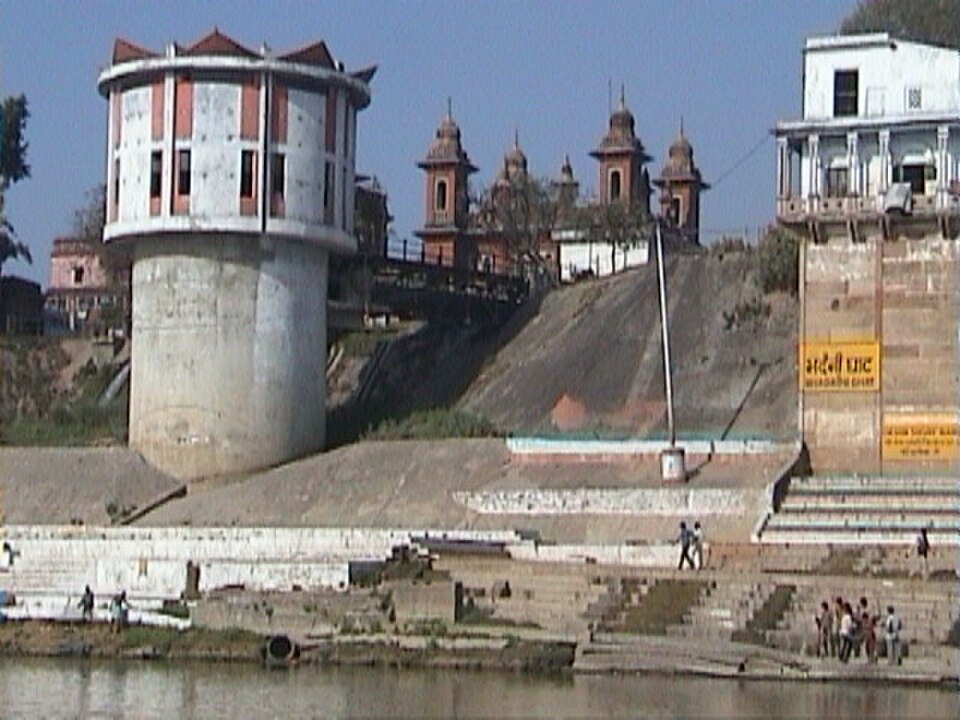
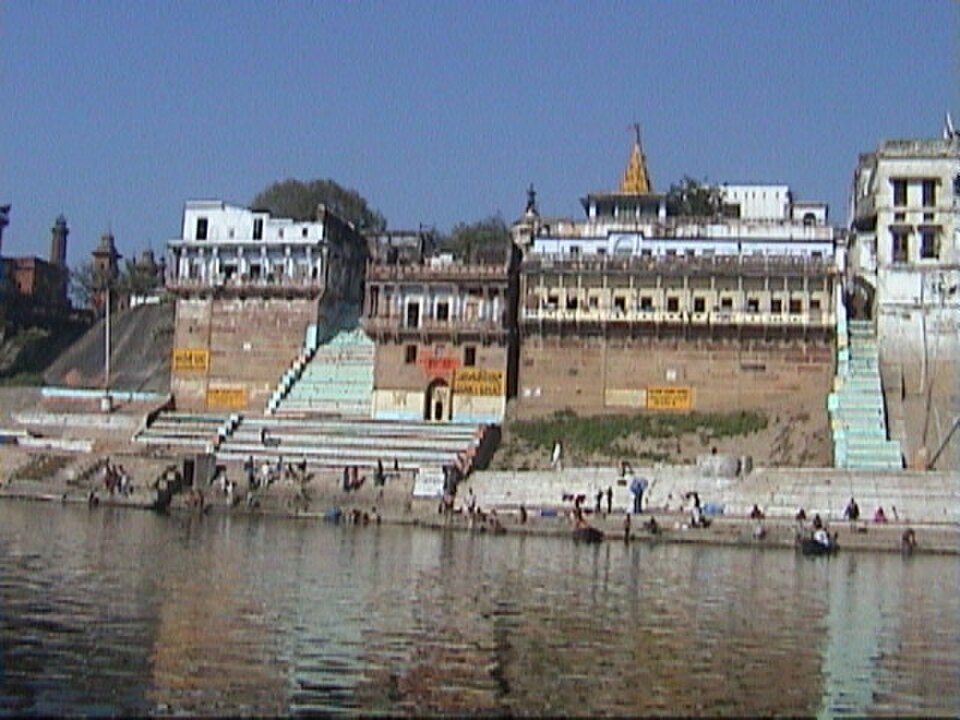
Durga Ghat earns its keep as a working landing, and its true character shows in the plain routines that fill its hours. Long before the sun tops the rooftops, the boatmen of the northern reach are at their boats — checking ropes, baling water, arranging the day's cargo of sacks, baskets and passengers. Their boats are sturdy workboats painted in blues and greens, and the men handle them with the ease of long habit. Along the upper steps, women from the mohalla wash utensils in the shallows, beating them with sand and rinsing them in the current; a washerman thrashes a bundle of clothes against a flat stone; children wade in the low water with shrieks of delight. The ghat is crowded in the way a courtyard is crowded — with familiar faces, small errands and the steady, unremarkable commerce of daily life.
The river's work never stops on this northern stretch. Boats carry pilgrims across to the far bank, where the floodplain stretches green and flat, and bring back vegetables, firewood and fodder for the markets of the old city. Fishermen cast their nets at dawn and again at dusk, spreading them on the steps to dry like great pale flowers. The boatmen of Durga Ghat are known throughout the neighbourhood for their knowledge of the shifting sandbars and channels, and local people trust them the way they trust the river itself — with a caution born of long acquaintance. In the heat of the afternoon the ghat grows quiet: the boats ride slack at their moorings, the boatmen sleep in the shade of their hulls, and only the patient sound of water against stone breaks the stillness. It is a working peace, earned by a morning of honest labour.
As evening falls the rhythm turns once more. The last bathers descend for the final immersion of the day, lamps are lit at the shrine and on the stone ledges, and the boatmen's voices carry across the water in the easy cadence of long acquaintance. A tea stall on the upper platform does brisk business as the neighbourhood gathers for the evening talk — the price of fish, the state of the monsoon, the news of the city. The children of the mohalla use the wide stones as their playground until their mothers call them home through the lanes. Durga Ghat has no spectacle to offer, and that is precisely its gift: a picture of the Ganga's oldest relationship with the city, in which the sacred river and the ordinary day are not separate things but one continuous, blessed life.
The River and the View
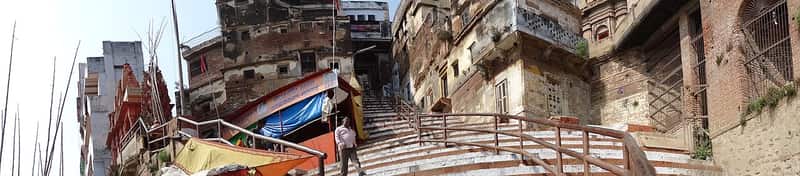
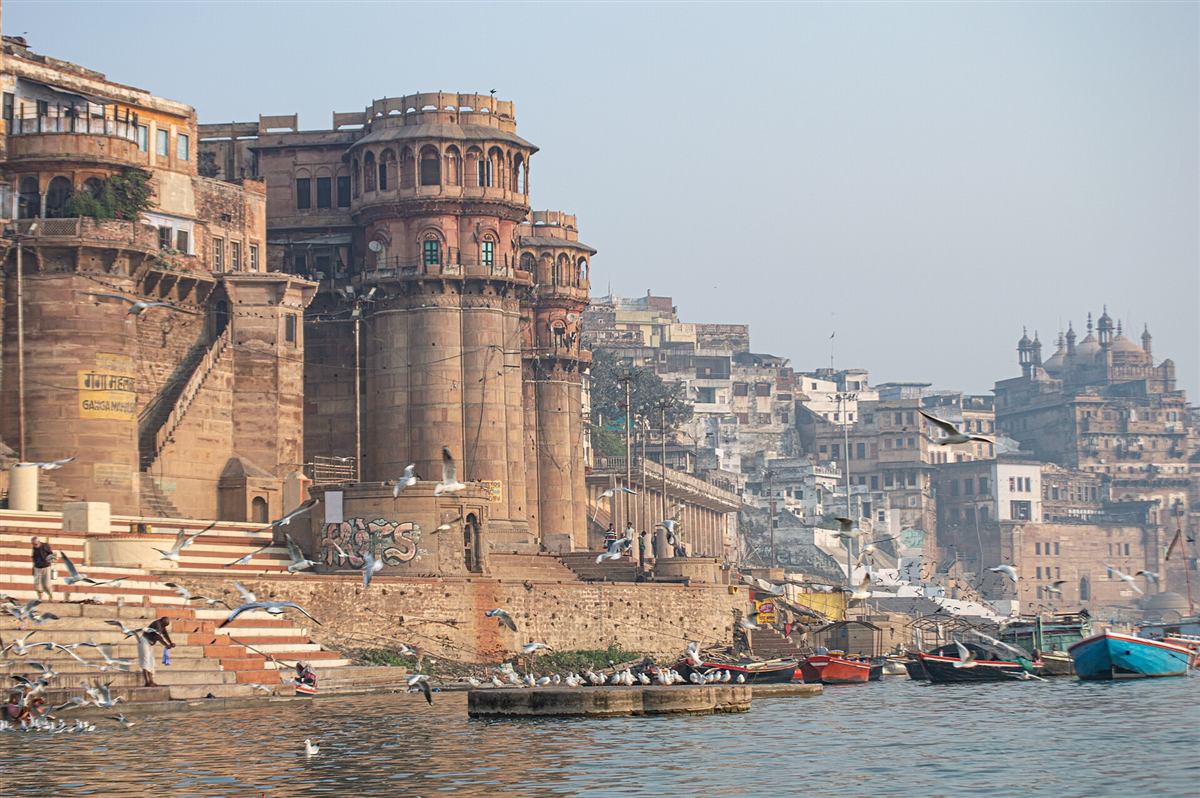
From the steps of Durga Ghat the Ganga reveals herself in her widest, most generous mood. North of the city's great crescent the floodplain opens out, and the river spreads across the horizon like a living mirror, silver at dawn and gold at dusk. The far bank lies low and green, its villages hidden among the trees, and the gulls and cormorants that ride the current belong more to the open river than to the city. Looking south from this reach, the long line of ghats recedes toward the crowded heart of Kashi — the towers of temples, the great stone palaces, the smoke of the burning ghats — while ahead of the northern bend the river widens toward the sacred confluence at Raj Ghat and the open country beyond. It is one of the finest long views in Varanasi, and almost nobody comes to see it.
The river here is not merely scenery; it is the highway, the larder and the lifeblood of the northern mohallas. The boats that pass Durga Ghat carry pilgrims on the great river circuit, farmers bringing produce to the city's markets, and families crossing to the floodplain for festivals. In the summer months, when the water withdraws into the deep channel, broad sandbanks appear mid-river, and the boatmen race their ferries — which the local saying calls the horses of the river — across the shallows with practiced skill. When the monsoon swells the river, the scene changes completely: the sandbanks vanish, the current quickens, and the water climbs the lower steps, reminding everyone that the Ganga is a living force that the ghats merely serve. To sit on the mid-steps and watch these moods succeed one another is to understand why the river is worshipped as a goddess and not merely admired as a landscape.
The view from Durga Ghat is also a lesson in the meaning of Kashi. Every direction from this modest landing leads somewhere sacred: south toward the temples of the city and the pyres of Manikarnika, north toward the confluence at Raj Ghat and the open stretch to the holy city's ancient edge, and across the water to the floodplain where the river god himself, in the form of a boy playing in the shallows, was once said to walk. Boatmen tell that on quiet mornings, when the mist lies low over the water, you can see the whole chain of ghats at once, strung along the river like a garland of stone. From Durga Ghat, that garland hangs at its northern end, and the goddess's blessing guards its last strand. It is a view that rewards patience, and the patient are few.
The Lanes Behind and the Durgakund
Behind Durga Ghat the old mohalla rises steeply through a web of lanes so narrow that the rooftops nearly touch. These alleys are the true country of the ghat: here the bathers live, the boatmen keep their homes, and the families who have tended the shrine for generations hang their washing between the walls. The lanes smell of cooking oil and incense, of cow dung cakes drying in the sun and the sweet damp of old brick. Doorways open onto tiny courtyards where tulsi plants stand in painted pots, and every few steps a small shrine or a painted image marks the passage of a deity. It is a complete world humming with its own rhythms, and the ghat below is simply the face it turns toward the river. Walking these lanes is walking through the biography of the ghat itself.
The most important thread running through these lanes is the one that leads to the Durgakund, the ancient tank of the goddess that gives the whole quarter its name. According to the old traditions of the city, the Durgakund marks the spot where Durga made her stand to protect Kashi, and the tank has been a centre of her worship for centuries. The temple beside the kund is one of the most frequented shrines in northern Varanasi, crowded during Navaratri and on the Tuesdays of the goddess, and its courtyard rings with bells from dawn to dusk. What visitors rarely notice is that the kund and the ghat belong to a single sacred geography: the same goddess who dwells at the tank extends her presence down to the water's edge. Devotees who bathe at the ghat often walk up to the kund afterwards to complete their worship, and the lanes between the two are worn smooth by the daily passage of their feet.
Walking these lanes, one feels the shape of the neighbourhood's devotion as clearly as the shapes of its houses. The Durgakund connection means that the ghat is never merely utilitarian: every bucket of water drawn from the river, every load of laundry carried up the steps, is moved within sight of the goddess's temples. The same women who bathe at the ghat in the morning take flowers to the kund in the afternoon; the same children who swim off the ghat's stones are brought to the kund to be blessed on their birthdays. In this way the two sacred places — one of water, one of stone — support each other like two hands cupped to hold a blessing. The visitor who climbs from the ghat to the kund, or descends from the kund to the ghat, is walking the oldest pilgrimage route of this quarter, a route measured not in kilometres but in faith.
The Neighbouring Ghats — Rama and Brahma
Durga Ghat stands in the middle of one of the most interesting stretches of the northern riverfront, flanked by two ghats whose names carry the whole sweep of Hindu tradition. To the south lies Rama Ghat, named for the hero of the Ramayana, the ideal king whose worship of Shiva is remembered in the devotional literature of Kashi. To the north lies Brahma Ghat, named for the creator god of the Hindu trinity, one of the very few ghats in the city dedicated to Brahma. Between the two, Durga Ghat holds the middle ground of the fierce, protective mother — and together the three form a living map of the divine family that watches over the city: the creator, the preserver and the protector standing along a few hundred metres of river.
Each of the neighbouring ghats keeps its own character. Rama Ghat is the quietest of the three, a plain landing beloved by morning bathers who value its peace; its shrine of Rama and Sita is tended with the same unhurried devotion as Durga's own. Brahma Ghat, farther north, carries an older and more mysterious sanctity, for legends say that the creator himself once performed a sacrifice on this spot, and the ghat's name is a rare survival in a city where Brahma's worship has almost vanished. The three ghats share the same working life — the same boatmen, the same bathers, the same washermen — and the same current runs past all their steps. Visitors who walk the northern chain on foot, climbing and descending from one ghat to the next, can cover Rama, Durga and Brahma within half an hour and see three faces of Kashi's faith in a single stretch.
The proximity of the three ghats also tells a story about the way Varanasi names its sacred places. There is no central plan to the ghats' names; they accumulated over centuries as patrons and communities dedicated their landings to the deities they loved. That is why the northern chain can hold a king's ghat beside a god's ghat, and a mother's ghat beside a creator's ghat, without any sense of conflict. For the boatmen who call the names across the water and the bathers who choose their steps each morning, the three names are simply part of one continuous prayer, spoken daily from Rama Ghat to Brahma Ghat. Durga Ghat, resting between them, is a reminder that the fierce mother stands guard not only over her own steps but over the whole blessed chain of the northern riverfront.
Visiting with Respect — Etiquette at the Ghat
Durga Ghat is a living place of worship before it is a place of sightseeing, and the first courtesy a visitor can offer is to remember that distinction. The shrine at the head of the steps is not a museum piece; it is the heart of the neighbourhood's devotion, and it should be approached as a place of worship — shoes removed or left aside, voice lowered, and no photographs of the inner sanctum without permission. When bathers are at their morning ablutions, keep to the upper steps and give them their privacy; the modesty of the faithful is a thing the river itself protects, and the thoughtful visitor turns away from what is not meant to be seen. Asking a devotee about the customs of the ghat is warmly welcomed; standing too close, staring or interrupting is not.
The river, too, asks its own courtesies. If you choose to bathe, follow the pattern of the regulars: keep to the marked stones, do not carry soap into the water, and never throw rubbish on the steps or into the current — the Ganga is a goddess here, and the plastic bottle you discard is an offence, not an accident. Leave the flowers and offerings of others untouched; they have been given to the river and belong to her alone. If you are offered prasad or blessings by a priest or an elder of the mohalla, accept with both hands and a smile; the gesture is the neighbourhood's way of including you in its blessing. Photography of the everyday life of the ghat is generally tolerated, but always ask before photographing people, especially the women of the mohalla, who value the privacy of their river rituals.
Finally, remember that Durga Ghat is a humble ghat in a great city, and its people extend their courtesy without expecting payment. If a boatman rows you out to see the river, or an elder shows you the way through the lanes to the Durgakund, a modest offering in the local spirit — a few rupees, or better, a purchase from their stall — is the accepted and graceful way to say thank you. Do not bargain aggressively over the ferries; the fares here are small and honestly set. Above all, carry the mood of the ghat with you when you leave: unhurried, grateful and quietly respectful. The people of the northern mohalla will remember a courteous visitor long after they have forgotten a thousand hurried tourists, and the goddess herself, the faithful say, keeps a special eye on those who honour her home.
Practical Notes — Reaching Durga Ghat
Durga Ghat lies on the northern riverfront of Varanasi, in the quiet stretch between Rama Ghat to the south and the open ground leading to Raj Ghat in the north. By land, the easiest approach is to walk north along the ghat promenade from Dashashwamedh, which takes roughly an hour at a gentle pace, or to take an auto-rickshaw to the lanes of the northern mohalla and walk down the last few hundred metres on foot, since vehicles cannot reach the river itself. From the old city's centre the walk passes through some of the most atmospheric neighbourhoods of Kashi, and most visitors find that the approach is half the pleasure. The ghat is not a major stop for tour boats, so the traveller who comes this far is already a traveller off the beaten path, and the river offers a more patient welcome to those who arrive on foot.
The best time to visit is early morning, between dawn and eight o'clock, when the bathing is at its height and the light on the water is soft and golden. The evenings, too, are lovely — the sunset over the floodplain, the lamps at the shrine, the boatmen's talk on the cooling stones. The monsoon months of July and August bring the river high, and the ghat's lower steps disappear under the current; at this season the ghat should be admired from the upper platform. The autumn months, especially October, bring Navaratri and the days of Durga worship, when the shrine above the ghat blazes with lights and the whole neighbourhood gathers in celebration — the finest moment of the year to see the ghat in its festival self. Winter mornings are misty and cold but deeply atmospheric, and the bathing continues through all of it.
In the neighbourhood the traveller has a wealth of nearby destinations. Rama Ghat lies just to the south, a short walk along the water; Brahma Ghat lies to the north, reachable on foot or by a short ferry ride. The Durgakund and its famous temple of the goddess rise in the lanes behind the ghat, less than a kilometre inland, and the Raj Ghat area, with its bridges, confluence and open river vistas, is a further walk north. On the way, the northern chain of minor ghats — each with its own deity, its own stories and its own community — unfolds like the beads of a rosary. Allow half a day for the whole northern excursion, and take water, comfortable shoes and a patient spirit. Durga Ghat will not be hurried, and the visitor who matches its pace will carry away a blessing of uncommon calm.

Durga Ghat — Gallery (10 Photos)
Image Credits
durga-01.jpg · durga-02.jpg · durga-03.jpg · durga-04.jpg · durga-05.jpg · durga-06.jpg · durga-07.jpg · durga-08.jpg · durga-09.jpg · durga-10.jpg — Wikimedia Commons, under free licenses.
Continue exploring
Similar Ghats Nearby
Book This Ghat — Get Notified
Download the app now and book a boat ride to Durga Ghat