

Vijayanagaram Ghat
Heritage GhatVijayanagaram Ghat is a grand ghat built by the King of Vijayanagaram in the 19th century. Known for its South Indian architectural style and ornate pillars.


Type
Heritage Ghat
Boat Fare
1.1x base fare
Best Time
6-9 AM
History
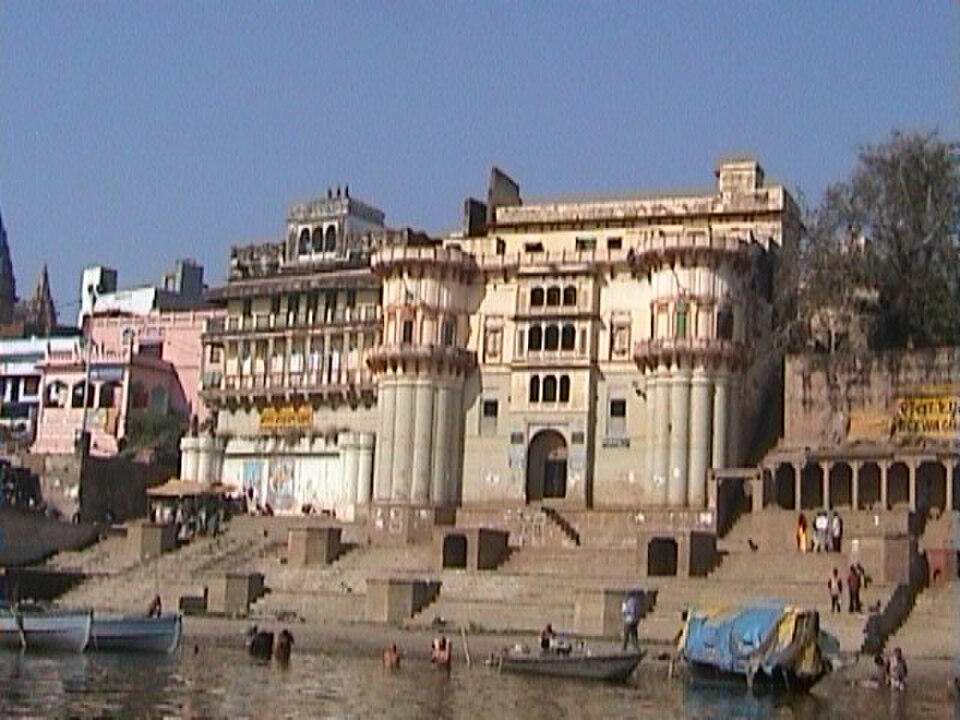
Built by the King of Vijayanagaram in the 19th century, this ghat is known for its South Indian architectural style with ornate pillars and carvings. A grand temple in Dravidian style stands on the ghat, reflecting the cultural ties between Kashi and South India.
Highlights
- Vijayanagaram palace architecture
- Royal historic heritage
- Peaceful bathing atmosphere
Festivals & Events
How pricing works in the NaviX app
No haggling at the ghat — everything is fixed in the app first
- 1
Fixed price before you board
The fare is shown in the app upfront — no bargaining at the ghat
- 2
Sharing or private — your choice
Share with fellow travelers or take the whole boat for your group
- 3
Pay only after the ride
UPI, card or cash — with an instant receipt
6:00 AM & 6:00 PM
Complete Guide
Vijayanagaram Ghat — The Complete Guide
History, mythology, rites and practical details — everything in depth.
On this page
- 1.Vijayanagaram Ghat — A Quiet Aristocrat of the Riverfront
- 2.The Maharaja of Vijayanagaram — A Prince of the Southern Deccan
- 3.Construction and the Royal Connection Through the Centuries
- 4.A Palace Face on the River — The Architecture of the Ghat
- 5.The Morning Bath — Daily Life at the Water's Edge
- 6.Moorings and Boatmen — The River's Working People
- 7.The River and the View — The Ganga at Vijayanagaram
- 8.The Lanes and the Mohalla — Life Behind the Ghat
- 9.Kedar, Lali and Harishchandra — The Ghat's Neighbours
- 10.Festivals by the Water — Celebrations at Vijayanagaram
- 11.Visiting with Respect — Etiquette at the Ghat
- 12.Practical Guide — Reaching Vijayanagaram and Planning the Visit
📅 Updated: 21 Aug 2026 · Author: NaviX Field Team (field research 2024-26) · 12 sections · 12 photos
Vijayanagaram Ghat — A Quiet Aristocrat of the Riverfront
Vijayanagaram Ghat stands quietly in the middle of Varanasi's long crescent of bathing steps, a handsome and dignified stairway that most visitors pass without a second glance. It lies between the busy ritual heart of the old city and the calmer southern stretch of the riverfront, close to Kedar Ghat on one side and Lali Ghat on the other. Unlike the roaring spectacle of Dashashwamedh or the deep solemnity of the cremation ghats, Vijayanagaram is a place of steady, everyday use: bathers at dawn, boatmen repairing their craft, women carrying brass pots, priests reading in the shade of the palace-like building that gives the ghat its aristocratic air. Its wide stone steps descend in easy, generous flights to the water, and at the top of the ghat a dignified residential frontage rises behind the platforms, built in the manner of a modest palace.
The ghat owes its name and its character to princely patronage from far away. It was built and endowed under the sponsorship of the Maharaja of Vijayanagaram — the princely state of Vizianagaram in present-day Andhra Pradesh — whose rulers joined the long tradition of Indian princes who raised ghats, temples and rest houses in Kashi as an act of devotion. For centuries, kings from every corner of the subcontinent regarded Varanasi as the spiritual capital of the Hindu world, and to leave one's name on its riverbank was counted the highest merit. Vijayanagaram Ghat is one such legacy, a southern dynasty's gift to the sacred city of the north. The result is a ghat that feels calm, orderly and a little aristocratic, its air of quiet dignity a living reminder of the royal hand that shaped it.
Perhaps because it lacks a great temple or a famous festival of its own, Vijayanagaram remains comparatively quiet even in the high pilgrim season. It offers the visitor something increasingly rare on the Varanasi riverfront: unhurried space, the sight of the Ganga as it flows past the old city, and the chance to watch the daily life of the ghats without crowds pressing in. This guide takes you through the ghat's royal patron, its history and architecture, the morning rituals of bathing, the boats and the boatmen, the surrounding lanes, the neighbouring ghats, the festivals that touch its calm, and finally the practical matters of reaching and enjoying it. Few ghats of the city reward the traveller with so much peace for so little effort.
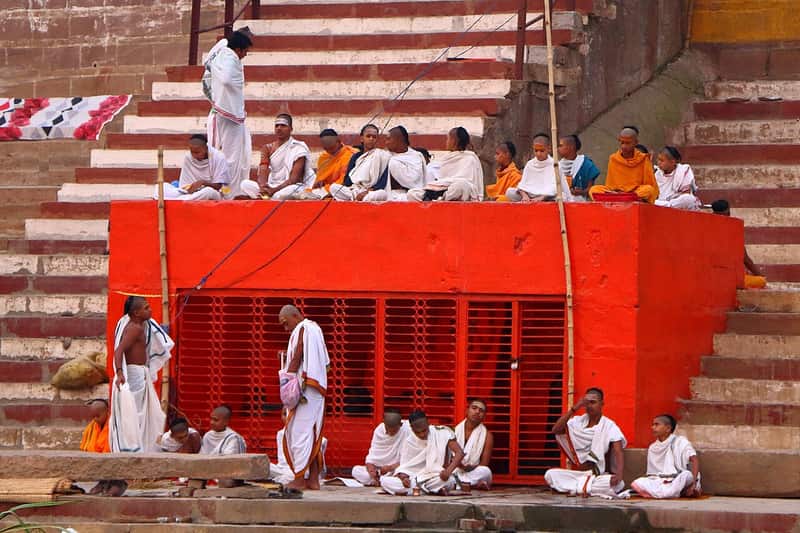
The Maharaja of Vijayanagaram — A Prince of the Southern Deccan
The story of Vijayanagaram Ghat begins not in Kashi but many hundreds of kilometres to the south, in the coastal region of present-day Andhra Pradesh. There, between the hills of the Eastern Ghats and the Bay of Bengal, lay the princely state of Vijayanagaram, often written in English as Vizianagaram. Its rulers, the Rajas of the Pusapati family, were notable patrons of religion, education and the arts, and like many Hindu princes of their age they considered the endowment of sacred sites in Varanasi one of the duties of kingship. The distance was enormous — a journey of weeks by road, rail and river — yet the bond of faith made the holy city feel like home, and the name of Vijayanagaram was inscribed on the Kashi riverfront for the same reason that other dynasties from Bengal, the Deccan and Rajasthan left theirs.
The custom of princely patronage along the Ganga is one of the oldest threads in the city's fabric, and almost every great ghat of Varanasi carries a royal name. Manikarnika was enriched by the Maratha lords, Scindia Ghat bears the mark of the Gwalior dynasty, Man Mandir was raised by Raja Man Singh of Jaipur, and Chet Singh Ghat remembers the maharaja who fought the British from its fort-like walls. Vijayanagaram Ghat belongs to this same fraternity of royal benefactors. For the Maharaja, building a ghat in Kashi was not merely an act of charity but a sacred investment, a way of ensuring that his name would be spoken with reverence beside the holiest river of India for as long as the water flowed.
The southern connection survives in the ghat's character. Where many ghats of the old city feel cramped and folded into the lanes, Vijayanagaram opens out with the generous proportions of a palace courtyard — broad platforms, an unhurried staircase, a frontage that turns its face to the river rather than to the market. It is the architecture of a family accustomed to space and dignity, transplanted to the crowded bank of the Ganga. Visitors who arrive knowing the patron's story often feel the ghat differently: every wide step becomes a memory of a royal road from the south, and the calm of the place reads as the confidence of a prince who knew his gift would endure.
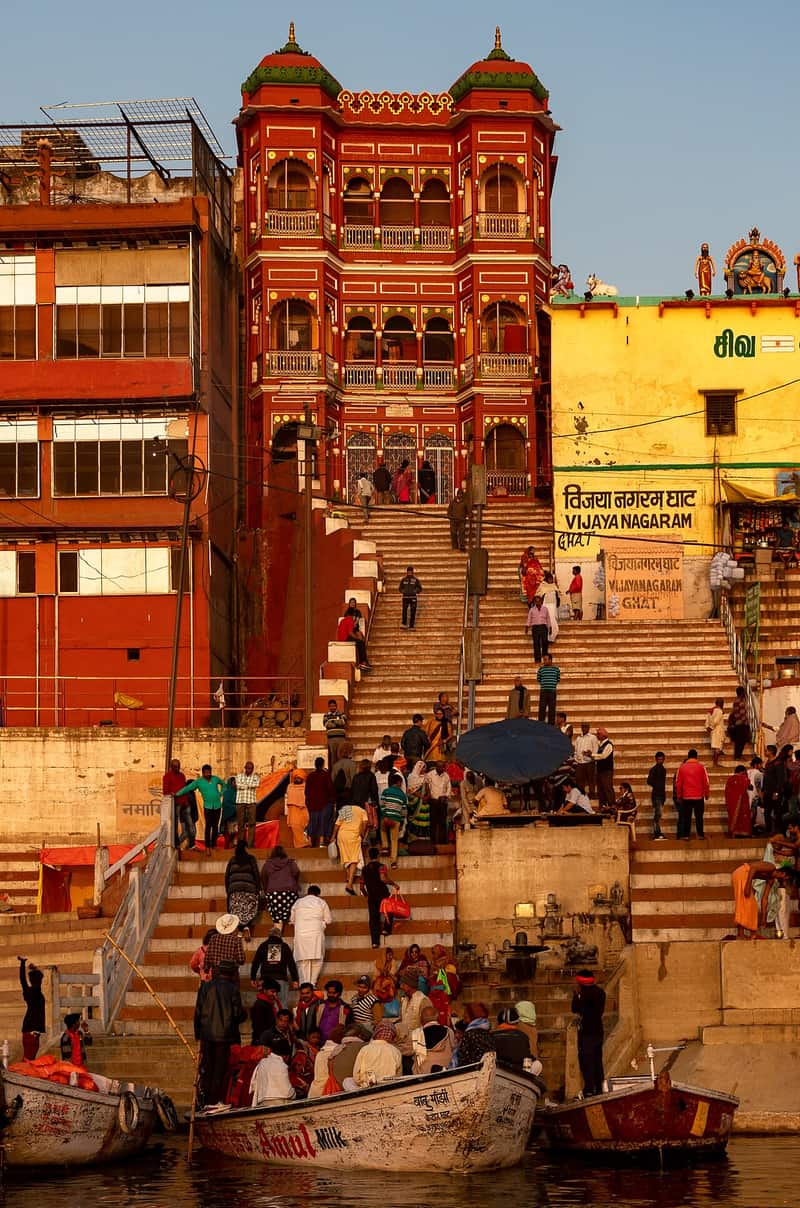
Construction and the Royal Connection Through the Centuries
The great wave of ghat building along the Ganga at Varanasi belongs mostly to the eighteenth and nineteenth centuries, when rival princely houses competed to leave the grandest mark on the sacred riverbank. Vijayanagaram Ghat rose in this atmosphere of royal rivalry, raised by the rulers of the Vizianagaram state as their own offering to Kashi. The exact year of its completion is not recorded in any surviving inscription, but the style of the structure and the records of the royal family place its construction firmly in the nineteenth century, when the state was prosperous and its maharajas were at the height of their influence. Like most ghats of the era, it was built of local Chunar sandstone and brick, with stone brought down the river from the quarries near Mirzapur, a practice as old as the city itself.
The royal connection to Kashi ran deep in the Vizianagaram family. The rulers were devoted worshippers of Shiva, and like many southern dynasties they made the long pilgrimage to the north, performing elaborate rituals on the riverbank and endowing temples, rest houses and ghats with land and money. Their ghat at Varanasi was part of a wider web of gifts — the family supported shrines and charities across the holy city, and their name remained attached to the riverfront long after the state itself had been merged into independent India in the middle of the twentieth century. The kings are gone now, and the palace at Vizianagaram is a memory, but the ghat they raised still stands in its original form, an unbroken link between a southern court and the eternal river.
In the decades since, the ghat has changed less than many of its neighbours. Modern additions have been modest — a few repairs, some new lamps, a renovated section of the frontage — and the general outline of the nineteenth-century structure remains intact. The river itself has been the greatest agent of change, shifting its course over the years, so that the waterline at Vijayanagaram today stands somewhat differently than it did when the maharaja's workmen set their last stone. Yet the essential character of the place, the calm and the dignity that its royal patrons intended, has survived every change of the current. Standing on the platforms of Vijayanagaram Ghat, one stands on ground that a southern prince chose, blessed and gave to the world.
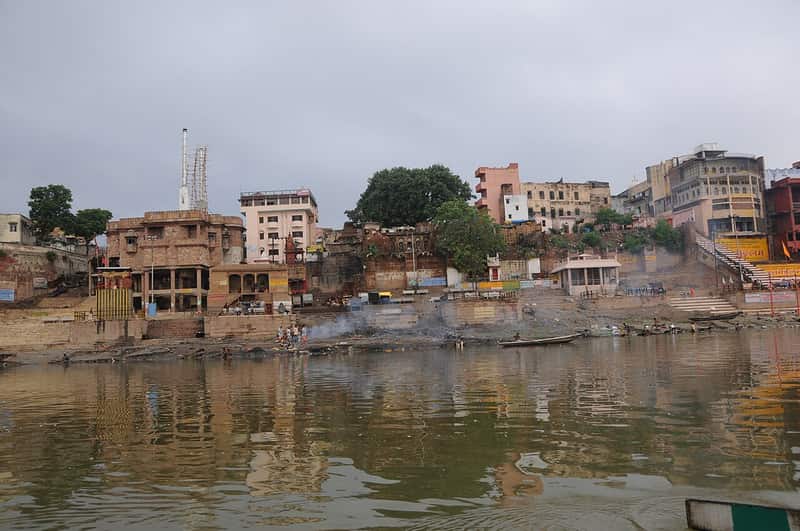
A Palace Face on the River — The Architecture of the Ghat
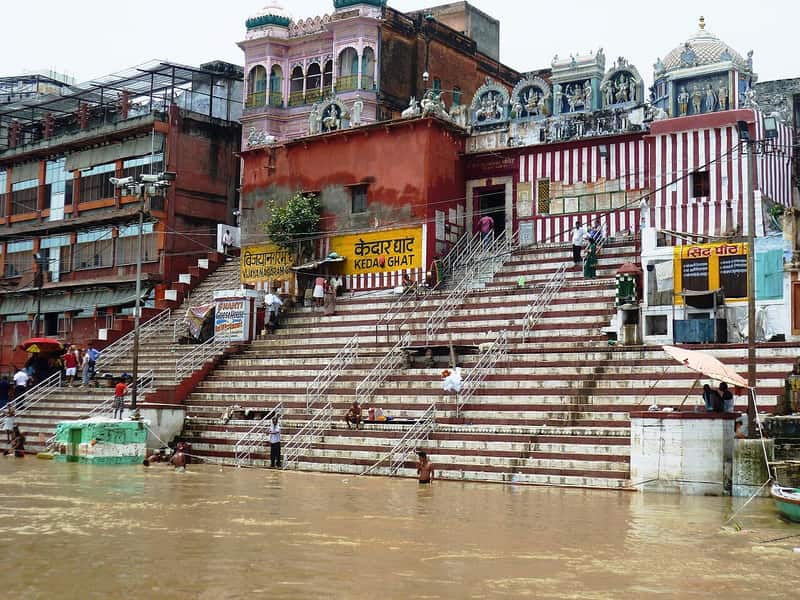
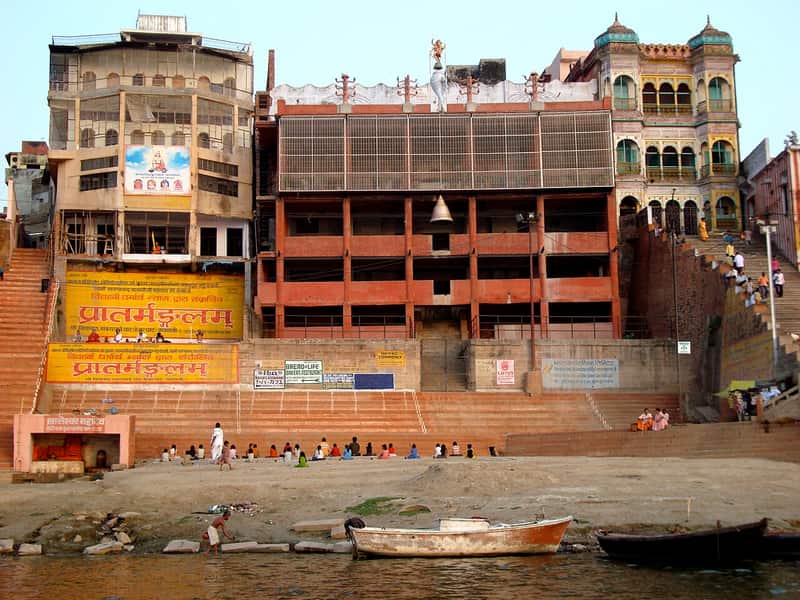
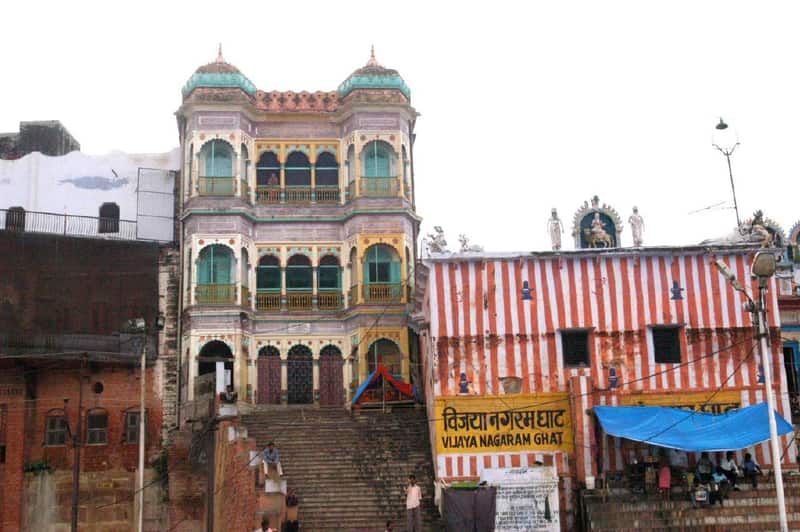
The architecture of Vijayanagaram Ghat is its quiet glory. Where many Varanasi ghats present a jumble of shrines, painted signs and climbing vegetation, this ghat offers a composed, symmetrical frontage that turns the full width of its upper terraces into a single elegant statement. The building behind the platforms is domestic in function yet palatial in manner — a broad facade of balconies and arched windows, with shallow eaves and a restrained decorative scheme that recalls the style of the old city's wealthy mansions while keeping a princely scale. Its plastered walls, once brilliant white, now carry the soft patina of river air and monsoon rain, and the whole composition rises in tiers from the waterline: first the great stone platforms, then the steps, then the terraces, and finally the skyline of the old houses beyond.
The steps themselves are the ghat's most generous feature. Cut from the sandstone of the Chunar hills, they descend in broad, shallow flights that make the descent to the river an unhurried ceremony rather than a scramble, and their width allows bathers, boatmen and pilgrims to pass without jostling. At intervals the staircase is broken by wide landings, and at the water's edge the lowest platforms are rebuilt again and again as the river rises and falls, each new course of stone bearing the marks of the floods it has survived. Small shrines are tucked against the retaining walls, and in the niches of the facade stand images of Shiva and Hanuman, their garlands renewed daily. Nothing here is grand in the manner of a great temple, yet the ensemble has a completeness, a sense of a place designed and finished as a whole, that many more famous ghats lack.
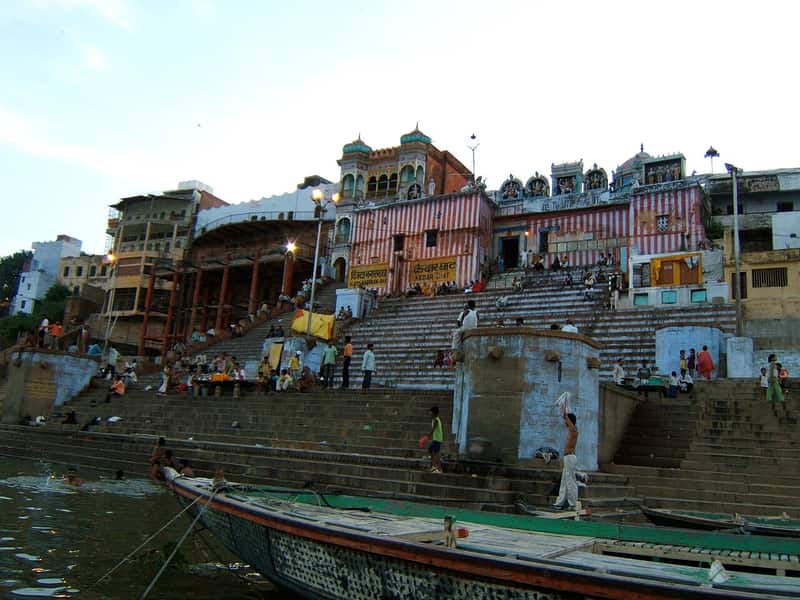
Seen from the river, the ghat composes itself like a stage: the dark water, the pale stone, the palace-like building rising above the steps. Boatmen who moor here say the facade was meant to echo, in miniature, the forts and palaces of the Vizianagaram kingdom, so that the maharaja's courtiers, arriving in Kashi by boat, would see a familiar silhouette against the sky. Whatever truth lies in the story, the architecture achieves exactly what good ghat architecture should: it frames the sacred act of bathing with dignity, gives the bather a handsome threshold, and turns the everyday business of washing and prayer into something ordered and beautiful. For lovers of the old riverfront, the palace face of Vijayanagaram is among the most satisfying sights of the mid-city ghats.
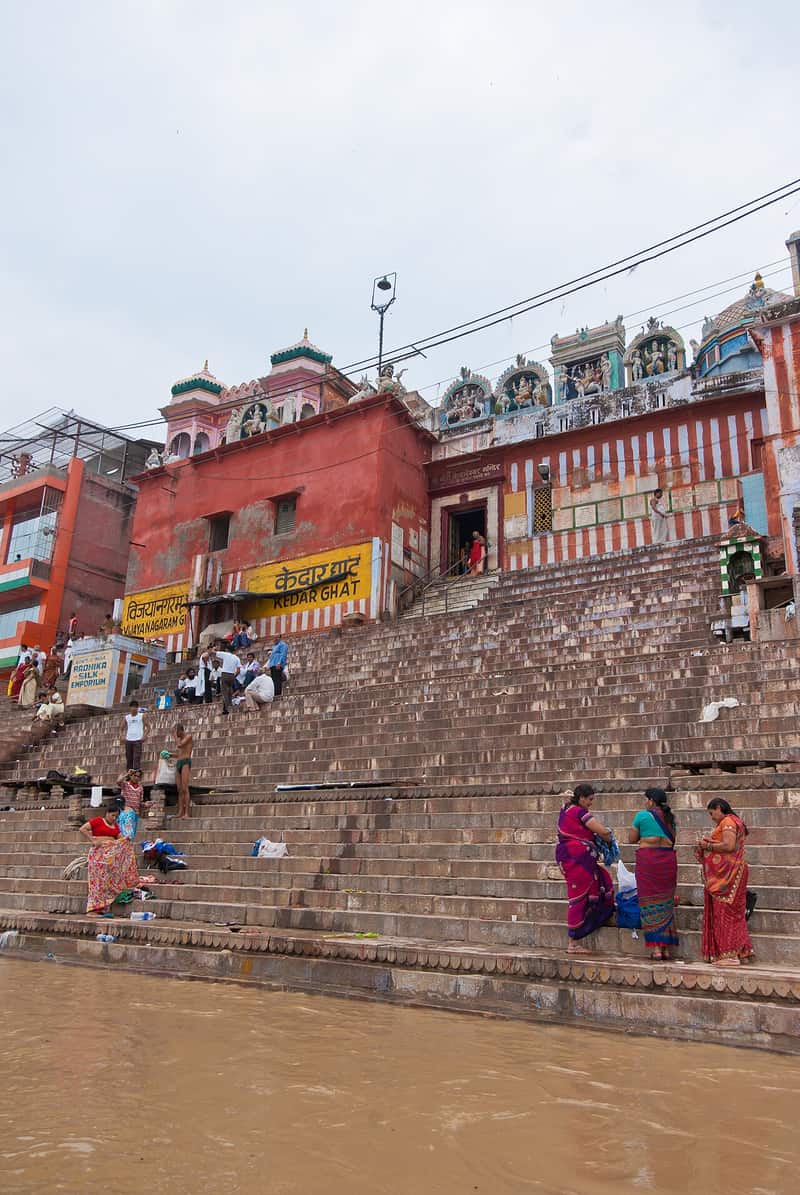
The Morning Bath — Daily Life at the Water's Edge
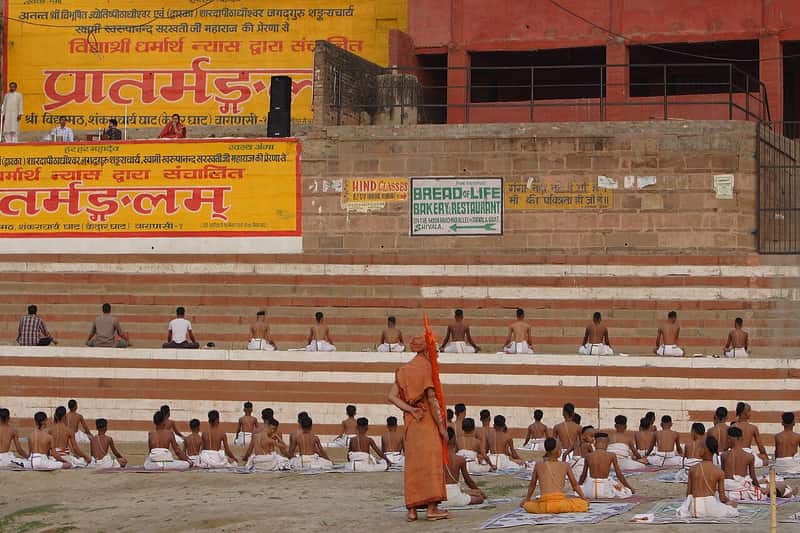
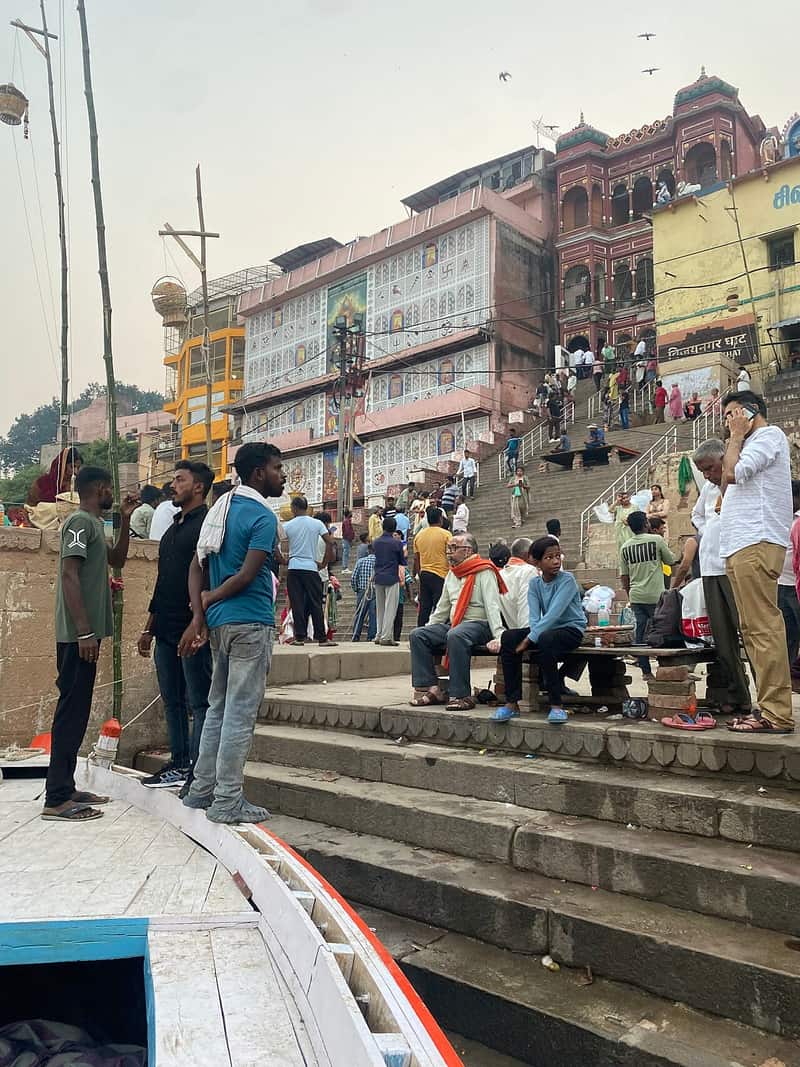
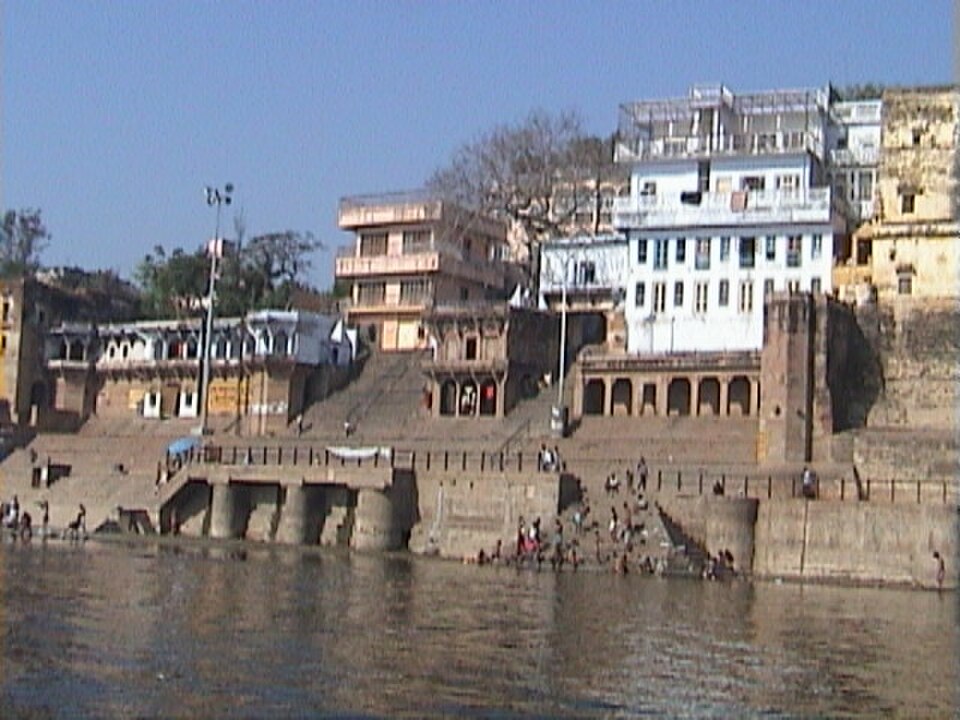
Like every ghat of Varanasi, Vijayanagaram wakes with the sun, and its first hours belong to the bathers. Long before the boats begin to stir, the first pilgrims arrive through the lanes carrying their brass lotas, their offerings of flowers and marigold, and the clean clothes they will change into after the dip. The ritual is unhurried and precise: the bather stands chest-deep in the cold water, faces the rising sun, pours water from the vessel with a whispered mantra, and ducks beneath the surface three times, rinsing the body and the mind together. Old men perform the practice with the ease of a lifetime; young women with infants step delicately on the slick stone; priests on the platforms wait with tilak and blessings for those who want them. The noise is low — the murmur of mantras, the splash of water, the call of a boatman — a gentle counterpoint to the uproar that governs the greater ghats.
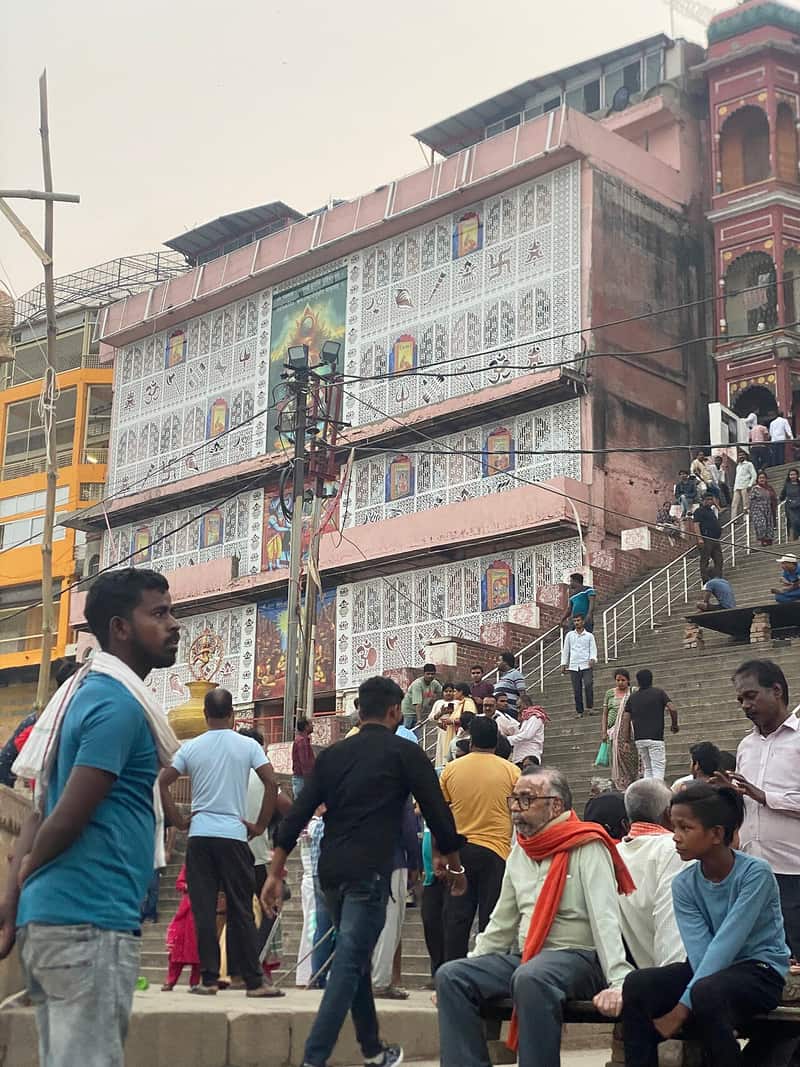
What makes bathing at Vijayanagaram special is the space. On many of the city's famous steps, the morning crowd is so dense that the waterline becomes a queue; here, the wide terraces and broad staircase absorb the bathers comfortably, and there is room to lay out clothes, to sit and dry in the sun, to hold a small puja on the stones without being jostled. Families come together, grandparents and grandchildren, and the ghat takes on the air of a slow festival of cleanliness and prayer. Women wash brass and steel vessels on the lower platforms, beating them with ash and sand until they gleam; laundry is beaten against the stones and spread on the rails to dry; and all the while the river takes it all in, the same patient water that has received the same offerings for millennia.
The late morning brings a different crowd: children out of school, students with books, office workers snatching a quick dip before the day's business. Some bathe with a specific vow in mind, carrying the ashes of a relative to be consigned to the Ganga from these gentle steps, while others come simply for the refreshment of the water. By noon the ghat is mostly quiet again, given over to the sun and the boats. For the visitor, the lesson of the morning is simple: arrive early, stand a little apart, and watch. The bathing of Vijayanagaram Ghat is one of the oldest and most ordinary rituals of the city, and in its ordinariness — unhurried, neighbourly, devout — lies its quiet beauty.
Moorings and Boatmen — The River's Working People
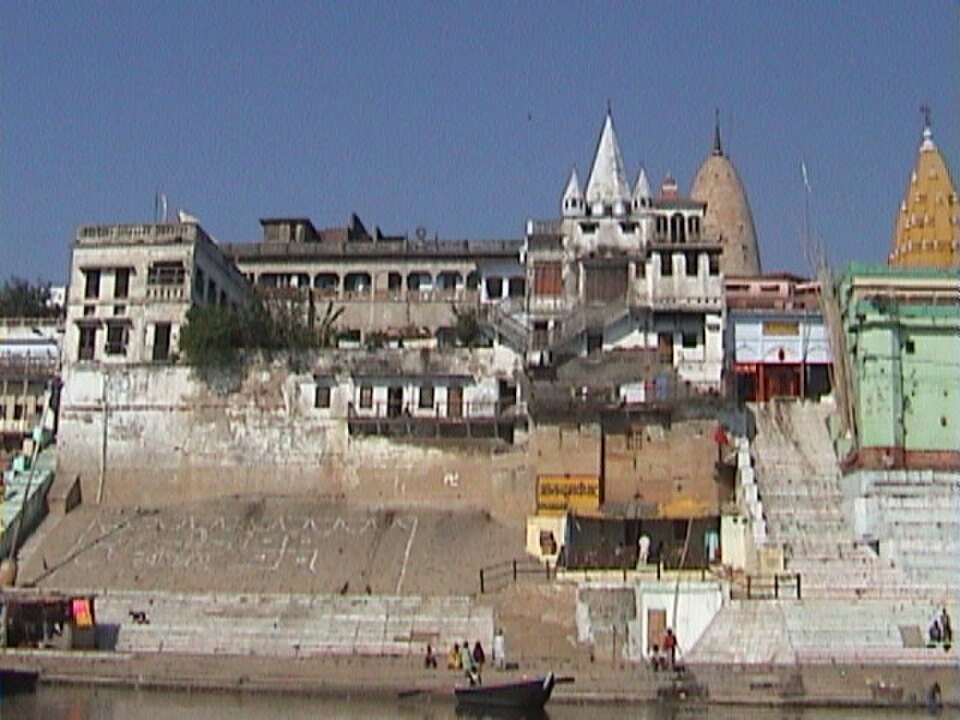
The boats of Vijayanagaram Ghat are a working fleet, not a tourist fleet, and that is exactly their charm. Simple wooden craft of the classic Varanasi pattern — high prow, broad hull, a canopy of bent bamboo covered with canvas — lie moored in a long line at the waterline, straining gently against their ropes as the current tugs at them. Their owners, the mallahs of the old boatmen's community, have worked these reaches of the river for generations, ferrying pilgrims, carrying goods, and reading the moods of the Ganga with an accuracy no weather forecast can match. Some of the boats are hired for sunrise rides along the ghats; others are working craft used for washing, fishing and transport. Painted in greens and blues, with a single eye and the word Jai Ganga on the bow, they are as much a part of the ghat as the stones themselves.
Boatwork at Vijayanagaram begins early. By first light the boatmen are on the water, checking the moorings, baling out the night's rainwater, and caulking seams with cotton and oil where the sun has dried the planks. The morning's ferries take pilgrims across to the far sandbank, where the current is gentler and the water cleaner, and bring them back with loads of firewood, fodder and market produce. Between trips the boatmen sit on the platforms, mending nets, smoking, and telling the endless river stories — of floods that swallowed whole ghats, of the shifting sandbanks that remake the shoreline every year, of the crocodile said to haunt the deep water below the palace facade. It is a hard life, ruled by the river's rhythm, and its men carry the quiet weather-beaten dignity of people who work with water.
For the visitor, the boats of Vijayanagaram offer the most peaceful water ride in the city. A boatman will row you slowly north toward the great ghats or south toward the quiet ones, and the view from the water shows the palace frontage as its builders meant it to be seen. The fare is modest and the pace is yours; there is no script, no commentary, only the creak of oars and the murmur of the river. The boatmen are not performers but hosts, and their pride in their craft is evident in the way they handle it — the precise stroke, the easy turn, the respectful pause as another boat passes. Taking a boat from Vijayanagaram is to enter the river's own element and to see the ghat, for once, exactly as the maharaja's builders intended.
The River and the View — The Ganga at Vijayanagaram
At Vijayanagaram the Ganga runs wide and comparatively calm, a broad sheet of slow-moving water that mirrors the sky from dawn to dusk. This stretch of the river, between the busy middle ghats and the quiet southern ones, carries the full history of the city in its current: the ashes of countless cremations, the petals of a thousand pujas, the silt of the Himalayan snows that begin their journey hundreds of kilometres upstream. In the dry months the river draws back, revealing wide sandbanks where boatmen dry their nets and children fly kites; in the monsoon it swells to a great brown flood that licks at the highest platforms and turns the ghat into a quay. Either way, the water at Vijayanagaram has a quality of light that painters love — grey and silver at dawn, copper at sunset, ink-blue under the moon.
The view from the ghat is one of the finest on the mid-riverfront. Looking north, the eye travels along the curving line of ghats past the domes and spires of the old city, catching the towers of the great temples and, on clear days, the smoke of the cremation ground rising on the far bank of the curve. Looking south, the shore grows quieter and greener, with the trees of Assi and the horizon of the southern suburbs. In between, the river itself performs an endless slow ballet of boats — a rowing ferry, a motor launch carrying tourists, a lone fisherman in a tiny skiff. Standing on the upper terrace of Vijayanagaram at sunset, with the water turning to gold and the first lamps beginning to glow in the windows behind you, it is easy to understand why the maharaja chose this exact spot for his gift.
The river is also the ghat's clock and calendar. Its rising and falling sets the rhythm of work, its sandbanks appear and vanish with the seasons, and its moods decide whether the bathers will find a gentle pool or a racing current at the steps. In the old accounts of the city, the Ganga at this point was described as dharma jal — righteous water — believed to carry the grace of all the sacred places upstream and downstream alike. Whether one shares that belief or not, standing at the waterline with the wide river before you has an effect that needs no theology: the scale of the water, the slowness of its passage, and the patience of its flow quiet the mind in a way that few other sights of the city can match.
The Lanes and the Mohalla — Life Behind the Ghat
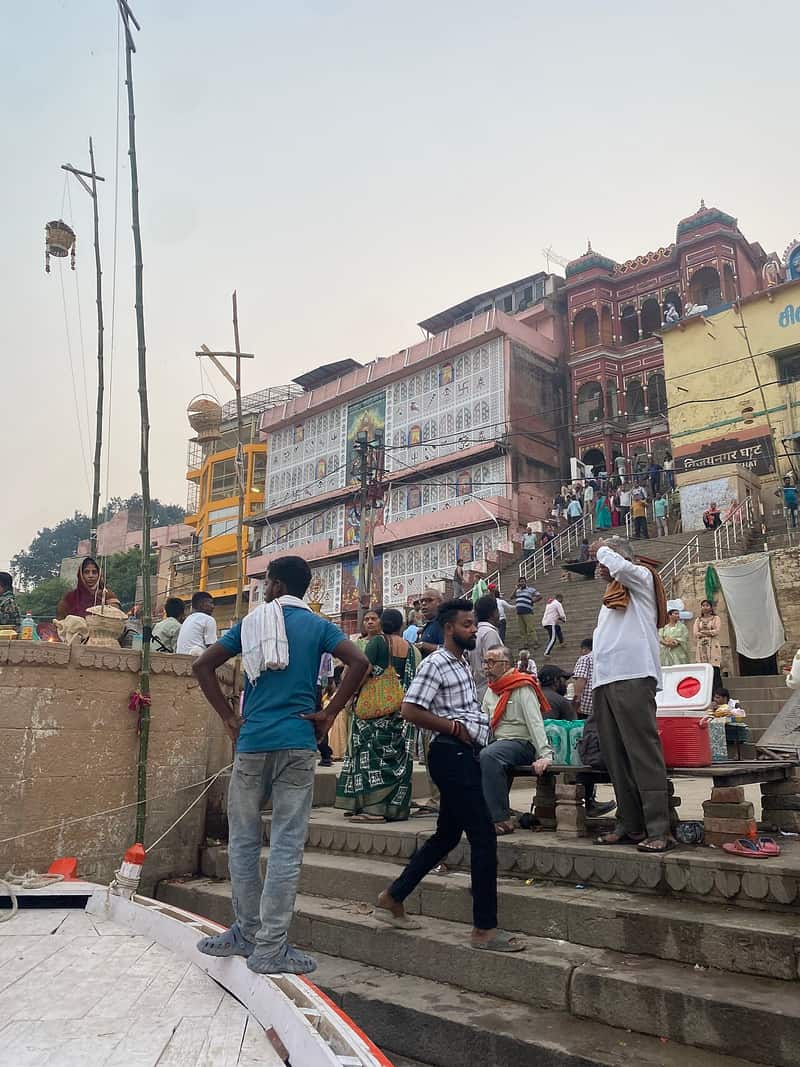
Behind Vijayanagaram Ghat begins the labyrinth of the old city, a dense warren of lanes and mohallas that has grown layer upon layer for centuries. The streets here are narrow enough that neighbours can shake hands from opposite windows, and the air is a mixture of cooking smoke, incense and the damp smell of old brick. The houses are tall and close together, their facades carrying the traces of a hundred repaintings — a faded arch here, an old balcony there, a plaque marking a family that has lived in the same rooms for two centuries. Temples stand at the corner of nearly every lane, some no larger than a cupboard, with tiny bells that ring as the faithful pass. This is the domestic quarter of Kashi, the city's living heart, and the ghat is its front door to the river.
The mohalla around Vijayanagaram is a mixed and lively one, home to priests and weavers, shopkeepers and artisans. In the mornings the lanes fill with the noise of commerce — the milkman with his brass cans, the vegetable sellers with their baskets, the chai stalls where the boatmen gather before the first trip. Small workshops produce the city's famous goods: here a house where saris are woven on wooden looms, there a courtyard where brass pots are polished until they glow. The women of the mohalla come and go from the ghat all day, fetching water in the old way, washing clothes, spreading them on the rails to dry, and the children of the quarter have learned to swim in the same river where their great-grandparents learned before them.
Walking the lanes of the mohalla is one of the great pleasures of a visit to Vijayanagaram. Unlike the tourist arteries near the main ghats, these streets carry no souvenir stalls and no touts; they are simply the working veins of the old city, and the passer-by is treated with friendly curiosity rather than commerce. A walk of twenty minutes will take you from the ghat past little shrines, sweet shops, sari workshops and old water tanks, eventually emerging near the larger lanes that lead back toward the heart of the city. For those who want to understand the ghat, the mohalla is essential context: the riverfront may be the stage, but the lanes behind are where the actors live.
Kedar, Lali and Harishchandra — The Ghat's Neighbours
Vijayanagaram Ghat does not stand alone; it is one link in a chain of steps that stretches unbroken along this reach of the Ganga, and its nearest neighbours give the place its context. To the south lies Kedar Ghat, named for the Himalayan shrine of Kedarnath, a quiet stairway beloved of Shiva's renunciates and known for the great Shivratri celebrations that fill it with saffron-clad ascetics once a year. To the north, separated by a short walk along the waterline, stands Lali Ghat — also called Lal Ghat — a smaller, humbler neighbour that shares Vijayanagaram's calm and its sense of being a place for everyday life rather than spectacle. Between and behind them run the lanes of the old city, so that a morning walk along this stretch of the river passes through three very different moods of Kashi in as many hundred metres.
Only a little further north, past the curve of the river, lies Harishchandra Ghat, one of the two great cremation grounds of Varanasi. Named for the legendary king Harishchandra, who in the great story of the Mahabharata worked as a slave of the Dom at a burning ghat and won back his kingdom and his son through truth, it is a place of intense ritual life, its pyres burning day and night. Its presence nearby gives Vijayanagaram a particular dignity: the calm bathing ghat and the busy burning ghat together speak the two halves of the Hindu vision of the river, the life-giving water and the fire of release standing almost side by side. Visitors walking between the ghats pass from the quiet of a princely bathing place to the profound solemnity of the cremation ground in a single stride of the city's rhythm.
The closeness of these neighbours shapes the character of Vijayanagaram in subtle ways. Because the cremation ghats are near, the pilgrim traffic here includes mourners moving quietly toward Harishchandra, and the boatmen of the stretch ferry families who have come to consign ashes to the Ganga. Because Kedar Ghat is near, the lanes behind Vijayanagaram see the passage of sadhus on festival days. Yet the ghat itself remains its own place — neither the austerity of Kedar nor the solemnity of Harishchandra, but a middle ground of ordinary, sunlit devotion. For the traveller, this neighbourhood of ghats offers the richest short walk on the riverfront: three faces of Kashi, from palace calm to cremation fire, within a single morning's stroll.
Festivals by the Water — Celebrations at Vijayanagaram
Although Vijayanagaram is a quiet ghat, it is far from forgotten when the festival season turns the Varanasi riverfront into a chain of lights and processions. The greatest of these is Dev Deepawali, the festival of the gods, celebrated on the full moon of Kartik — usually November — when the whole crescent of ghats is lined with thousands of oil lamps. Vijayanagaram plays its part in this spectacle: the palace frontage glows with rows of clay diyas, marigold garlands hang from the balconies, and families of the mohalla gather on the terraces to watch the lamps float out onto the dark water. Boatloads of pilgrims pass the ghat on their way to the great ceremonies, and for a few nights the quiet stairway is part of the most famous riverside celebration in India.
Through the rest of the year the ghat observes the ordinary calendar of Kashi with neighbourhood warmth. On Kartik Purnima itself, and on the full-moon days of the month of Kartik, special baths are taken before dawn, with the merit of a dip said to multiply a hundredfold. During Nag Panchami the images of the serpent gods are worshipped on the platforms, and during Makar Sankranti kites fill the sky above the ghat while pilgrims bathe in the winter sun. Chhath, the great festival of the east, sees devotees stand waist-deep in the Ganga at this very stretch, offering arghya to the setting and rising sun. And on every ordinary day of the year there are the small ceremonies that are festivals in miniature — a child's first haircut, a young man's upanayana, a widow's offerings at the waterline.
What distinguishes Vijayanagaram in festival season is its scale of intimacy. The great shows happen at Dashashwamedh and the famous ghats; here the celebrations remain local, attended by the families of the mohalla, the boatmen and the neighbouring sadhus, with the palace frontage as a calm backdrop. Visitors are welcome, and there is no better place from which to watch Dev Deepawali's sea of light than the wide terraces of this ghat, with the river's reflection doubling every flame. The festivals of Vijayanagaram are the festivals of Kashi's everyday — smaller, warmer and closer to the homes behind the steps — and they show the visitor a side of the holy city that the great pilgrim thoroughfares never reveal.
Visiting with Respect — Etiquette at the Ghat
Vijayanagaram Ghat is a living place of worship, not a museum, and visiting it well means remembering that simple fact. The bathers at the waterline are performing acts of deep religious meaning, and the first rule of etiquette is to keep a respectful distance and to photograph them only with permission, preferably from above and behind. Dress modestly, as one would in any holy place of India; shorts and beachwear are out of place on a bathing ghat. If you are invited by a priest to take part in a puja, you are welcome to join, but agree on the customary donation beforehand, as the same is expected at every ghat of the city. Small courtesies — removing shoes on temple platforms, not pointing at deities, folding the hands in greeting — go a very long way.
The second circle of etiquette concerns the river and its gifts. Never touch or step over the offerings that have been placed on the stones — flowers, garlands, small clay lamps, brass pots of water — for these are the material of someone's prayer, and to disturb them is to disturb the prayer itself. Take care not to toss plastic bottles or wrappers into the Ganga, a river already burdened beyond measure; keep your waste with you until you find a bin, and carry your own water rather than buying single-use plastic bottles at the ghat. If you are offered a boat ride, agree on the fare before you step aboard, and pay the agreed amount cheerfully at the end; the boatmen are honest, hardworking people whose families have served the river for generations.
The third circle concerns the ghat's deeper sensibilities. Near Harishchandra, the cremation ghat, families in mourning pass quietly through the same lanes, and it is correct to give them space and silence rather than curiosity; photography of the burning ghats is never acceptable. Likewise, if you see a funeral procession approaching the waterline, step aside and stand still until it has passed, joining the moment of quiet that all the city observes. And remember that the priests, the sadhus and the shopkeepers of the ghat are hosts, not performers; treat them with the same courtesy you would offer in any home. A visitor who follows these quiet rules will find the ghat opening itself generously — and will leave with something far more valuable than photographs.
Practical Guide — Reaching Vijayanagaram and Planning the Visit
Vijayanagaram Ghat is easy to reach and easy to enjoy, and a little planning makes the visit much richer. The ghat lies in the middle stretch of the riverfront, roughly a fifteen-minute walk south from Dashashwamedh Ghat along the waterline, or a shorter walk from the lanes around Godowlia. From the railway station or the Cantonment, an auto-rickshaw can drop you at the nearest lane head, from which the ghat is a few minutes on foot. The classic approach, however, is by boat: a sunrise ride from Dashashwamedh or Assi brings you to the ghat with the palace frontage glowing in the first light, and the boatman can wait while you climb the steps for a closer look. The ghat is accessible throughout the year, though the best months are October to March, when the air is cool and the water at its gentlest.
For the best experience, arrive before sunrise. The early light on the water, the first bathers, the boatmen untying their craft, and the gradual waking of the lanes make the dawn hour at Vijayanagaram the most beautiful of the day, and the quiet crowd makes it an easy place to observe without intrusion. Carry modest clothing, a scarf or shawl for temples and the winter mornings, a water bottle you can refill, and small change for boat fares and offerings. There are no large restaurants on the ghat itself, but the lanes behind hold a handful of chai stalls and small eateries where the boatmen themselves eat, and these are both cheap and welcoming. Allow an hour for the ghat itself and another for the lanes, and leave time for the neighbouring ghats — Kedar, Lali and Harishchandra are all within a short walk.
A final word on timing and the seasons. The riverfront is at its most splendid during Dev Deepawali in November, when the ghat is decked in lamps; during the month of Kartik the pilgrim traffic rises, and on full-moon days the ghat fills early. Monsoon months, from July to September, bring the river high and sometimes the steps wet, but also the dramatic sight of the great brown Ganga running at full strength. For photography, the late afternoon offers the warmest light on the palace facade, with the sun behind the river. However you choose to come — on foot, by rickshaw, or by the slow and traditional approach of boat — Vijayanagaram rewards the traveller who arrives without hurry, and it keeps its calm ready for those who seek it.
Vijayanagaram Ghat — Gallery (12 Photos)
Image Credits
vijayanagaram-01.jpg · vijayanagaram-02.jpg · vijayanagaram-03.jpg · vijayanagaram-04.jpg · vijayanagaram-05.jpg · vijayanagaram-06.jpg · vijayanagaram-07.jpg · vijayanagaram-08.jpg · vijayanagaram-09.jpg · vijayanagaram-10.jpg · vijayanagaram-11.jpg · vijayanagaram-12.jpg — Wikimedia Commons, under free licenses.
Continue exploring
Similar Ghats Nearby
Book This Ghat — Get Notified
Download the app now and book a boat ride to Vijayanagaram Ghat