

Shivala Ghat
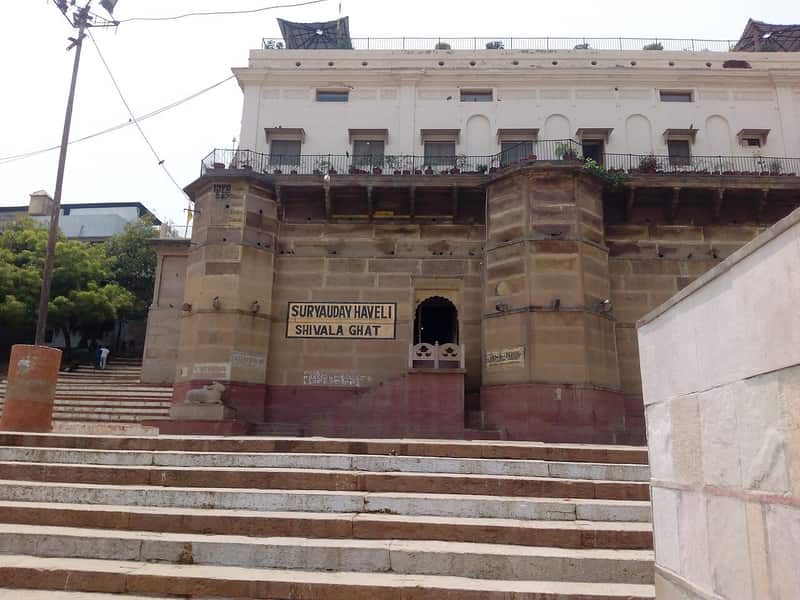
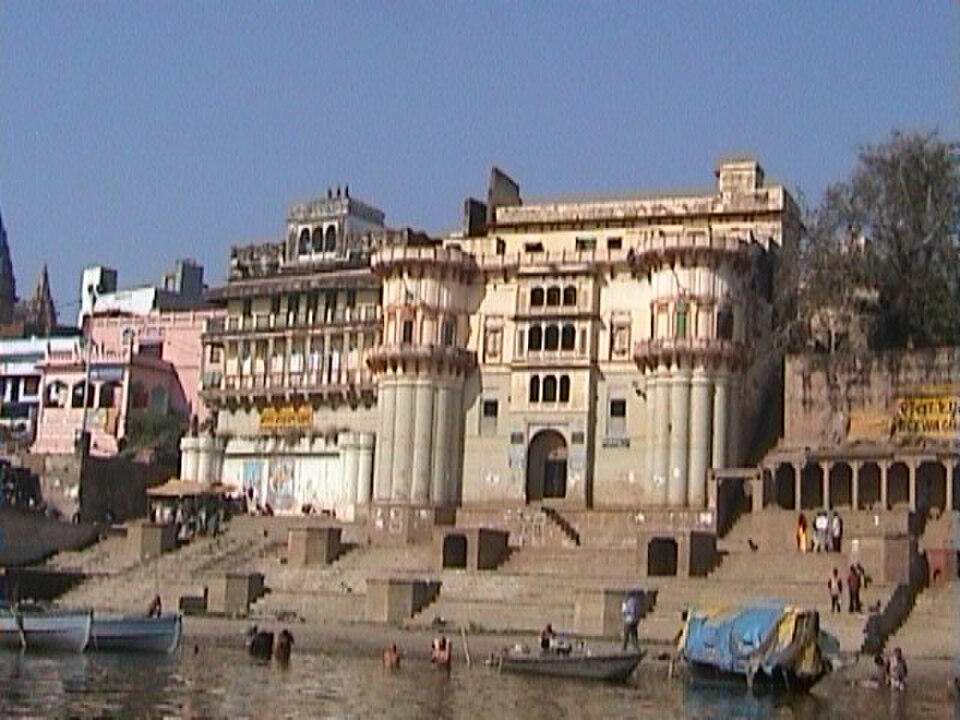
Heritage GhatShivala Ghat is an 18th-century historic ghat with a famous Shiva temple.


Type
Heritage Ghat
Boat Fare
1.1x base fare
Best Time
6-9 AM
History
Built in the 18th century. A famous Shiva temple is at the ghat center.
Highlights
- Historic royal palace architecture
- Sacred centre of Shiva lingas
- Glimpse of historic glory
Festivals & Events
How pricing works in the NaviX app
No haggling at the ghat — everything is fixed in the app first
- 1
Fixed price before you board
The fare is shown in the app upfront — no bargaining at the ghat
- 2
Sharing or private — your choice
Share with fellow travelers or take the whole boat for your group
- 3
Pay only after the ride
UPI, card or cash — with an instant receipt
6:00 AM & 6:00 PM
At the ancient Shiv temples along the ghat
Complete Guide
Shivala Ghat — The Complete Guide
History, mythology, rites and practical details — everything in depth.
On this page
- 1.Shivala Ghat: An Introduction
- 2.Shiva's House: The Name and the Temple
- 3.The Shivala Quarter: Hotels, Markets and Busy Lanes
- 4.Morning Bathing at Shivala
- 5.Boatmen and Moorings
- 6.The River and the View
- 7.Assi Ghat, Tulsi Ghat and the Southern Walk
- 8.Maha Shivratri and Local Celebrations
- 9.Respectful Conduct at the Ghat
- 10.Reaching Shivala: Practical Notes
📅 Updated: 21 Aug 2026 · Author: NaviX Field Team (field research 2024-26) · 10 sections · 10 photos
Shivala Ghat: An Introduction
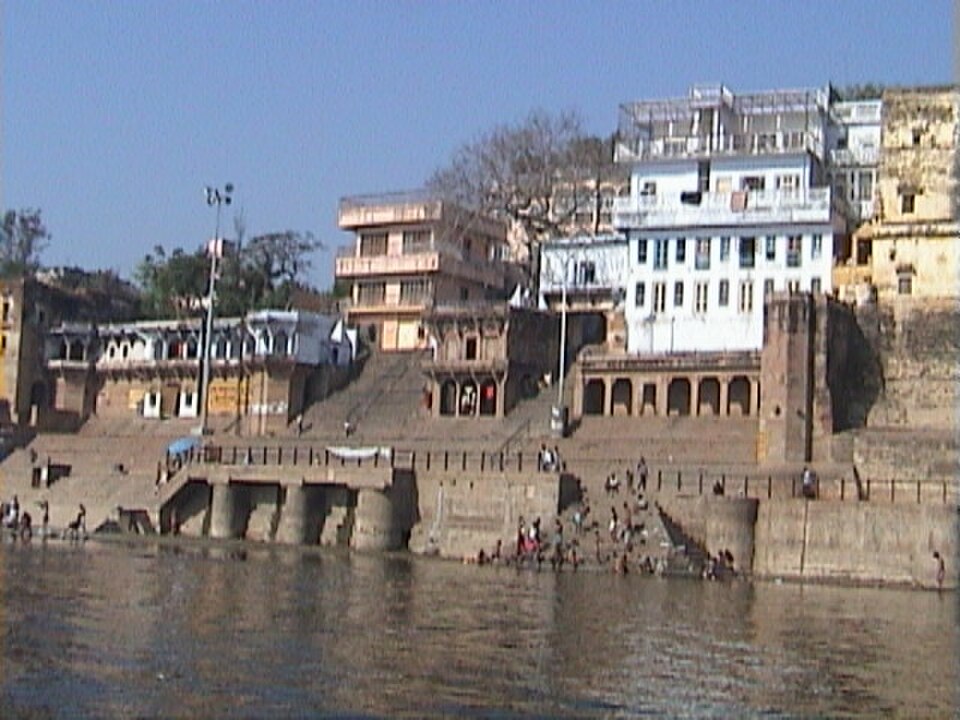
Shivala Ghat stands on the southern stretch of Varanasi's riverfront, in the lively quarter that bears its name. It is one of the largest and busiest ghats on this part of the Ganga, a broad fan of stone steps sweeping down from a dense residential neighbourhood to the water's edge. Unlike the quieter bathing platforms further south, Shivala is relentlessly alive from before dawn until late at night. Bathers arrive in family groups, boatmen shout for passengers, shopkeepers haul their wares across the steps, and the lanes behind the ghat hum with the traffic of an entire city district. For anyone walking between Assi Ghat and the old city, Shivala is an unmissable landmark, a place where daily commerce and river worship are woven into a single, unbroken rhythm. Its broad amphitheatre of steps is the great stage on which the quarter's public life unfolds.
The ghat's position gives it its character. It stands roughly midway along the southern riverfront, between the pilgrimage platforms of Assi and the dense maze of the old city, and the famous ghat walk passes directly through it. The steps are wide and deep, built for a river that rises and falls dramatically with the seasons. In the monsoon the water climbs close to the temple pavilions and shop fronts; in the dry winter months it retreats far across the sandbanks, leaving long stretches of pale sand where cattle graze and children kick footballs. Shivala is therefore a ghat of two faces at once — a crowded, commercial waterfront of boats and bicycles, and a serene place of ablution where pilgrims lower themselves into the water with their eyes fixed on the rising sun.
For the traveller, Shivala rewards those who linger. The crowd is more local than at Dashashwamedh, the commerce more everyday: pots and pans, flower garlands, sweet shops, mobile phone stalls. Old men sit on the parapets and watch the river; women wash clothes on the lower steps; a cow may wander through the middle of it all. From here the boat ride northwards reveals the whole theatre of the Varanasi ghats, while the walk southwards leads to the quieter reaches of Assi. Shivala is not a ghat one visits and forgets — it is a living neighbourhood with the Ganga at its feet, and it asks only that you take your time. Take a bench on the first terrace, order a glass of chai, and simply watch the current go by; the ghat will do the rest.
Shiva's House: The Name and the Temple
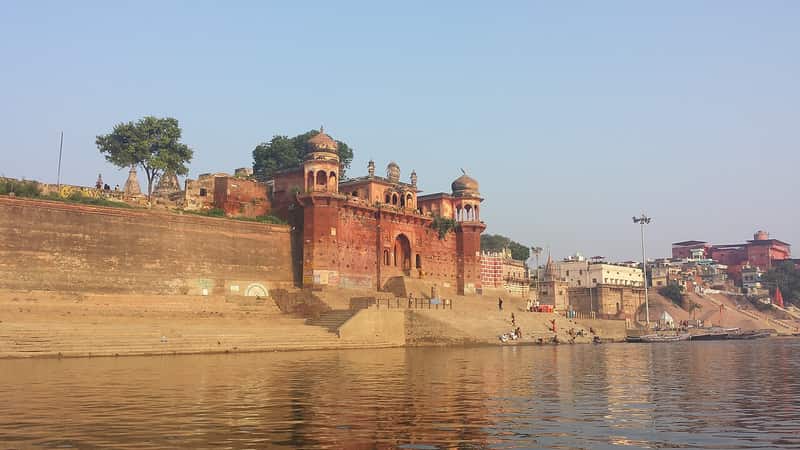
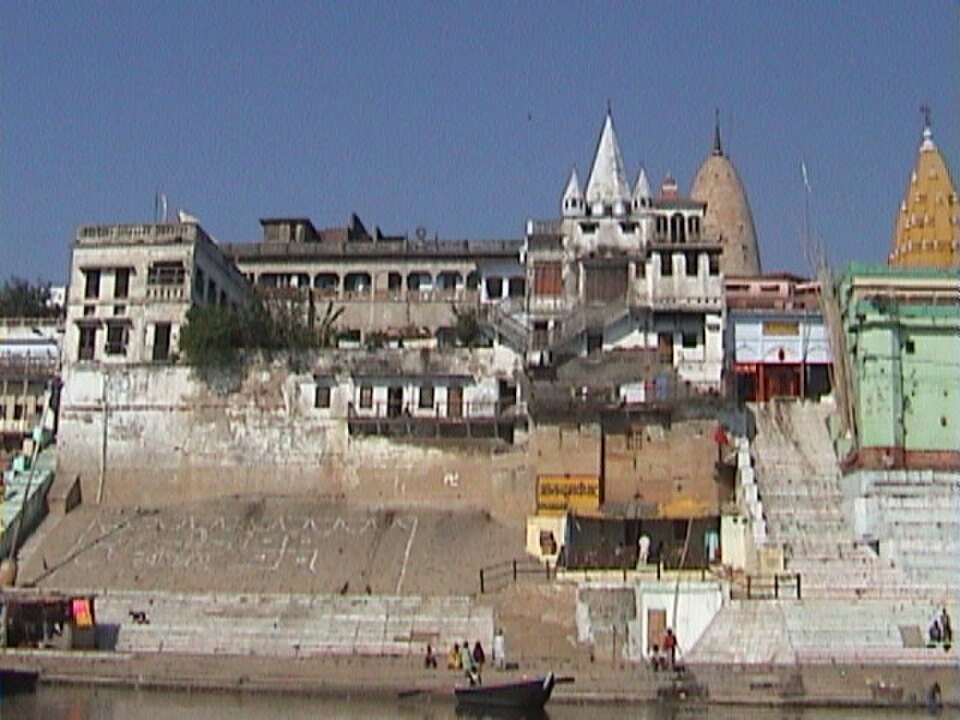
Shivala means the house of Shiva, and the name is no accident. Close to the ghat stands a temple of Shiva that gives the whole neighbourhood its identity; its shikhara rises above the rooftops, and through the day the sound of its bells drifts down the steps to the river. Shiva is the presiding deity of Kashi itself, the city that legend says he lifted on the points of his trident and saved from destruction, and this ghat carries his name as a reminder that every threshold in Varanasi leads, in the end, to him. Devotees often pause at the temple before their bath, touching the threshold with folded hands before descending to the water. The stone is worn smooth by that gesture, and the doorway is dark with the touch of a thousand hands.
The temple is modest beside the great shrine of Kashi Vishwanath, but it is deeply loved by the quarter. On Mondays, the day sacred to Shiva, the queues lengthen and the air grows thick with incense and the chanting of Om Namah Shivaya. Women carry brass pots of Ganga water to pour over the lingam, while families bring flowers, bel leaves and offerings of sweets. Priests conduct the abhishekam through the morning, and by evening the temple glows with oil lamps as the aarti begins. For the residents of Shivala this small sanctuary is the beating heart of their lanes, a place of marriages, mourning and daily blessing, where every important moment of a household's life is first brought before the deity.
The name also carries an older geography. In earlier centuries this stretch of the riverfront was one of the principal halting places for pilgrims arriving from the south, and the temple marked the point where their journey through the sacred city began. The deity received their first prayers before they moved on towards the great ghats of the centre. To stand on Shivala's steps and look from the temple to the river is to see the whole logic of Kashi in miniature: the shrine above, the cleansing water below, and between them the endless traffic of human devotion. The tradition lives on; every morning the quarter's first prayers are still offered at this threshold before the day's work begins.

The Shivala Quarter: Hotels, Markets and Busy Lanes
Behind Shivala Ghat lies the busy quarter that shares its name, one of the most densely populated districts on the southern riverfront. Here pilgrims and students, shopkeepers and boatmen, old families and new migrants live within a few narrow lanes of one another. The bazaar of Shivala is famous for its everyday goods — brassware, stainless steel pots, cloth, spices, sweets and the garlands of marigold that every household seems to need — and the pavements are stacked high from morning to night. Cycle rickshaws, scooters and hand-pulled carts thread through streets too narrow for cars, and the air carries the mixed smell of frying snacks, incense and river water. It is the kind of bustle that seems chaotic until you stand still long enough to see its order.
The quarter is also the natural home of the traveller. Along the lanes leading down to the ghat stand dozens of guesthouses and hotels, from simple rooftop rooms to comfortable modern establishments, many with terraces that look directly over the Ganga. Because the ghat is less crowded with tour groups than the central riverfront, staying here offers a calmer base from which to explore the southern ghats on foot. Restaurants serve thalis and lassis, tea stalls do a brisk trade at dawn, and shops selling puja materials, shawls and prayer beads cluster around the temple. Everything a visitor needs lies within a few minutes' walk of the steps, and the tea stalls above the ghat open their shutters before the sun is fully up.
The life of the quarter is conducted in public. Neighbours gather on the chabutaras, the raised platforms that front many houses; barbers work in the open air; students crowd the coaching centres that have made this part of the city an educational hub. In the evenings the lanes fill with families out for a stroll, and the ghat itself becomes a promenade where the whole neighbourhood comes to sit, chat and watch the last light fade over the river. To understand Shivala is to understand that the ghat and the quarter are one — the steps are simply the place where the street finally meets the water. This is the oldest pattern of Indian urban life, and nowhere in the city is it more legible than here.
Morning Bathing at Shivala
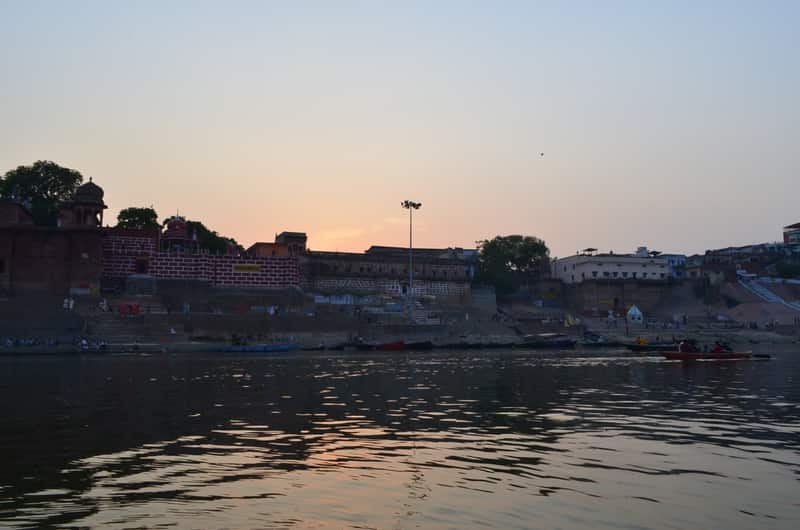
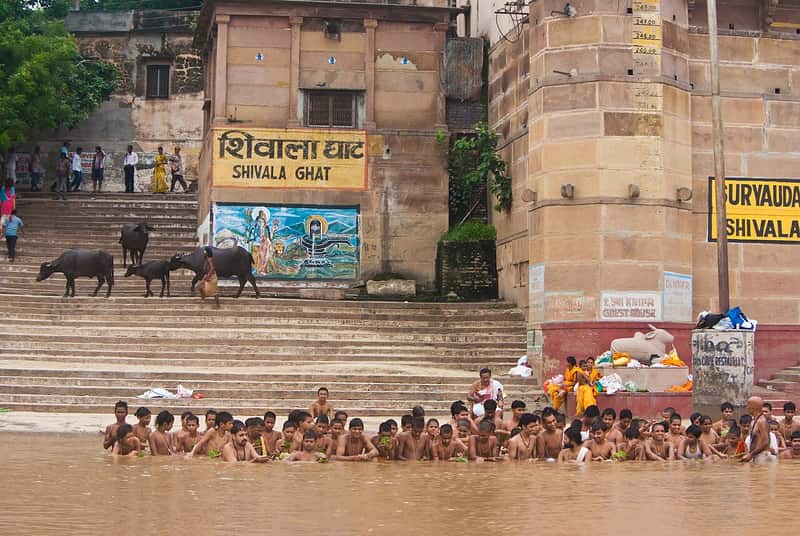
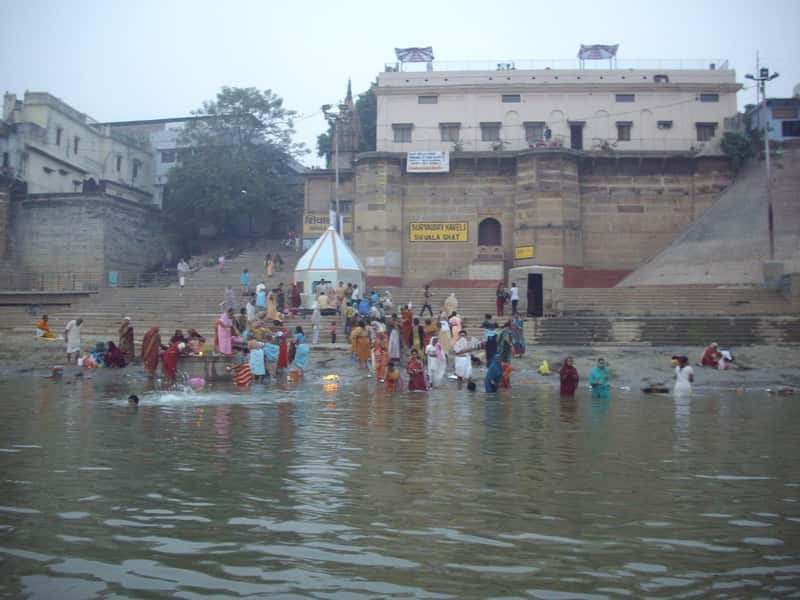
At dawn the ghat belongs to the bathers. Long before the sun clears the far bank, figures descend the wide steps with brass lotas and plastic buckets, towels folded under their arms. The ritual is unhurried and precise: clothes folded on the parapet, a first sip of water offered skyward, a murmured prayer, and then the slow, deliberate descent into the cold river. The immersion itself is the moment of meaning — a full dip, a handful of water raised to the sun, and the sense that the accumulated burdens of the years are being washed away. For the pilgrims of Kashi, no other bath is quite like this one. Nothing is hurried; the water is cold and the prayers are long, and the priests say that Ganga herself is listening.
The scene is communal as much as personal. Men chant together as they rinse, women in bright saris help one another with the water, children shriek at the cold and are dried vigorously by grandmothers. Some bathers take the water standing, some kneel, some dive in cleanly; priests on the lower platforms conduct small ceremonies, applying tilak and receiving offerings. The wooden and stone platforms built out into the river give the bathers footholds at every season, and in the winter months the sandbanks themselves become bathing beaches, crowded with colour against the pale sand. By seven the crowd is at its thickest, and the lower steps gleam with wet footprints as one family finishes and another takes its place.
After the dip comes the business of the morning. Bathers wring out their clothes, change behind shawls and sheets, and climb the steps with wet hair and shining faces. Many pause at the temple to offer the water they have carried up, or buy prasad and a marigold garland from the stalls on the first terrace. The ghat's water taps, built for ritual washing, are busy until mid-morning, and the sound of wet cloth slapped on stone joins the general chorus of the morning. By the time the sun is high, the bathers have thinned and the boats take over the river — but the day at Shivala always begins, as it has for centuries, with the body and the river meeting in the oldest of Varanasi's daily rituals.
Boatmen and Moorings
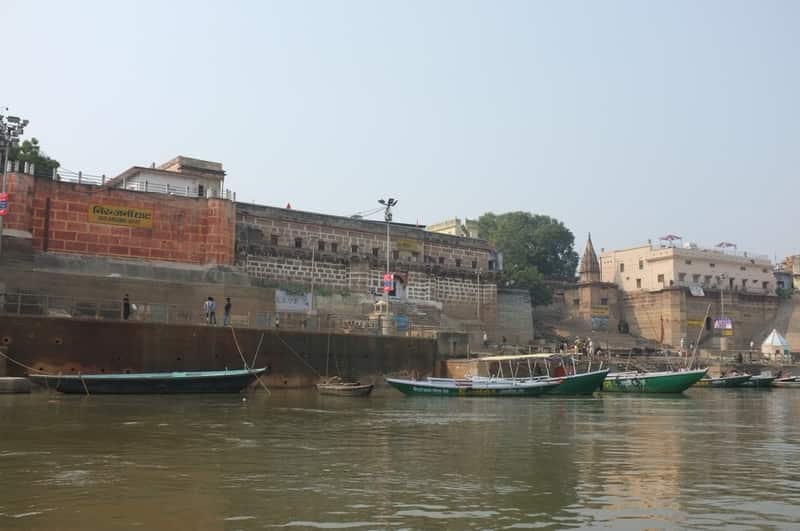
Boats are the ghat's second life. At any hour of daylight a flotilla of wooden skiffs bobs at the moorings below Shivala, their hulls painted in brilliant greens, blues and reds, their tarpaulin roofs rigged against sun and rain. The boatmen of the ghat — the mallah community, who have worked this river for generations — know every current, sandbank and channel for miles in either direction. They call to passers-by with the eternal questions of the riverfront: a sunrise ride, a boat to Assi, a round trip of the ghats. The negotiations are cheerful and brief, and once agreed, the boat is boarded with an ease that comes from a lifetime of stepping from stone to gunwale. Every boatman knows the river's moods better than any map.
The sunrise trip is the classic Shivala journey. As the sky turns from grey to gold, the boatman pulls steadily upstream along the line of ghats, past the smoke of morning fires and the silhouettes of bathers, until the boat swings back downstream to reveal the whole arc of the sacred city glowing in the first light. On the return, the oars dip in a rhythm as old as the city itself. The return trip carries the whole skyline in its wake — temple spires, hotel terraces, washing lines and the smoke of a thousand kitchens. Even a short crossing to the far bank, where sandy fields and low villages stretch to the horizon, offers a view of Shivala's skyline that no photograph from the shore can match. It is the one ride in Varanasi that no traveller should miss.
The boats are also working vessels. Locals use them to carry goods, to visit relatives on the other side, or simply to commute to the bathing sands; during the monsoon floods they become the quarter's only link to the city. Mooring is a fine art, for the river's level changes by metres between seasons, and the boatmen re-anchor their craft almost daily as the water advances or retreats. In the evening the boats return to their lines below the ghat, their lights flickering on the black water, and their wakes spread and dissolve like the day's small worries. By the time the last boat is tied for the night, the moon is usually already over the river, and the day of the waterfront ends where it began — among the boats of Shivala.
The River and the View
Here the Ganga is magnificent. The river at Shivala is wide and slow, curving gently southwards towards Assi, and the far bank lies low and sandy, an almost empty horizon of pale land and scattered trees. In the dry season great sandbanks rise in midstream, turning the river into a maze of channels, and it is possible to walk out across the wet sand where boats lie beached like stranded whales. The view changes every hour: rose-gold at sunrise, white-hot at noon, inky and starred at night, with the lights of the ghats strung along the water like a necklace. Nothing in Varanasi is seen twice, because the river refuses to hold still; even the ghat's own reflection is never the same two days running.
The river is the true master of the ghat. In the monsoon it swells into a brown flood that climbs the steps to the very thresholds of the shops, and the boatmen become ferrymen for the whole quarter. By winter it has fallen back, clear and blue-green, and the bathing platforms stand high above the water. The Ganga here is not scenery but presence — its current is visible, its voice is audible in the lap of water against stone, and its smell of silt and fish is part of the memory of every visitor. Pilgrims read the river as scripture, noting its moods, its levels, its gifts; those who bathe in it say it does not feel like water at all, but like a living current of time.
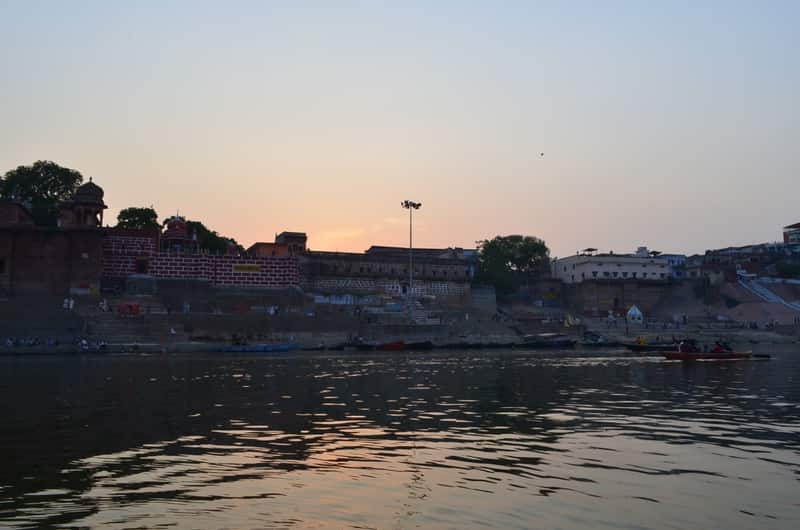
Sunset at Shivala is a public ritual. As the light fails, families gather on the steps, boats drift in from the river, and the aarti lamps begin to glow at the temples nearby. Across the water the smoke of evening fires rises from the far bank, and the last boatmen call out their final fares of the day. It is the moment when the ghat's noise falls away and the river itself takes the stage — wide, dark, endless, carrying the city's lamps, its prayers and its ashes southwards into the night. Somewhere downstream a conch sounds, and the whole riverfront holds its breath for a moment; then the night takes over, and Shivala sleeps with the sound of moving water in its ears.
Assi Ghat, Tulsi Ghat and the Southern Walk
Shivala sits at the heart of the southern ghat walk, the long pilgrimage promenade that runs from the city's oldest ghats towards the open river at Assi. Heading south, the walker passes a string of smaller ghats — Bhadaini, Janaki, Anandamayi — before reaching Assi Ghat, where the Assi stream joins the Ganga and where each morning the Subah-e-Banaras cultural programme draws a crowd of visitors for classical music and yoga at sunrise. Assi is the liveliest meeting point of the southern riverfront, with its cafes, bookshops and backpacker lanes, yet it remains, like Shivala, a working ghat at heart. The walk itself is flat and easy, shaded here and there by old trees, and it can be done in either direction with equal pleasure.
Turning north from Shivala, the walk threads past Tulsi Ghat, sacred to the memory of the poet-saint Tulsidas, who is said to have lived and composed his Ramcharitmanas in this very neighbourhood. Above the ghat, the temple of Sankat Mochan and the great Hanuman shrines lie a short distance inland, reachable by rickshaw through the same crowded lanes. Continuing north, the ghats grow older and more crowded — Hanuman Ghat, the cremation platforms, and finally the immense theatre of Dashashwamedh. Each step of the walk offers a different Varanasi, and Shivala is the hinge between them. Mornings are best, when the light is soft and the crowds are still gathering, and rickshaws are easy to find at every corner of this walk.
This southern stretch has its own rhythm, distinct from the old city's. The ghats are spaced more widely, the crowds thinner, the river more present in daily life. Fishermen cast nets off the platforms, dhobi families beat clothes on the washing stones, and children swim in the shallow channels left by the retreating water; men play cards on the parapets while women bring washing down to the river. For the traveller who has seen the fireworks of Dashashwamedh, the southern walk is a relief and a revelation — a chance to watch Kashi living its ordinary life. It is Kashi without a stage, and all the more moving for it, with Shivala as the natural base, the resting point, and the return address.

Maha Shivratri and Local Celebrations
Shivala comes into its own during Maha Shivratri, the great night of Shiva, which the whole quarter observes with intense devotion. From early morning pilgrims stream towards the temple, carrying water, milk and bel leaves, and the queues stretch far into the lanes. The ghat itself fills with families who have come to bathe before offering their prayers, and the river, already crowded with boats, takes on the festive colours of a fair. The boats themselves are strung with marigolds and ferried across with lanterns. By night the temple blazes with lamps and the chanting never stops, for the legend holds that Shiva danced the universe into being on this night, and that those who keep vigil will be held fast in his hand; by midnight the lanes are still full, and no one in the quarter thinks of sleep.
The year brings other celebrations to the ghat. On Ganga Dussehra, the river is honoured for the day of its descent to earth, and the steps are thronged with devotees performing arghya to the water. Kartik Purnima, the festival of lamps, turns the whole riverfront into a sea of flickering diyas, with Shivala's boats setting their own strings of lights adrift on the current. During the months of Kartik, pilgrims perform the morning bath throughout the season, and the ghat wears its most joyful face — marigolds, incense, music and the constant splash of water. The festival calendar is crowded, but the ghat never tires of it; each festival simply gives the neighbourhood one more reason to gather at the water.
Local life adds its own festivals. Processions wind through the lanes behind the ghat, idols are carried down to the river for visarjan, and the quarter's temples hold their anniversaries with feasts and music. For the visitor, festival time at Shivala is simply the intensification of everything the ghat already is — the same crowds, the same boats, the same bells, but raised to a higher pitch. The shops stay open late, the tea stalls do double business, and the ghat glows with an energy that is hard to describe and impossible to forget. It is worth checking the lunar calendar before a visit, for on these nights the old riverfront shows a face that has not changed since the city began.
Respectful Conduct at the Ghat
Shivala is a working ghat, and its courtesies are those of a shared home. Photography should be discreet: the bathers at the water's edge are engaged in a private act of devotion, and most will gladly smile for a portrait if asked first, while resenting a lens aimed from the darkness of a stairway. Dress modestly, cover shoulders and knees, and remove shoes before entering temples or approaching the platforms where priests officiate. The river itself deserves the greatest courtesy — bathing water, not washing-up water; offerings placed gently on the water, never rubbish thrown into it. Above all, remember that the ghat belongs to those who live by it; you are a guest, and the house is holy.
Money matters are handled lightly but firmly. Agree a price with a boatman before stepping into the boat, and remember that the fare asked of a visitor is often higher than the fare paid by a local — a small sum for him, a fair one for you, and no cause for either anger or guilt. Hawkers and guides will approach, sometimes persistently; a polite no, thank you repeated with a smile is the language everyone understands. Tipping is welcome but never demanded, and it is good manners to buy a garland or a packet of prasad from the stalls even if you do not need it. A little patience costs nothing, and at Shivala it buys a great deal; the men and women who work these steps have seen every kind of visitor, and they respond warmly to warmth.
Watch, and learn the rhythm of the place. Do not block the steps with your bags; do not sit on the platforms where the priests conduct ceremonies; and when the crowds press in on festival days, move with them rather than against them. Monkeys raid bags at the ghat — keep food out of sight. If you bathe, follow the lead of the locals: enter slowly, face the sun, and offer a handful of water skyward in greeting. You will leave Shivala with the same courtesy you brought, and the ghat will remember you only as kindly as you remembered it. And if you are ever unsure of any custom, simply ask — the people of the ghat are its best teachers.
Reaching Shivala: Practical Notes
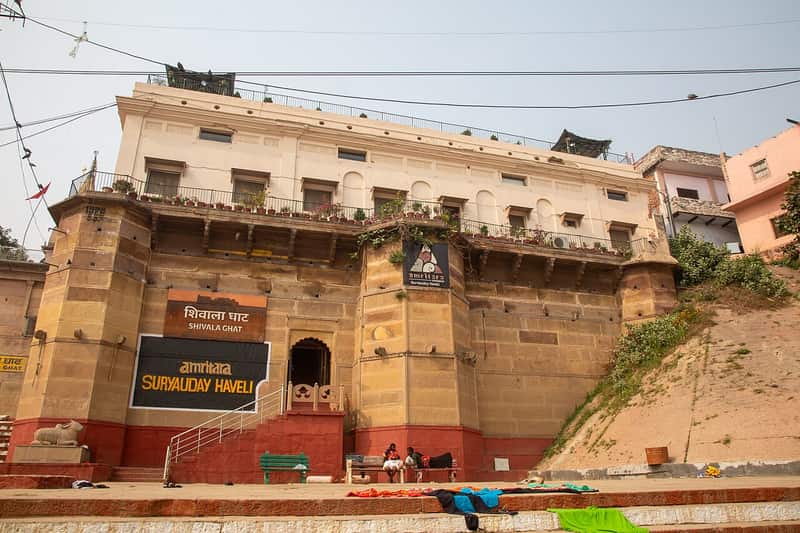
Shivala is easy to reach. From Assi Ghat, the walk along the river takes twenty minutes on level paths, and from the city centre a cycle rickshaw or auto rickshaw will bring you to the ghat's entrance in a quarter of an hour, depending on traffic. The nearest major landmarks are the Shivala police chowki and the bus stand on the main road above the ghat, from which the steps descend directly to the river. Signs in Hindi and English mark the way from the main road, and the ghat is impossible to miss once you are within two hundred metres. Those arriving by boat can ask any boatman on the southern riverfront for a landing at Shivala — it is one of the easiest ghats to identify from the water, its broad steps rising like an amphitheatre from the river.
The best time to visit is early morning, between six and nine, when the bathing is at its height and the light is soft; the evening hours, around sunset, offer the gentler pleasure of the promenade and the aarti. The most pleasant season is winter, from October to March, when the days are warm and clear; summer brings heat and the monsoon brings the flood, which is spectacular in its own way but reduces the ghat's usable steps. Sundays and festival days bring larger crowds; weekdays are quieter. Allow at least two hours for a proper visit — time to climb, to sit, to take a boat, and to let the place work its slow magic. If you come for the bathing alone, come at first light, when the ghat is at its most intimate.
Combine Shivala with its neighbours to make a full day of the southern riverfront: walk down to Assi in the morning, return through Tulsi Ghat and Bhadaini in the afternoon, and finish with a sunset boat ride from Shivala itself. Several good guesthouses stand within a minute of the steps for those who wish to sleep within sound of the river. Carry small notes for boat fares and temple offerings, keep your shoes in a bag when you descend to the water, and remember that the ghat, like the city, rewards the unhurried. Most of all, leave the ghat as you found it — clean, quiet, and unhurried; the river will remember your visit long after you have forgotten it. Namaste, and a good journey.
Shivala Ghat — Gallery (10 Photos)
Image Credits
shivala-01.jpg · shivala-02.jpg · shivala-03.jpg · shivala-04.jpg · shivala-05.jpg · shivala-06.jpg · shivala-07.jpg · shivala-08.jpg · shivala-09.jpg · shivala-10.jpg — Wikimedia Commons, under free licenses.
Continue exploring
Similar Ghats Nearby
Book This Ghat — Get Notified
Download the app now and book a boat ride to Shivala Ghat