

Munshi Ghat
Heritage GhatMunshi Ghat was built in the 18th century. It has a famous palace and a beautiful Shiva temple.


Type
Heritage Ghat
Boat Fare
1.1x base fare
Best Time
6-10 AM when morning sun illuminates the palace.
History
Built in the 18th century by Maharani Munshi. A famous palace atop the ghat is now a museum housing rare collections of local art and architecture.
Highlights
- Hidden ghat near Dashashwamedh
- Historic memory
- Peaceful stop
Festivals & Events
How pricing works in the NaviX app
No haggling at the ghat — everything is fixed in the app first
- 1
Fixed price before you board
The fare is shown in the app upfront — no bargaining at the ghat
- 2
Sharing or private — your choice
Share with fellow travelers or take the whole boat for your group
- 3
Pay only after the ride
UPI, card or cash — with an instant receipt
🕉️
Aarti details not available for this ghat yet
Complete Guide
Munshi Ghat — The Complete Guide
History, mythology, rites and practical details — everything in depth.
On this page
- 1.Munshi Ghat at a Glance
- 2.The Munshi Family and the Naming of the Ghat
- 3.Built in a New Century: The Making of Munshi Ghat
- 4.The Painted Walls: Windows That Never Open
- 5.A Photo Icon on the Ganga
- 6.The Daily Bathing Scene
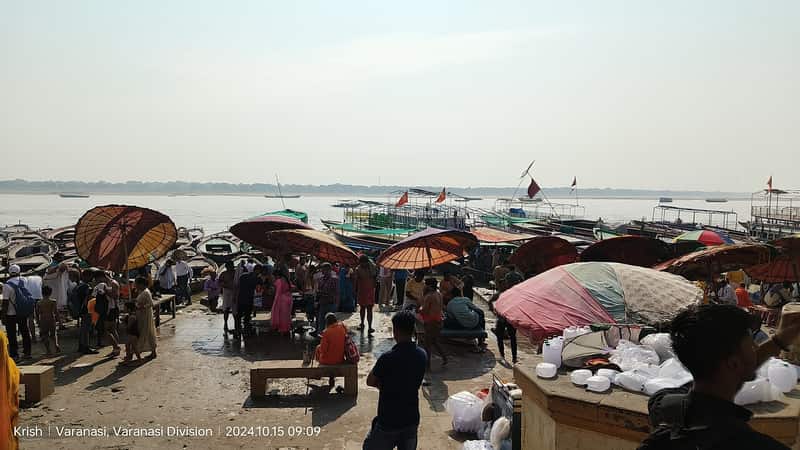
- 7.Moorings, Boatmen and the Long Rides
- 8.The River and the Far Shore
- 9.Behind the Wall: Lanes and Mohallas
- 10.Neighbours on the Water: Darbhanga and Ahilyabai Ghats
- 11.Etiquette at a Living Ghat
- 12.Reaching Munshi Ghat: A Practical Guide
📅 Updated: 21 Aug 2026 · Author: NaviX Field Team (field research 2024-26) · 12 sections · 12 photos
Munshi Ghat at a Glance
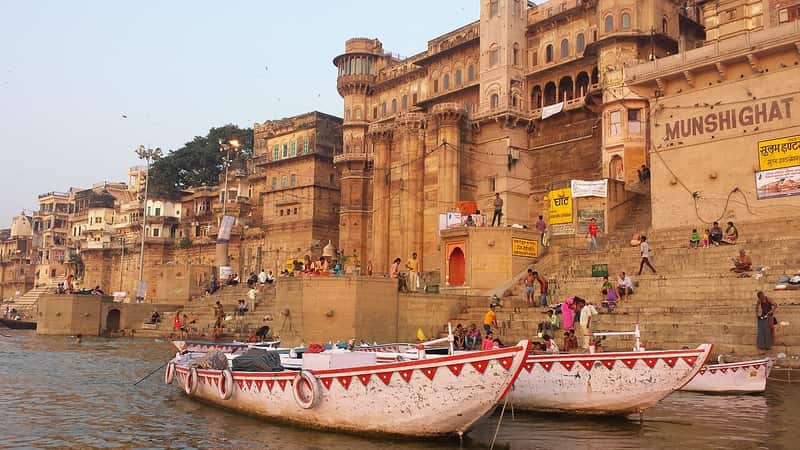
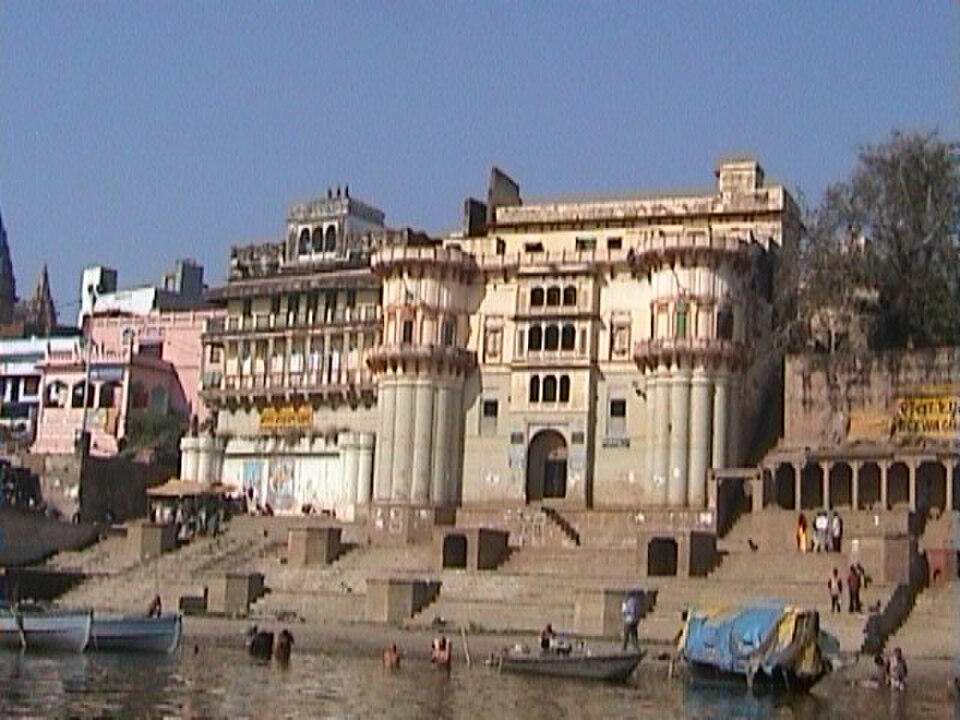
Munshi Ghat occupies one of the most charming stretches of the Varanasi riverfront, standing on the middle curve of the great crescent of ghats between Darbhanga Ghat and Ahilyabai Ghat. It was built in the early years of the twentieth century by a family of munshis, the clerks and secretaries who managed the accounts and correspondence of princely courts, and it remains one of the best-loved landings on the Ganga. What makes it unforgettable is its painted front: a wall of ochre, red and pale blue, decorated with painted windows that never open, false balconies, and arches that seem to smile at the river. Broad stone steps sweep down to the water, and the whole composition is so neat, so picturesque, that it has become one of the most photographed ghats in the city. Pilgrims bathe here, boatmen moor their craft here, and photographers of every skill level come to capture its famous face.
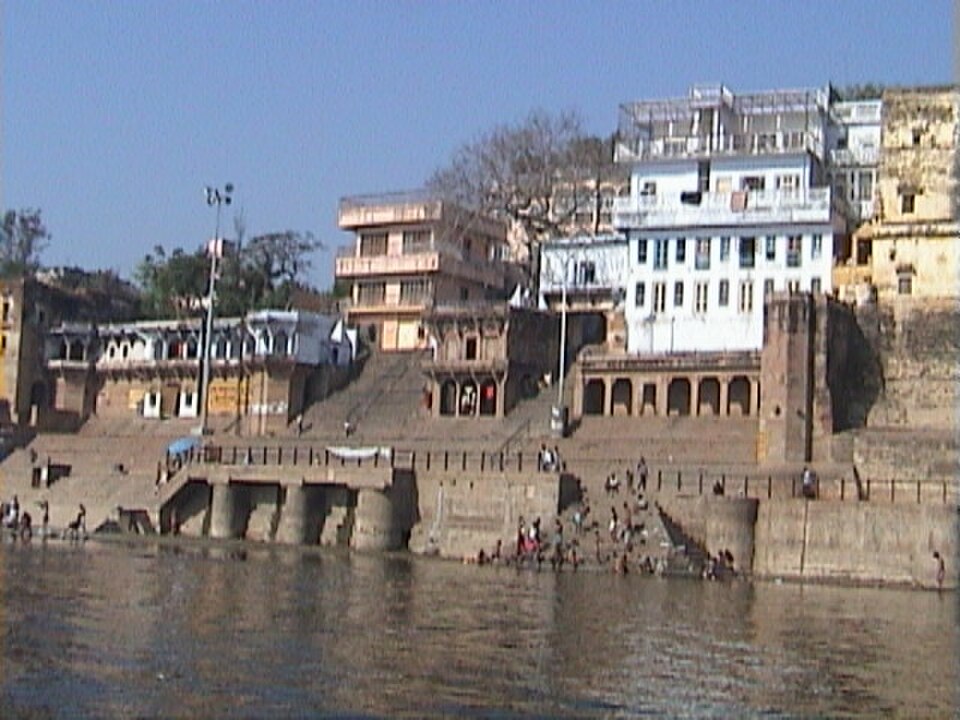
The ghat lives on two levels, and both are worth exploring. Above, the painted facade and the gateways behind it belong to the photographers, who fill the upper steps from first light to last. Below, the broad apron of stone belongs to the river: bathers in wet clothes wring out their saris and dhotis, children splash in the shallows, and kettles of tea steam on the stalls set against the wall. In the middle of the day the landing dozes, with boatmen napping in the shade of their vessels and cows investigating the flower stalls. Late afternoon brings the second wave of activity, as bathers return with the setting sun and the painted wall turns from crimson to gold. The rhythm is unhurried, the mood friendly, and the ghat welcomes everyone — pilgrims, travellers, artists and idlers — with the same open, unpretentious charm.
This guide explores Munshi Ghat in twelve short sections. It begins with the story of the munshi family and the naming of the landing, then recounts the construction of the early twentieth century and the murals that made the ghat famous. Further sections describe the daily scene of bathing, the boats and boatmen, the river itself and the view across to the far shore, and the lanes and mohallas that press against the palace wall. The final sections look outward: at the neighbouring ghats of Darbhanga and Ahilyabai, at the etiquette of visiting a living shrine, and at the practical details of getting here, choosing the right hour, and making the most of a riverside walk. Whether you come for a single photograph or a long morning of watching, Munshi Ghat offers one of the gentlest introductions to the sacred riverfront.
The Munshi Family and the Naming of the Ghat
The name Munshi honours an office as much as a family. In Persian, Hindi and Urdu alike, a munshi is a clerk, a secretary, a keeper of accounts and letters — the trusted right hand of rulers, merchants and landowners. Through the nineteenth century, when the courts and estates of North India conducted their business in Persian, the munshi class became indispensable. Men who began as humble copyists could rise to manage entire estates, and with wealth came the ambition to leave a visible mark on the world. The family that built this ghat belonged to that rising world of the literate and the numerate, and they chose the holiest river in India to display their good fortune. Their name, painted on the memory of the city, is all that most visitors know of them, but the ghat itself tells the rest of the story.
The choice was a quiet revolution. For centuries the great ghats of Varanasi had belonged to kings and temples, to rajas and maharajas who carved their dynasties into the stone. A family of clerks claiming a frontage on the Ganga announced that merit, learning and patient service could now achieve what birth alone had once conferred. The ghat was built in the early years of the new century, when the old princely order was slowly giving way to a world of professionals, lawyers and officials — and the munshi family stepped confidently into that new age. Local tradition remembers them as people of cultivation and piety, who endowed not only this landing but also the rituals and charities attached to it. To stand on their steps is to stand inside their ambition, a century old and still beautifully preserved. Their precise lineage has faded from living memory, but the affection in which the ghat is held suggests they were honoured neighbours.
Today the name anchors the ghat in the everyday speech of the city. Boatmen give directions by it, photographers know it by the pattern of its windows, and pilgrims who bathe there rarely pause to ask who the munshi was. Yet every visit is, in a small way, a tribute to that anonymous family of clerks — a reminder that the sacred city has always been built not only by princes but by the patient, industrious men who kept the ledgers and dreamed of immortality at the water's edge. The ghat is their memorial, and no inscription was ever more eloquent than this painted front, with its open welcome to the river. Kashi has a thousand names on its stones; few of them are as modest, and few have aged as gracefully, as the name of Munshi.
Built in a New Century: The Making of Munshi Ghat
Munshi Ghat belongs to the last great age of ghat-building on the Ganga. By the early twentieth century the riverfront of Varanasi was almost complete; the grand temples and princely landings had been laid down over centuries, and only the choicest plots remained. What the new century added was a final flourish of private devotion, as wealthy families of the emerging professional classes built their own small ghats along the gaps between the older monuments. The munshi family secured a frontage between the imposing Darbhanga Ghat and the temple-centred Ahilyabai Ghat, and there they raised a palace front that combined the classic vocabulary of the Varanasi ghat — broad stone steps, an arched gateway, the pavilions of a river palace — with a lightness of touch all its own.
Building on the Ganga is never a simple matter. The river rises and falls by many metres between the dry months and the monsoon, so every stone below the high-water mark must survive burial under flood silt and the battering of the current. The builders of Munshi Ghat solved the problem in the traditional way: a gently inclined apron of chipped stone slopes to the water's edge, and stone steps disappear and reappear with the seasons, their treads worn smooth by a century of feet. The palace front itself was designed less for living than for ceremony. Its painted windows give on to solid walls, its balconies hold no one; its purpose was to greet the river and the city with a face of prosperity. This was the custom of the time, when a ghat front was a statement as much as a stairway.
Time has treated the ghat kindly. Unlike some neighbouring landings that have crumbled or been rebuilt in concrete, Munshi Ghat has kept the character of its own era — the faded charm of early-twentieth-century civic pride, repainted again and again in the old spirit so that the front still reads as a single, coherent picture. When the floods carried away stones, they were replaced in the same manner; when the monsoon rose, the ghat simply waited, as it had done for a hundred years. Today it stands as a small, perfect document of its age: not ancient, but historic; not grand, but exactly right. A century of bathers, boatmen and photographers have worn its edges soft, and it remains what its builders intended — a friendly, painted welcome on the busiest river in India.
The Painted Walls: Windows That Never Open
What makes Munshi Ghat unforgettable is paint. Across its frontage runs a dazzling composition of arches, blind windows and false balconies, every element rendered in brilliant pigment — vermilion, ochre, peacock blue and white. The windows are painted shut, the balconies hold no one, and the entire picture is a deliberate, joyous fiction, the architectural equivalent of a smile. Photographers are drawn to it for a simple reason: no other ghat in the city offers so much pattern, so evenly lit, in so compact a frame. In the low golden light of morning and evening the facade glows like an illuminated manuscript, and in the hard light of noon its colours flatten into a painter's study of blue against red. It is a wall built for the eye, and the eye never tires of it.
The painting tradition is not new to Varanasi. For centuries the families who owned the riverfront beautified their landings with limewash and colour, and the city's artists were famous for their painted facades. What the munshi's builders did was to take the fashion of their day — the painted European-style balconies and shuttered windows beloved of the early twentieth century — and translate it into the idiom of the ghat. The result is a hybrid of Rajput palace, Mughal pavilion and colonial bungalow that exists nowhere else in quite this form. Every few years the guardians of the ghat whitewash the facade and repaint the pattern, and with each repainting a new generation of painters carries the tradition forward, keeping the colours as bright as the day the first brush touched the wall.
The murals repay a slow look, and a close one. What appears from a distance as a single block of colour resolves, up close, into individual elements — lotus buds, diamond lozenges, sunbursts, curling leaves — each a small votive of the painter's skill. The blue of the shutters against the warm wall is the signature of the whole landing, and it is this blue, repeated across the windows, that photographers seek when they frame their shots. By evening the pattern softens; the light gathers in the arches, shadows lengthen across the steps, and the ghat, which has been a busy stage all day, becomes simply a picture painted by the river. Watch it at dusk, when the far shore darkens and the facade holds the last colour in the sky, and you will understand why the wall was worth building.
A Photo Icon on the Ganga
Ask a photographer in Varanasi for one picture that sums up the riverfront, and Munshi Ghat will be near the top of the list. Its proportions are made for a lens: a facade of manageable height, steps that lead the eye down to the water, and a frame that needs no cropping. The painted windows anchor every composition, and a single boat or bather at the waterline supplies the human note that turns a pretty wall into a living scene. The classic shot is taken from the mid-river in the early morning, when the rising sun strikes the facade full on and the blue shutters glow against the warm wall. From a boat, from a tripod on the steps, or from a rooftop across the river, the ghat arranges itself for the camera with a patience that no model could match.
The ghat changes character with the light, and the knowing photographer comes more than once. At dawn the wall is cool and pink, and the first bathers step into the water; by late morning the colours are at full strength; at dusk the facade turns to gold and then to silhouette against the last sky. Monsoon evenings bring drama, with great clouds piled over the river and the ghat's colours deepened by rain. Reflections matter too: on a calm winter morning the painted wall hangs upside down in the current, doubled and perfect. Detail shots are equally rewarding — a blue shutter against peeling ochre, a boat's curved bow against the arches, wet steps that mirror the sky. Every surface of Munshi Ghat is a composition waiting to be found.
The image has travelled far beyond the city. Painted-front ghats appear on posters, in travel magazines, on the covers of guidebooks and in the feeds of travel pages, and the pattern of Munshi's windows has become shorthand for the charm of old Varanasi. Yet the photograph is only half the story. The ghat rewards what cameras cannot catch — the smell of marigolds and wet stone, the slap of water on the boat's side, the conversations between boatmen and bathers, the sudden hush when the aarti bells sound from a nearby temple. Come for the famous picture if you like, but stay for the scene around it. The best photographs of Munshi Ghat are the ones that remind you it was a place of life long before it became a place of pixels.
The Daily Bathing Scene
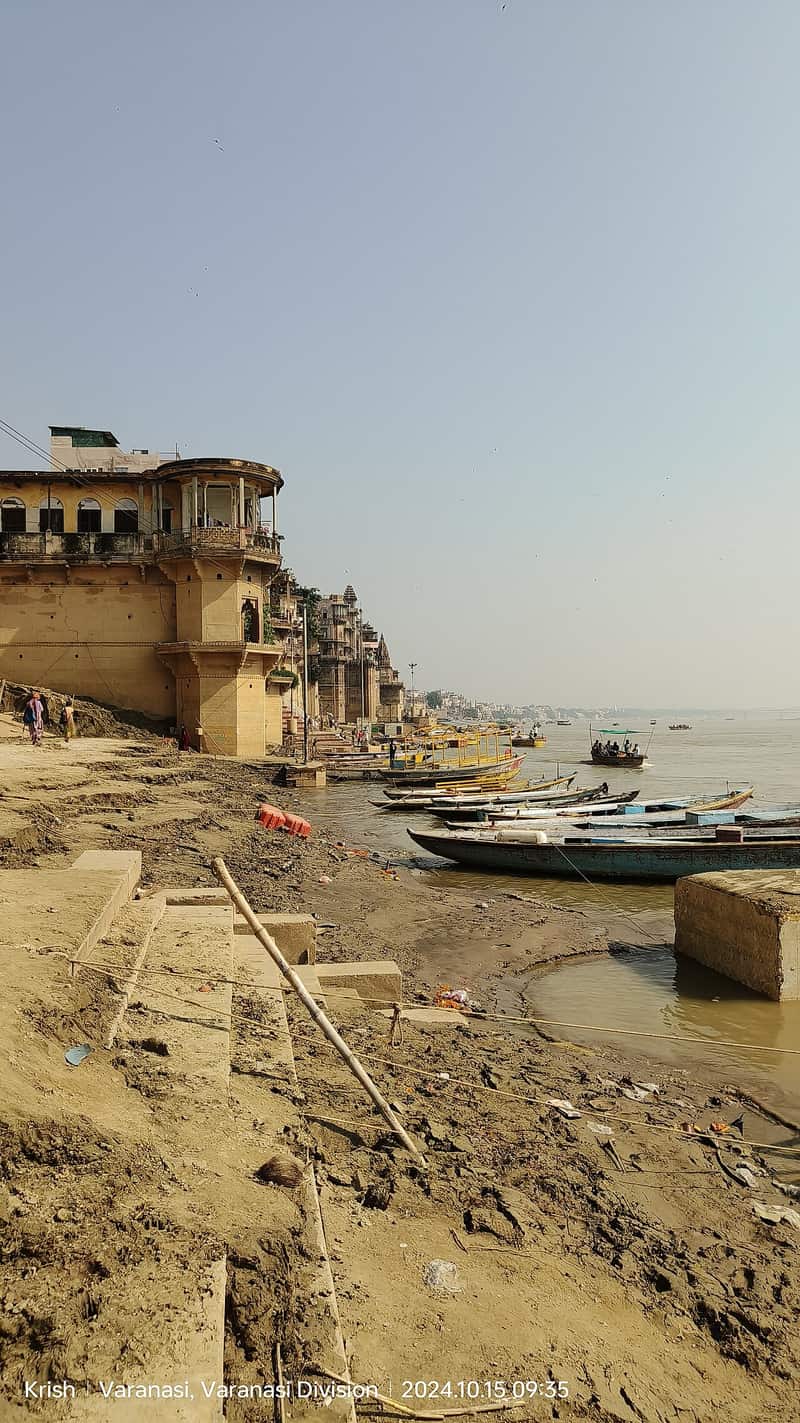
Long before the first tourist arrives, Munshi Ghat belongs to the bathers. In the grey half-light of dawn, figures wrapped in shawls make their way down the painted steps, carrying brass pots, towels and bundles of flowers. They pause at the waterline, dip their fingers, touch their foreheads, and then step in with a gasp that is part cold, part joy. The river is a mother, and the bath is a greeting. Some bathers stand chest-deep in the current, murmuring mantras; others pour water into their cupped hands and let it run back with offerings of marigold; the more devout take a ritual dip for each of the day's prayers. By seven o'clock the landing is full of life, and the painted wall looks down on a scene unchanged in its essentials for a century.
Bathing at Munshi Ghat is quieter than at the great central ghats, and all the more intimate for it. Neighbours recognise one another and exchange news while they wring out their clothes; the same women arrive at the same hour with the same brass vessels, and the same old men take their place on the same stone. On auspicious days — full moons, the festivals of the solar calendar, the holy Mondays of the month — the crowd swells, and the steps fill with families who have come for the special baths of the Hindu year. Priests set up small stalls of holy water and offerings, sellers spread out rudraksha beads and vermilion, and the waterline becomes a moving mosaic of orange saris and white dhotis. The ghat shows its other face: still the same painted beauty, but now the setting for a festival.
To bathe in the Ganga at Munshi Ghat is to take part in an old and serious ritual. The water is understood not as mere river but as the goddess Ganga herself, whose touch washes away the sins of the past and prepares the soul for the day ahead. Pilgrims therefore approach the bath with devotion and leave with deliberation, drying themselves in the sun, offering a final handful of water to the rising sun, and arranging their flowers before climbing the steps again. Visitors who are not bathing can watch this daily theatre with respect from the upper steps; if they wish, they may dip in the water themselves, modestly and briefly, as countless travellers have done before them. The ghat's welcome extends to all, but its deepest life belongs to these early hours, when the painted wall reflects in water that has been blessed by a million baths.
Moorings, Boatmen and the Long Rides
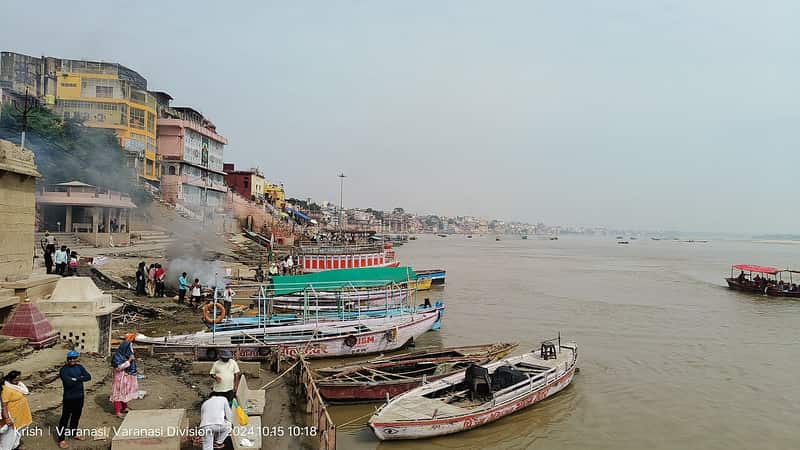
The waterline of Munshi Ghat is a small harbour. Wooden boats — broad-bottomed rowing boats with high, curved bows painted in strips of green, red and white — lie moored along the steps, tugging gently at their ropes as the current runs past. Their owners are the malah boatmen, who know every sandbank and eddy of this stretch of the Ganga. They sit cross-legged on the masonry with their long bamboo poles, calling to passers-by, bargaining cheerfully, and waiting for the moment when a family of pilgrims or a group of tourists decides on a ride. The negotiations are part of the theatre: rates are quoted, hands are raised, smiles exchanged, and a price is finally agreed that both sides pretend to accept with reluctance.
The classic trip is the sunrise boat ride, when the whole riverfront comes alive in a single golden hour. From Munshi Ghat the boat can head north past Dashashwamedh Ghat, where the great aarti platforms stand silent at dawn, or drift south past the quieter ghats toward Assi. The other direction leads to the burning ghats, and the mood shifts as the painted walls give way to the smoke and silence of Manikarnika and Harishchandra. The boatmen guide these journeys with a practised mix of story and silence, pointing out temples, telling the legends of the ghats, and rowing with an economy of effort that comes from a lifetime on the water. Most of them belong to families that have plied these same currents for generations, and their boats bear the names of their fathers.
From the water, Munshi Ghat shows its finest face. Approached by boat, the painted facade rises slowly above the line of moored craft, the blue shutters catching the light, the arches framing the sky, and the whole wall reflected in the moving mirror of the river. This is the view the builders intended, the face of the ghat turned toward the great waterway, and it is worth every rupee of the boatman's fee. The ghat itself has no pier of its own — boats nose directly into the steps — so landing here feels intimate, as if the river had delivered you to a private door. Take the ride at least once, in either direction; the painted windows that looked so charming from the shore become something else from the water: a welcome.
The River and the Far Shore
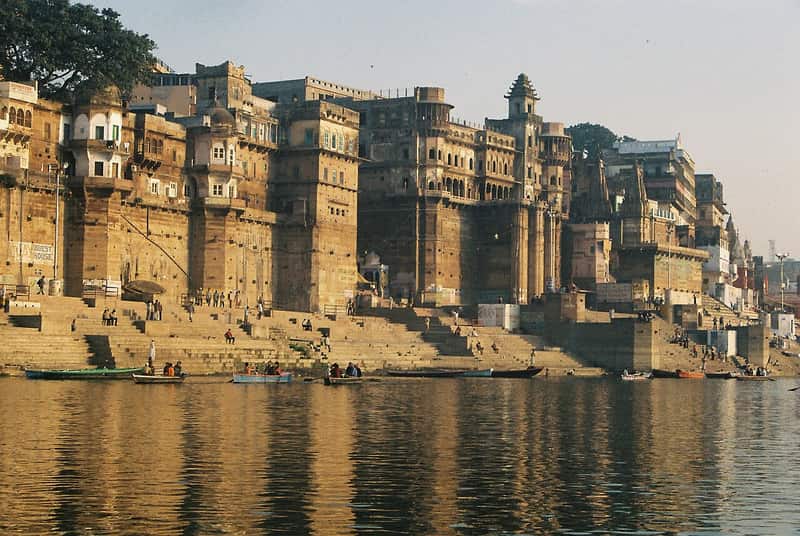
Munshi Ghat is only the frame; the picture is the river. The Ganga here is broad and unhurried, flowing past the mid-city ghats at a stately pace that seems to carry the whole of Varanasi with it. In the dry months the water withdraws to the far side of a wide sandbank, leaving the ghat's lower steps high and dry and stranding boats far from the shore; in the monsoon the river swells to the top of the painted wall, brown and powerful, almost eager. Between these extremes the river keeps a rhythm of its own, rising with the rains of July, falling through the winter, and touching the ghat at a hundred different levels through the year. Each level has its own geography, and the boatmen read the water like a book.
Across the river, the far shore is a stretch of pale sand and green scrub, unbroken by buildings and almost uninhabited. This emptiness is one of the great gifts of the Varanasi riverfront — the city crowds the near bank, but the far bank stays wild, so that from the ghat one can look over water and sand to a horizon that might belong to a different world. Fishermen wade with their nets at dawn, cattle graze on the banks, and the smoke of the burning ghats drifts across the current. At sunrise the far shore turns rose, at sunset a deep violet, and on moonlit nights the sand glows like snow. The view is a meditation: the painted wall behind you, the river in front, and beyond it all the silence of the open plain.
The river is more than a view; it is the reason the ghat exists. Every ritual of Kashi is oriented to the Ganga — the bath, the offering, the final cremation — and every ghat is simply a door through which the city meets its goddess. At Munshi Ghat this meeting is especially gentle, because the landing is modest and the current here is calm. Pilgrims pour the water back, boatmen live on it, children swim in it, and the painted wall has been watching the same dance of light and current for a hundred years. Stand at the waterline in the evening, when the last sunlight leaves the far shore and the river turns the colour of old gold, and you will feel what the ghats have always meant: that in Kashi, the divine is not in the temple only, but in the water at your feet.
Behind the Wall: Lanes and Mohallas
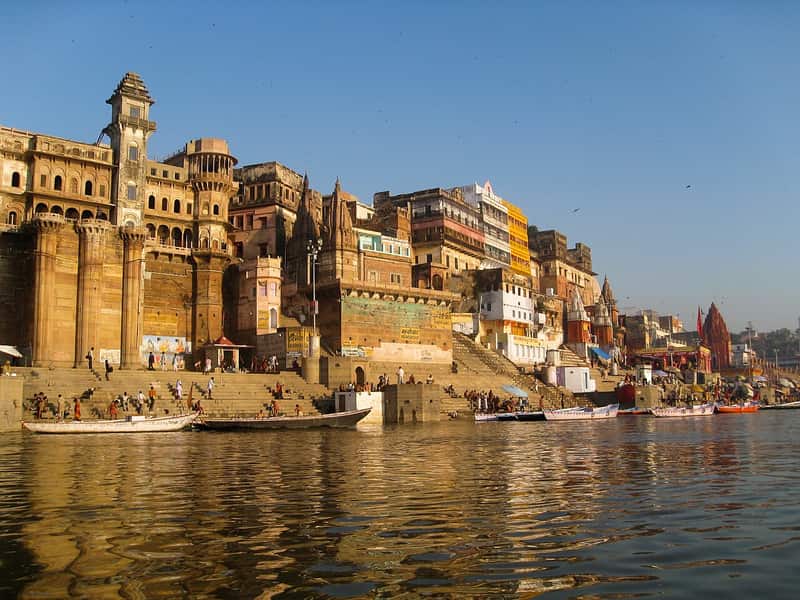
Behind Munshi Ghat the city closes in, and the narrow lanes of the old riverfront quarters rise steeply away from the water. This is Bengali Tola and its surrounding mohallas, a district of tall old houses, hidden temples, and courtyards where washermen, priests, traders and boatmen have lived for generations. The lanes are barely wide enough for two bicycles to pass; their walls are lime-washed, their balconies lean toward one another, and the roofs are a tangle of water tanks, satellite dishes and drying clothes. Sunlight falls in shafts through the gaps between buildings, and at midday the lanes are cool and green with shadow. Every few steps there is a small shrine or a painted doorway, and the air smells of incense, frying mustard oil and the river itself.
Life in the mohalla is lived in public. Women gather at the hand pumps and taps; children play cricket in any open corner; men sit on the chabutaras outside the shops, discussing the day's news over tea. The ghat is the neighbourhood's front room — when the evening heat breaks, whole families drift down the steps to sit by the water, and the painted wall becomes the backdrop for a hundred small conversations. The proximity of the river shapes everything: the houses are built high against floods, the staircases are steep, and the courtyards collect the monsoon rain in cisterns. For the people who live here, the Ganga is not a tourist sight but the edge of their world, a daily presence at the end of the lane.
The quarter has its own places of worship and commerce. Small temples stand at intervals along the lanes — some no more than an alcove with an image and a lamp — and their bells mark the hours of the day. Sweet shops, sari shops and paan stalls cluster near the ghat approach, and on festival mornings the steps are laid with offerings and rangoli patterns. For the visitor, the lanes behind Munshi Ghat offer the most honest glimpse of Varanasi living: not the stage-set of the ghat but the working city behind it, where temple bells, cooking smells and the cries of vendors form a single continuous music. Walk a little way in any direction and the crowd swallows you; walk back to the ghat and the river opens out again, blue and wide, as if the city had been holding its breath.
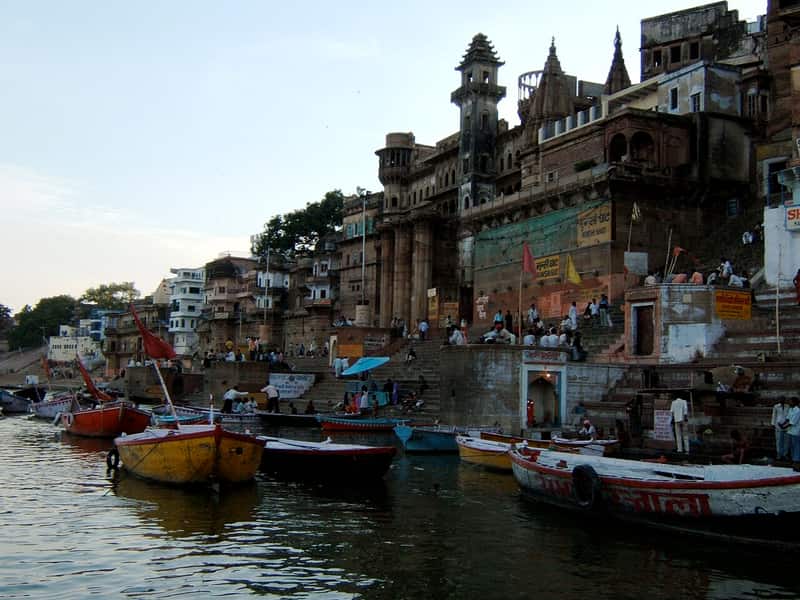
Neighbours on the Water: Darbhanga and Ahilyabai Ghats
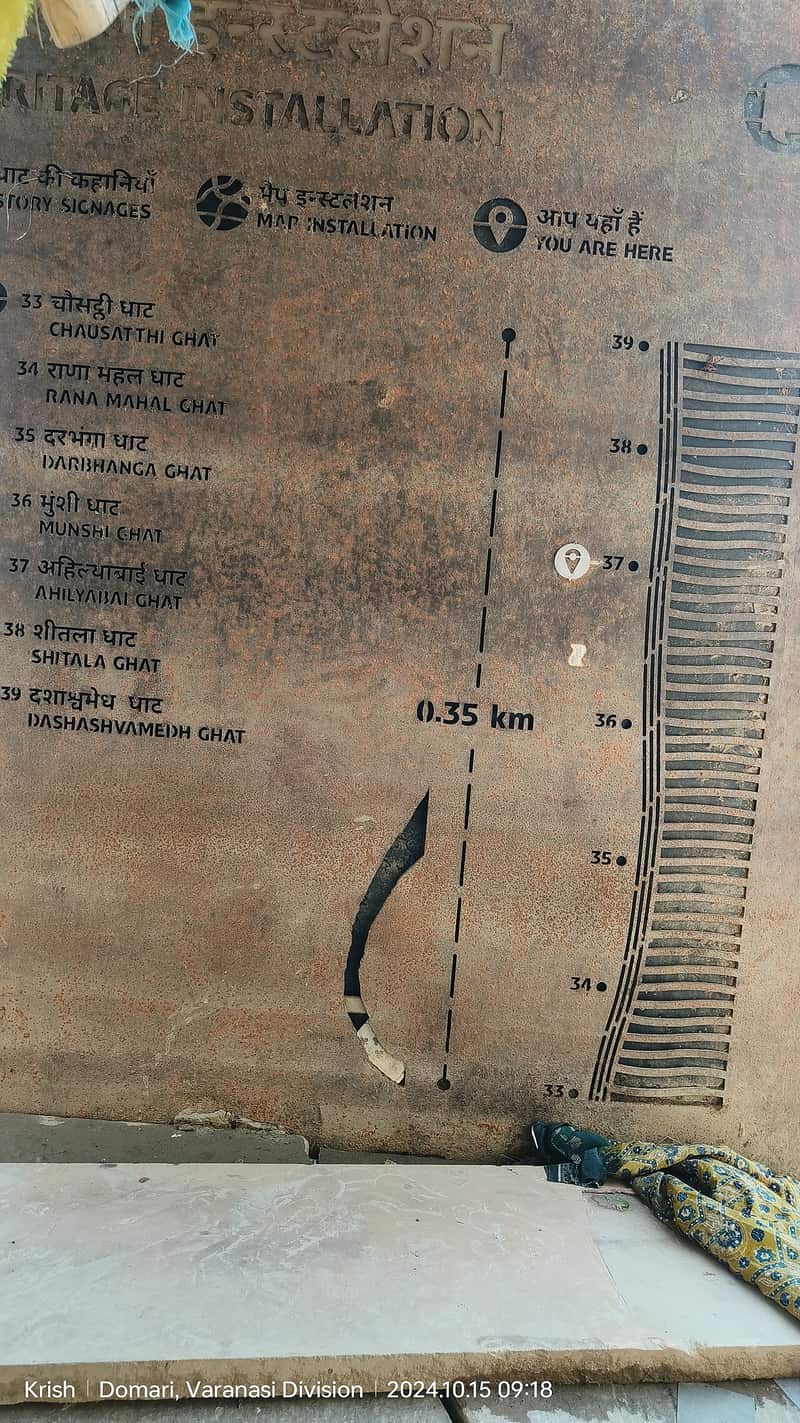
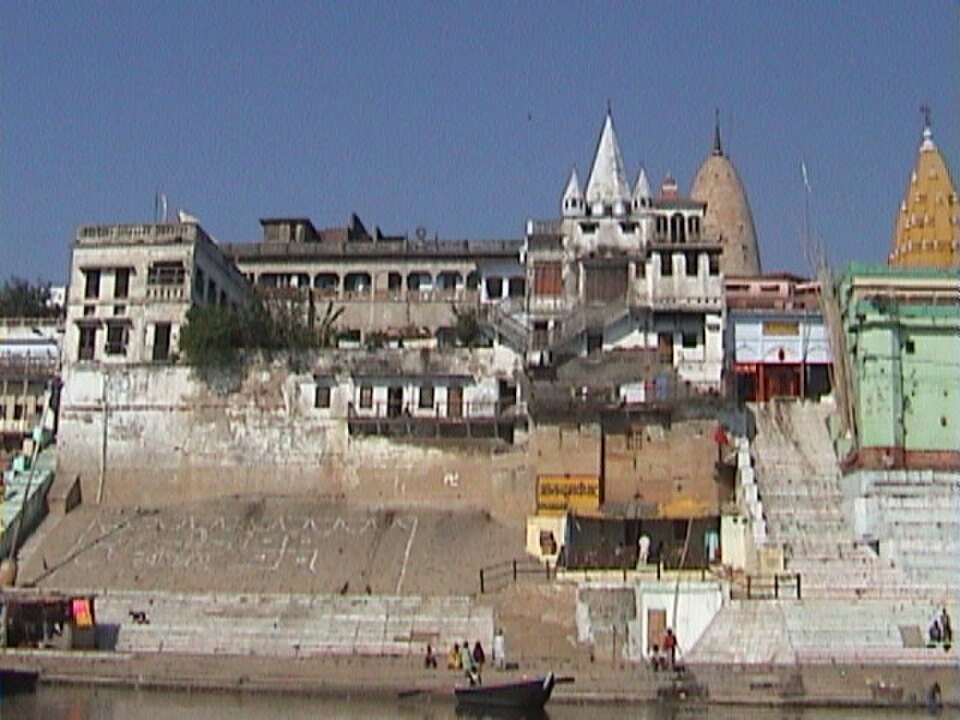
Munshi Ghat does not stand alone; it is the middle member of one of the finest clusters on the riverfront. To the north, Darbhanga Ghat rises in the grand manner of the princely ghats, its palace front built by the maharaja of Darbhanga in the early twentieth century. Ornamental, confident and beautifully proportioned, it was designed for ceremony and display, with pavilions and a broad stairway worthy of a king. To the south, Ahilyabai Ghat carries the name of Ahilyabai Holkar, the celebrated queen of Indore, whose devotion built hundreds of temples and ghats across India in the eighteenth century. The two neighbours frame Munshi Ghat between them — the grand and the queenly on either side of the modest painted clerk, a strange and delightful company.
Walking between the three ghats is a short, rewarding journey through three styles of building. Darbhanga's sandstone front speaks of royal budgets and princely display; Munshi's painted wall speaks of bourgeois pride and good taste on a smaller scale; Ahilyabai's simpler landing speaks of eighteenth-century piety, centred on the temple that still stands above its steps. The differences are visible in every cornice and pilaster, yet all three share the same essential geometry — the stairs, the platform, the shrine or palace above — that makes a Varanasi ghat what it is. In a few hundred metres of riverfront you can read a small social history of the city: kings, clerks and queens, each building their door to the Ganga in the manner of their station.
The three ghats also share a single working river. Boats moor along the whole stretch, bathers use whichever steps suit them, and the boatmen who wait at Munshi will take you past both neighbours with the ease of long familiarity. The Maharaja of Darbhanga's ghat is a favourite landing for sunset photographs; the Ahilyabai Ghat has its temple where the faithful stop before bathing; and Munshi, in between, remains the friend of every passer-by. Together they form a small museum of the riverfront's history, and a walk from Darbhanga to Ahilyabai — past the painted windows and the blue shutters — is one of the most pleasant half-hours in Varanasi. Do not rush it; the three ghats deserve to be seen slowly, one after another.
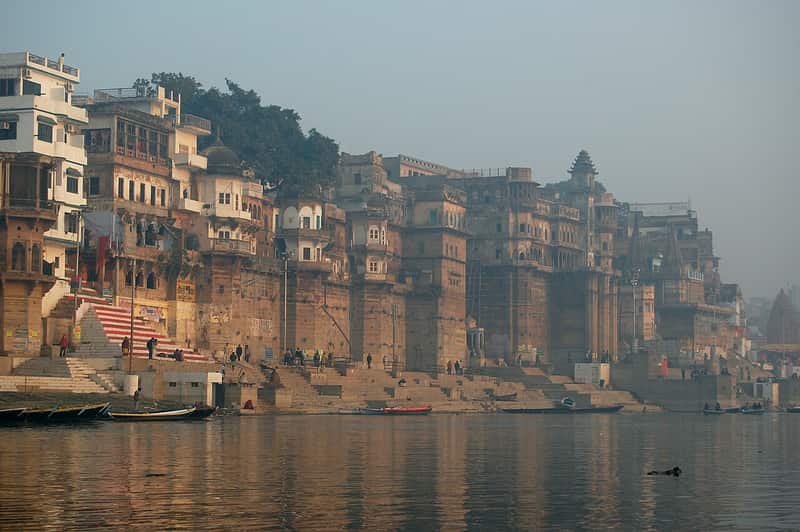
Etiquette at a Living Ghat
Munshi Ghat is not a museum; it is a living place of worship and work, and it asks of its visitors the courtesy that any household would. Dress modestly, especially while bathing or sitting near the water, and keep the lower steps clear for those who have come to perform their rituals. Bathing is done in the open by both men and women, each in traditional cloth, and the visitor's curiosity must not become a stare. Before taking photographs of bathers, boatmen or sadhus, ask with a smile; most will agree, many will pose, and a few will politely refuse — their refusal is final, and the ghat's goodwill is worth more than any frame. Never photograph the burning ghats from this stretch; the smoke to the north marks a place of mourning, not a subject.
The ghat also has its helpers, and a word on dealing with them is in order. Pandits may approach to offer prayers and blessings, and boatmen will offer rides; both are part of the ghat's economy. If you wish to accept, agree on the price clearly before the service begins; if you do not, decline with the same courtesy you would offer any tradesman at home. A gentle no is respected and remembered; an angry one is not. Ashes and offerings left on the steps belong to the river — do not step on them, and do not remove the flowers that have been placed at the waterline. The Ganga receives everything eventually, and the visitor who touches nothing disturbs nothing.
Small gestures complete the picture. Remove your shoes if you enter a temple above the ghat, keep your voice low in the early morning when the bathers are at their prayers, and avoid the water's edge if you are carrying refuse — the river is a goddess, and even its busiest reaches are treated with reverence. Offerings of flowers, a handful of grains or a coin in the water are traditional and welcomed, though visitors should never throw plastic of any kind into the Ganga. Finally, remember that for the people around you this is home: the steps are their front porch, the river their mother, and the painted wall the face of their quarter. Meet that familiarity with respect, and Munshi Ghat will treat you not as a stranger but as a guest.
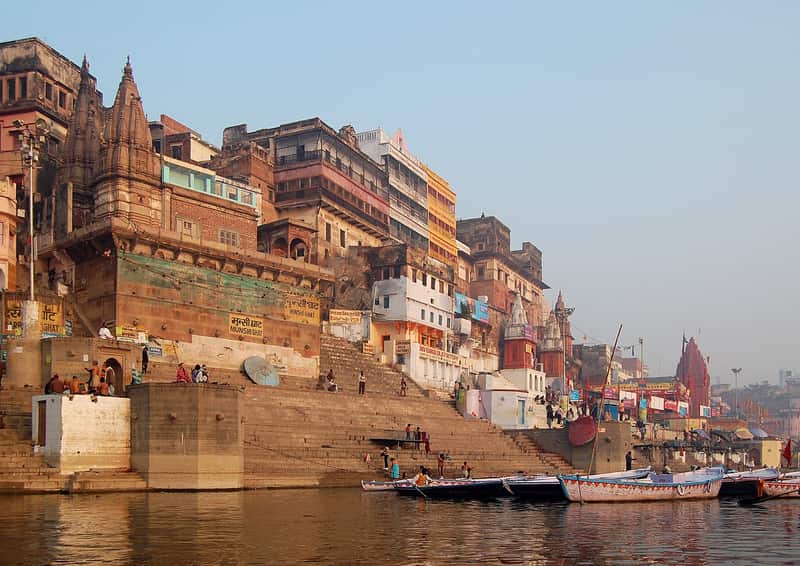
Reaching Munshi Ghat: A Practical Guide
Munshi Ghat lies on the middle stretch of the riverfront, and reaching it is simple from almost anywhere in Varanasi. From the heart of the old city at Godaulia, it is a walk of about twenty minutes along the riverfront promenade or through the lanes; from Dashashwamedh Ghat, the most famous landing in the city, it is a pleasant twenty-minute stroll south along the ghats. Rickshaws and taxis can take you to the Bengali Tola road behind the ghat, from where a short lane leads to the steps, and cycle rickshaws wait at the top of the ghat lane. The landing is on the main boat route, so arriving by boat from any point on the river is equally easy. The walk is flat, well trodden and safe, and the riverfront promenade between the ghats is one of the great pleasures of the city.
The best time to visit depends on what you seek. For bathing and the classic photograph, arrive before sunrise — the light on the painted wall at dawn is the ghat's most famous sight. For a quieter visit with softer colours, come in the late afternoon and stay for sunset, when the facade turns gold and the boats come home. The cool months from October to March are the most comfortable, with clear mornings and warm afternoons; April to June are hot and bright, best enjoyed from the water; the monsoon from July to September brings dramatic skies, high water and fewer crowds. Whatever the season, the morning hours are the calmest, and the ghat is at its most intimate then. A hat, water and sturdy shoes make any visit more pleasant.
Plan a little more than the ghat itself. Combine Munshi with its two neighbours: walk north to Darbhanga Ghat and the painted splendour beyond, or south to Ahilyabai Ghat, whose temple gives the landing its purpose. A full riverfront walk can continue past Dashashwamedh to the burning ghats and on to the northern reaches, while a boat ride south reaches the quiet ghats and the university quarter beyond Shivala. Keep your phone and camera in a dry bag if you take a boat, and watch your step on the worn, wet stone. The ghats have no entry fee, and the only ticket is your time. Spend an hour or a morning; take the photographs, take the ride, take a bath if you wish — and leave the painted wall exactly as you found it: smiling.
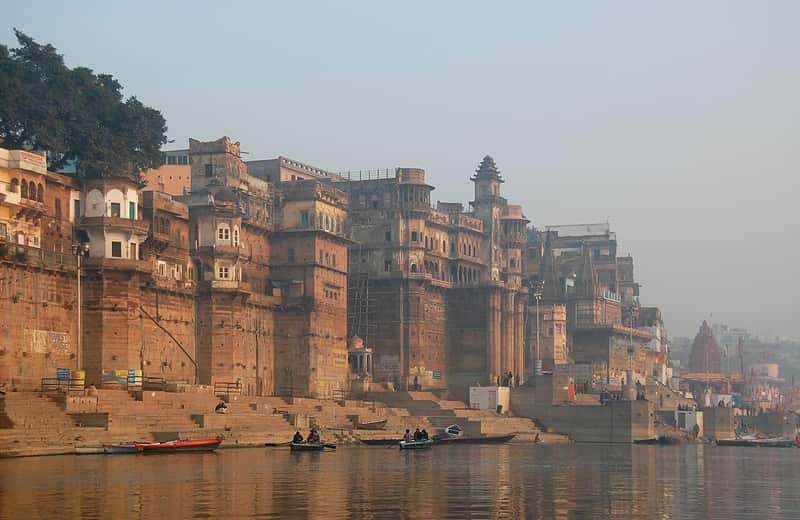
Munshi Ghat — Gallery (12 Photos)
Image Credits
munshi-01.jpg · munshi-02.jpg · munshi-03.jpg · munshi-04.jpg · munshi-05.jpg · munshi-06.jpg · munshi-07.jpg · munshi-08.jpg · munshi-09.jpg · munshi-10.jpg · munshi-11.jpg · munshi-12.jpg — Wikimedia Commons, under free licenses.
Continue exploring
Similar Ghats Nearby
Book This Ghat — Get Notified
Download the app now and book a boat ride to Munshi Ghat