

Darbhanga Ghat
Major GhatDarbhanga Ghat is one of the most elegant ghats. Built in the 18th century by the King of Bengal, it features a grand palace that is now a museum.


Type
Major Ghat
Boat Fare
1.3x base fare
Best Time
7-10 AM when morning sun illuminates the palace.
History
Built in the 18th century by Maharaja Ishwar Singh of Bengal. The ghat features an elegant palace in the Bara Bhaiyya style. The palace is now a museum displaying local craftwork and historical artifacts. A famous community kitchen operates daily here.
Highlights
- Grand architecture of Brijrama Palace
- Best viewpoint near the aarti
- Luxury boat boarding point
- 2-minute walk from Dashashwamedh
Festivals & Events
How pricing works in the NaviX app
No haggling at the ghat — everything is fixed in the app first
- 1
Fixed price before you board
The fare is shown in the app upfront — no bargaining at the ghat
- 2
Sharing or private — your choice
Share with fellow travelers or take the whole boat for your group
- 3
Pay only after the ride
UPI, card or cash — with an instant receipt
7:00 PM
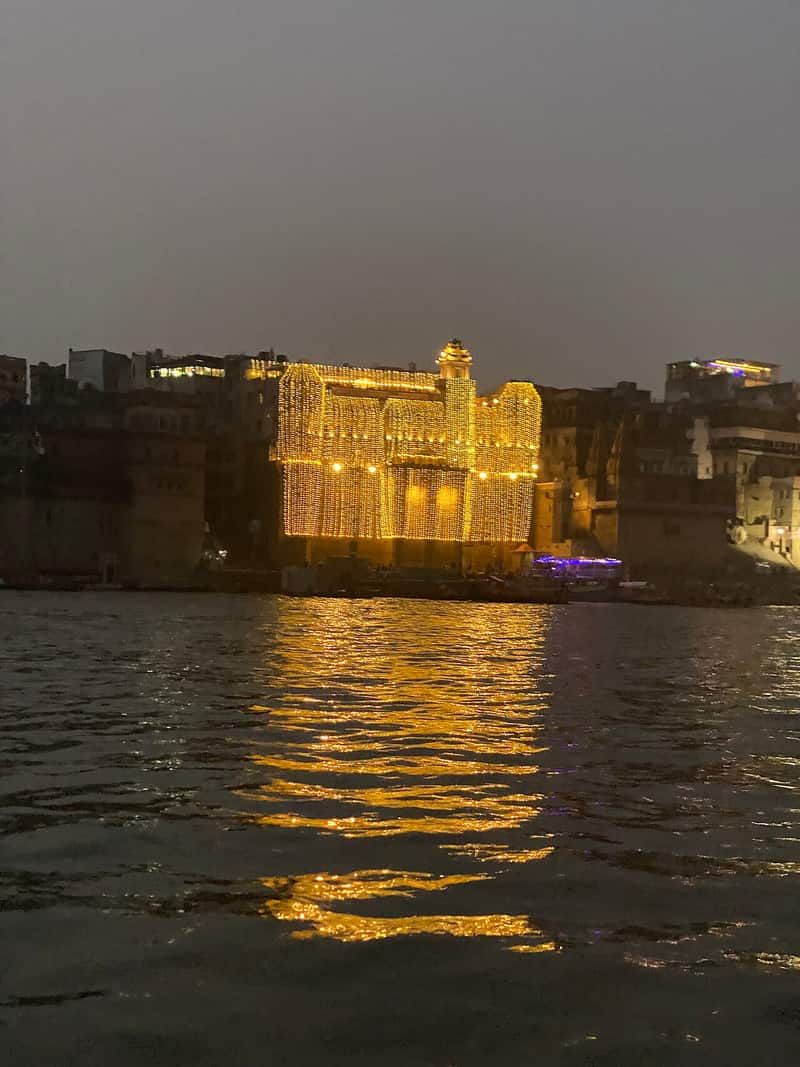
View from the luxury palace ghat
Complete Guide
Darbhanga Ghat — The Complete Guide
History, mythology, rites and practical details — everything in depth.
On this page
- 1.Darbhanga Ghat: An Introduction
- 2.The Brijrama Palace Complex
- 3.The Darbhanga Maharajas and Their Patronage
- 4.Architecture: Painted Facades, Balconies and Stairways
- 5.The Daily Bathing Scene
- 6.Moorings and Boat Excursions
- 7.The River and the View
- 8.The Lanes and Mohallas Behind the Ghat
- 9.Neighbours: Rana Mahal and Munshi Ghats
- 10.Etiquette: Respectful Conduct
- 11.Practical Guide: Reaching, Timing and Nearby Ghats
📅 Updated: 21 Aug 2026 · Author: NaviX Field Team (field research 2024-26) · 11 sections · 11 photos
Darbhanga Ghat: An Introduction
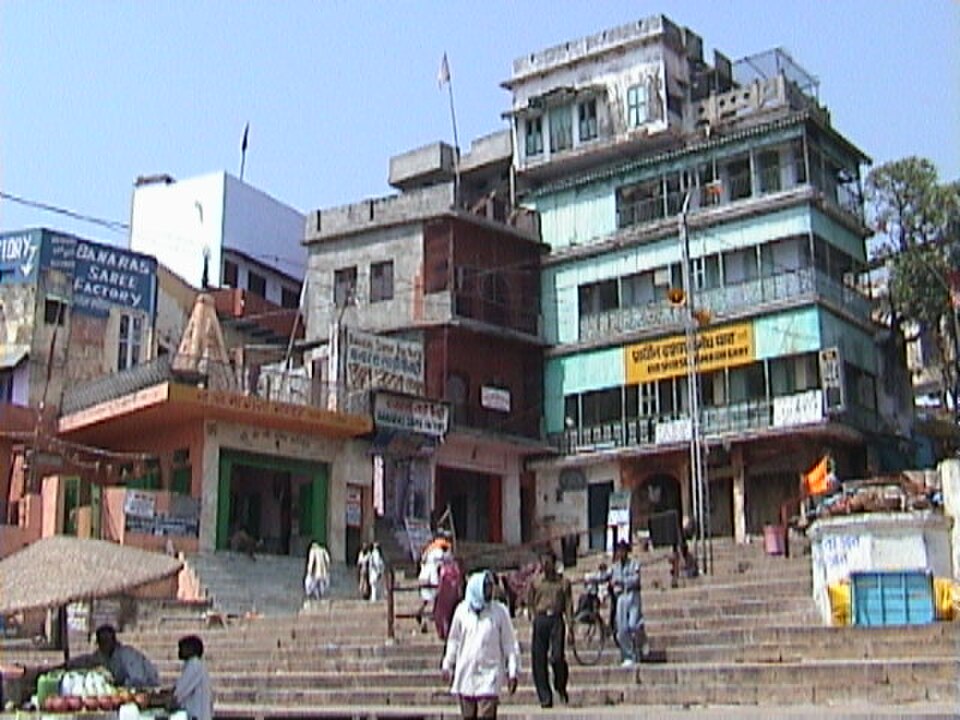
Darbhanga Ghat is one of the grandest royal landings on the middle riverfront of Varanasi, a sweeping flight of stone steps set beneath the painted facades of the Brijrama Palace. The ghat belongs to the Maharaja of Darbhanga, head of one of the greatest zamindar families of Bihar, whose devotion shaped this whole stretch of the Ganga. It stands between Rana Mahal Ghat to the south and Munshi Ghat to the north, completing a chain of palatial stairways found nowhere else along the sacred river. Rows of iron balconies, ornamental arches and broad stairways give the landing the air of a royal residence built directly upon the water, and its warm, honey-coloured walls glow beautifully at sunrise. For photographers it is a dream — nearly every angle produces a postcard, and at dusk the palace windows light up like lanterns above the river.
But Darbhanga Ghat is no museum of royal memory. From the first light of day, the long steps carry the living routines of Kashi: bathers arriving with brass lotas, priests settling under cloth canopies, flower sellers setting out marigold necklaces, and boatmen untying the boats that rest against the lower stones. Pilgrims from Bihar — many of them descendants of the tenants who once owed loyalty to the Darbhanga estate — feel a special kinship with this ghat and come here as to a family shrine. Between the ritual seasons, the ghat fills with wedding processions, film crews and honeymooners, drawn by the same painted walls that made the palace the darling of postcard printers for more than a century. In the late afternoon the steps become a grandstand from which the whole riverfront watches the sun descend beyond the far bank, painting the palace facade in shades of rose and gold.
This guide explores Darbhanga Ghat section by section: the palace complex that crowns it, the history of its royal patrons, the architecture of its painted facades, and the daily life of bathing, boating and worship that flows across its steps. It also looks behind the ghat into the lanes and mohallas of the old city, introduces the neighbouring landings of Rana Mahal and Munshi, and closes with practical advice on etiquette, the best hours to visit, and how to reach the ghat by foot or by boat. Whether you come to bathe, to photograph, or simply to sit on a step and watch the Ganga roll past, Darbhanga Ghat rewards you with the most complete picture of princely Kashi that the middle riverfront can offer. Arrive early, stay unhurried, and let the palace and the river do the rest.
The Brijrama Palace Complex
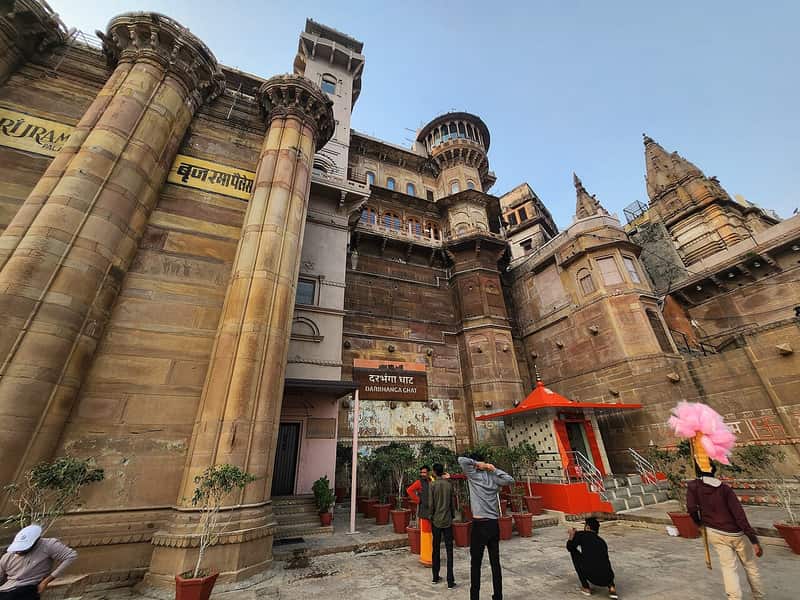
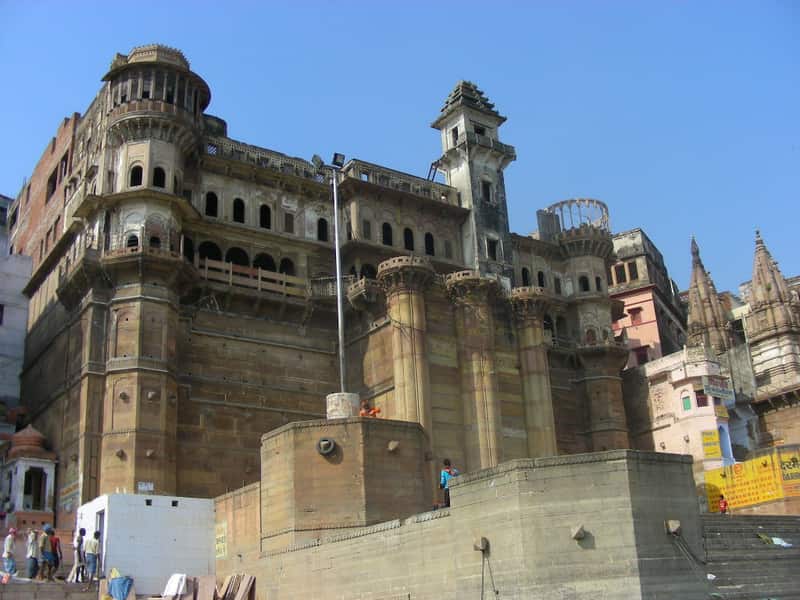
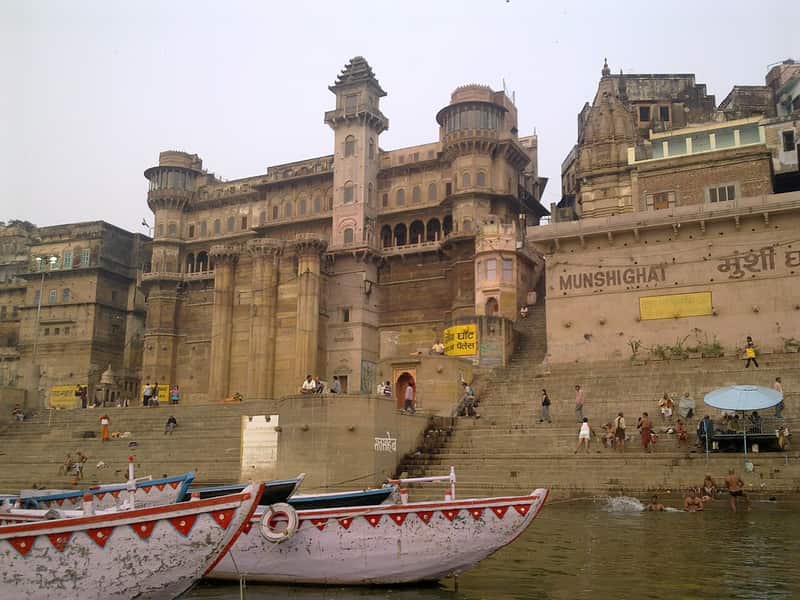
The Brijrama Palace is the crown of Darbhanga Ghat and one of the most romantic buildings on the entire riverfront. It was conceived in the nineteenth century as the riverside residence of the Maharaja of Darbhanga, a mansion where the princely family could receive the sacred river at their own door and entertain the scholars, priests and pilgrims who flocked to Kashi. The complex spreads along the bank in a series of connected blocks, each crowned with parapets, chhatris and ornamented gables, its painted facades turned squarely toward the sunrise. Long stairways descend from the palace terraces to the water, so that the building and the ghat read as a single composition — architecture descending into worship. In the golden light of dawn the palace glows like a wedding cake, and generations of photographers have considered it the finest backdrop on the Ganga.
For decades the palace stood in dignified decline, and its revival is a story of patience and craft. Restorers rebuilt crumbling cornices brick by brick, recovered original colour schemes from beneath layers of whitewash, and repaired the delicate ironwork of the balconies by hand. Today the palace operates as a luxury heritage hotel, one of the few places on the river where a traveller can sleep within sight and sound of the Ganga. Suites open onto balconies that overlook the water, the rooftop restaurant serves Banarasi cuisine under the stars, and a private landing lets guests step from the hotel directly into a waiting boat. Staying here is an experience of princely Kashi that few cities can offer, and even those who are not guests pause at the gates to admire the carved entrance and the peepul tree shading the courtyard.
Yet the palace is not cut off from the ghat that supports it. The ground level remains part of the living neighbourhood — a small temple, the quarters of priests, stairways that climb to the upper lanes, and shops that serve the daily needs of the riverfront. This mingling of five-star luxury and everyday Kashi is precisely what makes Darbhanga Ghat extraordinary: above, the painted balconies of the maharajas; below, the timeless traffic of bathers, boatmen and devotees. The palace gives the ghat its grandeur, and the ghat gives the palace its soul. Walking from the waterline up to the palace gates is to cross, in a few dozen steps, the entire social history of the riverfront.
The Darbhanga Maharajas and Their Patronage
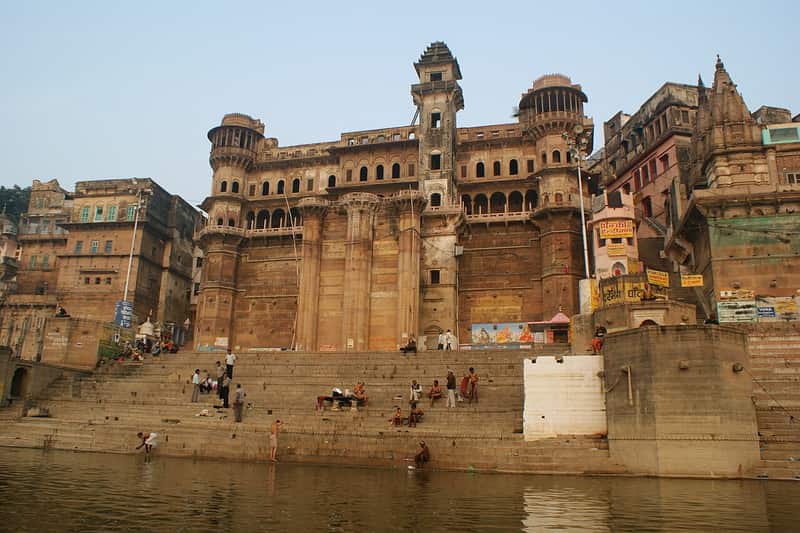
The story of Darbhanga Ghat begins with the princely house of Darbhanga, one of the largest and wealthiest landholding families of colonial India. The Maharajas of Darbhanga held estates across much of Bihar and were counted among the richest men of the subcontinent, but in the memory of Kashi they are remembered not for their wealth but for their piety. The family showered the holy city with benefactions — temples, ghats, dharamshalas, wells and Sanskrit colleges — and the riverside mansion above this ghat was their grandest personal gift: a residence where the maharaja could perform his devotions, receive pilgrims and host the learned men of the city in a setting worthy of his rank.
The palace was raised in the later nineteenth century, when the maharajas sought a permanent riverside presence in the city that Hindus regard as the gateway to liberation. Whenever the family visited, the ghat came alive: the maharaja would bathe at dawn with his household, distribute alms to the poor, and feed hundreds of pilgrims in the palace courtyard, while musicians performed on the terraces above the Ganga. The construction of the ghat's long stairways was itself an act of piety, for in Kashi the building of steps to the sacred river has always been counted among the highest merits — a reason the stairways here are among the finest on the middle riverfront. Every donation was recorded, and local tradition still speaks of the maharaja's generosity with the warmth reserved for remembered benefactors.
The twentieth century was unkind to the palace. Land reforms dismantled the great estate, the family's fortunes scattered, and the mansion stood shuttered for decades, its paintings fading above the busy ghat. The twenty-first century brought a second life: a meticulous restoration transformed the ruined palace into a heritage hotel, and once again the balconies glowed with light. The maharajas are gone, but their ghat remains — a living monument to a family whose name is still spoken with affection wherever the Ganga bends through the city of Shiva. To bathe at Darbhanga Ghat today is to stand on ground that royal piety built and royal devotion kept sacred for more than a century and a half.
Architecture: Painted Facades, Balconies and Stairways
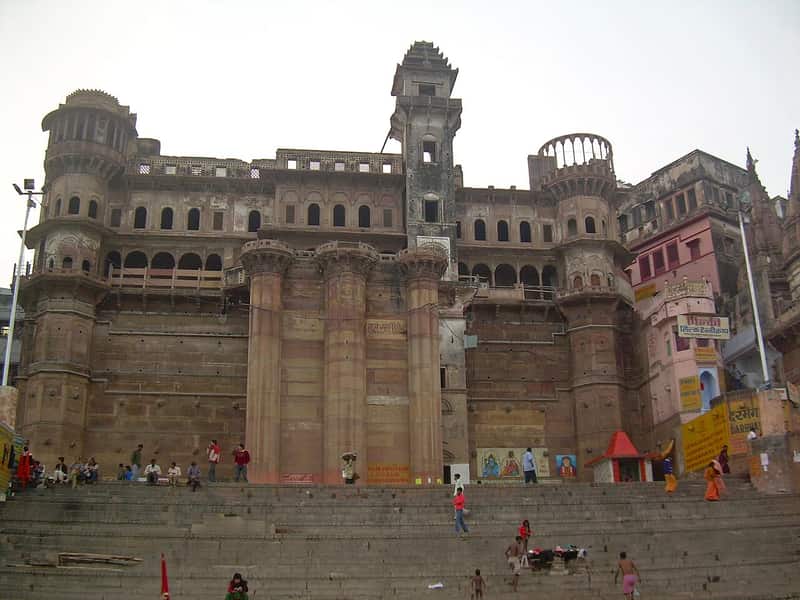
The architecture of Darbhanga Ghat is a lesson in the princely style of late-nineteenth-century Banaras. The palace facades are painted in soft creams, pinks and yellows, with floral arabesques, medallions and peacocks picked out along the cornices. Rows of balconies project from the upper storeys, their iron balustrades worked into curling foliage, while chhatris and ornamental parapets crown the roofline. The style blends Rajput palace architecture with the grand motifs of the British Raj — neoclassical arches, cusped windows, projecting eaves — into something entirely its own: an exuberant, romantic riverside palace that belongs to no single school but to the confident taste of a maharaja who wanted the world to see his devotion and his wealth in equal measure.
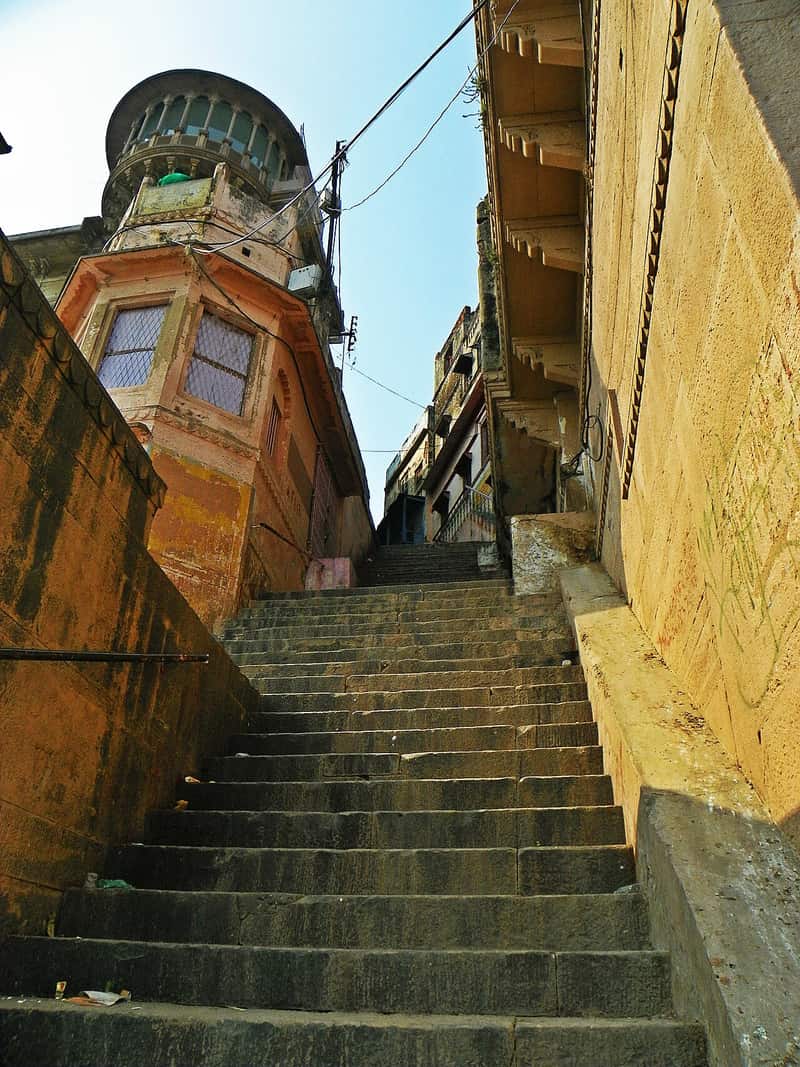
Below the facades, the stairways carry the real weight of the composition. From the waterline the steps climb in long, easy flights toward the palace terraces, divided into broad landings where bathers set down their lotas and boatmen haul their ropes. The steps are cut from the local sandstone that gives every old ghat of Kashi its warm tone, and their edges have been worn smooth by a century and a half of bare feet. At intervals the stairway is interrupted by small platforms and alcoves where oil lamps are set at night, and at its crown a pillared porch shades the entrance to the palace — the point where stone architecture gives way to painted mansion and the riverfront becomes a royal residence.
The genius of the design is that nothing is out of place. The palace, the stairways, the landing platforms and the temple at the base were built as one composition, and even after restoration they speak with a single voice. The ironwork, the plaster mouldings, the painted flowers and the worn stone all belong to the same confident moment in the history of Banaras, when the riverfront was the grandest street of the city and the maharajas built their palaces upon the water like kings of the Ganga's own realm. A visitor who climbs the stairs slowly will notice the details — a carved keystone, a fading bird, a date scratched into the plaster — each one a small signature of the craftsmen who served the maharaja.
The Daily Bathing Scene
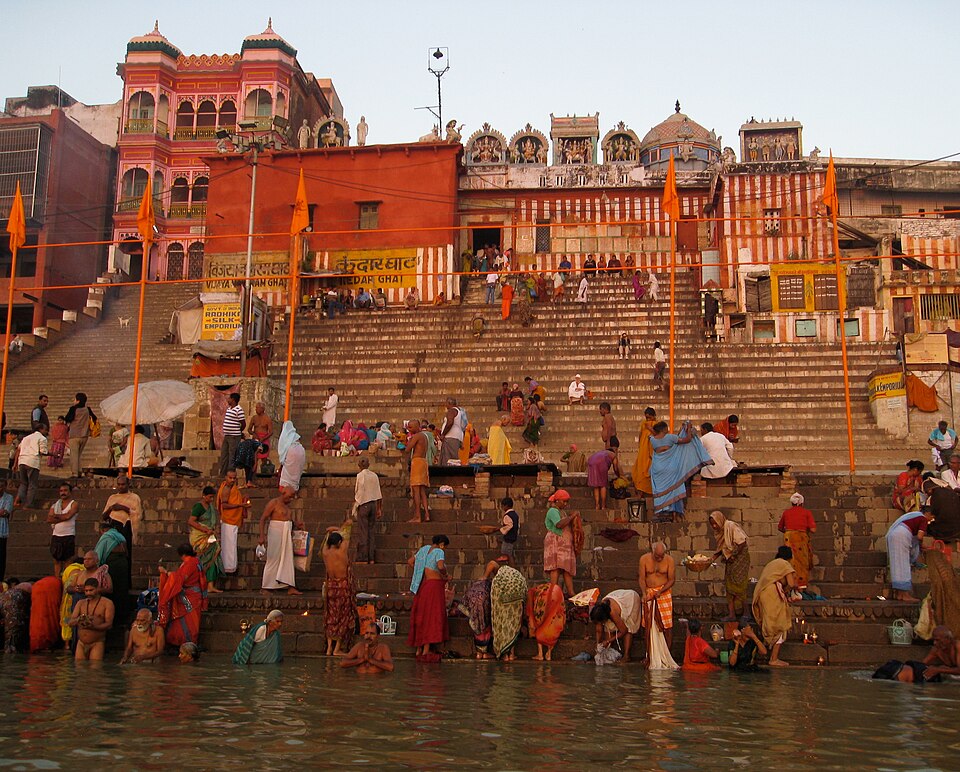
The first act of every day at Darbhanga Ghat is the bath. Well before sunrise the long stairways begin to fill — elderly men in white dhotis, women in sarees of every colour, children rubbing sleep from their eyes — all making their way down to the water with brass lotas and bundles of clean clothes. The ritual is unhurried and deeply personal: a dip, a chant, water cupped and raised to the rising sun, flowers set adrift. The priests under their canopies intone mantras and mark foreheads with sandalwood paste, while the boatmen watch the scene with the calm of men who have seen it ten thousand mornings in a row.
Because Darbhanga stands on the middle riverfront, its bathing waters are generally cleaner and deeper than those of the crowded northern ghats, and in the bathing season many pilgrims prefer it for that reason. Devotees from Bihar are the most numerous among the bathers, for the Darbhanga connection makes the ghat feel like family ground; they arrive in trainloads during the sacred months, camp on the upper platforms, and carry away brass pots of Ganga water to sprinkle on the shrines of their home villages. The bathing platforms themselves are kept immaculate by the ghat's caretakers, and the presence of the palace lends the whole ritual a certain dignity — here the morning dip is performed beneath the painted gaze of maharajas, which the pilgrims, with their instinct for the sacred, find entirely fitting.
For the visitor, joining the morning scene is the purest way to know the ghat. It is enough to arrive by six, sit on the steps above the crowd, and watch the ritual unfold — the sun rising over the far bank, the water turning silver and gold, the palace behind glowing into full colour. No one will hurry you, and no one will object if you merely watch; bathing here is a public act of faith performed in the open air, and the ghat receives all comers — the pilgrim, the boatman, the photographer and the curious traveller — with the same ancient hospitality.
Moorings and Boat Excursions
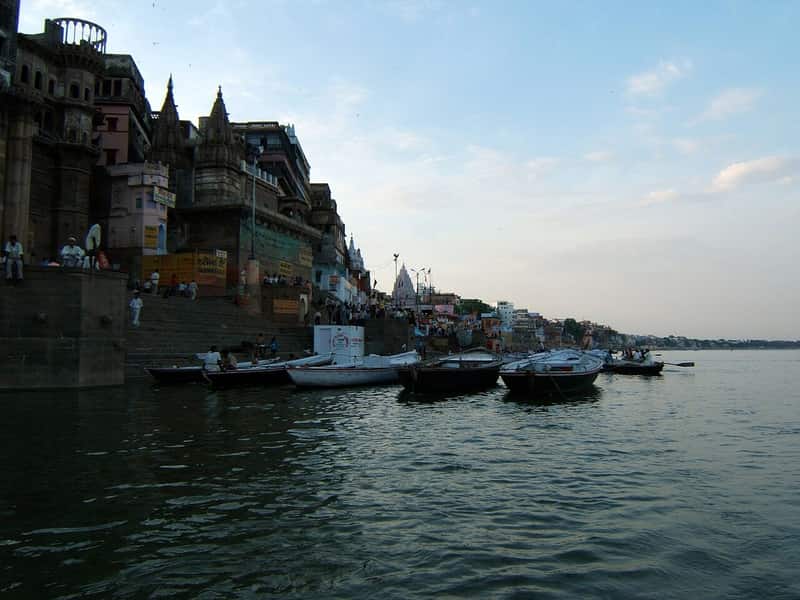
The lower steps of Darbhanga Ghat form a natural harbour. Wooden boats lie in rows against the stones, their hulls painted in greens, reds and blues, each one fitted with canvas awnings and cushions for passengers. Boatmen sit in groups on the steps, mending nets and bargaining in the easy drawl of the river, while the rowing boats rock gently in the current that slips past the ghat. The landing is used by fishermen, ferries, wedding boats and the launches of the palace hotel, so there is almost always movement on the water — a boat setting out, a boat returning, a boatman calling out the price of a morning ride.
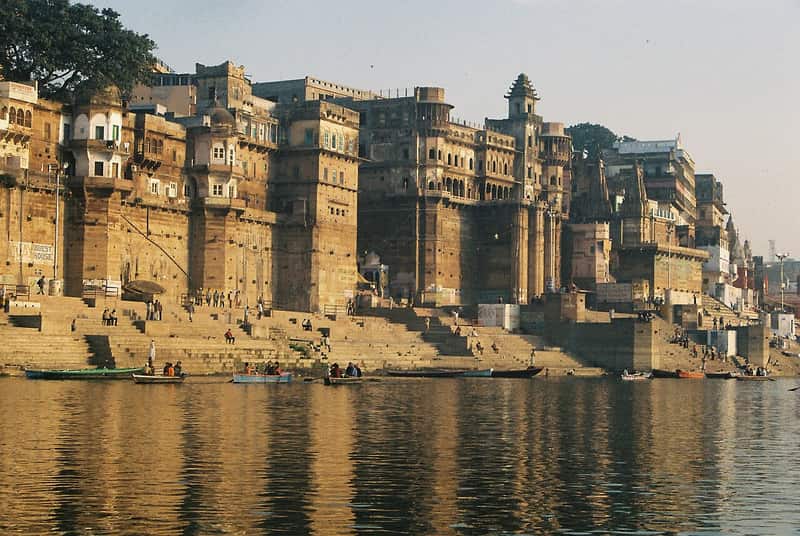
The classic excursion from the ghat is the sunrise ride toward the northern riverfront. A quiet row toward Dashashwamedh and the great crescent beyond reveals the whole history of the city in a single glance — the temples and palaces, the bathing crowds, the smoke of Manikarnika. Heading south instead, the boat passes the quieter ghats of Shivala and Ahilyabai toward the tree-lined shore at Assi. In either direction the finest views of Darbhanga Ghat itself are from the water: from midstream the palace rises like a stage set, its painted balconies reflected in the moving river, and the long stairways descend like a staircase built for kings.
Boat hire is simple but worth negotiating before you board. A standard one-hour trip in the high season costs a few hundred rupees; longer excursions and sunset rides cost more, and the boatmen will agree to a round trip or a photograph stop without complaint. The hotel launches of the Brijrama Palace use a private landing at the northern edge of the ghat, and their passengers glide past the public moorings with the serene authority of house guests. Whatever boat you take, carry water, keep your camera safe, and let the boatman do his work — the river here is wide and strong, and the men who row it know every current and sandbank like the lines of their own hands.
The River and the View
Darbhanga Ghat is above all a place of water. The Ganga at this point runs wide and strong, curving gently so that the ghats of the middle riverfront face the sunrise across a great sheet of open river. In the cool hours of the morning the surface lies like polished metal, reflecting the palace in perfect stillness; by midday the light breaks into a million sparks, and in the evening the water turns to flame as the sun goes down beyond the eastern bank. Because the palace mirrors itself in the river, the reflection is counted as part of the building itself — half the beauty of Darbhanga Ghat is painted on the water.
The river is also a calendar. In the hot months the waters fall, exposing broad sandbanks where cattle graze and pilgrims walk out to bathe in the deep channel; in the monsoon the Ganga swells, covering the lower steps and turning the ghat into a great amphitheatre of brown water; in winter the river lies low and clear, its currents visible as shifting ribbons of silver. Each season changes the face of the ghat, and the palace presides over them all with the calm of a century-old observer. The river is never the same twice, and no two photographs of Darbhanga Ghat are ever quite alike.
The view from the steps is worth a long sit. Across the water, the far bank lies flat and green, dotted with the small shrines and fishing camps of the other shore; upstream and downstream the riverfront curves away in its long arc of ghats and temples. Herons and gulls work the shallows, and at dusk the first lamps appear along the waterline — the evening aarti is lit a little to the north, and the sound of bells drifts down the river. The Ganga here is not a scenic backdrop but the living heart of the scene: everything at Darbhanga Ghat — the palace, the steps, the bathers, the boats — exists in relation to it.

The Lanes and Mohallas Behind the Ghat
Behind Darbhanga Ghat the old city climbs steeply in a labyrinth of lanes, and this is where the ghat's other life is lived. Narrow alleyways thread between tall houses whose upper storeys lean toward each other, their windows carved with balconies and their doorways painted with auspicious symbols. Temples stand at almost every turning — some of them tiny shrines barely wider than a man, others substantial temples with carved mandapas — and the air carries the smoke of incense, the smell of frying sweets and the sound of temple bells. This is a Brahmin neighbourhood, settled for centuries by priestly families who served the ghats and their pilgrims.
The lanes form a living market of the riverfront trades. Flower sellers string marigolds at their stalls, paan and tea shops do a brisk business from dawn, and vendors carry trays of bangles, toys and temple prasad up and down the steps. Families live above the shops in houses that open onto shared courtyards, and in the evening the alleys fill with the laughter of children and the clatter of cooking pots. The palace occupies only the riverside edge of the quarter; behind it, ordinary Banaras — students, clerks, priests, artisans — carries on as it has for centuries, indifferent to the grandeur at its doorstep.
Exploring these lanes is one of the pleasures of visiting the ghat, but it should be done with care and courtesy. The alleyways are narrow, shared and often private, so walk slowly, greet the residents, and ask before photographing doorways and people. Look for the older mansions with their carved gates, the ancient wells still in use, and the rooftop views that open suddenly between the houses. A small offering at the neighbourhood shrines, a rupee at a doorway, goes a long way in these lanes, whose hospitality to strangers is a tradition far older than the palace itself. From the upper terraces you can see the whole curve of the riverfront — the palace below, the ghats receding north and south, and the Ganga unrolling toward the horizon.
Neighbours: Rana Mahal and Munshi Ghats
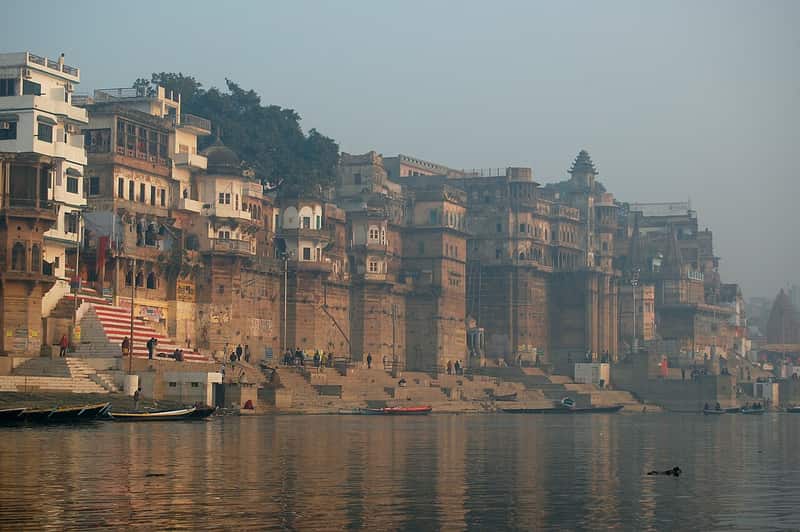
To the south, joined almost seamlessly to Darbhanga Ghat, stands Rana Mahal Ghat — the two landings share the same palace complex and are often mistaken for a single building. Rana Mahal, which preserves the name of a Rana patron, is slightly more modest in scale but equally rich in painted facades and balconies; together the two ghats form one continuous, five-star facade of late-nineteenth-century grandeur. The walk between them is a matter of minutes, and the transition from one palace to the next is so smooth that visitors often photograph the pair as a single wall of balconies and colour. Beyond Rana Mahal the riverfront turns quieter, running through the plains of Ahilyabai Ghat, named for the great queen of Indore whose piety left its mark across India.
To the north, separated by a short walk along the water, lies Munshi Ghat — a gentler, quieter landing built by Sridhara Narayana Munshi, a minister of the Nagpur state, in the early twentieth century. Munshi Ghat is a plain stone stairway without the palaces of its neighbours, popular with bathers who prefer its calm and with families who spread their mornings on its broad, sun-warmed steps. From Munshi the riverfront continues toward the great northern ghats — Shivala, Niranjani, Kedar and, far beyond, the crowds of Dashashwamedh — so the ghat serves as a quiet doorway between the palace quarter and the livelier riverfront.
For planning a riverside walk, the sequence is simple: from the south, walk north from Ahilyabai through Rana Mahal, pause at Darbhanga, continue through Munshi, and you will have seen the whole middle riverfront in under an hour. Alternatively, a boat from Dashashwamedh passes all of them in a single, glorious glide, with the palace ghats rising and falling along the bank like painted scenery. Darbhanga Ghat sits at the very centre of this chain, and a visit to it is naturally a visit to its neighbours — each of them a different chapter in the same story of royal devotion to the Ganga.
Etiquette: Respectful Conduct
Darbhanga Ghat is a living place of worship, and its first rule is respect. Dress modestly — shoulders and knees covered — as you would in any temple of India, and keep in mind that every person on the steps, from the priest under the canopy to the woman filling her lota, is engaged in an act of faith. Photographing the bathing crowd is welcome from the steps, but ask before photographing individuals close up, and never point a camera at anyone during the most intimate moments of prayer. Shoes are tolerated on the lower public steps, but it is gracious to remove them before approaching the small temple at the base of the ghat.
A few practical courtesies go far on any ghat. Do not block the stairways, which are the arteries of the riverfront — stand to one side, keep your belongings close, and let the bathers, priests and porters pass. Offerings of flowers and lamps float past on the water; do not disturb them, and carry your own litter away with you. If a priest offers his services — a prayer, a mark on the forehead, a story of the ghat — you are free to accept or decline, but if you accept, a small donation is customary. Money is part of the economy of the ghat, and handling it with grace is part of the ritual.
The palace hotel has its own quiet rules: its landings and gates are private, and guests value their privacy, so admire the facade from the public steps and the water rather than the hotel doorways. Early morning and dusk are the times of deepest devotion, when the ghat is at its most moving — and when it asks its visitors to be stillest. Sit, watch, listen; the ghat will teach you its manners in half an hour. What matters most is the spirit: come as a guest, not a spectator, and the people of the ghat will treat you with the courtesy that has welcomed pilgrims to Kashi for three thousand years.
Practical Guide: Reaching, Timing and Nearby Ghats
Darbhanga Ghat is easy to reach. The most pleasant approach is on foot along the riverfront from Dashashwamedh Ghat — roughly twenty minutes of walking past the old ghats, or ten minutes southward from Assi — and the ghat is impossible to miss, for the painted palace announces itself from a great distance. By road, take a rickshaw or taxi to the lane of Shivala and walk the short distance to the water; the ghat is well signposted and the approach passes through the living lanes of the old city. By boat, every ferry and excursion along the middle riverfront passes the ghat, and the boatmen of Dashashwamedh will bring you to its steps for the price of a short ride.
The best time to visit is early morning, from about five-thirty to eight, when the bathing is at its height and the light on the palace is at its loveliest; sunset from the steps or from a boat is the other great hour. The cool months from October to March are the most comfortable, with crisp winter sunrises and long, golden evenings; summer mornings are hot but quiet, and the monsoon brings high water and dramatic skies. The most striking photographs are taken from a boat at sunrise, when the palace is lit by the rising sun, or at dusk, when its windows begin to glow. Allow at least an hour for the ghat itself and another for the lanes behind it.
Darbhanga Ghat sits conveniently between the ghats of Ahilyabai and Shivala to the south and Munshi and the northern chain beyond, so a full morning can be spent walking the riverfront in either direction. If you want to stay the night, the Brijrama Palace itself offers rooms; otherwise the guesthouses and hotels of the Shivala quarter are a short walk away. The ghat is safe, busy and well maintained, but the usual cautions apply — keep valuables close, agree on boat prices before boarding, and drink only bottled water. With those few habits in place, Darbhanga Ghat is one of the most rewarding places on the Ganga to spend a slow, luminous hour.
Darbhanga Ghat — Gallery (11 Photos)
Image Credits
darbhanga-01.jpg · darbhanga-02.jpg · darbhanga-03.jpg · darbhanga-04.jpg · darbhanga-05.jpg · darbhanga-06.jpg · darbhanga-07.jpg · darbhanga-08.jpg · darbhanga-09.jpg · darbhanga-10.jpg · darbhanga-11.jpg — Wikimedia Commons, under free licenses.
Continue exploring
Similar Ghats Nearby
Book This Ghat — Get Notified
Download the app now and book a boat ride to Darbhanga Ghat