

Ahilyabai Ghat
Heritage GhatAhilyabai Ghat is an 18th-century historic ghat built by Queen Ahilyabai Holkar.


Type
Heritage Ghat
Boat Fare
1.1x base fare
Best Time
6-10 AM when morning light illuminates the temple.
History
Built by Queen Ahilyabai Holkar in the 18th century. A beautiful Shiva temple is at the ghat center.
Highlights
- Ahilyabai Holkar’s 1778 construction
- Memory of a great woman ruler
- Peaceful bathing and darshan
Festivals & Events
How pricing works in the NaviX app
No haggling at the ghat — everything is fixed in the app first
- 1
Fixed price before you board
The fare is shown in the app upfront — no bargaining at the ghat
- 2
Sharing or private — your choice
Share with fellow travelers or take the whole boat for your group
- 3
Pay only after the ride
UPI, card or cash — with an instant receipt
6:00 AM & 6:00 PM
Built by Rani Ahilyabai Holkar
Complete Guide
Ahilyabai Ghat — The Complete Guide
History, mythology, rites and practical details — everything in depth.
On this page
- 1.Ahilyabai Ghat: An Introduction
- 2.The Queen of Indore: Rani Ahilyabai Holkar
- 3.An Eighteenth-Century Legacy: Construction and Patronage
- 4.Royal Simplicity: The Steps and Structures
- 5.The Daily Bathing Scene
- 6.Moorings and Boatmen
- 7.The River and the View
- 8.Lanes and Mohalla: Life Behind the Ghat
- 9.Neighbouring Ghats: Shivala and Nishadraj
- 10.Festivals at the Ghat
- 11.Etiquette and Respectful Conduct
- 12.Practical Guide: Reaching the Ghat and Best Times
📅 Updated: 21 Aug 2026 · Author: NaviX Field Team (field research 2024-26) · 12 sections · 12 photos
Ahilyabai Ghat: An Introduction
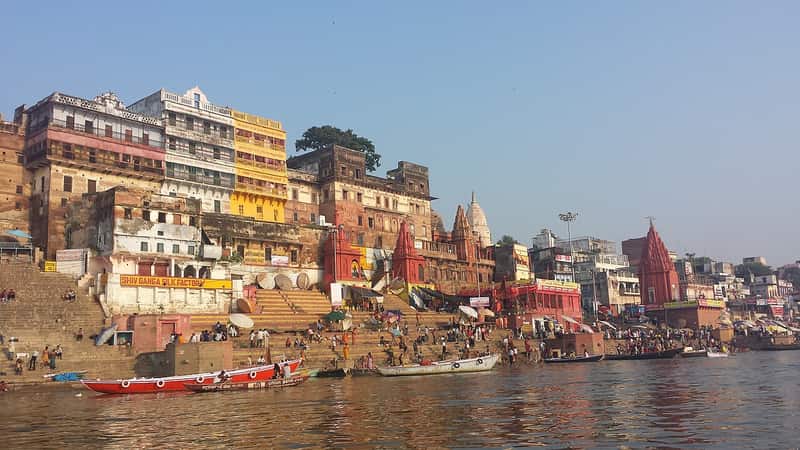
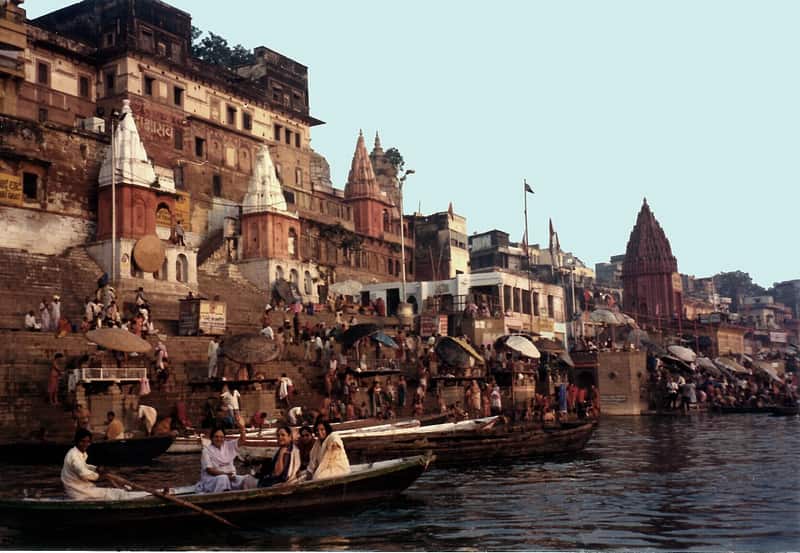
Ahilyabai Ghat stands on the southern stretch of Varanasi's riverfront, on the calm reach of the Ganga that lies between Nishadraj Ghat and Shivala Ghat. Its wide stone steps descend in even, unhurried tiers from a quiet lane to the water's edge, and the whole composition breathes an air of royal simplicity that is rare among the crowded ghats of the old city. Where Dashashwamedh roars with commerce and Manikarnika burns with funeral fires, Ahilyabai is a ghat of measured calm. Bathers arrive in ones and twos, priests wait quietly on the lower platforms, and boatmen doze in their skiffs while the river does its endless work. It is one of the few places on the southern riverfront where you can hear the water lap against the stone.
The ghat takes its name from the woman who built it, Rani Ahilyabai Holkar of Indore, and it is in every sense her monument. In the eighteenth century, when much of the Varanasi riverfront was being reshaped by the great Maratha families, Ahilyabai was among the most devoted patrons the city has ever known. She gave Kashi its rebuilt Vishwanath temple, a network of ghats, dharamshalas and rest houses, and countless smaller shrines, and this ghat preserves her vision of dignified, unpretentious stonework. Standing on her steps, one senses the presence of a queen whose piety was matched by her practicality: nothing here is wasted, nothing is ostentatious, and everything is built to last. Her spirit of quiet, purposeful giving is written into the very masonry.
For the traveller, Ahilyabai Ghat is the calm heart of the Shivala neighbourhood. The lane behind it leads to guesthouses and tea stalls, the ghat itself offers one of the best unbroken views of the southern riverfront, and the morning bathing scene unfolds without the self-consciousness of the busier ghats. Boats wait below for a slow circuit of the river, and from the water the ghat reveals itself as a long, serene line of stone that time has treated kindly. Whether you come to bathe, to pray, to photograph or simply to sit and watch the river, this ghat gives you room to breathe. In Varanasi, where so many ghats demand attention, Ahilyabai quietly offers stillness instead, and that is a gift in itself.
The Queen of Indore: Rani Ahilyabai Holkar
Rani Ahilyabai Holkar was born in 1725 in the village of Chondi in Maharashtra, into a family of modest means. At the age of eight she was noticed by Malhar Rao Holkar, the founder of the Holkar dynasty, who recognised her intelligence and married her to his son Khanderao. Her life took a tragic turn early: her husband was killed in battle in 1754, her father-in-law followed in 1766, and within months of taking charge she faced a court full of rivals who doubted that a widow could rule. Yet Ahilyabai proved them wrong. From 1767 until her death in 1795 she governed the vast Holkar dominions of Malwa from her capital at Maheshwar on the banks of the Narmada, fighting wars, hearing petitions, and administering justice with a firmness that won the admiration of friend and foe alike.
She was known among her people as Devi Ahilyabai, and the British Governor-General Warren Hastings, who met her late in her reign, compared her to Catherine the Great of Russia, a compliment that says more about her reputation than any monument. Her administration was legendary for its accessibility: every day she personally sat to hear the complaints of her subjects, rich or poor, and the justice of her court was feared and respected in equal measure. Yet the same woman who could order an army to battle would rise before dawn to pray, and her letters read like the meditations of a saint, full of humility before Shiva and before the holy city of Kashi, which she regarded as the very roof of her faith. This union of the sword and the prayer mat defined her entire reign.
Ahilyabai's devotion expressed itself in stone. She rebuilt temples at Somnath, Dwarka, Kedarnath and Badrinath, at Rameshwaram and Gaya, and she restored the Vishwanath temple of Kashi itself, which had lain in ruins for generations. She built ghats, dharamshalas, wells and resting places along the great pilgrim routes of India, so that no traveller to the holy places would suffer thirst or shelterlessness. Her capital at Maheshwar, with its painted palace and riverside temples, remains one of the loveliest river towns in India. She died in 1795, but her name became a byword for righteous rule, and every stone she raised in Kashi keeps her memory alive. On this ghat, her spirit survives in its calmest, most characteristic form.
An Eighteenth-Century Legacy: Construction and Patronage
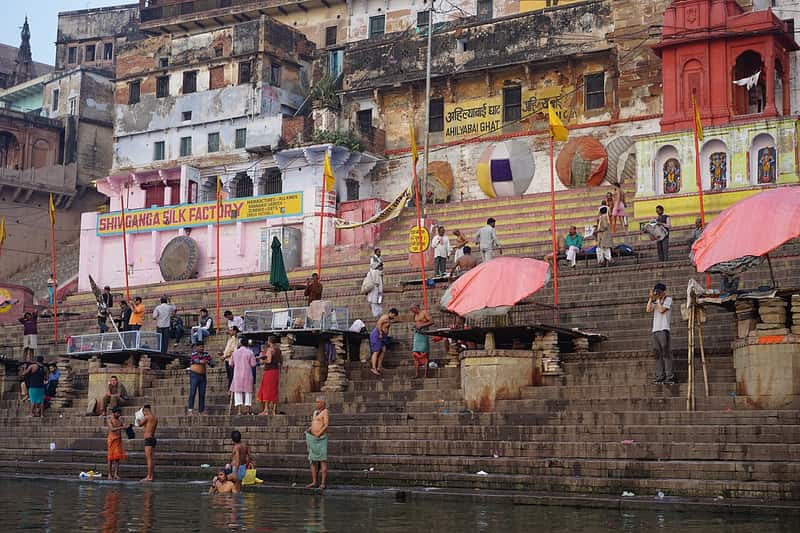
The eighteenth century was the great age of the Varanasi riverfront. As the Mughal empire declined, the Maratha powers of central India became the protectors and patrons of Kashi, and every noble family seemed to want to leave its mark on the holy city's bank. Ahilyabai Ghat belongs to this remarkable generation of building. The ghat was constructed in the third quarter of the century, when the queen was at the height of her power, and it formed part of a programme of pious construction that included the rebuilding of the Vishwanath temple itself. In 1780 she laid the foundations of the temple that stands near the river to this day, and this ghat rose at roughly the same time, as her gift to the pilgrims who arrived by boat and needed a dignified place to land and to bathe.
Ahilyabai's patronage was systematic in a way that earlier princely giving had rarely been. Where other rulers built for glory, she built for use, with ghats where a pilgrim could bathe, dharamshalas where a traveller could sleep, and wells and baolis where a thirsty walker could drink. Her engineers and masons travelled from Indore and Maheshwar to supervise the work, and her treasury met the cost without the elaborate dedications and festivals with which other ghats were inaugurated. What survives of her work shows her taste: solid, symmetrical stonework, broad terraces, and an absence of the carved fantasy that decorates the ghats of Man Singh or the palaces of later rajas. She built for eternity, not for show, and the plain dignity of this ghat is her signature.
The history of the ghat after her death is quieter, but no less real. Successive caretakers of the Shivala area maintained the steps; the Holkar family itself retained interests in Kashi for generations, and the memory of the queen's generosity stayed fresh in the city's folklore. In the twentieth century, as tourism grew, the ghat was absorbed into the great riverside walk that links Assi to the old city, and its calm made it a favourite of travellers in search of a quieter Varanasi. The plaques and inscriptions of the ghat are few, but its history is written plainly in its stone: a queen's devotion, an era's ambition, and the slow, patient work of the Ganga itself, which has worn the steps smooth without ever erasing them.
Royal Simplicity: The Steps and Structures
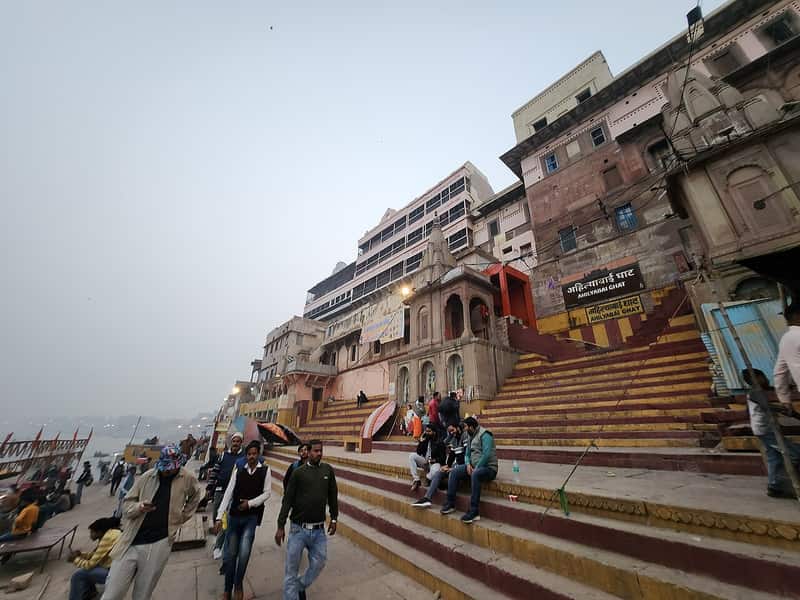
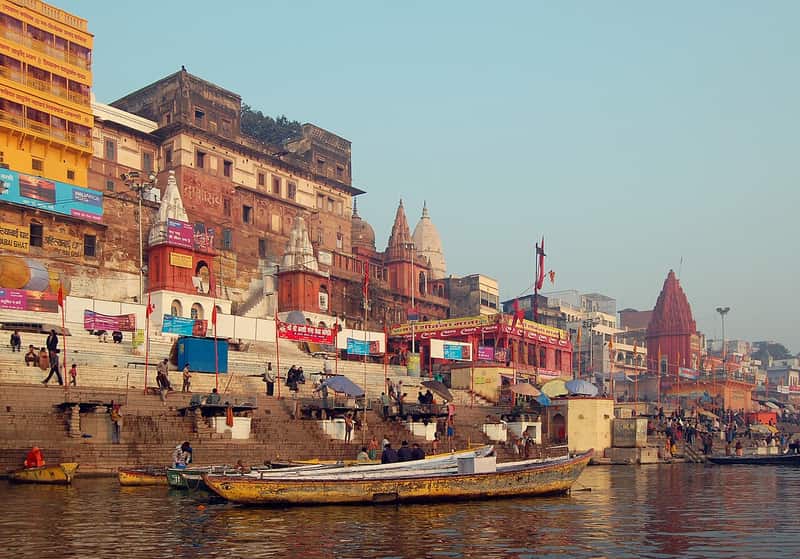
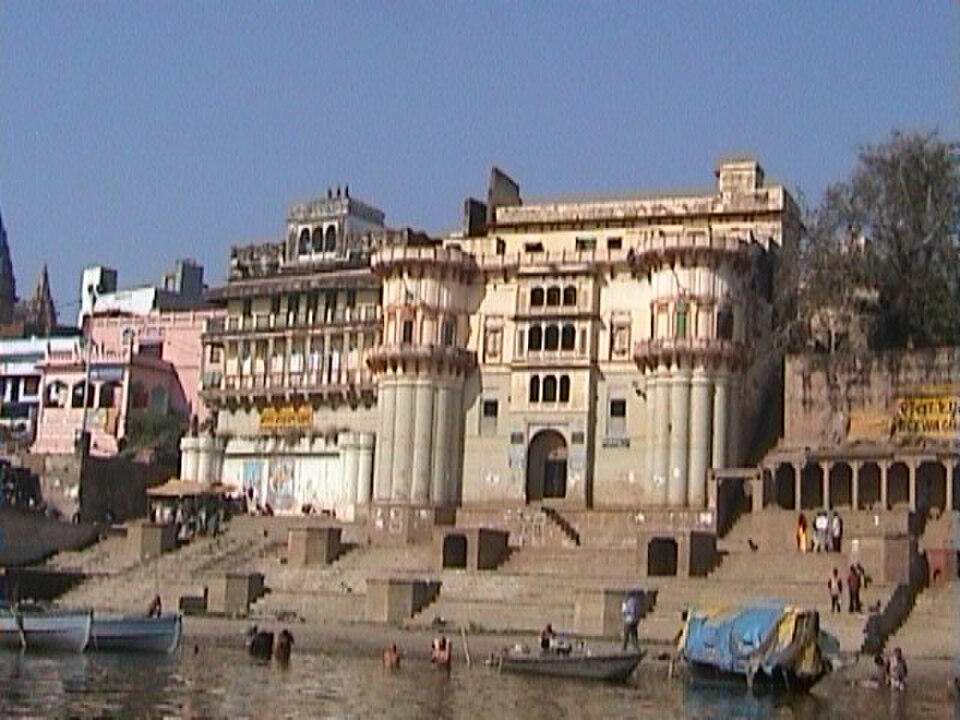
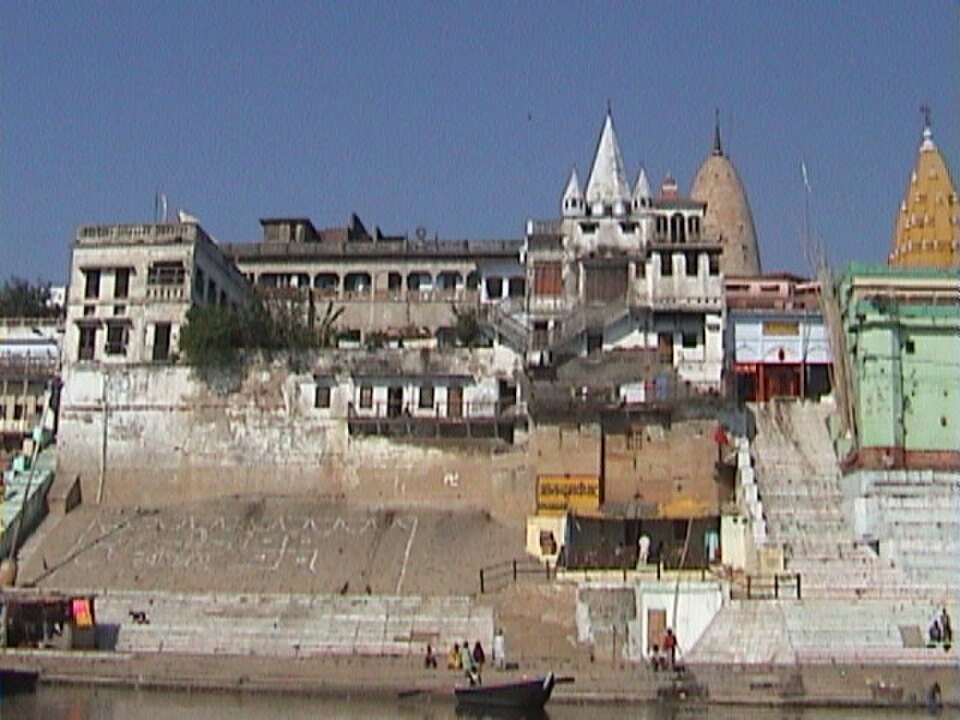
The architecture of Ahilyabai Ghat is a study in royal simplicity. The steps are broad and deep, laid in long, straight flights that descend in easy stages from the lane to the water, with generous landings at intervals where bathers can fold their clothes and set down their lotas. The stone is a warm sandstone, cut in large regular blocks and laid with a precision that has kept the ghat remarkably level for over two centuries. There are no elaborate towers, no carved pavilions, no fantasy of the kind that adorns the neighbouring ghats of the same period. The effect is of a building that knows its own dignity and needs no ornament to prove it. The queen's own taste, austere, devout and purposeful, is legible in every course of masonry.
At the top of the ghat stand the structures that serve its daily life: small shrine pavilions, a row of stone seats where the elderly gather, and the metal railings and water taps that belong to a later century. Lower down, the ghat opens onto stone chabutaras, or platforms, built out into the river, giving bathers a foothold at any season of the year. In the winter, when the water retreats, these platforms stand above a wide beach of sand; in the monsoon they become islands in the current, and only their topmost slabs remain dry. The retaining walls that brace the ghat against the flood are among its finest engineering, massive and gently battered, built to absorb the weight of the river for months at a time.
Every element of the ghat speaks of durability. The joints are tight, the edges are chamfered to resist the wearing of bare feet and lapping water, and the stone itself was chosen from quarries known for withstanding the Ganga's particular chemistry. Over the centuries the river has risen into the lanes and retreated to the far sandbanks, yet the ghat has survived without major rebuilding, a testimony to the honesty of eighteenth-century construction. Small shrines have been added by later generations, and the platforms have been repaired many times, but the original lines of the ghat remain exactly as the queen's masons laid them. To walk down these steps is to walk through a piece of living history, intact and unmodified, which is precisely how its builder would have wanted it.
The Daily Bathing Scene
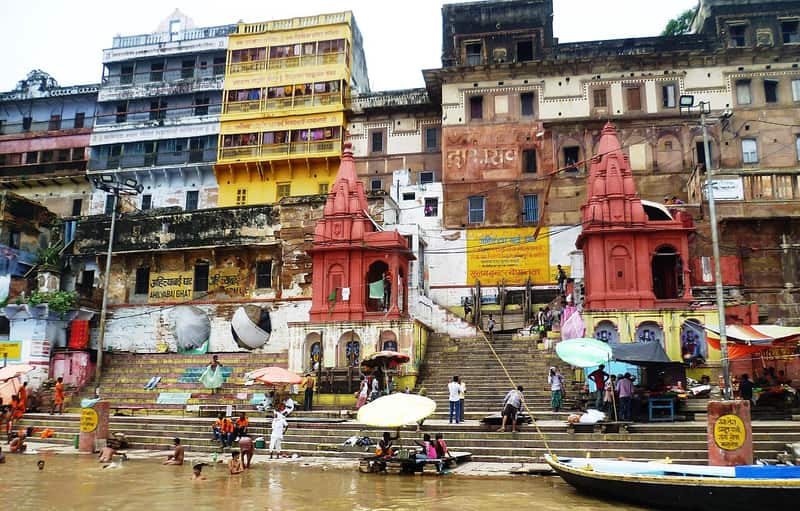
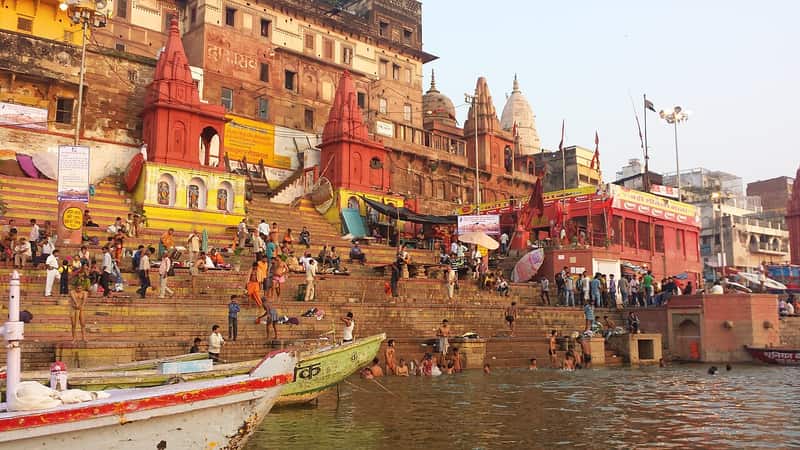
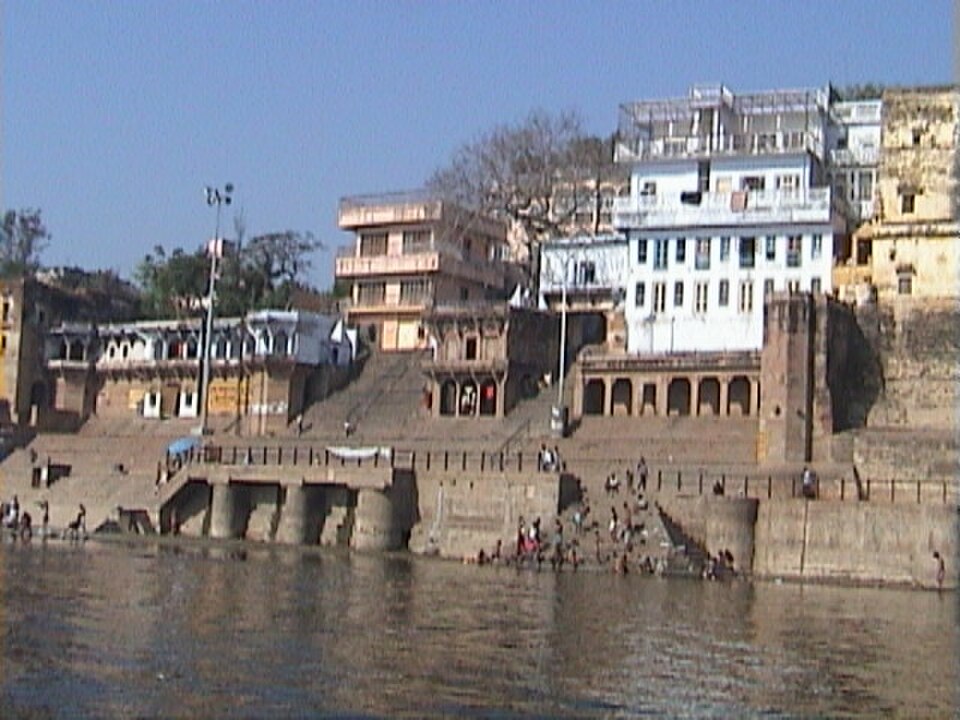
At dawn, Ahilyabai Ghat belongs to the bathers. Before the sun has cleared the rooftops of Shivala, the first figures come down the steps, old men with brass lotas, women with plastic buckets and steel tumblers, a grandmother steadying a grandchild by the hand. The ritual here is unhurried, conducted with the ease of generations: clothes folded on the chabutara, a first handful of water raised toward the sun, a murmured prayer, and then the slow immersion. What distinguishes bathing at Ahilyabai from the great shows at Dashashwamedh is its intimacy. There is no crowd pressing for space, no guide shouting prices; there is only the water, the morning, and the private conversation between a soul and its river, conducted in full view of heaven but in perfect privacy of spirit.
The priests of the ghat serve the ritual in a quiet key. They sit on the lower platforms with their baskets of tilak, sandalwood paste, vermilion and marigold, and perform the small ceremonies that pilgrims request: a name and a prayer, a mark on the forehead, a libation offered to the sun and to the ancestors. Family groups arrive together, the men descending first, the women bathing a little apart, and the young, in the way of the young, splashing and laughing until an elder calls them back to seriousness. Around seven the ghat is at its fullest, wet footprints covering the lower steps, and the water itself is a moving mosaic of heads and hands and brass pots catching the first flat light of day.
The bathing continues until late morning, then thins to a trickle. Afterwards, bathers wring out their clothes on the railings, change behind spread shawls, and climb slowly back to the lane, some stopping to buy a garland or a packet of prasad from the small stalls above. By midday the ghat is given over to the lazier commerce of the afternoon, with women washing clothes, children diving from the platforms, and boatmen mending nets, but the memory of the morning's ritual lingers in the air. On festival days, and especially in the holy month of Kartik, the bathing becomes a flood and the ghat is crowded from dawn to dusk. Yet even then, this remains a bather's ghat before anything else, and the river receives them all, one by one, exactly as she has for two and a half centuries.
Moorings and Boatmen
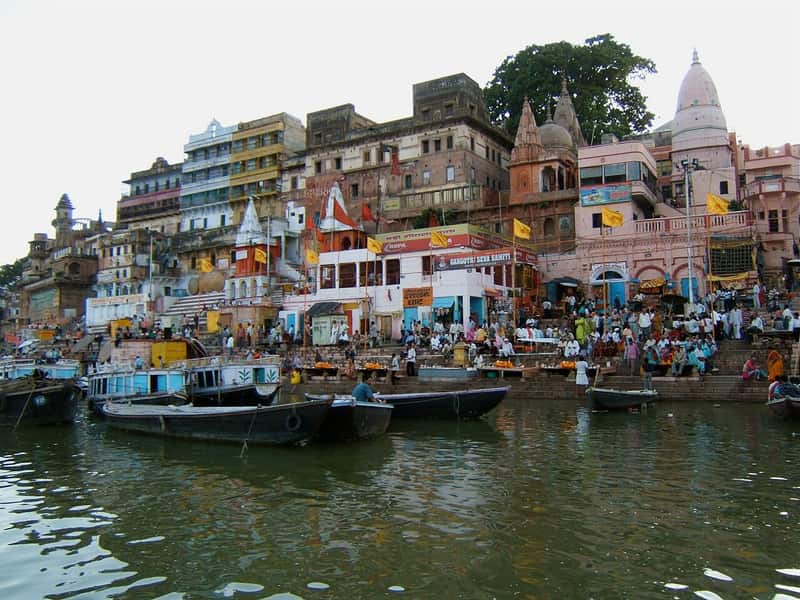
Below Ahilyabai Ghat the wooden boats of the riverfront keep their steady rhythm. The moorings here are smaller and quieter than those of the central ghats, a dozen or so skiffs at most, their hulls painted in greens and blues, their tarpaulin roofs slung low against the sun. The boatmen of the Shivala stretch are fishermen and ferrymen first and tourist guides second, and they know this reach of the Ganga the way a farmer knows his field. They can read the sandbanks that shift with every monsoon, the channels that open and close, and the exact hour at which the current turns. When a passenger appears on the steps, the nearest boatman uncurls himself, dips his oars, and the negotiation begins, short, friendly, and concluded in the old manner with a nod and a handshake.
The classic journey from this ghat is the sunrise circuit of the southern riverfront. The boat slips out from the mooring as the sky colours, and the oarsman takes the craft upstream along the long line of ghats, past Bhadaini and Janaki, past the bathers' platforms, until the whole southern curve of Kashi opens behind the boat like a fan. On the return, the rower lets the current do half the work, and the ghats pass in review: Shivala's temples, the quiet terraces of Ahilyabai, the towers of the old city rising behind them. A short crossing to the far bank is the alternative, ten minutes of deep water and then the immense sand islands of the far shore, where herons stand in the shallows and villages hide among the fields, and where the whole skyline of Varanasi is visible in one astonishing glance.
For many of the local people, the boats are not an excursion but a necessity. Fishermen set out before dawn with their nets, women cross to the far bank to visit relatives, farmers carry produce between the two shores, and during the monsoon floods the boats become the only bridge between the ghat and the world beyond the water. The moorings are managed with the informal discipline of the river, for every boatman knows his place in the line, and the arrival of a new skiff is a small event for the whole company. At evening, when the last trips are done, the boats are pulled up and tied, their lights lit, and the water laps quietly at their sides. Then the ghat settles into darkness, and the river resumes the conversation it has been holding with the city since time began.
The River and the View
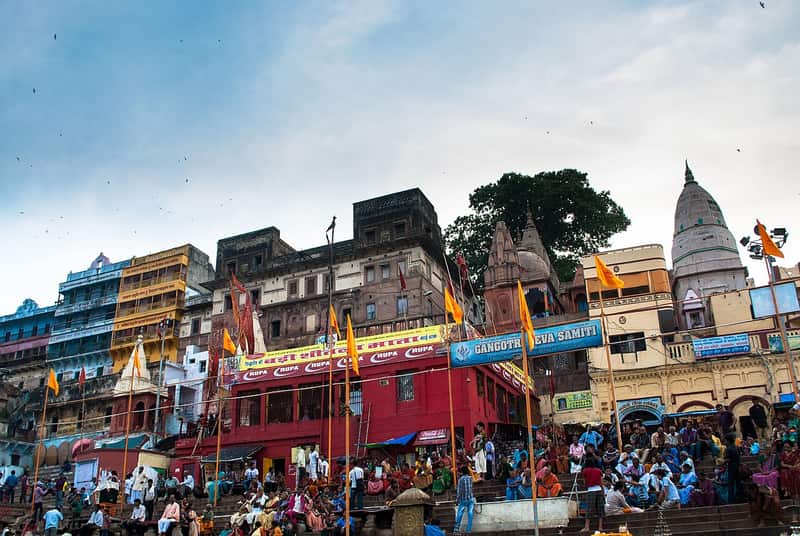
The Ganga at Ahilyabai Ghat is a river in full maturity. Here, on the southern reach, she runs wide and deep, her current steady and muscular even in the dry months, her colour shifting through the day from silver at dawn to dark bronze at evening. In winter the water retreats to reveal vast sand beaches, and the river seems to shrink to a blue channel in the middle of a pale desert; in the monsoon she swells to fill her whole bed and more, racing past the ghat with a sound like distant thunder. The relationship between this ghat and the river is closer than at any other point along the waterfront, because the steps meet the water in long gentle shelves, and standing on the lowest platform you feel the current at your feet.
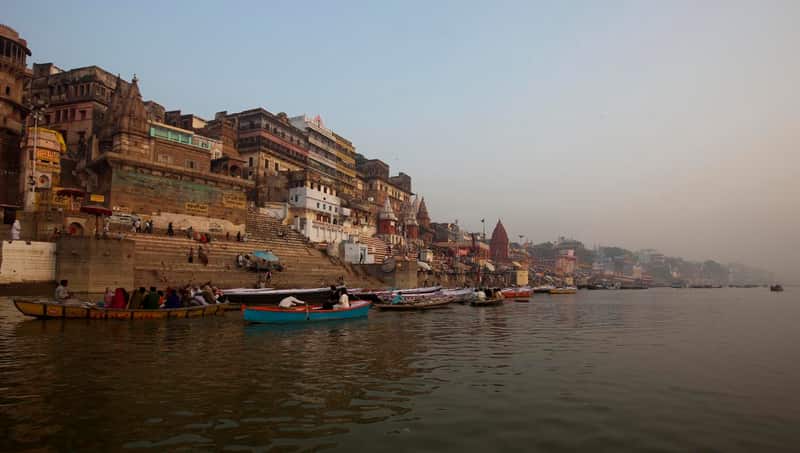
The view from the water is the ghat's finest possession. Looking upstream to the south, the eye travels past Nishadraj Ghat and the houses of Bhadaini to the distant bend where Assi Ghat begins the long arc of the sacred crescent. Looking downstream to the north, the towers and domes of the old city rise in a broken skyline, the temple of Shivala, the rooftops of the lanes, and beyond them the high buildings of the central ghats. The far bank is a flat, green world of fields and palm clusters and low villages, seemingly untouched by the city across the water. It is the classic Varanasi view, and from the middle of the river at Ahilyabai it appears at its most uncluttered, unbroken by the crowds and construction that crowd the central reaches.
The river here is also a working river. Fishing boats string their nets at dawn; barges carry sand from the islands; the far bank is a patchwork of cultivation watered by the retreating monsoon. In the evenings, when the bathers have gone and the boats are tied, the ghat settles into the long dusk of the riverfront. The water turns from bronze to ink, the lights of the far bank come on one by one, and the sound of temple bells drifts across the surface from the ghats above. On full moon nights, the whole river becomes a sheet of trembling silver, and the ghat's pale stone glows in the dark. Then it is easy to understand why the river has been worshipped here for three thousand years, for she is, in the end, the real reason this ghat exists at all.
Lanes and Mohalla: Life Behind the Ghat
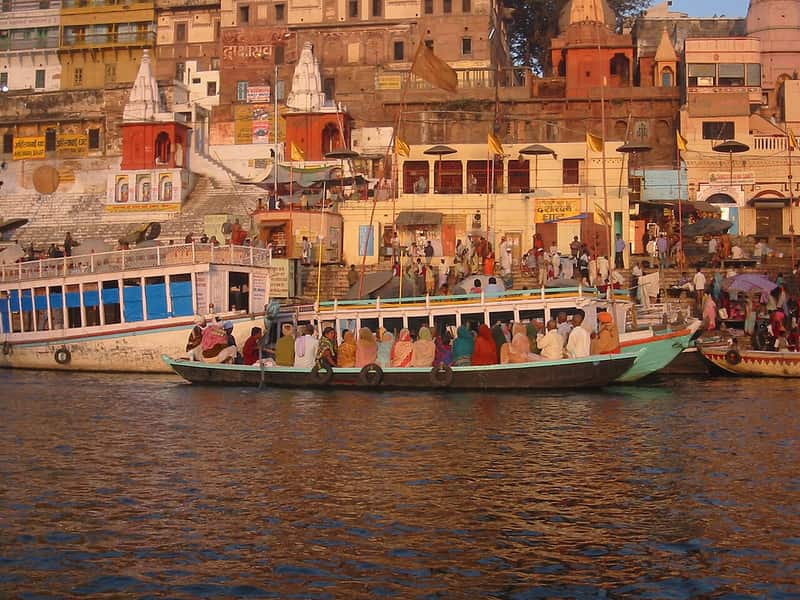
Behind Ahilyabai Ghat lies the quarter of Shivala, one of the busiest residential districts of the southern riverfront. The ghat's own lane is a narrow, shaded passage lined with old houses whose facades bear the signs of two centuries of occupation — fading paint, flowering balconies, doorways worn smooth by generations of hands. A few steps from the ghat the lane widens into the bazaar, where the commerce of the quarter gathers: shops selling puja materials, garlands, sweets and cloth; tea stalls with their perpetual audience of old men; and the cycle rickshaws that wait in patient lines for passengers. The sounds are those of any Indian street at work — bells, bargaining, engines, radios — and the smells of frying food and incense and river air mingle into a single unmistakable perfume.
The quarter is also the traveller's home base. Along the lanes above the ghat stand guesthouses and hotels in every price range, from rooftop rooms with camp beds to comfortable modern establishments with river-view terraces. Staying here means waking to the sound of temple bells and the clatter of the bazaar, and walking downhill for two minutes to find the river at your feet. The restaurants of Shivala serve the honest food of the city — thalis, kachori, lassi — and the sweet shops keep their own private recipes. For those who want a quieter, more local Varanasi than the hotel rows of the central ghats, this neighbourhood is the natural choice, and many visitors who come for one night end up staying for a week.
Life in the mohalla is lived in public, and the ghat is its drawing room. Families come down in the evening to sit on the steps; children fly kites from the terraces; the elderly gather on the chabutaras to argue about the price of vegetables and the state of the world. Festivals fill the lanes with colour and noise, and processions pass down to the water to dip the images of the gods. The rhythm of the quarter is tied to the river in a hundred small ways — the shops that open when the first bathers come down, the boats that are hired for weddings and funerals, the sand that drifts up the lane on windy days. To stay in this mohalla is to live inside the reality of Kashi, and the ghat is simply the place where that reality meets the eternal water.
Neighbouring Ghats: Shivala and Nishadraj
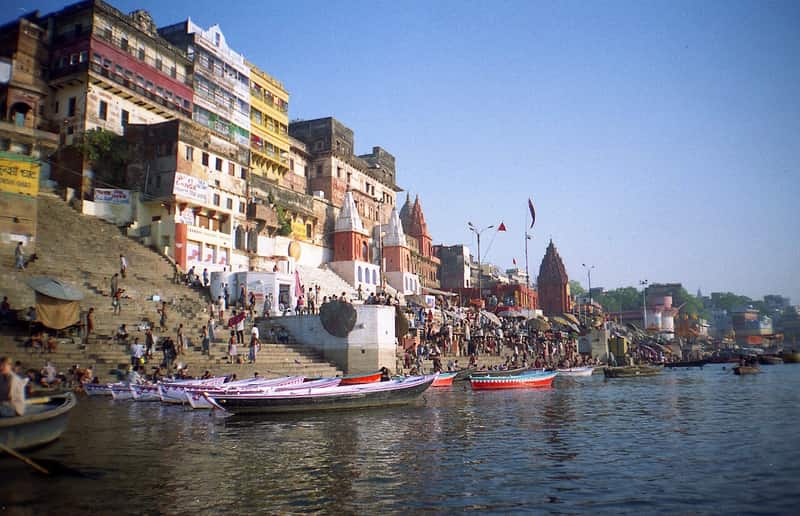
Ahilyabai Ghat sits in the closest company of the southern riverfront, within a short walk of two of the most characterful ghats of Varanasi. Immediately to the north lies Shivala Ghat, the busy commercial heart of the quarter, its broad steps crowded with boats, stalls and bathers from dawn to dusk. Shivala takes its name from the Shiva temple that stands above it, and its ghat is the working waterfront of the neighbourhood, the place where commerce and worship, school children and sadhus, all share the same steps. A walk between the two ghats takes barely five minutes, and the lanes between them are among the most lively in the whole southern city. Together the two ghats form the twin heart of the Shivala quarter.
To the south lies Nishadraj Ghat, named for the king of the boatmen from the great Indian epic, the Ramayana. According to the legend, when Lord Rama, his wife Sita and his brother Lakshmana crossed the Ganga on their journey into exile, it was the boatman-king Nishadraj Guha who ferried them across the river, and this stretch of the bank is traditionally honoured as the place where that crossing took place. A modern shrine to Nishadraj stands near the ghat, its image showing the king of the boatmen in the act of his historic service. For the boatmen of Varanasi, Nishadraj is their patron and their pride, and the ghat that bears his name is a daily reminder that their ancient craft was once honoured by the gods themselves.
The three ghats — Nishadraj, Ahilyabai and Shivala — make one of the best short walks on the whole riverfront. Begin at Nishadraj in the early morning, when its steps are given over to bathers and its shrine is bright with marigolds; walk north along the water's edge to Ahilyabai, quiet and dignified, the most contemplative of the three; and finish at Shivala, where the day's commerce will already be in full swing. From any of them, the boatmen will take you onward to the great ghats of the centre — Dashashwamedh and Manikarnika — or south to Assi. Seen together, the three ghats tell the whole story of the southern riverfront: legend, devotion and daily life, side by side on the same eternal water.
Festivals at the Ghat
Through the year, Ahilyabai Ghat takes part in the great festival calendar of Kashi, and each festival gives the quiet ghat a different face. The month of Kartik, which usually falls in November, is the holiest bathing season of the year: on the festival of Kartik Purnima, at the full moon, the ghat is packed from the lane to the water with pilgrims who have observed the month's vow of rising before dawn to bathe in the Ganga. Boats decked in marigolds crowd the moorings, priests perform the rituals of the morning, and the air is thick with the blowing of conch shells and the ringing of bells. For the whole month the ghat lives at double speed, and the usually quiet steps wear the festive look of a wedding morning.
The most spectacular festival of the riverfront is Dev Deepawali, the festival of the gods' lamps, which falls fifteen days after Diwali. On this evening every ghat of Varanasi is lined with hundreds of oil lamps, and Ahilyabai is no exception — its terraces blaze with clay diyas set in rows along the steps and platforms, their flames mirrored in the dark water below. The lamps honour the goddess Ganga, who descended to earth on this day, and the boatmen take their craft out onto the river for a floating procession of light. The great ceremonies at Dashashwamedh draw the crowds and the cameras, but the lamp-lined steps of Ahilyabai offer the quieter, more intimate version of the same celebration, and many regulars consider it the most beautiful.
Other festivals follow through the year. On Ganga Dussehra, in late spring, the ghat commemorates the river's descent to earth with special bathing and worship; on Makar Sankranti, in January, thousands dip in the icy water as kites fill the sky above the neighbourhood. Mauni Amavasya, the silent new moon of the Magh month, brings the greatest crowds of all, when pilgrims bathe in complete silence and the ghat is thronged from before dawn. Throughout the year, the lunar calendar governs the ghat's rhythm: every new moon and full moon, every Monday of Shravan, every festival of Shiva, brings its own quieter surge of bathing and prayer. Whatever the season, the ghat's role never changes — to receive the faithful, and to carry their prayers to the river.
Etiquette and Respectful Conduct
Ahilyabai Ghat is a living place of worship, and a few simple courtesies will make your visit both respectful and rewarding. Dress modestly, with shoulders and knees covered, and if you come to bathe, bring a change of clothes and change discreetly, wrapping yourself in a shawl or towel as the local bathers do. Avoid entering the water in shoes, and keep your footwear at a distance from the places where people sit and pray. The ghat's water taps and platforms are used for ritual washing; use them considerately and never wash your own clothes or utensils in the bathing area reserved for pilgrims. Above all, remember that for the people around you this is not a spectacle but a sacred duty, performed with an intimacy that deserves to be honoured with quietness.
Photography calls for particular care. The ghat is one of the most photogenic in the southern city, and the golden morning light over the bathers is a picture every traveller wants. Take your photographs, but do so with discretion: ask before pointing your camera at individuals, especially women bathing or performing rituals, and avoid photographing anyone in a state of partial dress. The priests, whose quiet rituals are part of the ghat's life, will usually oblige a friendly request for a photograph, often in return for a small offering. What you should never do is thrust a camera into the middle of a ceremony or follow a bather down the steps with your lens. A little patience and a smile will win you every picture worth having, and a friend besides.
Finally, treat the ghat and the river as the sacred ground they are. Do not throw litter of any kind — plastic, food, bottles — into the water or onto the steps; the Ganga receives the ashes of the dead, but she should never be made to carry our waste. Sadhus and beggars may approach you; a polite refusal is perfectly acceptable, and if you wish to give, a small coin or some prasad is the traditional manner. When priests offer you a blessing and ask for a donation, you are free to give what you wish or decline without embarrassment. And if you come to bathe, understand what you are doing: the water is cold, the prayers are ancient, and the immersion is an act of faith. Done with respect, your bath at Ahilyabai will remain with you for a lifetime.
Practical Guide: Reaching the Ghat and Best Times
Ahilyabai Ghat is easy to reach. On foot, the most pleasant approach is along the riverside promenade itself: from Assi Ghat, the ghat-walk northwards passes Bhadaini, Janaki and Nishadraj Ghats and reaches Ahilyabai in about thirty minutes of easy walking. By road, cycle rickshaws and autos drop you in the Shivala bazaar, two minutes from the ghat lane; from the old city, a shared boat from Dashashwamedh is the most charming alternative — a twenty-minute ride past the central ghats that delivers you straight to the moorings below. Bicycles are also feasible on the quiet morning lanes, and the ghat's position between two bus routes makes it simple to combine with the rest of the southern riverfront.
The best time to visit is the cool season, from October to March, when mornings are crisp and the sun rises over the far bank in clear gold. Arrive before seven to see the bathing at its fullest and the light at its most beautiful; by nine the scene relaxes, and the rest of the morning is ideal for photography and for sitting with a chai on the upper terrace. The monsoon months of July to September are dramatic — the river rises to the top of the steps and the ghat becomes a flooded amphitheatre — but bathing is not advisable then, and the crowds are replaced by the spectacle of the swollen river. Summer, from April to June, is hot and exhausting, best left to the early-morning hours or avoided altogether.
Plan your visit as part of a day on the southern ghats. A suggested circuit: start at Nishadraj Ghat at sunrise, walk north past Ahilyabai to Shivala, take a boat from Shivala for a short circuit of the river, and end the morning with breakfast in the bazaar. Then walk on to Tulsi Ghat and Assi for the rest of the day, or cross the city to the central ghats. Whatever your route, carry water, wear shoes you can slip on and off, and leave the ghat as clean as you found it. Ahilyabai rewards the unhurried: the longer you sit, the more it reveals. Come once for the sights, come again for the stillness — the queen's ghat will be here, calm and unchanged, as it has been for two and a half centuries.
Ahilyabai Ghat — Gallery (12 Photos)
Image Credits
ahilyabai-01.jpg · ahilyabai-02.jpg · ahilyabai-03.jpg · ahilyabai-04.jpg · ahilyabai-05.jpg · ahilyabai-06.jpg · ahilyabai-07.jpg · ahilyabai-08.jpg · ahilyabai-09.jpg · ahilyabai-10.jpg · ahilyabai-11.jpg · ahilyabai-12.jpg — Wikimedia Commons, under free licenses.
Continue exploring
Similar Ghats Nearby
Book This Ghat — Get Notified
Download the app now and book a boat ride to Ahilyabai Ghat