

Mehta Ghat
Neighbourhood GhatA small landing known by the V.S. Mehta Hospital built above it in 1962.


Type
Neighbourhood Ghat
Boat Fare
1x base fare
Best Time
Morning and evening the water stays calm, recalling the old mooring of the boatmen.
History
The ghat took its name from the V.S. Mehta Hospital, built above the bank in 1962. Before that this was a small mooring used by the local boatmen. It was part of the earlier ghat of the area and never grew a separate fame. Today it serves as a modest landing beside hospital walls.
Highlights
- Below the V.S. Mehta Hospital
- An old mooring of the boatmen
- A small landing between big ghats
Festivals & Events
How pricing works in the NaviX app
No haggling at the ghat — everything is fixed in the app first
- 1
Fixed price before you board
The fare is shown in the app upfront — no bargaining at the ghat
- 2
Sharing or private — your choice
Share with fellow travelers or take the whole boat for your group
- 3
Pay only after the ride
UPI, card or cash — with an instant receipt
🕉️
Aarti details not available for this ghat yet
Complete Guide
Mehta Ghat — The Complete Guide
History, mythology, rites and practical details — everything in depth.
On this page
📅 Updated: 21 Aug 2026 · Author: NaviX Field Team (field research 2024-26) · 10 sections · 10 photos
An Introduction to Mehta Ghat
Mehta Ghat is a small, unpretentious river landing on the northern stretch of Varanasi's storied riverfront, squeezed into the dense chain of minor ghats that line the eastern bank of the Ganga. It claims none of the grand ceremonies of Dashashwamedh, nor the solemn crowds of Manikarnika; its world is the everyday one of the river. Here bathers arrive before dawn, boatmen uncoil their ropes, and washermen beat clothes against the lowest stones while the water murmurs past. The ghat itself is simple — a modest run of steps, a weathered shrine, and the river lying broad and grey at the bottom of the descent. Nothing about it announces itself, and that is exactly what makes it a true fragment of Kashi. The place has no grand history that anyone can recite, only a present that has never needed one.
For the visitor, Mehta Ghat offers something rarer than spectacle: a sight of Kashi without performance. Because few tourists find their way here, you stand among people for whom the Ganga is a daily companion rather than a monument to be photographed. This is what old residents call the piety of ordinary life — a small brass lamp floated at dusk, a fistful of marigolds offered to the current, a whispered invocation before the first immersion of the day. Nobody performs for you, nobody hurries you along, and nobody sells you anything you did not ask for. The ghat keeps the unhurried rhythm of the households that depend on it, and in that plainness lies its quiet and enduring charm. What the great ghats give you in splendour, this one gives back in peace.
Mehta Ghat sits in the quieter northern quarter of the city, not far from Raj Ghat, and it belongs to a company of similarly modest landings, among them Ganesh Ghat and Rama Ghat. Walk the riverfront here and the ghats flow into one another, a continuous staircase of timeworn stone running north toward the Varuna. This is the Kashi that guidebooks pass over: no floodlights, no sound systems, only the slap of water, the cry of crows, the creak of a tethered boat. For those who linger, Mehta Ghat rewards patience with the oldest pleasure of the holy city — watching the Ganga pass, and with it the slow unfolding of the day. In a city of loud wonders, this modest landing is a wonder of an older, quieter kind.
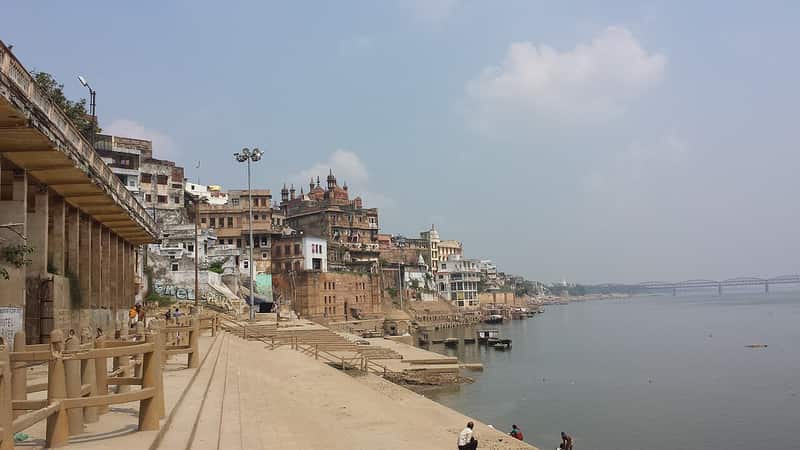
The Name and Its Meaning
Like most ghats along this stretch of the Ganga, Mehta Ghat takes its name from the family or community that once built and maintained it. The surname Mehta, carried for generations by merchants, scribes and officials who made their way to Kashi over the centuries, is a well-known title among the trading and administrative families of northern India. Such names are stamped across the riverfront in stone — each ghat a small memorial to a household that paid for the steps, the well, or the little shrine so that pilgrims and citizens alike could come down to the water with ease. The practice is an old one: to bathe at a ghat, it was said, is to honour those who made the descent possible.
In the local telling, the ghat's plainness is part of its identity. The family that gave it its name did not build for glory; they built a serviceable landing where boats could moor and women could fill their pitchers without struggling on slippery clay. Over time the surname faded from common memory, and what remains is simply the name on the wall, the worn steps, and the daily traffic of the river. The steps themselves give the only biography that survives — stone slabs cut by different generations, worn smooth at the centre where countless feet have passed, and patched here and there by whichever household still takes an interest. In Varanasi hundreds of such minor ghats survive, modest, functional, and named for patrons whom history has mostly forgotten.
What matters to those who use the ghat is not the genealogy of the name but the blessing it carries. A ghat's name is recited in the pilgrimage round of the northern riverfront, spoken alongside Ganesh and Rama, and chanted softly by boatmen as they row past. In the old practice, naming a ghat was itself a gift, for it ensured that the patron's name would be spoken daily by thousands of tongues as long as the river kept its course. To bathe at a named ghat is to touch the city's memory in a small way — an ordinary act that joins the living river to the long line of people, from merchants to mendicants, who have called these steps their own. The name lives on in that daily utterance, spoken as casually as a greeting and as steadily as a prayer.

Daily Life at the Ghat
The true life of Mehta Ghat begins long before the sun clears the eastern treeline. By the time the first light lays a pale ribbon across the Ganga, the day's routines are already under way: an old man unrolls his towel on the mid-steps, a boatman checks his anchor stone, women from the nearby mohalla come down with brass pots balanced on their hips. The air at this hour smells of woodsmoke and wet earth, and the sounds are intimate — a bucket drawn up, a door unlatched, the muted thunder of the city waking far behind the rooftops. The ghat has no grand events to organize its hours, so the day arranges itself around the river: bathing in the early coolness, laundering when the sun gains strength, and the ferrying of people and goods whenever the current permits.
Throughout the morning the steps serve as an open-air workshop. Clothes are beaten on flat stones, then spread across the rails and railings to dry in a patchwork of colour; children splash in the shallows under the watchful eye of a grandmother; a man kneels to brush his teeth with a neem twig while his small boat rocks at his side. The traffic is light and neighbourly — everyone here is known, and a newcomer is noted with a nod and a brief, curious glance rather than a demand. Commerce, when it appears, is small: a few vegetables in a basket, a stack of earthen pots brought from the kilns up the lane, a chai stall set up on the upper platform for the boatmen's morning break. Everything is done without complaint and without ceremony, and that ease is the signature of the place.
By mid-afternoon the ghat dozes. The sun beats down on the empty steps, the boats ride slack on their ropes, and even the washerman naps in the shade of a shrine. Toward evening the pattern reverses: bathers return for the last dip of the day, lamps are lit on the stone ledges, and the boatmen's talk carries across the water as they prepare for the night crossing. This rhythm — dawn, morning, noon, dusk — repeats with little variation, and that steadiness is precisely what gives Mehta Ghat its character. It is not a destination to be visited and ticked off; it is a place that is simply, continuously lived in. Those who pass through on their way to the grand ghats rarely notice it, but the river's oldest clients would not trade it for any of them.
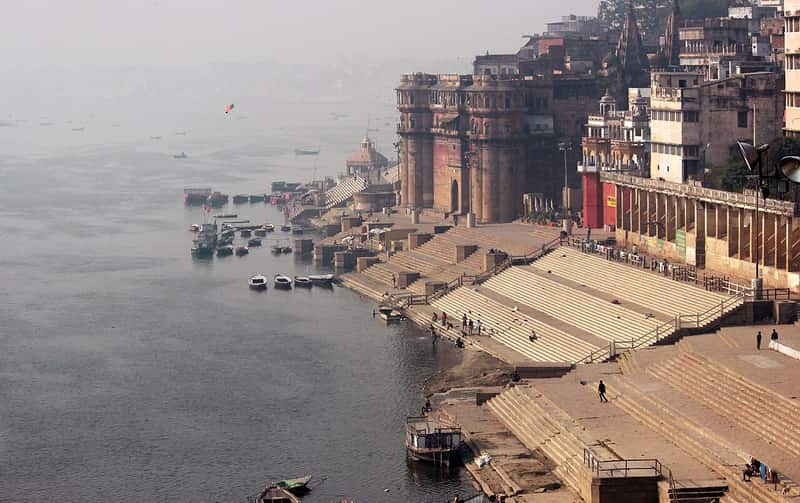
The Morning Bath
The morning bath at Mehta Ghat is a private ritual performed in public, and it follows a pattern as old as the city itself. The earliest bathers arrive while the stars are still faint, moving carefully down the uneven steps in the half-dark, their towels and brass lotas held close. The water at this hour is cold and clear, and the first immersion — the shiver, the sharp intake of breath, the murmured name of the Ganga — wakes the body more surely than any tea. Men and women bathe at separate hours or at separate stones, each wrapped in the modesty that the river itself seems to demand, and the whole performance has a quiet, devotional gravity that no ceremony at the great ghats can quite reproduce.
The ablutions are thorough but unhurried. Water is poured from the lota over head and shoulders, cupped hands are raised to the rising sun in a slow arghya, and a little river water is carried home in a small bottle for the day's first blessing. Some bathers oil their hair before the dip, others simply stand chest-deep and let the current carry their thoughts away, and a few bring small brass lamps to set adrift on wooden chips. The talk, when it happens, is low — a greeting, a shared complaint about the cold, a request for the time of the sunrise puja. Nothing here is performed for an audience; every gesture is addressed to the river alone, in the old grammar of water, hands and prayer.
By eight in the morning the peak of the bath is over. The sun has climbed above the rooftops of the old city, the bathers have dried themselves in the warmth of the stone, and the ghat begins its workday. Yet the memory of the ritual lingers in the little details — the wet footprints on the steps, the marigold petals floating past the boats, the copper pot left overturned to drain. To see Mehta Ghat at this hour is to understand what bathing means in Kashi: not a quick splash before breakfast, but a slow conversation between a person and the oldest holy river in the world, a conversation renewed at dawn as faithfully as it has been for millennia. The afternoon will bring its own peace, but the dawn is when the ghat is most itself.
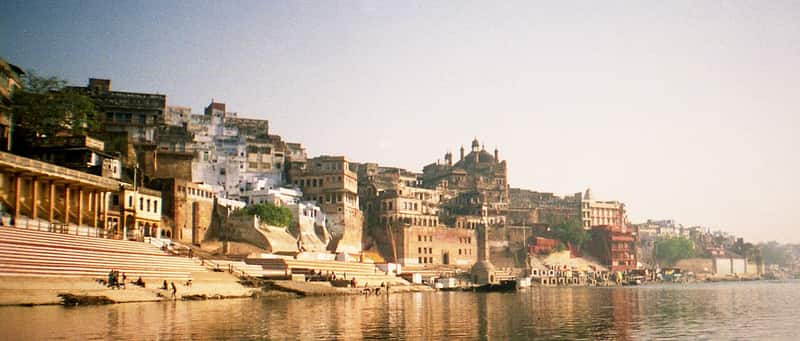
The River and Its Moods
Seen from Mehta Ghat, the Ganga is not the tourist-postcard river of golden sunsets alone; it is a working river with a personality that changes by the hour. In the early morning the water lies flat and silver, so still that the far shore seems a line of dark moss; by mid-morning the breeze combs it into small bright flakes of light; and by afternoon it runs a broad, opaque brown-grey, carrying the whole city's business silently downstream. The current here is steady but not violent, strong enough that boatmen angle their craft against it with practiced care, mild enough that children wade in the shallows without alarm. The river is never the same twice, and the people of the ghat read it the way others read a clock.
The river's moods govern the ghat's routines. In the dry season the water withdraws, leaving long shelves of silt and sand where men repair boats and children hunt for coins; in the monsoon it swells until the lowest steps vanish and the stone seems to rise straight from the water. The bathers know these changes by heart — where to enter when the current runs fast, which steps stay dry when the river is in flood, how to read the colour of the water for the day's omens. Fishermen set their nets according to the season, and boatmen know which hours the wind makes the crossing hard. For all its sanctity, the river here is treated with the practical familiarity of a well-known neighbour — honoured, but never feared, and never taken for granted.
Yet even at Mehta Ghat, the humblest of landings, the river keeps its sacred gravity. A boatman does not step into his boat without a word to the water; a bather rinses his lota three times before filling it; the evening aarti at the little shrines is offered first to the Ganga, then to the gods. This northern stretch of the river is wide and quiet, far from the crowds of the central ghats, and the silence lets the river speak for itself. To sit on Mehta Ghat's steps in the last light is to hear what the Ganga has been saying for millennia — the same unhurried counsel, delivered to anyone willing to sit still and listen. The river answers with the only eloquence it knows, which is movement without hurry.
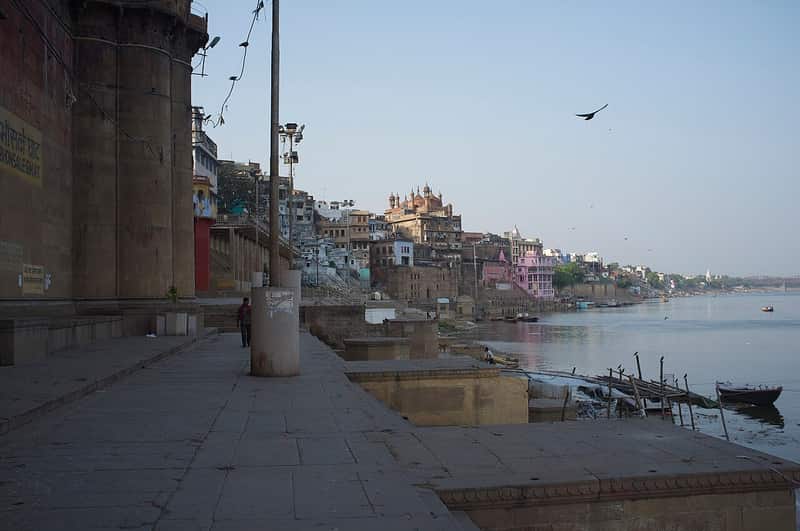
The Lanes and Mohalla Behind
Behind Mehta Ghat the city climbs abruptly, and a single narrow lane leads from the water's edge up into the residential mohalla that has stood there for generations. The lane is barely wide enough for two people, its walls of lime-washed brick and ochre plaster running with moss; overhead, the balconies of neighbouring houses nearly touch, cutting the sunlight into slender blades. This is domestic Kashi — washing lines strung across the gap, a shrine of Hanuman tucked into a corner where three alleys meet, the smell of woodsmoke and frying spices drifting down from the kitchens above. Every stone of the lane has been polished by generations of feet, and every doorstep carries the traffic of daily life. In the evenings the lane becomes a drawing room, with chairs and cots set out on the thresholds until the mosquitoes drive everyone indoors.
The mohalla is a small world in itself. Families have lived here for centuries, and the lane knows every face: the milkman who comes at dawn, the priest who pads down to the ghat with his puja tray at the same hour each day, the children who race to the water the moment school lets out. Shops are few — a pan stall, a mithai counter, a bicycle repair stand propped against a wall — but they serve their purpose without fuss, and the shopkeepers greet every passerby by name. The connection between lane and ghat is intimate; the steps are simply the backyard of these houses, and the river is their drain, their bath, their laundry and their temple all at once. There is no wall between the sacred and the domestic here; the same hands that wash the dishes fill the lota for prayer.
For the visitor the neighborhood is the true texture of northern Kashi, a place where daily life proceeds exactly as it has for centuries, indifferent to the passing of empires. Old men sit on string beds in the late afternoon, arguing about the price of vegetables and the state of the world; women exchange news over the parapet of the common well; a wedding party somewhere plays its brass band into the evening. To wander these lanes after visiting the ghat is to see where the piety of the river begins — in the kitchens, the courtyards and the thresholds of ordinary homes, whose inhabitants carry the Ganga's water into every room of their lives. It is a Kashi of small voices, and to listen well is to hear the whole city.
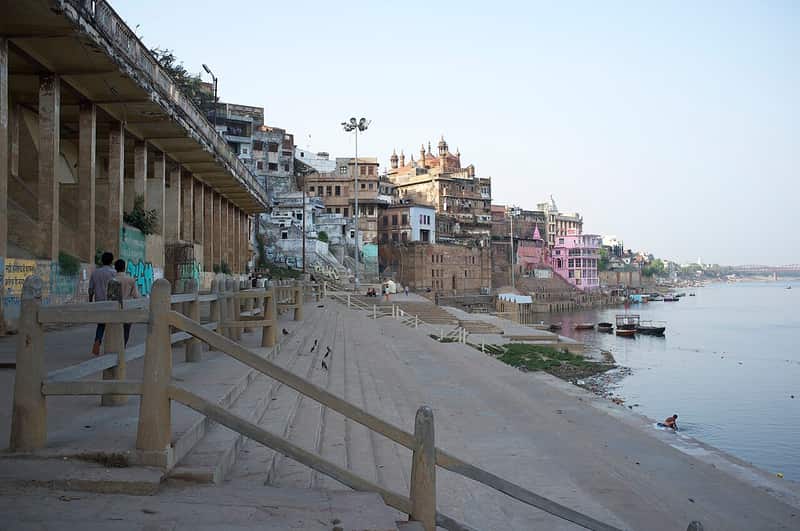
Ganesh Ghat and Rama Ghat
Mehta Ghat does not stand alone; it is only one link in the unbroken chain of steps that runs northward from the city's core, and its nearest neighbours are Ganesh Ghat and Rama Ghat. The three ghats sit so close together that a walker can pass from one to the next in a minute, their boundaries marked only by the subtle breaks in the stone where one family's staircase gives way to another's. Ganesh Ghat, named for the elephant-headed lord who is honoured first in every undertaking, has a small shrine where boatmen pause before crossing; Rama Ghat carries the name of the hero of the Ramayana and is a favourite morning landing for bathers from the surrounding mohallas. Each is small, each is old, and each has its own circle of regulars.
The trio forms a gentle neighbourhood of water. Children run freely between the ghats, a single row of boats is shared among the three sets of steps, and the same washerman works the stones of all three landings, following the sun as it moves. On festival days — Ganesh Chaturthi, Ram Navami, the great bathing fairs — the distinction between them disappears entirely, and the entire length of the shore becomes one moving crowd of lamps, flowers and singing. On ordinary days, though, each ghat keeps its own pace, and Mehta's quietness stands in easy balance with the livelier morning bustle of its two famous neighbours. Together they demonstrate how the riverfront of Kashi is not a row of separate monuments but a single, continuous society of steps.
Walking the short stretch between the three ghats is one of the best ways to understand the northern riverfront. The steps open onto small platforms where mendicants sit, where a bangle seller lays out her wares, where an old sadhu conducts an impromptu class in the Ramcharitmanas. From any point in this chain the eye travels south toward the tall towers of the central ghats and north toward the flat expanses where the Varuna enters the Ganga. Seen this way, Mehta Ghat reveals itself as part of a whole — a single, modest step in the city's long descent into the holy river, meaningful above all in the company it keeps. Stand at the water line and the three ghats read as one single staircase, worn, holy and alive.

A Quiet, Unpretentious Kashi
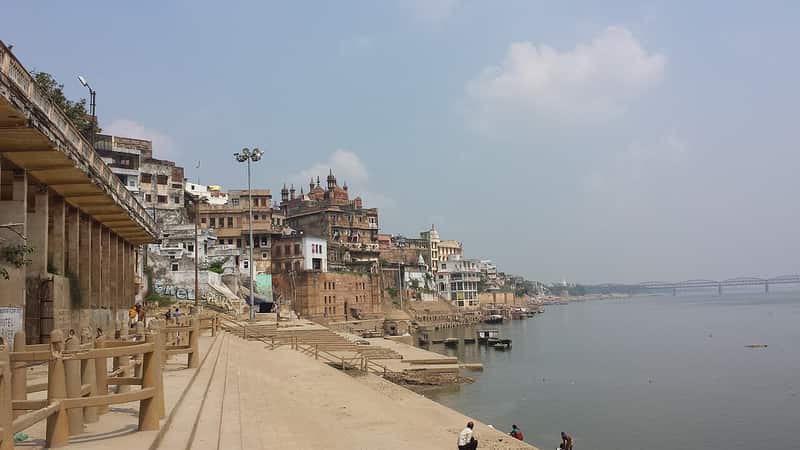
The atmosphere of Mehta Ghat is best described by what is absent. There are no flower sellers pushing garlands, no photographers with trained parrots, no tour boats idling offshore with loudspeakers. What remains when the commercial theatre of the central ghats is stripped away is the essential mood of Kashi — a deep, unforced serenity that has survived every empire because it depends on nothing. The soundscape tells the story: the soft percussion of wet clothes on stone, the creak of a mooring rope, the long cry of a boatman calling across the water, and beneath all of it, the steady voice of the current. Even the pigeons seem to keep their own counsel here, and the only hurry belongs to a kite riding the thermals high above the water.
Time moves differently here. On the central ghats one is aware of the clock — of ceremonies to attend, of boats to catch, of sights to check off a list. At Mehta Ghat the hours dissolve into the motion of the river, and an old man who sits down to smoke his hookah after breakfast may still be there when the sun is overhead, having exchanged no more than a dozen words. There is nothing to do, and that is the point; the ghat permits the luxury of simply being present, of letting the minutes pass without being spent. For the visitor weary of the city's famous clamour, this is the northern riverfront's quietest gift — a place where Kashi asks nothing of you but your company. That, for many travellers, is the rarest offering Banaras has to give.
Yet the peace is not empty; it is inhabited by the oldest habits of devotion. The women who come to fill water greet the river with folded hands; the mendicant who sleeps on the upper platform wakes to a whispered mantra; the evening deepens and someone lights a lamp without ceremony, setting it adrift on a leaf. This is what makes Mehta Ghat emblematic of ordinary Kashi — the faith here is not on display, it is simply lived, the way one lives with an old friend. To sit on these steps at the blue hour is to feel the city at its most honest, without costume, without audience, and without need of any. It is Kashi stripped to its essentials — water, stone and faith — and nothing else is required.
Etiquette and Respectful Conduct
Visiting a living ghat like Mehta means remembering that the steps are not a stage but a home. The bathers are engaged in acts of private devotion in public space, and the first rule of courtesy is to give them room — to wait at the upper steps while someone is at prayer, to avoid standing between a bather and the sun during the arghya, and never to aim a camera lens at a person mid-immersion. Photographing the river, the boats and the steps is generally welcome; photographing faces is not, unless permission is first asked in a low voice and a smile accepted as an answer. A little patience will repay itself, for the ghat reveals itself to those who watch before they ask. The residents, in turn, will treat you with the same courtesy, once they see you mean no harm.
Modesty and clothing carry their own etiquette. Swimwear of the kind worn on beaches is out of place here; visitors who wish to bathe should wear the same loose garments the locals wear, and women should be mindful that most bathing is done without undressing, in full view of the community. The water is holy to the people who use it, so nothing should be thrown into the river except flowers, and even offerings are best made with the same quiet gesture one sees around you. Shoes are left at the head of the steps or on the boats, never placed where water is drawn, and the shrine platforms are always approached barefoot. These are small rules, but the people of the ghat notice when they are kept. They are the quiet grammar of the place, and a visitor who learns them will find the ghat generous beyond expectation.
The deeper courtesy is one of pace. Nothing at Mehta Ghat is rushed, and a visitor who hurries — who descends to the water with loud chatter, who jostles at the mooring ropes, who expects to be served as a customer — will feel the awkwardness immediately. Sit, watch, learn the rhythm, and the ghat will open itself to you: a boatman will nod you into his boat, a woman will point out the best bathing hour, an old man will share his hookah and his silence. Respect at this ghat is simple to practise: move slowly, speak low, give thanks to the river, and leave the steps exactly as you found them. Do that, and you will be welcome back at any hour, on any day, for as long as the river keeps its course.
Practical Information
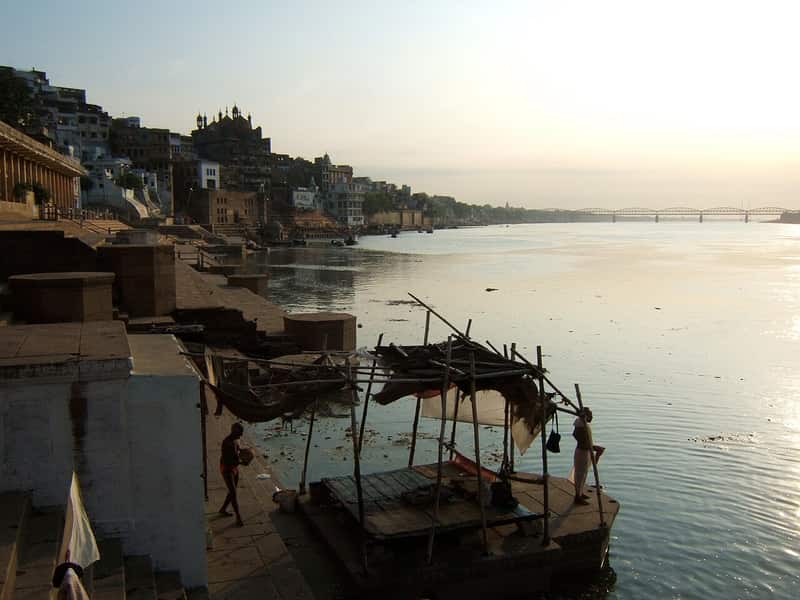
Reaching Mehta Ghat is a walk through living Kashi. The ghat lies on the northern riverfront, close to Raj Ghat, and is best approached on foot along the ghat road or through the lanes that descend from the main northern artery; auto-rickshaws and cycle-rickshaws reach the vicinity, but the last stretch to the water is usually on foot. The nearest well-known landmarks are Ganesh Ghat and Rama Ghat, and anyone who has found either can follow the steps to Mehta within minutes. The walk itself — through old mohallas with their shrines, tea stalls and milking buffaloes — is part of the pleasure, and a boat ride along the shore offers an alternative approach that is as beautiful as it is simple. For the first-time visitor, asking any shopkeeper near Raj Ghat for the way to Mehta usually brings a smile and a gesture toward the water.
The best time to visit is the early morning, between dawn and nine o'clock, when the bathing is at its most beautiful and the light on the river is softest. Sunset brings a quieter, more contemplative mood, and the evening lamps of the small shrines are a gentle spectacle in themselves. Winter mornings can be cold and misty, summer mornings hot, but both have their own character; the monsoon months bring the river high and should be approached with care, as the lower steps may be submerged. Comfortable walking shoes are essential, a bottle of drinking water is wise, and modest, practical clothing will help you blend into the life of the ghat rather than stand apart from it. Carry nothing valuable to the water's edge; the steps are public, and crowds, however small, are unpredictable.
A visit to Mehta Ghat combines naturally with its neighbours. Follow the steps south to see the fuller life of the central ghats, or walk north from Ganesh Ghat toward the quieter reaches of the northern riverfront and the confluence of the Varuna. Boatmen at the nearby landings will happily row you along the shore for a different perspective of the chain of ghats, and the fare is modest once agreed in advance. There is no entry fee, no ticket window and no fixed programme at Mehta Ghat — only the river, the steps and the ordinary faith of the city. Come without expectations, stay without hurry, and you will carry away one of the truest memories of Kashi. And if you return the next morning, as many do, you will be greeted like an old acquaintance of the place.
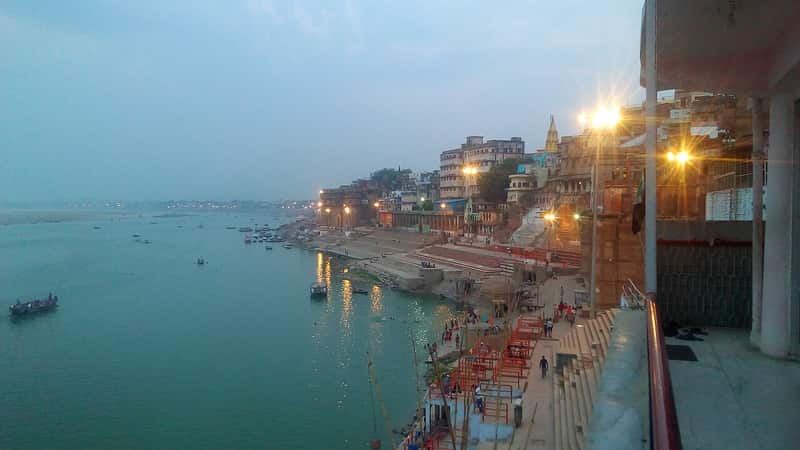
Mehta Ghat — Gallery (10 Photos)
Image Credits
mehta-01.jpg · mehta-02.jpg · mehta-03.jpg · mehta-04.jpg · mehta-05.jpg · mehta-06.jpg · mehta-07.jpg · mehta-08.jpg · mehta-09.jpg · mehta-10.jpg — Wikimedia Commons, under free licenses.
Continue exploring
Similar Ghats Nearby
Book This Ghat — Get Notified
Download the app now and book a boat ride to Mehta Ghat