

Lalita Ghat
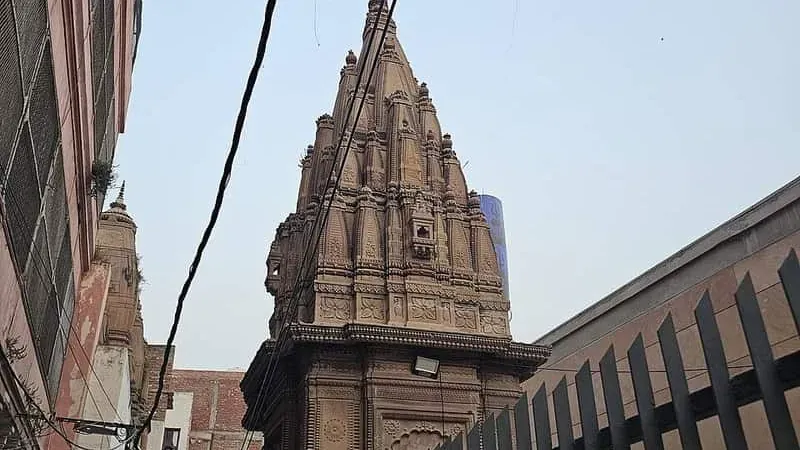
Major GhatLalita Ghat was built by the King of Nepal in the 19th century. It has a Ganges Keshav temple and a palace in Nepali style.


Type
Major Ghat
Boat Fare
1.3x base fare
Best Time
4-7 PM for sunset with beautiful color play on the ghat.
History
Built by King Bir Shumsher of Nepal in the late 18th century. The ghat is named after the Lalita Temple on the site. The ghat has a solid Nepali palace with gleaming Nepali-style domes. The palace is now a museum displaying Nepali art and architecture. This ghat has become popular with painters and filmmakers worldwide.
Highlights
- Entry point of the Kashi Vishwanath Corridor
- Closest ghat for temple darshan
- Lalita Gauri Temple nearby
- View of the Nepali temple architecture
Festivals & Events
How pricing works in the NaviX app
No haggling at the ghat — everything is fixed in the app first
- 1
Fixed price before you board
The fare is shown in the app upfront — no bargaining at the ghat
- 2
Sharing or private — your choice
Share with fellow travelers or take the whole boat for your group
- 3
Pay only after the ride
UPI, card or cash — with an instant receipt
6:30 PM
Closest aarti to Kashi Vishwanath Temple
Complete Guide
Lalita Ghat — The Complete Guide
History, mythology, rites and practical details — everything in depth.
On this page
- 1.Lalita Ghat — Nepal's Corner of the Old City
- 2.The Goddess of the Name — Who Is Lalita?
- 3.The Nepal Connection — A Himalayan Pilgrimage
- 4.The Rana Palace — A White Facade Over the Ganga
- 5.Temple Life — Hanuman, the Goddess and the Monkeys
- 6.The Quiet Bathing Scene — Rituals on the Steps
- 7.An Intimate Mood — Out of the Tourist Mainstream
- 8.The River at Lalita — Deep Water and Distant Smoke
- 9.The Neighbouring Ghats — Toward Manikarnika and the Old City
- 10.Dev Deepawali — A Sea of Lamps on the Northern Ghats
- 11.Etiquette — Respectful Conduct on a Sacred Ghat
- 12.Practical Guide — Getting to Lalita Ghat
📅 Updated: 21 Aug 2026 · Author: NaviX Field Team (field research 2024-26) · 12 sections · 12 photos
Lalita Ghat — Nepal's Corner of the Old City
Lalita Ghat is a small, atmospheric landing on the northern stretch of Varanasi's riverfront, tucked between the grand ceremonial ghats of the south and the intense cremation stretch around Manikarnika. It has none of the crowds of Dashashwamedh, none of the ranks of tourist boats packed along the central steps. Instead it offers a quieter, older face of Kashi — a place where pilgrims climb down narrow stone steps toward the Ganga, where boats rest against weathered pillars, where sadhus sit reading in the shade, and where the white architecture of Nepal rises directly above the water. For centuries this modest ghat has been a home away from home for Nepali pilgrims, a fragment of the Himalayan kingdom set down on the banks of the holy river, and a living witness to the unhurried rhythms of daily life that still define this ancient quarter of the oldest living city on earth.
The ghat's identity is anchored by a white-painted palace built by the Rana rulers of Nepal and by a cluster of temples that includes a shrine to Hanuman and a temple of the Goddess Lalita, the deity whose name the ghat carries. Together they give the landing a distinctive flavour — part Hindu tirtha, part diplomatic remnant, part intimate neighbourhood. Visitors who linger here, sitting on the steps as the boats come and go, often feel they have stepped out of the tourist mainstream into the real texture of Banaras: the daily worship, the laundry spread on the rails to dry, the tea stalls tucked into the alleys behind, the brass pots being scoured at the water's edge. It is a place that rewards patience, and those who give it an hour usually leave with the strongest memories of their entire visit to the holy city.
On the ghat itself life moves at a slower rhythm than almost anywhere else on the riverfront. Sadhus read by the water, children dive from the bows of moored boats, families perform their morning puja with marigolds and brass lamps, and the boatmen mend their nets or doze in the sun. Upstream, the pale smoke of Manikarnika drifts over the current, a constant reminder of the river's sacred purpose, while downstream the great ghats gleam in the morning light. Lalita is a ghat for those who want to feel Kashi rather than merely see it — a place to sit, to watch, to listen, and to understand why this ancient city has drawn the faithful for more than two thousand years, generation after generation returning to the same water and the same quiet devotion.
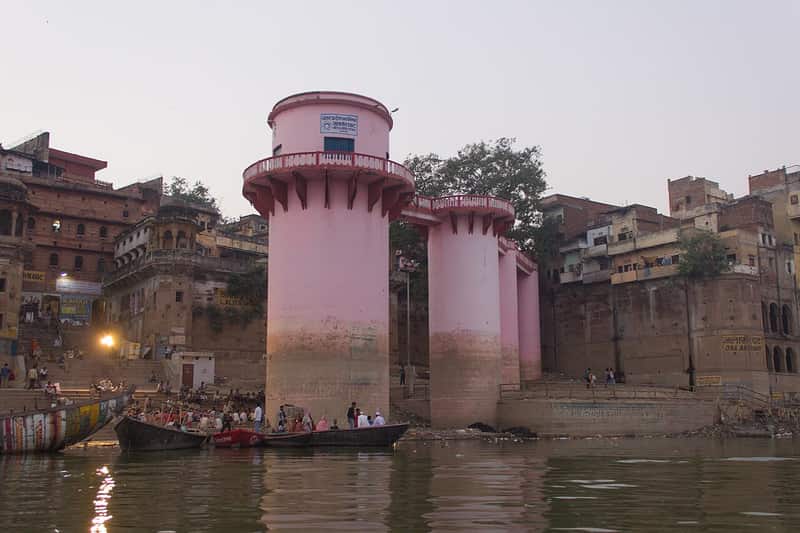
The Goddess of the Name — Who Is Lalita?
The name Lalita belongs to the Goddess — Lalita Devi, a form of Durga and of Parvati, the supreme beauty and power of the Devi in Hindu worship. In the Lalita Sahasranama, the thousand names of the goddess recited across India, she is praised as the one who plays the universe into being, whose grace is effortless and whose power is infinite, the consort of Shiva in his most beautiful aspect. The temple at this ghat is dedicated to her, and it is she who gives the landing both its name and its blessing. For the women of the old city who come to her shrine, she is the mother who protects the home, grants children, and watches over the daughters who bear her name, and the small courtyard around her temple is filled daily with the scent of incense and the murmur of prayer.
Legend says the goddess was worshipped here long before the palace was built, when the forested northern bank of the Ganga was already a place of her devotion. Pilgrims passing toward the greater shrines of Kashi would pause at her small sanctuary, light a lamp, and continue on their way, and her fame grew slowly through the centuries as one act of faith was added to another. Over time the humble shrine grew into the temple that stands today, its simple sanctum holding the image of the goddess flanked by the other forms of the Devi, and its walls bearing the marks of generations of devotion. The name stuck to the whole neighbourhood, and the ghat itself came to be known simply as Lalita — the ghat of the beautiful goddess, spoken with affection by the boatmen and the shopkeepers alike.
For visitors the name is worth pausing on. In Sanskrit, lalita also means playful, charming, graceful — and the ghat carries something of that quality, a light-footed elegance that contrasts sharply with the sombre grandeur of the cremation ghats nearby. Standing on the steps at dawn, it is easy to imagine the goddess who lends her name to the place as a gentle presence among the bathers, the boatmen and the monkeys, a mother who watches over this quiet corner of the holy city. The name and the place seem made for each other, and those who hear it called out by a boatman across the water understand at once that they have arrived somewhere small, beautiful and blessed — the name itself is a prayer, spoken lightly, carried on the morning air.
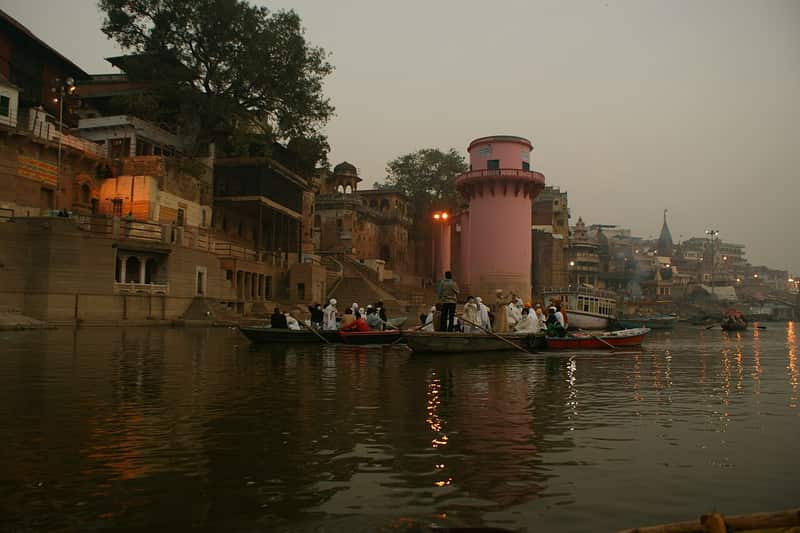
The Nepal Connection — A Himalayan Pilgrimage
No other ghat in Varanasi is as closely tied to Nepal as Lalita. The connection goes back centuries, to the kings of the Himalayan kingdom who made Kashi a second homeland and a place of pilgrimage beside their own sacred valley. Nepali rulers, officials and merchants maintained houses in the old city, and when the powerful Rana dynasty took control of Nepal in the nineteenth century they built a palace here, directly above the ghat, to serve their own pilgrimages to the holy city. For the Ranas, bathing at Lalita and worshipping in the temples of Kashi were essential acts of piety, performed during visits that combined state business with religious duty, and their presence turned this quiet landing into a centre of the Nepali presence in India. The Ranas' devotion made Lalita one of the most honoured bathing places of the north, and their carriages and processions were a familiar sight on these narrow streets.
The palace made the ghat a natural gathering place for Nepali pilgrims. Generations of them arrived in Kashi for the great festivals, for the sacred month of Kartik, or simply to die within sight of the Ganga; for devout Hindus, Kashi has always been the place where death brings liberation, and many Nepali families still bring their aged relatives here for their final days, as their ancestors did before them. Around the palace grew a small Nepali quarter, with its own customs, its own food, its own language echoing in the lanes and its own festivals celebrated far from the Himalayas. The white facade of the palace came to stand, in the Nepali imagination, for the friendship between their kingdom and the sacred city, a friendship that survived wars, famines and the changing dynasties of both.
Today the bond remains alive in ways that are both visible and invisible. Nepali pilgrims still come to Lalita in numbers, often identifiable by their distinctive dress and their quiet, disciplined manner of worship, and the Nepali flag has flown from the palace on festive occasions. The palace itself, weathered and lived in, no longer houses royalty, and its grand rooms have been divided among ordinary families, but the deep historical connection it represents continues to give this ghat its unique character. Lalita remains, in the truest sense, a fragment of Nepal on the banks of the Ganga — a place where the Himalayas and the holy river meet in the heart of Banaras, and where two ancient peoples have shared one devotion for centuries. It is a bond written into the very stones of the ghat, and it endures because both peoples still come to the same water with the same prayer.
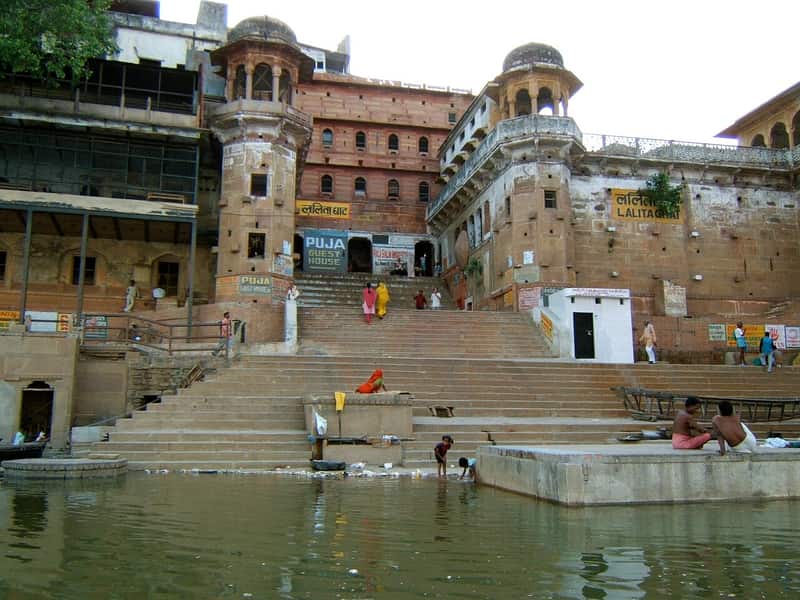
The Rana Palace — A White Facade Over the Ganga
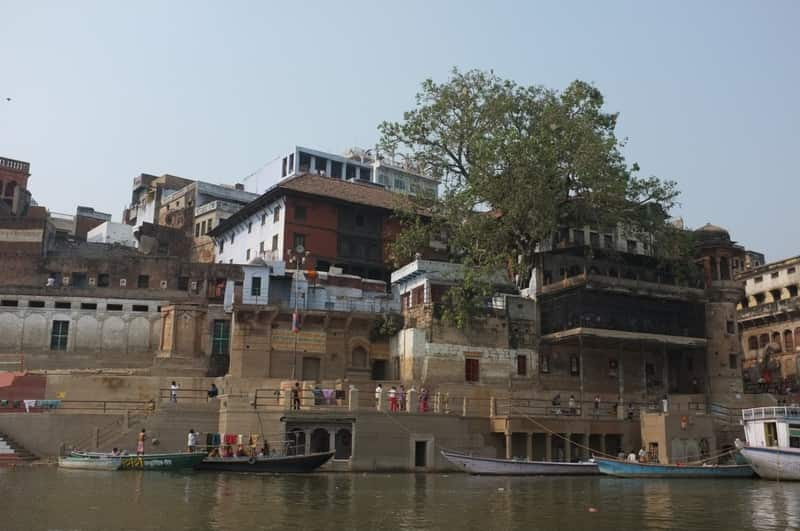
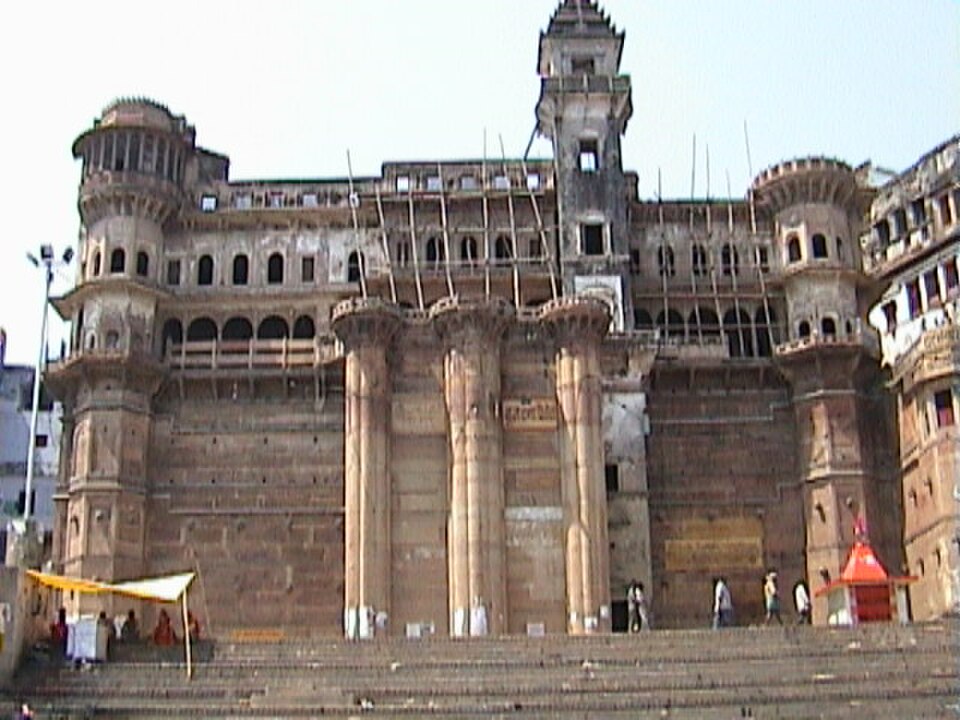
Above the steps of Lalita Ghat rises the palace built by the Rana rulers of Nepal, the single most distinctive landmark of the landing. Its painted white facade, ornamented with balconies, verandas and delicate stucco work, looks directly down on the river, a graceful piece of the old city's architectural drama. Built in the nineteenth century, the palace served the Rana family during their pilgrimages to Kashi, offering them a private residence with a front row view of the Ganga and its morning rituals, and a place where the court etiquette of Kathmandu could be maintained even away from home. For generations it was a symbol of the deep alliance between Nepal and the holy city, and its image appears in the old photographs and paintings that record the ghat's long history.
The balconies of the palace are part of the ghat's romance. From these shaded wooden galleries, the Rana ladies could watch the river without being seen, and the kings could greet the crowds gathered below during festivals, scattering coins and blessings to the faithful. The painted decoration — flowers, figures, patterns in fading colours — gives the building an almost theatrical quality, as if the palace were a backdrop to the daily drama of the ghat, with its bathers, boatmen and priests as the permanent cast. Today the building is divided into small rooms, rented out and lived in by families, some of them Nepali descendants who still feel the pull of their ancestral connection and who keep alive the memory of the palace's royal days. The building's upper rooms, with their high ceilings and broad windows, still look down on the river with the calm authority of an age when kings were the ghat's most important visitors.
The palace also anchors the ghat's identity in a more practical sense. Its presence tells the visitor instantly that this is not just another bathing ghat but a place of royal history, of diplomacy and devotion intertwined, where the affairs of two nations were conducted beside the rituals of the river. When the morning sun strikes the white walls, and the whole facade is reflected in the water below, it is easy to understand why the Ranas chose this very spot for their residence. It was a little balcony on the Ganga where the Himalayas came to meet the sacred river, and where the kings of Nepal could bow to Kashi from their own threshold, at once guests and lords of the holy city. Standing on the ghat today, looking up at those faded white walls, one can still feel the presence of that royal past, layered beneath the ordinary life of the neighbourhood.
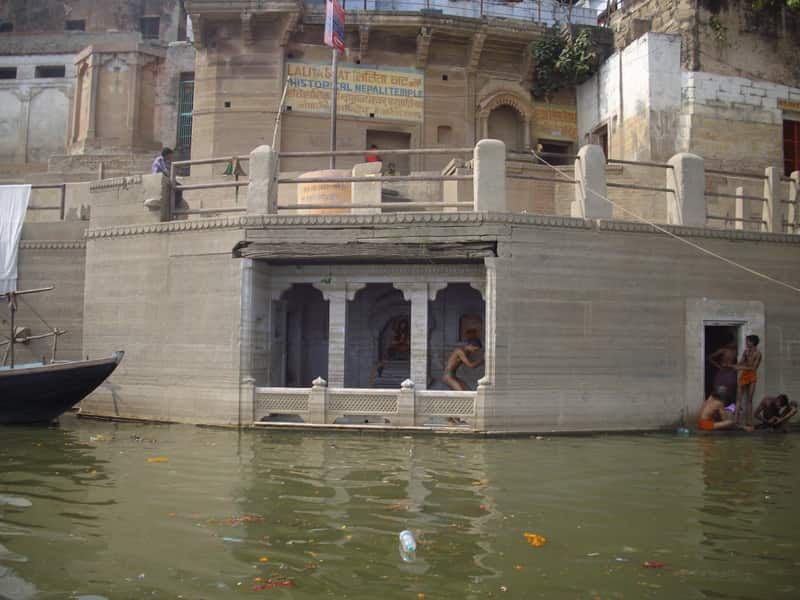
Temple Life — Hanuman, the Goddess and the Monkeys
A cluster of small temples rises from the ghat's upper terraces, the most prominent being the Hanuman temple and the shrine of Lalita Devi. The Hanuman temple is a local heart of worship; throughout the day the faithful climb the steps to offer marigold garlands, vermilion and sweets to the monkey god, asking for protection, courage and the removal of obstacles, and the priests mark the foreheads of the devotees with red tilak before they descend again to the river. On Tuesdays and Saturdays, the days sacred to Hanuman, the temple fills with worshippers, and the air thickens with the ringing of bells, the blowing of conches and the rhythmic chanting of the Hanuman Chalisa that spills out into the narrow lanes behind the ghat, and on festival days the whole terrace shimmers with sound and colour.
The Lalita Devi temple, standing close by, draws the women of the neighbourhood with particular devotion. Mothers bring their daughters for the goddess's blessing before weddings and examinations, newly married brides come to be introduced to the household deity, and women with wishes to be granted sit on the temple steps, their lips moving in silent prayer. The idol of the goddess, adorned with bright cloth and fresh flowers, presides over the daily rhythm of the ghat with an almost maternal calm. The small rituals — the tilak, the aarti, the distribution of prasad, the singing of bhajans in the evenings — repeat day after day exactly as they have for generations, unchanged by the centuries and unshaken by the modern city around them. The goddess is not a distant figure here but a neighbour, visited daily by the families who live in the lanes above the ghat.
The temples also have their unofficial residents: the monkeys. The langur and rhesus monkeys of the neighbourhood treat the ghat as their home, leaping between balconies, watching the bathers with clever, curious eyes, and occasionally snatching a garland or a piece of fruit from an unwary devotee. The people treat them with affection mixed with caution, offering them bananas while guarding their own prasad, and the monkeys repay the courtesy by keeping the temple precincts clear of pigeons and crows. For the visitor, the sight of the monkeys and the priests, the bangles and the bells, the incense and the chanting, all woven together, makes the temple terrace of Lalita one of the most alive and welcoming corners of the old city's riverside. It is a scene that has changed little in a hundred years, and that is precisely its charm.
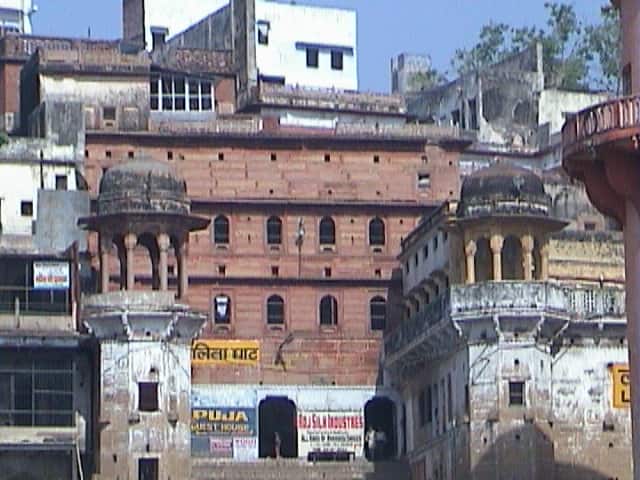
The Quiet Bathing Scene — Rituals on the Steps
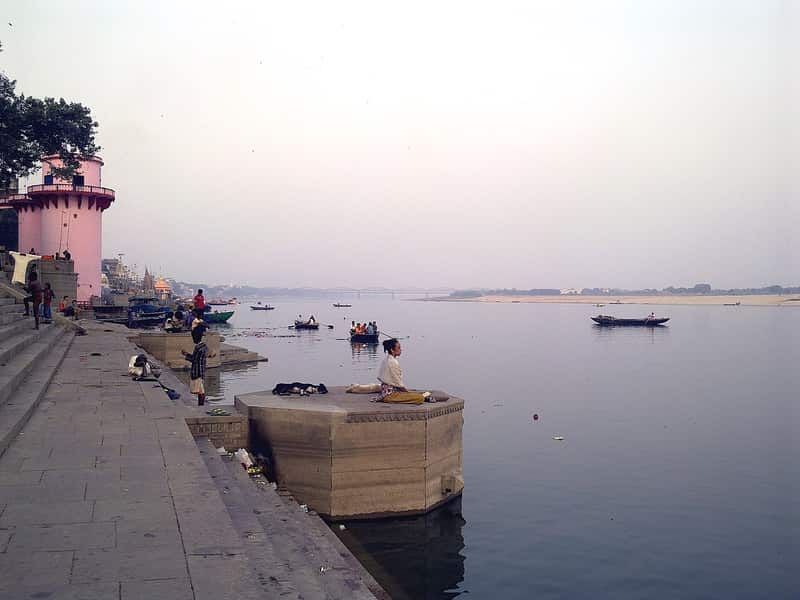
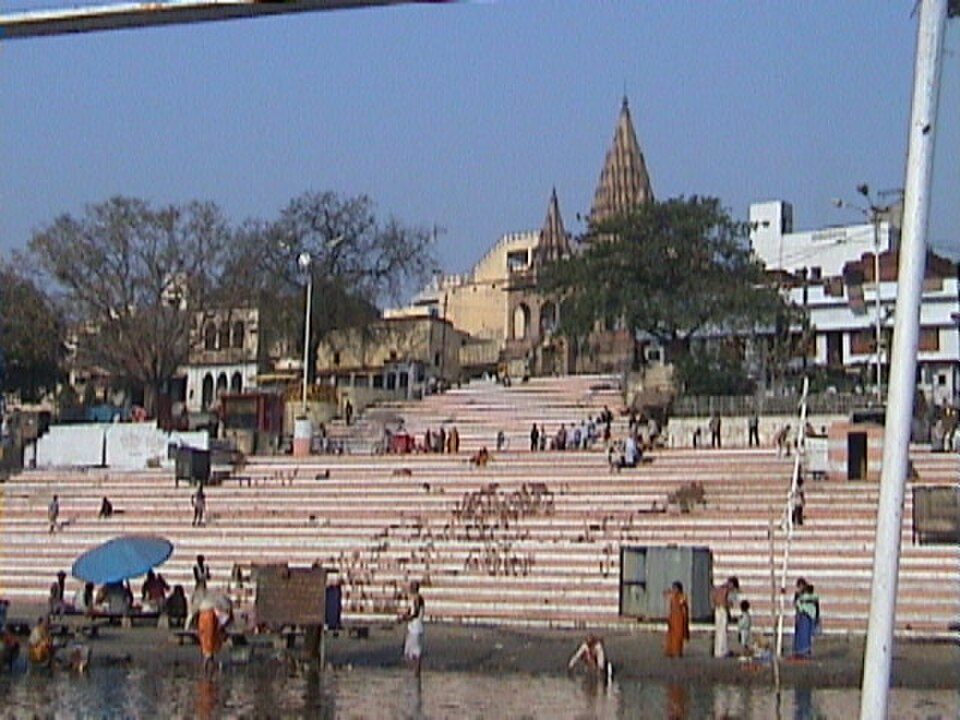
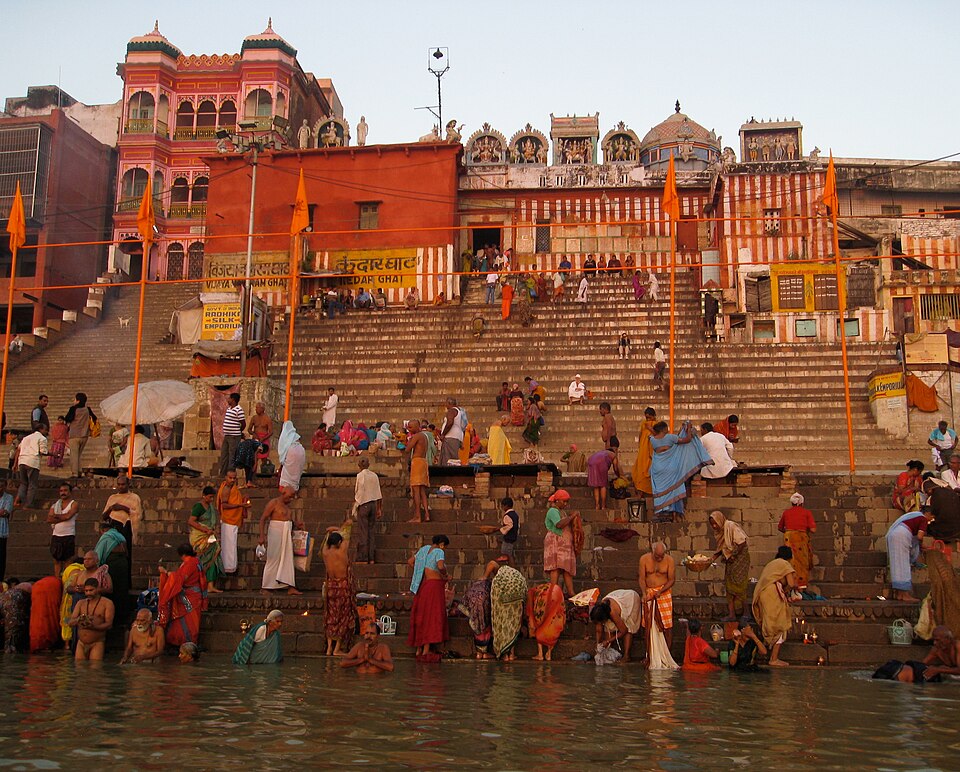
Bathing at Lalita is a quieter affair than at the grand ghats of the south. Where Dashashwamedh seethes with hundreds of bathers, pilgrims and vendors, Lalita sees a steady but modest stream of people at dawn — local residents, elderly men with their prayer beads and sacred threads, women in groups carrying brass pots, the occasional Nepali pilgrim who has made this ghat his own. They step carefully down the worn stone stairs, some holding the rail, some balancing a lota and flowers in their hands, and enter the water with a splash and a whispered prayer. The morning here belongs to the faithful, not to the crowds, and the silence is broken only by the sound of the water and the distant ringing of temple bells. For those who come only to look, there is no better vantage point than the upper steps, where the whole morning unfolds below like a slow ceremony.
The ritual is simple and ancient, unchanged for millennia. The bather stands waist-deep in the current, faces the rising sun, and pours water back toward the east with cupped hands; he recites the Gayatri mantra, offers a few drops to Surya, the sun god, and lets the river carry away the rest. Some perform the tarpana for their ancestors, pouring water with sesame and rice through their fingers; others simply immerse themselves three times and climb out, changing into dry clothes on the steps. Near the water's edge, small aartis are conducted — a lamp waved before the river, a bell rung, a few grains of rice thrown — a miniature version of the great evening ceremony that fills the southern ghats with music and fire. At Lalita the rite is kept deliberately small, a personal conversation between the devotee and the river rather than a public spectacle.
For a visitor, joining this scene is best done with respect and from a little distance. Sitting on the steps above, one can watch the whole ritual of a Banaras morning unfold in perfect order — the first light breaking over the water, the boatmen untying their boats, the priests chanting at their small shrines, the crows and pigeons circling the temple roofs, the milkman's cart rattling through the lane behind. The pace of life at Lalita is gentle, and those who spend an hour here often find that the quiet bathing scene stays with them longer than any grand festival, because it is the everyday religion of Kashi, practised quietly and faithfully as it has been for thousands of years. To watch it is to witness the quiet heart of Hindu practice, unchanged by kings, tourists or empires.
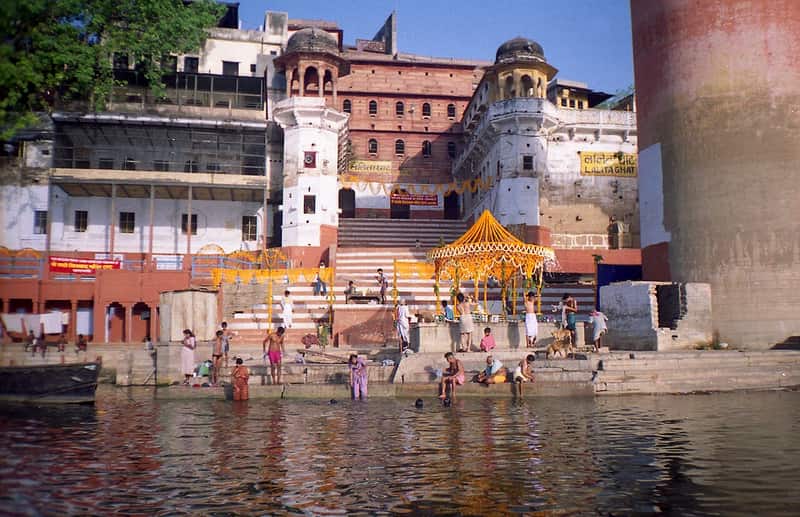
An Intimate Mood — Out of the Tourist Mainstream
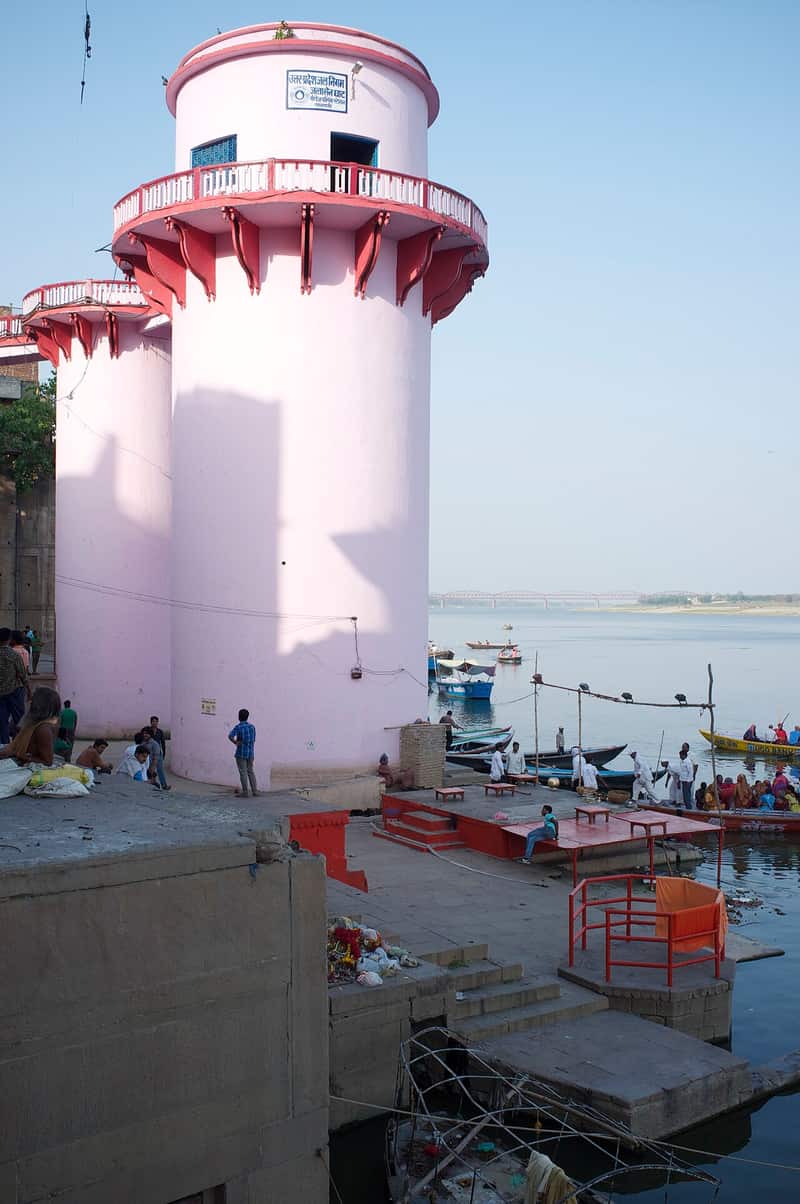
To reach Lalita Ghat is to enter a different atmosphere from the great ceremonial ghats. The entrance is a narrow passage between tall old buildings, and visitors must walk through a lane where the city's daily life presses close — bicycle bells, drying chillies, the call of tea vendors, the chatter of women at the water pumps — before the steps suddenly open onto the river. There is no grand esplanade here, no ranks of souvenir shops, no tourist offices, no signboards in a dozen languages. Just a flight of worn stone stairs leading down to the water, flanked by weathered buildings whose facades bear the patina of centuries of monsoon rain, and whose windows look out on the comings and goings of the boats. Arriving here feels less like visiting a monument and more like entering a courtyard where the city has always lived.
The stone itself tells the ghat's long story. The steps are uneven, worn smooth in the middle by countless bare feet, green with moss near the waterline, patched here and there with repairs that have settled into the surface and become part of it. Boats are moored to iron rings and stone pillars, their hulls painted in bright stripes of red and green, their owners dozing in the shade or calling to passersby in the slow, musical speech of Banaras. Everything about the place feels older and more intimate than the manicured ghats to the south — as if Lalita had been left to age in its own way, undisturbed by the machinery of tourism, and had kept its character precisely because of it. Every groove in the stone, every chipped corner, is a record of the thousands who have passed this way before you.
This is precisely why so many visitors fall in love with it. On the steps of Lalita one can sit for an hour and see almost no other tourist; what replaces them is the texture of daily Banaras life, lived without self-consciousness. A woman rinses her brass pots, a sadhu reads aloud from a worn text, a boy dives off a moored boat, a priest performs a small ritual for a family from the neighbourhood, a shopkeeper delivers sweets on a bicycle. The ghat offers the rare feeling of stepping out of the tourist mainstream into the living city, and for many travellers that feeling is the real treasure of Varanasi, worth more than any monument or festival. It is the ghat itself, in its unguarded ordinariness, that stays in the memory.
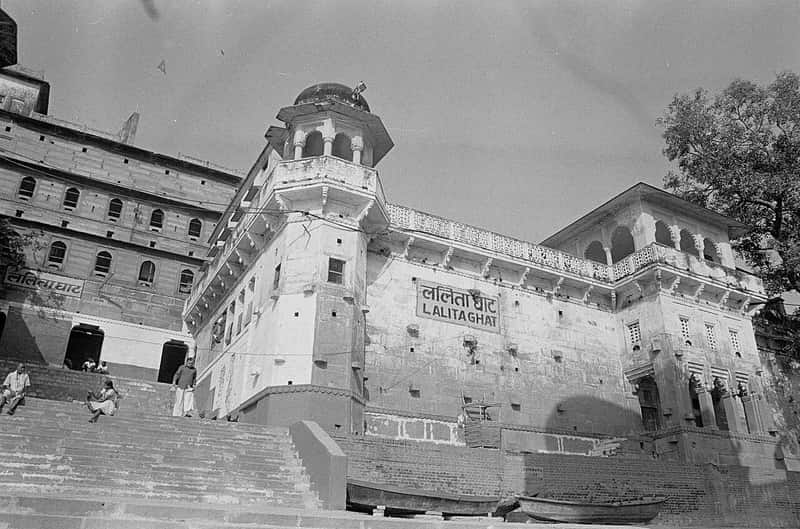
The River at Lalita — Deep Water and Distant Smoke
The Ganga runs deep off the steps of Lalita, the current stronger and darker here than in the shallow southern stretches, where the river spreads wide and slow. The channel is wide enough for substantial boats, and the ghat serves as a working landing for ferries and cargo craft as well as a bathing place, with goods and passengers moving between the water and the old city all day. At dawn and dusk the water takes on a silver-grey sheen, and the reflections of the palace and the temples ripple across its surface. Boatmen offer short rides from the steps, and for a small sum a visitor can drift out into the current and watch the whole northern riverfront unfold from the water, seen as generations of pilgrims have seen it.
The view from a boat is the classic view of Varanasi. To the south, the ghats rise in an unbroken chain of palaces and temples toward the distant bustle of Dashashwamedh, their steps crowded and their domes gleaming. To the north, the eye is drawn to the tall tower of Manikarnika Ghat and the pale smoke that hangs above its burning platforms — the eternal sign that the river at this point is not only a bathing place but a place of final departure, where the living and the dead meet at the water's edge. From midstream, Lalita itself appears small and gentle between these two poles, its white palace a bright note against the older stone, its boats bobbing gently at their moorings. Between the smoke and the pageantry, this stretch of water carries its own quiet authority.
For many pilgrims, the significance of the river here is precisely this dual character: the same water that bathes and purifies also carries the ashes of the dead, and Lalita stands where the two currents meet. It is common to see small diyas floated on the water near the ghat — offerings for ancestors, hopes for the living, prayers drifting with the current. Sitting on the steps at sunset, watching the light fade over the water and the first lamps being lit on the boats, one feels the full power of the Ganga at Varanasi. This is a river that has received the prayers, the bodies and the faith of millions for longer than any other place on earth, and at Lalita the intimacy of that great history is felt most directly.
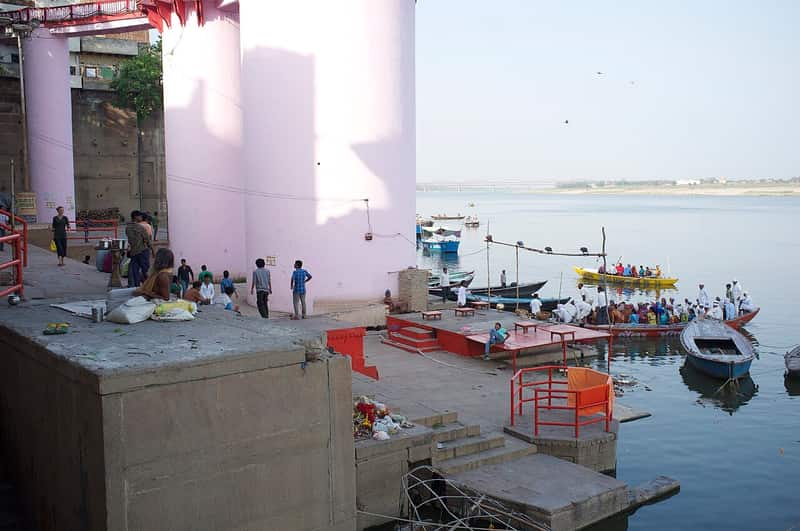
The Neighbouring Ghats — Toward Manikarnika and the Old City
Lalita sits on the northern stretch of the ghats, in the immediate neighbourhood of the cremation ground. Just a short walk to the north, past the old buildings and down a few more steps, lies Manikarnika Ghat, the most sacred burning ghat in the world, and beyond it the whole chain of the northern ghats continues toward the river's bend, growing quieter and more rural as the city gives way to the countryside. To the south, in the other direction, lie the ornate palaces and observatory of Man Mandir and the great ceremonial ghats beyond, with their crowds and their festivals. Lalita is thus a threshold, a quiet pause between the pageantry of central Varanasi and the intensity of the burning ground, and it partakes of both worlds. From its steps one can turn north and see the pyres, or turn south and see the gilded domes, and feel the whole span of the city's sacred geography in a single glance.
Behind the ghat, the old city climbs steeply. Narrow lanes twist upward through densely packed houses, past small shrines, sweet shops and courtyard temples, eventually connecting to the great arteries of the old city where the rickshaws and the crowds of the tourist quarter begin. Walking these lanes is an education in itself — every turn reveals a shrine, a well, a doorway carved a century ago, a terrace where carpets are drying in the sun, the smells of cooking and incense mixing in the narrow air. Many visitors find that the lanes behind Lalita are as memorable as the ghat itself, and that the two together give the fullest picture of how Banaras actually lives. Here the ghat and the neighbourhood are one organism, and the boundary between worship and daily work is barely visible.
The journey between the ghats is best made by boat, as the pilgrims have always made it. From Lalita, a boatman can row north to Manikarnika in a few minutes, passing the smoke and the pyres, and continue to the farthest northern ghats; or he can turn south, drifting past the bathing platforms and the palaces toward the wide stairs of Dashashwamedh. Seen from the water, the ghats form a single continuous city on the river's edge, a ribbon of stone and faith that has grown over three thousand years. Lalita takes its place in that chain as the modest, friendly face of the northern stretch — a good place to begin or end a northern ghats tour, and a fine introduction to the whole sacred riverfront. Whatever direction the boat takes, the traveller leaves Lalita with the sense of having touched the genuine substance of the holy city.
Dev Deepawali — A Sea of Lamps on the Northern Ghats
On the full moon night of Kartik, fifteen days after Diwali, the ghats of Varanasi celebrate Dev Deepawali, the festival of lights of the gods, and Lalita takes part in its own quiet way. While the great ceremony centres on Dashashwamedh and the southern ghats, with their stages and their crowds, the northern stretch is not forgotten. As evening falls, the steps of Lalita are lined with hundreds of clay lamps, their flames mirrored in the dark water, and the whole riverfront glows with a double light — one burning on the stone, one trembling on the Ganga. The palace above the ghat and the little temples add their own lamps to the display, and the darkness of the cremation stretch itself is softened by the glow. Even the boatmen keep their boats afloat on the water that night, so that the reflection of every lamp doubles and redoubles.
Dev Deepawali celebrates the day the gods are believed to have descended to the Ganga to bathe and to welcome the souls of the departed, and it is a night of joy mixed with remembrance. Along the northern ghats, families gather on the steps, float diyas on leaf boats, and share sweets and laughter, their voices carrying over the water. The atmosphere at Lalita on this night is intimate rather than spectacular — no fireworks, no giant stages, no loudspeakers, just the entire neighbourhood sitting together on the ancient steps, watching the river turn into a mirror of flame. For those who want to see the festival without the crowds, the northern ghats offer the truest and most moving feeling of the celebration. Here the festival is not performed for cameras but shared between neighbours, and that makes it all the more beautiful.
There is a particular poignancy in the lamps near Manikarnika on Dev Deepawali. The same ghats that see the smoke of pyres every day are, on this one night, lit by thousands of tiny flames honouring the dead and welcoming the gods. From a boat on the water, the sight is unforgettable: the entire northern crescent glowing with light, the palace of Lalita standing bright above the steps, and the reflection of every lamp joining the reflection of the moon on the sacred river. It is a reminder that in Varanasi, light and death, celebration and devotion, have always lived side by side, and that the lamps of the festival are also lamps of remembrance, carrying the same meaning as the flames of the burning ghat. Seen together, the two fires — of life and of remembrance — tell the whole story of this extraordinary city.
Etiquette — Respectful Conduct on a Sacred Ghat
Lalita is a living sacred place, and visitors are asked to treat it with the respect it deserves. Modest dress is essential — shoulders and knees covered, especially at the temples, and shoes removed before entering any shrine. Bathing is welcome but should follow local custom: enter the water gently, keep voices low, and never throw anything into the Ganga except the ritual offerings. It is considered polite to ask before photographing people, and to be mindful that many of the bathers are performing rites for departed relatives, for whom this quiet ghat has particular meaning. What may look like a simple splash and a dip is, for them, the most solemn act of their lives. A quiet manner and a soft step will open more doors here than any camera or guidebook.
Photography calls for particular care in this part of the riverfront, because Manikarnika, the great cremation ground, lies just a short walk to the north. Photographing the pyres, the mourners or the cremation itself is deeply offensive and is strictly avoided by respectful travellers. Around the northern ghats, keep a calm and solemn manner; do not stare at the funerals, do not interfere with the bearers carrying the dead, and do not touch the offerings. The Doms and the priests who serve the ghats should be treated with the same courtesy as the pilgrims, and the traditional guide fees, if a boatman or priest is engaged, should be settled politely and clearly in advance, to avoid the confusion that disappointment brings. A little patience and a good deal of respect will make the visit smooth and leave everyone satisfied.
Above all, approach the ghat with the understanding that it is not a stage arranged for visitors but a place where people pray, mourn, bathe and live. Dress with modesty, speak with softness, give alms if you wish but never with condescension, and let the rituals unfold without interruption. Travellers who observe these simple courtesies find that the ghat responds in kind — the boatmen are generous with their stories, the priests share their blessings, the shopkeepers open their doors. The quiet beauty of Lalita is offered freely to those who approach it with an open and respectful heart, and the memory of such a welcome lingers long after the visitor has left the city. The ghat rewards those who honour its holiness with the warmth of its own people, and that exchange is the finest souvenir of all.
Practical Guide — Getting to Lalita Ghat
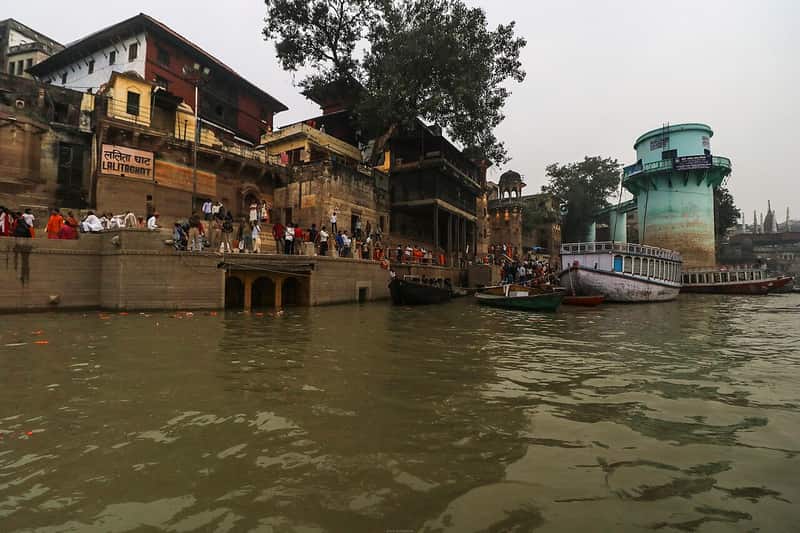
Lalita Ghat is reached most easily by boat, which is also the most beautiful way to arrive. From the central ghats, a short ride north along the river brings you directly to its steps; the boatmen near Dashashwamedh and Man Mandir know the landing well and will drop you there as part of any northern ghats tour. On foot, walk north from Dashashwamedh along the riverfront, or follow the lanes inland from Man Mandir, and the ghat will appear where the old city meets the water. Rickshaws and cycle-rickshaws can bring you as far as the lane-heads, but the last stretch is always on foot through the narrow passages of the old city, which is itself part of the experience. The walk is short but memorable, passing temples, shrines and the living rooms of the old city on the way.
The best time to visit is the early morning, between sunrise and mid-morning, when the light is soft and golden, the bathers are at their devotions, and the ghat has a calm that the daytime hours rarely allow. The hours just before sunset are also lovely, when the steps turn to gold and the boats return to their moorings. There is no entry fee; the ghat and its temples are open to all, though a small donation at the temples is welcomed and customary. Plan to spend at least an hour — time to sit on the steps, to watch the river, and to walk the lanes behind the ghat, where the life of the old city continues on its own terms. Morning is also when the light is kindest to the white palace, catching its painted facade at its most photogenic.
Combine Lalita with its neighbours for a complete morning. Man Mandir, with its astronomical observatory, lies a short walk or boat ride to the south, and Manikarnika, the great cremation ghat, lies close to the north — visit it with respect and from a distance. The most rewarding way to see all three is a northern ghats boat tour, which passes the palaces, the bathing platforms and the smoke of the pyres while the boatman narrates the riverfront's history. Start from Man Mandir or Dashashwamedh in the early morning, drift north past Lalita, and let the holy river show you the old city from its oldest perspective — the water, the way pilgrims have seen it for three thousand years. However you arrive, leave a little time simply to sit, for the ghat will teach you more than any itinerary.
Lalita Ghat — Gallery (12 Photos)
Image Credits
lalita-01.jpg · lalita-02.jpg · lalita-03.jpg · lalita-04.jpg · lalita-05.jpg · lalita-06.jpg · lalita-07.jpg · lalita-08.jpg · lalita-09.jpg · lalita-10.jpg · lalita-11.jpg · lalita-12.jpg — Wikimedia Commons, under free licenses.
Continue exploring
Similar Ghats Nearby
Book This Ghat — Get Notified
Download the app now and book a boat ride to Lalita Ghat