

Scindia Ghat
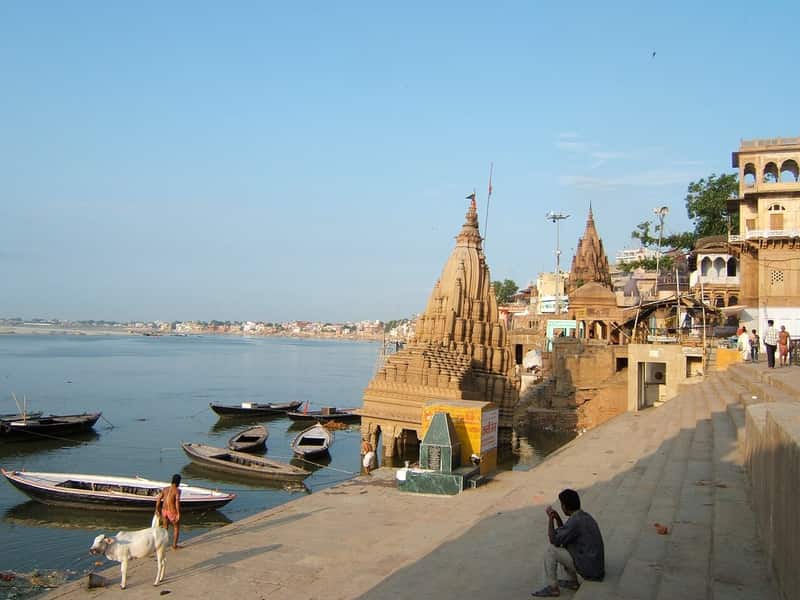
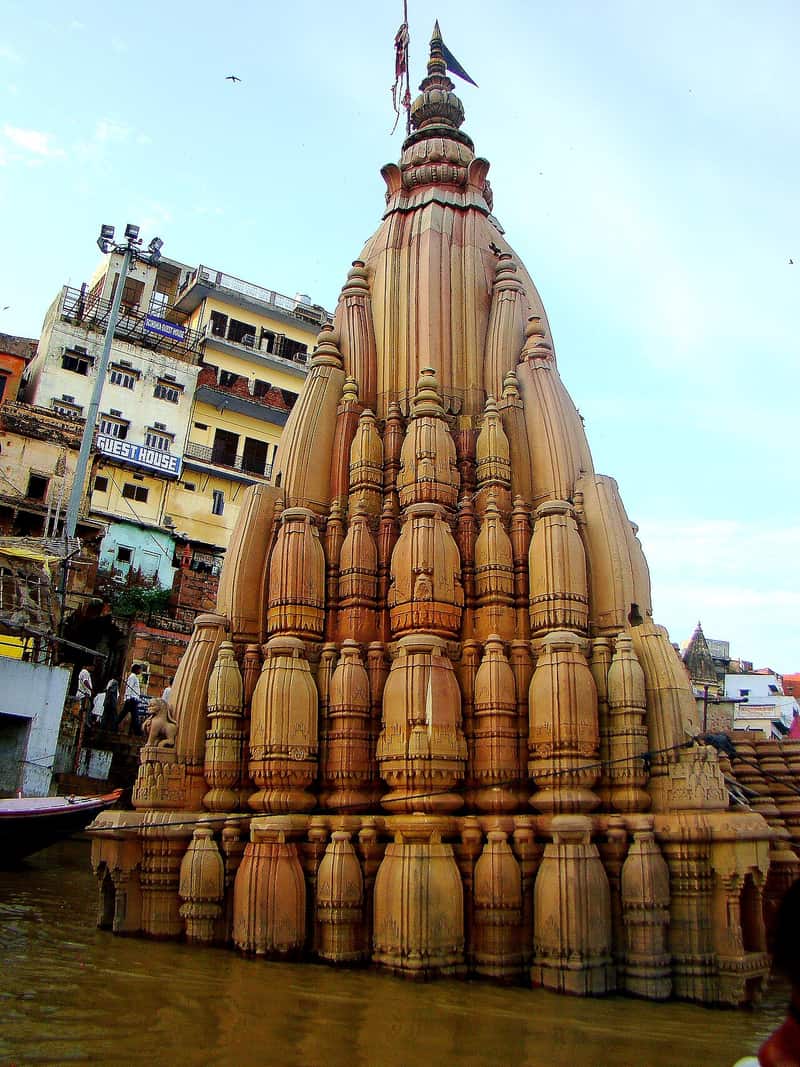
Heritage GhatScindia Ghat is a 19th-century historic ghat. It has a grand gateway and a partially submerged Shiva temple in the river.


Type
Heritage Ghat
Boat Fare
1.1x base fare
Best Time
5-7 PM for sunset lighting on the submerged temple.
History
Built by Maharani Baizbai Scindia in the 19th century. A solid Shiva temple on the ghat has partially sunk into the river due to the weight of construction. Legend says when the ghat was built, the temple sank. A famous Langar (community kitchen) branch operates daily here.
Highlights
- The tilted Ratneshwar Temple in the water
- Memory of the Bindu Madhav Temple
- Scindia royal architecture
- Best ghat for photography
Festivals & Events
How pricing works in the NaviX app
No haggling at the ghat — everything is fixed in the app first
- 1
Fixed price before you board
The fare is shown in the app upfront — no bargaining at the ghat
- 2
Sharing or private — your choice
Share with fellow travelers or take the whole boat for your group
- 3
Pay only after the ride
UPI, card or cash — with an instant receipt
6:00 AM & 6:00 PM
At the leaning Ratneshwar temple
Complete Guide
Scindia Ghat — The Complete Guide
History, mythology, rites and practical details — everything in depth.
On this page
- 1.Scindia Ghat — A Tilted Temple and a Royal Legacy
- 2.The Leaning Temple — A Tower Half Under Water
- 3.Queens and Maharajas — The Making of the Ghat
- 4.Between Fire and Water — Scindia on the River
- 5.Stone Steps, Arches and Painted Palaces
- 6.Shiva at the Water's Edge
- 7.A Quiet Neighbour to the Sacred Fire
- 8.The Boatyard of Banaras
- 9.First Light on the Ganga
- 10.Evening Lights and the Glow of Ganga Mahal
- 11.Etiquette and Courtesy at the Ghat
- 12.Practical Guide — Reaching Scindia Ghat
📅 Updated: 21 Aug 2026 · Author: NaviX Field Team (field research 2024-26) · 12 sections · 12 photos
Scindia Ghat — A Tilted Temple and a Royal Legacy
Scindia Ghat is one of the most striking sights on the entire riverfront of Varanasi, and the first ghat that many visitors photograph from a boat. It stands roughly at the centre of the great crescent of stone steps, its long terraces rising in gentle tiers from the water to a ridge of old palaces and temples. Its name is a reminder of a forgotten royal patronage, for this landing was built under the protection of the Scindia or Shinde family, the Maratha rulers of Gwalior, whose banner flew over Kashi in the early nineteenth century. Yet what makes the ghat unforgettable is not its size or its history alone. It is the extraordinary spectacle of a tall Shiva temple leaning sharply to one side, as if the earth itself had tilted beneath it, its shikhara half swallowed by the slow brown water of the Ganga.
The tilted temple gives the ghat an air of the fantastic, a picture that belongs on a painter canvas rather than in the middle of a bustling holy city. Pilgrims and travellers stand on the steps for long minutes simply staring at it, watching the current slide around the submerged masonry and trying to measure the impossible angle of the tower. Around it, the ghat continues its ordinary life — boatmen shout and bargain, sadhus sit cross-legged with their begging bowls, washerwomen beat clothes on flat stones, and cows pick their way between the sleeping pilgrims. The oddity of the leaning shrine sits perfectly within this everyday confusion, and after a little while it begins to feel less strange than the fact that nothing else in Kashi seems to be standing perfectly straight either.
For the visitor arriving for the first time, Scindia Ghat rewards patience. Come early, climb to the top of the terraces, and the ghat reveals itself as a complex little world — a working boatyard, a place of worship, a staging area for the cremation ghats to the south, and above all a vantage point from which the whole sweep of the Varanasi riverfront can be seen at a single glance. This guide follows the ghat through its history, its temples, its boats and its daily rhythms, and finishes with practical advice on how to reach it and what to look for when you are there.
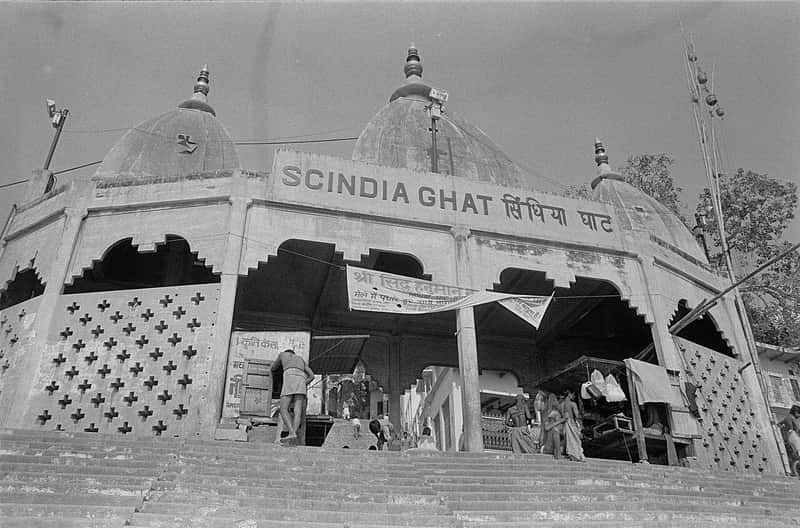
The Leaning Temple — A Tower Half Under Water
The leaning temple of Scindia Ghat has become the most photographed religious ruin in Varanasi, and its story is one of accident, collapse and patience. The shrine is dedicated to Shiva and stands at the water edge, but it no longer stands up. Over the course of the nineteenth century the ghat upper levels were repaired and extended while the river steadily rose, and at some point the weight of the new construction pressed the foundations downward. The temple sank slowly into the soft alluvial silt, its base disappearing beneath the current while the tower above remained standing — but now at a dramatic, drunken angle that has made it the signature image of the ghat.
The exact details of the collapse are lost, and the same story is told in several versions. Some say the temple was overwhelmed when the ghat was rebuilt in the 1830s, its platform raised too quickly on ground that could not hold it. Others say the shrine sank gradually over the decades, the Ganga rising one monsoon and the next until the water reached the garbhagriha, the inner sanctum, and the priests were forced to move the deity to higher ground. What is certain is that the temple is still in use. The murti of Shiva was shifted into a small shrine above the flood line, but the old tower remains an object of devotion from the water, garlanded with marigolds by passing boatmen and saluted by pilgrims who believe that even a fallen temple of Shiva retains its power.
Seen from the river at dawn, the tilted shikhara looks almost supernatural — a broken mast of stone against the pale sky, its reflection lying crooked in the water. At close range it is stranger still, because the building that appears from afar to be a small temple is in fact a substantial structure, its lower storey flooded, its doorway washed by the current, and boats moored casually against its walls. For photographers it is the most rewarding subject on the entire riverfront, because every angle produces a different and surprising composition. And for the pilgrim it carries a gentle lesson: even in a city of gods, nothing is permanent, and even the holiest of towers may lean, and still be holy.
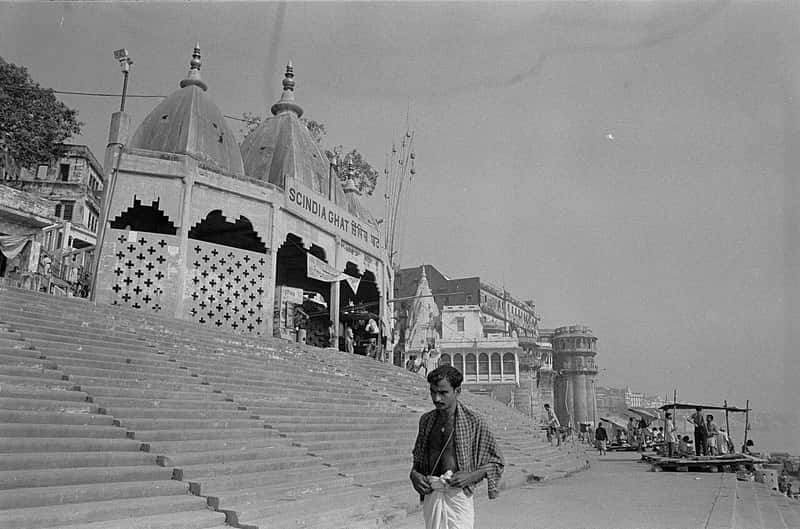
Queens and Maharajas — The Making of the Ghat
Scindia Ghat was built in the middle decades of the nineteenth century under the patronage of the Scindia family, the Maratha dynasty that ruled the kingdom of Gwalior from their great fort city far to the south-west. The ghat creation is credited especially to Maharani Baiza Bai, the widow of Daulat Rao Scindia, one of the most formidable women of her age. After her husband death she travelled extensively across India, managing alliances and endowments with a political skill that impressed the British East India Company itself. When she passed through Kashi in the 1830s she found the riverfront in need of a grand new landing worthy of her family, and she devoted money and energy to building the ghat that bears the Scindia name.
The Maratha connection to Varanasi ran much deeper than one building project. For two generations, the Maratha confederacy had regarded Kashi as a second capital of their culture — a city of learning, pilgrimage and law where their queens came to bathe, their generals came to make offerings, and their bankers maintained palaces. The Peshwas of Pune patronised the ghats heavily, and the Maharaja of Gwalior kept his own riverside palace at Scindia Ghat, a long building of balconies and carved windows that still stands above the terraces today. For the Scindias, patronising Kashi was an act of piety, politics and prestige all at once: it announced that the rulers of Gwalior were protectors of the holiest city in India.
The riverfront of the ghat thus grew into a small Scindia quarter. The palace guarded the crest of the terraces, the new stone steps ran down to the water, and a chain of small temples and rest houses followed. Though the family power declined in the twentieth century, their imprint on this corner of Kashi never faded. The great floods and the slow rising of the Ganga tested the construction, and the famous temple at the water edge sank into the silt, but the palace above kept its dignity, and the ghat kept its name. Standing on the steps today, with the palace behind and the tilted tower below, one can still feel the presence of the proud Maratha house that decided, two centuries ago, to build its monument beside the holiest river in the world.
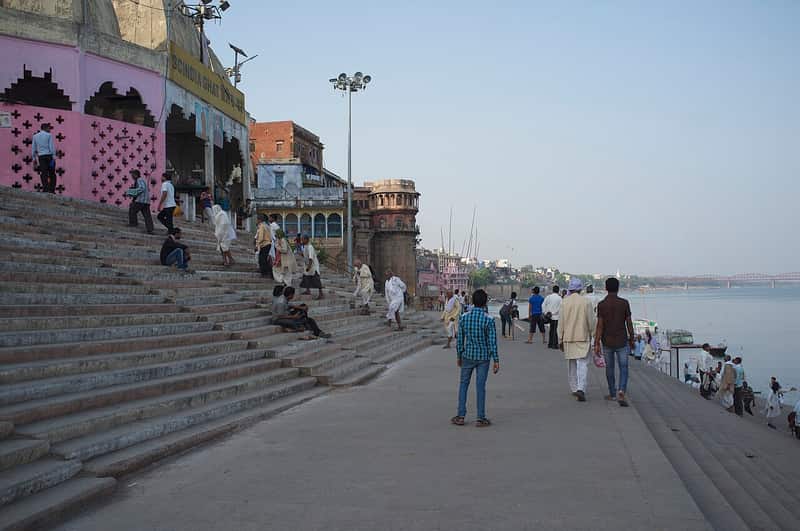
Between Fire and Water — Scindia on the River
Scindia Ghat sits at the southern end of the great ghat crescent, and its position shapes its character more than any other fact about it. Immediately to the south, hidden beyond a low spur of buildings, lies Manikarnika Ghat, the great cremation ground, whose smoke drifts across Scindia steps when the wind blows from that quarter. To the north, the terraces continue past Ganga Mahal and the old Rajput palace toward the quieter, less visited ghats of the upper city. Standing at the water edge, one can place the whole of the Varanasi sacred geography at a glance: the burning ghat behind, the bathing ghats before, and the great river carrying everything toward the east.
The contrast with Manikarnika is the most powerful experience of the site. On one side of the spur, mourners carry their dead through the narrow lanes and the smoke of the pyres rises day and night; on the other, at Scindia, pilgrims bathe, women wash clothes, children play on the flat stones and boatmen bicker over fares. The proximity of the two ghats is not accidental: in the old city the cremation ground and the bathing ground belong together, because both are stations of the same sacred passage from life through death to liberation. For the visitor, this makes Scindia a place of deep reflection, where the everyday and the eternal stand within a few dozen paces of each other.
The river perspective is arguably the best reason to come. From a boat moored mid-stream, Scindia Ghat presents its full face: the long flights of steps, the row of painted buildings at the crest, the palace balconies, and below them all the unforgettable leaning temple standing in the water. Because the ghat is flanked by Manikarnika on one side and Ganga Mahal on the other, it is framed on both flanks by history, and the boatman commentary — naming the ghats as they pass — turns a half-hour cruise into a living lesson in the city geography. Land or water, the ghat rewards the traveller who takes time to understand where it stands, and why.
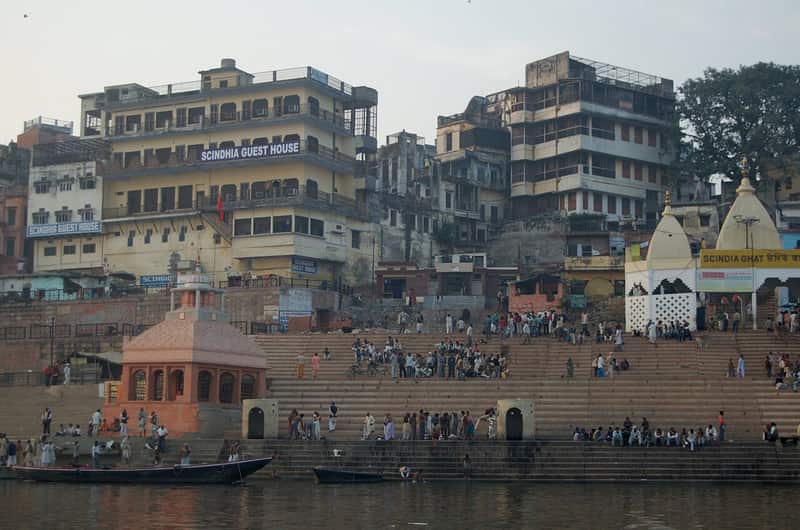
Stone Steps, Arches and Painted Palaces
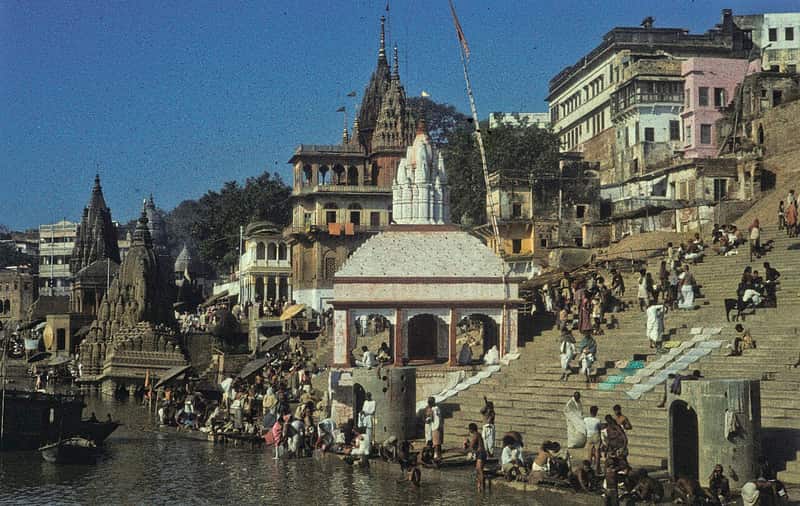
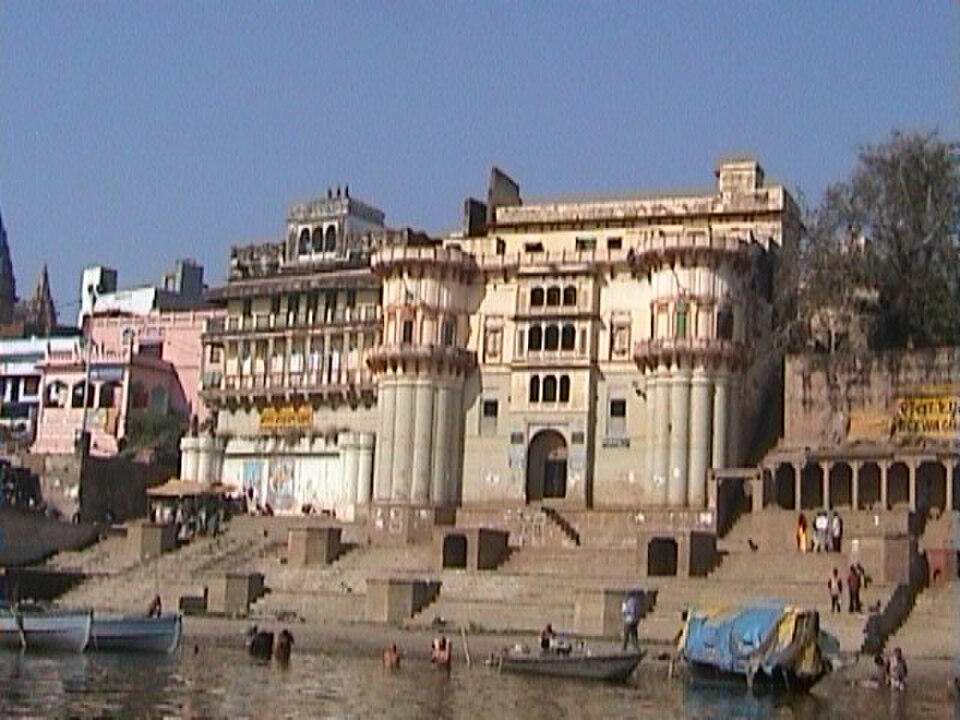
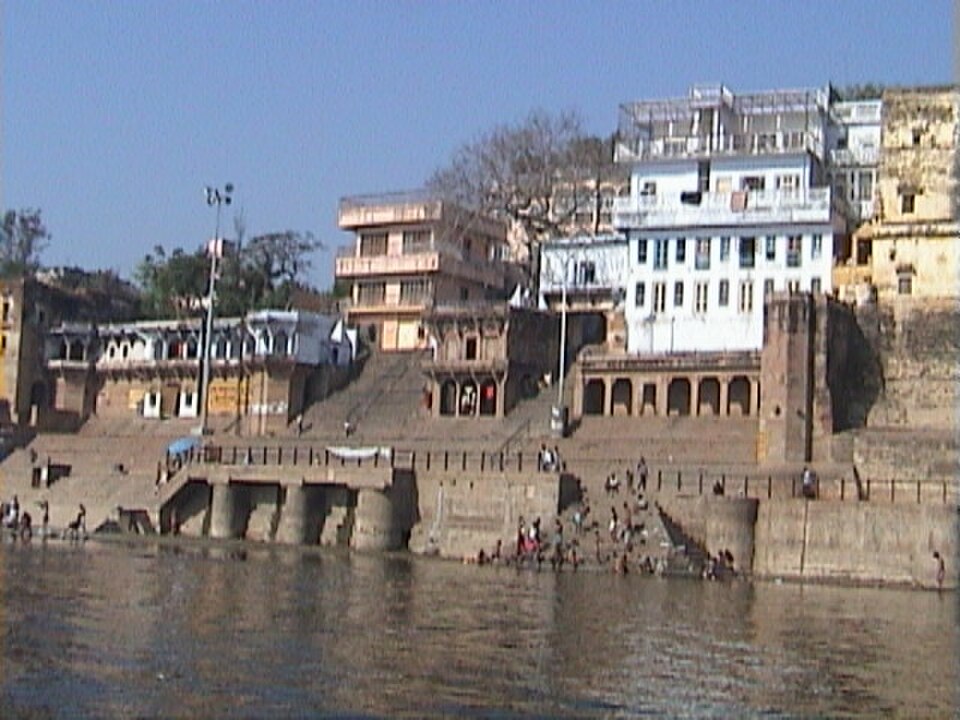
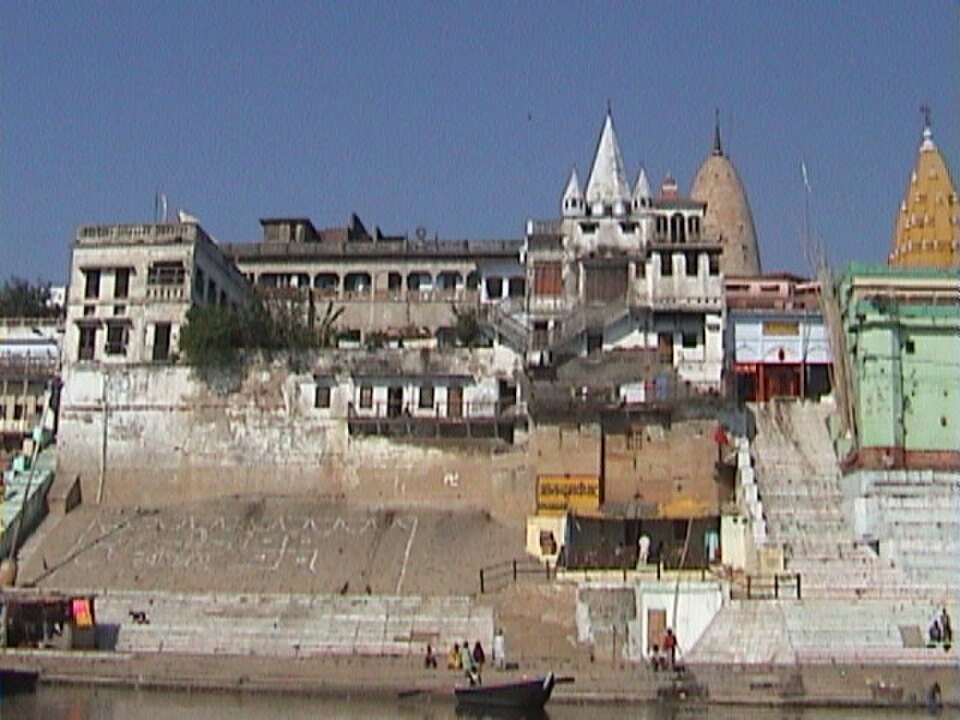
The architecture of Scindia Ghat combines the grandeur of Maratha palace-building with the everyday busyness of a working riverfront. The ghat begins at the water with broad stone steps, worn smooth by two centuries of bare feet, and climbs in three or four long terraces toward the crest. Above the steps rise the buildings that give the ghat its particular skyline: a row of painted facades in pink and ochre, some with wooden balconies, others crowned with small temple towers. The palace of the Maharaja of Gwalior dominates the ridge, its long frontage pierced by carved windows and overhanging balconies that seem to lean out over the terraces like spectators at a festival.
Water steps, arches and shrines interlock here in a tight composition. As the steps approach the water they widen into flat platforms where boats land and devotees sit, and at intervals the wall is broken by arched openings leading into cool passageways and small shrine rooms. At the crest, a chain of little temples runs along the ghat — shrines to Shiva, Ganesha and Hanuman, most of them modest, brightly painted, and crowded with the offerings of the neighbourhood. The whole arrangement is less a single monument than a miniature city, with lanes, courtyards and altars tucked into a space no wider than a few houses, yet every part of it is coherent, each level giving onto the next with a logic that centuries of use have made natural.
What strikes the careful eye is the mixture of ages. Here a Mughal-style cusped arch survives from an older building; there a nineteenth-century facade shows Victorian plasterwork beside a Maratha balcony; and at the water edge the tilted temple belongs to a different world altogether. The ghat has been patched, repaired and extended so many times that its architecture is a geological record of the Varanasi taste. Nothing is exactly symmetrical, nothing is entirely original, and yet the whole has a harmony that purpose-built riverfronts rarely achieve. For the visitor who walks slowly and looks closely, Scindia Ghat is a museum without walls, in which every balcony, bracket and step tells the story of a city that has always built, rebuilt and believed.
Shiva at the Water's Edge
Shiva is the presiding deity of Scindia Ghat, and the whole site is arranged around his worship. The famous leaning temple at the water edge was consecrated to him, and although its sanctum is now flooded, the deity was removed to a small shrine higher up the terraces, where the daily puja continues without interruption. Beyond the main temple, the crest of the ghat holds a ring of smaller Shiva shrines, many of them built to shelter particular forms of the god — the sankat-haran Shiva who removes sorrow, the gauri-shankar Shiva of the mountain, the lingams placed by grateful families after a wish was granted. In this, Scindia Ghat is a perfect image of Kashi, the city that is itself said to rest on Shiva trident.
Devotees come to these shrines at every hour, but the ghat is busiest in the early morning and at sunset, the two sandhyas of the Hindu day. Men and women arrive with brass lotas of Ganga water, flowers and bel leaves, and the little sanctums fill with the fragrance of incense and the low murmur of prayers. The offerings are simple — a coin, a marigold, a spoon of milk — but they are made with the intensity that only centuries of family habit can produce. Many of the devotees are themselves from families that have worshipped at these same shrines for generations, and some old men will recall a grandfather who placed his first offering before the leaning temple when it still stood straight, in the years before the river swallowed its base.
The great festival of the ghat is Maha Shivratri, the night of Shiva, which falls in February or March. On that night the shrines of Scindia glow with lamps, the terraces fill with singing and chanting, and the whole riverfront joins in the great all-night vigil of the god wedding to Parvati. Processions wind through the lanes carrying images of Shiva in palanquins, and devotees fast and keep watch until the dawn bell. For the visitor, the sight of the tilted temple at Maha Shivratri is unforgettable — the ancient leaning tower garlanded and lit, still receiving the worship of the city as it has for two hundred years, a symbol of the faith that does not weaken even when its stones sink into the river.
A Quiet Neighbour to the Sacred Fire
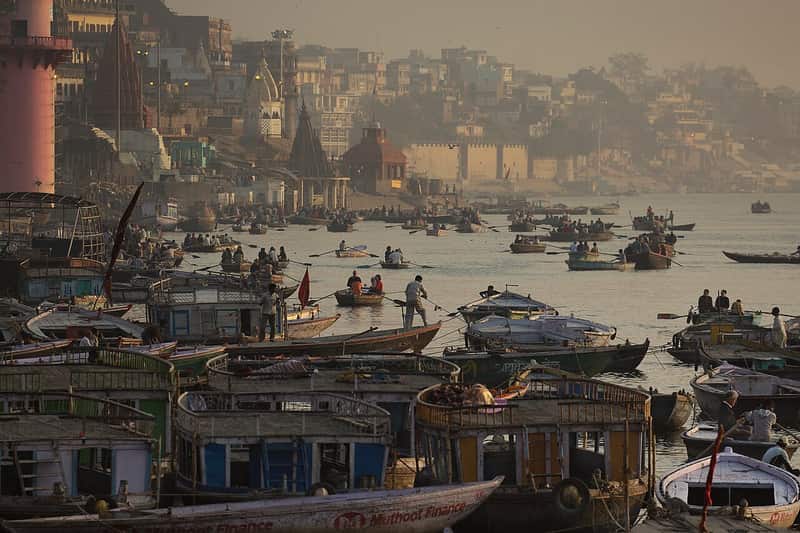
Scindia Ghat position directly beside Manikarnika gives it a quiet and unusual role in the city sacred geography: it serves as the viewing point, resting place and staging area for the great cremation ground. Visitors who are unwilling or uninvited to walk onto the burning platform itself often choose to sit on the Scindia steps and watch the smoke of Manikarnika from a respectful distance, their view softened by a hundred yards of water and air. Mourners, too, use the ghat: funeral parties gather here while arrangements are made, relatives rest on the flat terraces, and boats carrying mourners from the far bank put in at Scindia before the last rites begin.
The mood is calm rather than sorrowful, which is itself a lesson in how Kashi understands death. On the Scindia steps the two worlds intermingle without tension — a wedding party may be photographing the tilted temple while, a few hundred yards away, a funeral pyre is lit; pilgrims bathe while bearers carry their burden down the neighbouring lane. The ghat thus becomes a place where the visitor can approach the reality of Manikarnika at his own pace, watching the smoke rise and fall, listening to the chanted name of Ram drifting on the wind, without intruding on grief or violating the dignity of the rites. It is the closest many travellers will ever come to the burning ghat, and for most it is exactly the right distance.
There is a practical side to this role as well. The deep water off the Scindia steps provides reliable mooring for the heavy wooden boats used by the Dom community and funeral parties, and the ghat wide platforms serve as a staging ground where wood, ghee and other supplies for the pyres are unloaded and stored. The juxtaposition of the boatyard, the bathing platforms and the smoke of the pyres just beyond the spur is a complete picture of the economy of death and worship that sustains this corner of Kashi. For the traveller, standing on Scindia Ghat with the Manikarnika smoke rising against the sky is to be present at the very hinge of the city purpose — the place where the living and the dead share the same river.
The Boatyard of Banaras
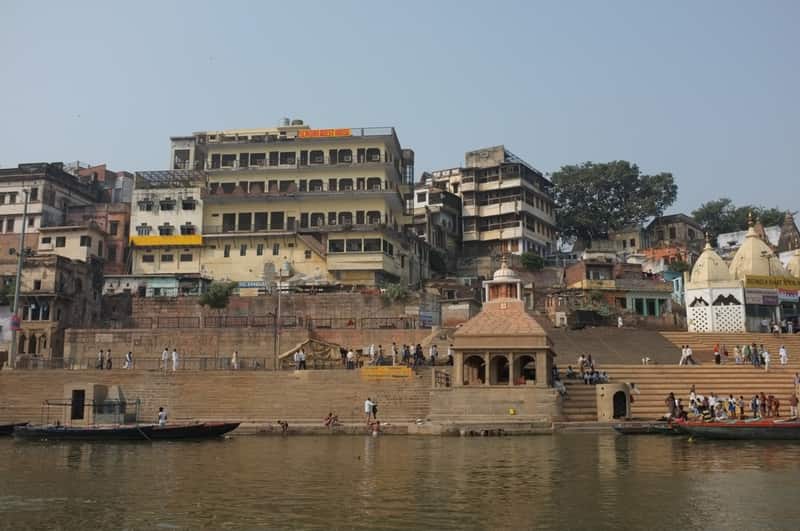
Scindia Ghat is one of the great boatyards of Banaras, and much of the life of the ghat is the life of boats. Along the water edge and up onto the flat platforms, wooden craft of every age are hauled ashore for repair — long rowing boats with curved prows, broad ferries, sleek racing skiffs and the sturdy cargo boats that carry goods across the river. Boatbuilders work among them with adze and chisel, shaping fresh planks to replace worn ones, while their helpers mix tar and pitch in iron pots and caulk the seams between the boards. The smell of wood and pitch, the ring of hammers and the low sound of sawing are as much a part of the ghat as the chanted prayers of the shrines.
Around the repair yards moves a whole supporting trade. Painters arrive with cans of bright colour to give the weathered hulls their annual coat of green, red and yellow; rope-sellers keep coils of mooring line; a small chai shop at the crest serves the workmen; and the famous crane of Scindia — a simple wooden contraption with a long boom, raised and lowered by hand — hoists the heavier boats bodily from the water. Watching the crane at work is a small spectacle in itself, the boatmen shouting directions as the great hull swings dripping over the steps before settling on its cradle. It is a scene of timeless craft, performed in much the same way as it was a century ago.
The ghat is also the morning ferry point of the neighbourhood. From first light, boatmen call for passengers across the river to Ramnagar and the far bank, and the broad ferries take pilgrims, workers and schoolchildren on the short crossing. During festival seasons the fleet swells, and at Dev Deepawali the same boats are dressed with lamps and marigolds for the evening procession on the water. For the visitor, the boatyard gives the ghat its authenticity: it is not a museum of the past but a living workshop, where the city oldest trade is carried on in full view. To sit on the steps and watch the builders and painters work is to watch Banaras itself at its most honest — hands at work, river flowing, boats coming and going without pause.
First Light on the Ganga
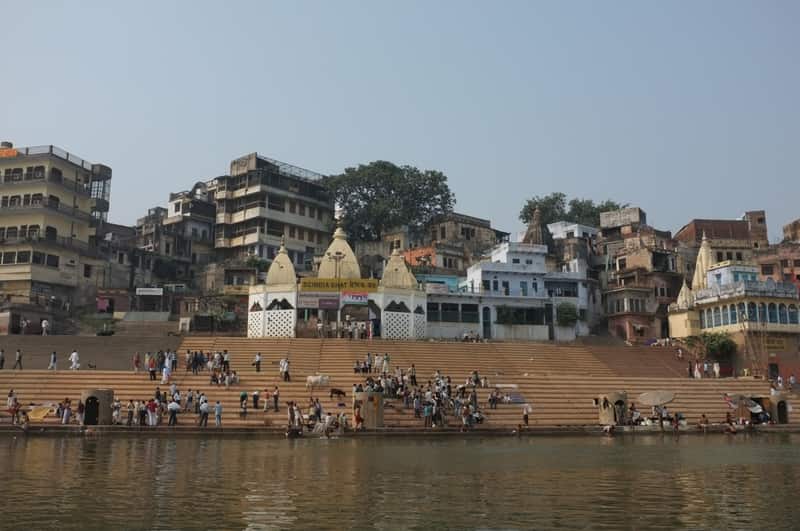
Sunrise at Scindia Ghat is the hour that photographers dream of and wake early for. Before the sun clears the eastern bank at Ramnagar, the river is a sheet of soft grey touched with rose, and the leaning temple stands in silhouette, its broken line dark against the brightening sky. As the first rays strike the water, the surface turns to beaten gold, and the reflection of the tilted shikhara shimmers and dances across the ripples. Sadhus arrive on the steps in their saffron cloth, settle into their morning postures and begin their breathing and meditation, while the first ferries push off and the boatmen cries begin to carry across the water.
The bathers come as the light strengthens. Men and women in their washing clothes walk down the wet steps into the current, dip themselves with closed eyes, and pour brass lotas of water toward the rising sun with a silent prayer. Some dunk fully, then stand shivering and joyful, their heads shaved for a vow or damp with the river blessing. The whole ghat becomes a tableau of devotion and morning routine: a woman arranging marigolds for the shrine, a boy selling incense, a pilgrim prostrating on the platform, an old man inscribing his own little sandalwood mark on his forehead before the first temple. The sounds are the sounds of waking life — water splashing, bells ringing, pigeons clattering from the palace ledges.
For the photographer this is the most forgiving and most rewarding hour of the day. The low light softens the harsh geometry of the steps, hides the cracks in the old facades, and gives every subject — the tilted temple, the palace balconies, the boats drawn up on the sand — a golden edge that disappears by mid-morning. There is also a practical reward: the ghat is at its quietest, with only the earliest pilgrims about, so the famous views can be had without a crowd and without negotiation. Those who linger after sunrise are repaid again, because as the sun climbs, the pink and ochre buildings of the crest begin to glow like coals, and the leaning temple, now fully lit, seems to straighten itself in the morning light.
Evening Lights and the Glow of Ganga Mahal
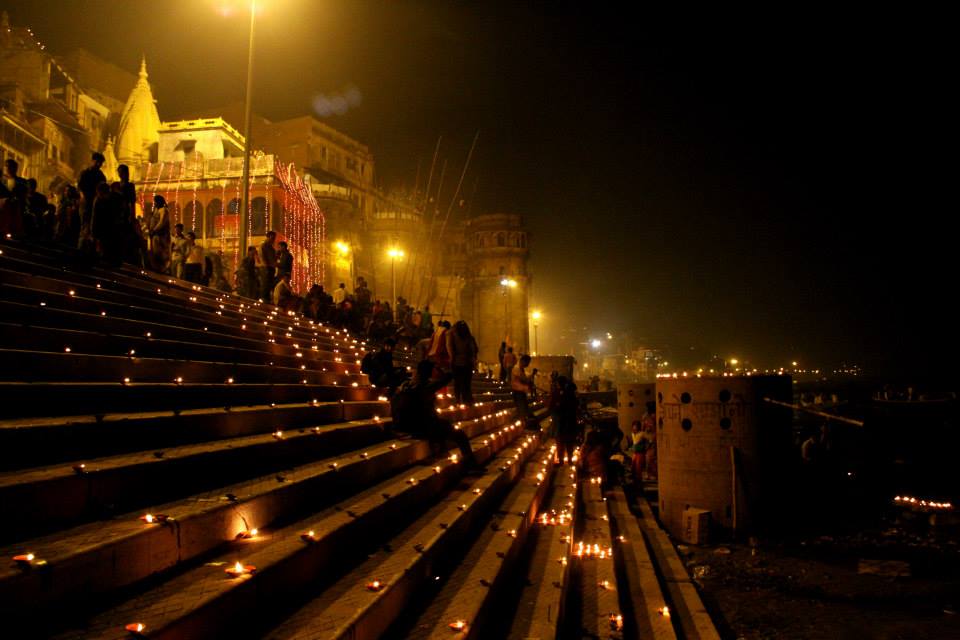
When the sun goes down, Scindia Ghat changes character completely. The working light of day fades, the boatyard falls quiet, and the ghat turns itself toward the water and the lamps. As dusk deepens, the crest buildings begin to glow — the palace windows lit from within, the little shrines bright with electric bulbs and the tiny flames of oil lamps, and along the whole line of the riverfront the ghats of Kashi strike up their own constellation of lights. The tilted temple becomes a dark silhouette against the last colours of the sky, its reflection a crooked spear of darkness on the moving water. By the terrace walls, small groups of people gather to talk, and the evening bell of the nearest temple carries across the river like a summons.
The most beautiful of the ghat neighbours is Ganga Mahal, whose facade lights up at night like a stage set, its long balconies and arched windows throwing warm light down onto the terraces of Scindia. The two ghats are so close that they read as one composition after dark, and the reflected glow of Ganga Mahal stains the water at the Scindia feet with gold and amber. This is the hour when the ghat reveals its gentlest self: couples sit on the steps, children chase each other among the moored boats, boatmen sleep rolled in blankets in the stems of their craft, and the smoke of the Manikarnika pyres, still rising beyond the spur, becomes a pale blue veil against the night sky.
On the festival of Dev Deepawali, which falls on the full-moon night of Kartik Purnima in November, Scindia Ghat becomes one of the most magical places in the city. Thousands of small earthen lamps are set along the steps, on the platforms and on the water itself, and the ghat glitters with their wavering flames. The boats are strung with lights and garlands, and the leaning temple is outlined with lamps, so that even the old ruined tower takes part in the festival. Firecrackers burst overhead, chants drift on the air, and the whole riverfront is reflected in the dark water like a second, upside-down city. For the visitor, seeing Scindia Ghat on Dev Deepawali night is to see Kashi at the height of its beauty — an entire bank of the Ganga burning with tiny, joyful lights.
Etiquette and Courtesy at the Ghat
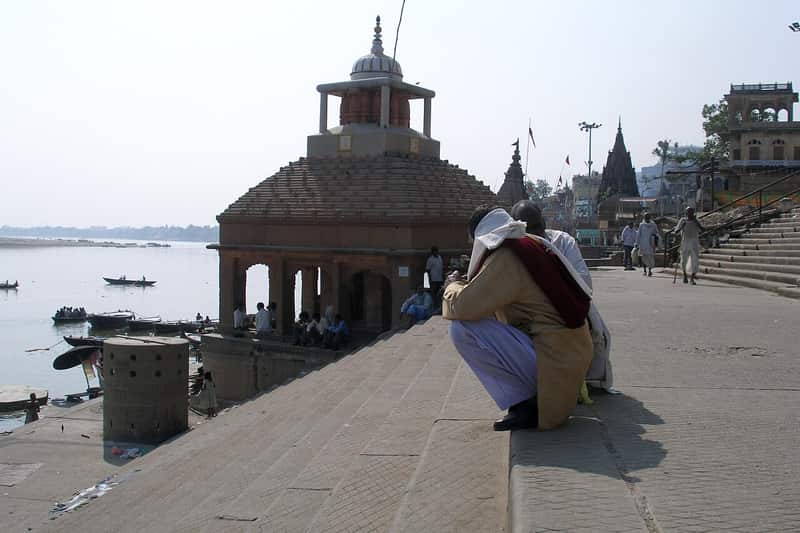
Scindia Ghat is a living place of worship, work and grief, and the visitor who moves through it with courtesy will be repaid with the warmth that Banaras reserves for respectful guests. The first rule is to dress modestly — shoulders and knees covered — especially when walking near the temples at the crest, and to remove footwear before entering any shrine. Photography is welcome, and the leaning temple is every traveller prize, but it is courteous to ask before photographing individual people, particularly sadhus, pilgrims at prayer and those who are visibly mourning. A simple gesture of the hand and a smile usually works where words fail.
Near the cremation side of the ghat, the rules tighten. It is proper to keep a respectful distance from funeral processions, to lower the voice, to put the camera away when mourners are passing, and never to photograph the dead or the pyres themselves without explicit permission, which is almost never given. Asking to be shown the burning ghat is acceptable in principle, but guides and boatmen will sometimes try to turn it into an elaborate and overpriced ritual, so it is wise to agree the price in advance and decline politely anything that feels like a performance. If you are moved to give, offerings to the shrines and small alms to the sadhus are traditional; giving money to the boatmen who attach themselves to tourists is entirely optional.
Safety matters as much as courtesy, because this is a working ghat with unrailed steps. The steps are uneven and often wet, and the water level changes dramatically between seasons, so shoes with a good grip are essential and a slow, careful pace near the water edge is wise. Avoid standing too close to the edge at dusk, when the light fails, and never swim in the deep channel, whose current is far stronger than it looks. Finally, remember that you are a guest in a neighbourhood of tremendous age and belief: silence near the temples, patience with the crowds, honesty in all transactions, and the ghat will treat you as kindly as it has treated pilgrims for two hundred years.
Practical Guide — Reaching Scindia Ghat
Reaching Scindia Ghat is easy, and half the pleasure is in the approach. The simplest and most beautiful way is by boat: from Dashashwamedh Ghat, the city main riverfront landing, a shared or private boat travels north along the ghats in twenty to thirty minutes, passing the quieter terraces of Assi, the tall towers of the old city and the smoke of Manikarnika before easing into the deep water off Scindia. The boatmen know the stop well, and from the water you will first see exactly what the ghat is famous for — the leaning temple standing in the current. By land, the ghat is a ten-minute walk north from Manikarnika along the riverfront lane, and the narrow streets that feed it are themselves a small adventure of shrines, chai shops and old houses.
The best time to visit is the early morning, between sunrise and about nine o'clock, when the light is golden, the crowds are thin and the ghat life — bathers, boatbuilders, ferrymen — is at its liveliest. Sunset is the second choice, for the glow of the palace and the lights coming on. The ghat is open all day and every day, and there is no entry fee; the only costs are your boat, your chai and whatever you choose to give as offerings or alms. The dry months from October to March are the most comfortable, while the monsoon months of July and August bring high water, when the steps shrink and the submerged temple disappears almost completely beneath the risen Ganga.
Scindia Ghat is best combined with its neighbours. Manikarnika, directly to the south, demands a visit for any traveller who wishes to understand Kashi, though it must be approached with respect and, ideally, on foot from the ghat itself. To the north, Ganga Mahal is a short stroll, and beyond it the quieter ghats of the upper city lead toward the great Raj Ghat. A rewarding half-day route goes by boat from Dashashwamedh to Scindia, spends an hour at the boatyard and the leaning temple, then follows the riverfront lane through Manikarnika and back. For travellers following the cremation-ghat route, Scindia is the natural base: it is calm enough to reflect, close enough to witness, and deep enough in history to reward every step.
Scindia Ghat — Gallery (12 Photos)
Image Credits
scindia-01.jpg · scindia-02.jpg · scindia-03.jpg · scindia-04.jpg · scindia-05.jpg · scindia-06.jpg · scindia-07.jpg · scindia-08.jpg · scindia-09.jpg · scindia-10.jpg · scindia-11.jpg · scindia-12.jpg — Wikimedia Commons, under free licenses.
Continue exploring
Similar Ghats Nearby
Book This Ghat — Get Notified
Download the app now and book a boat ride to Scindia Ghat