

Raja Ghat
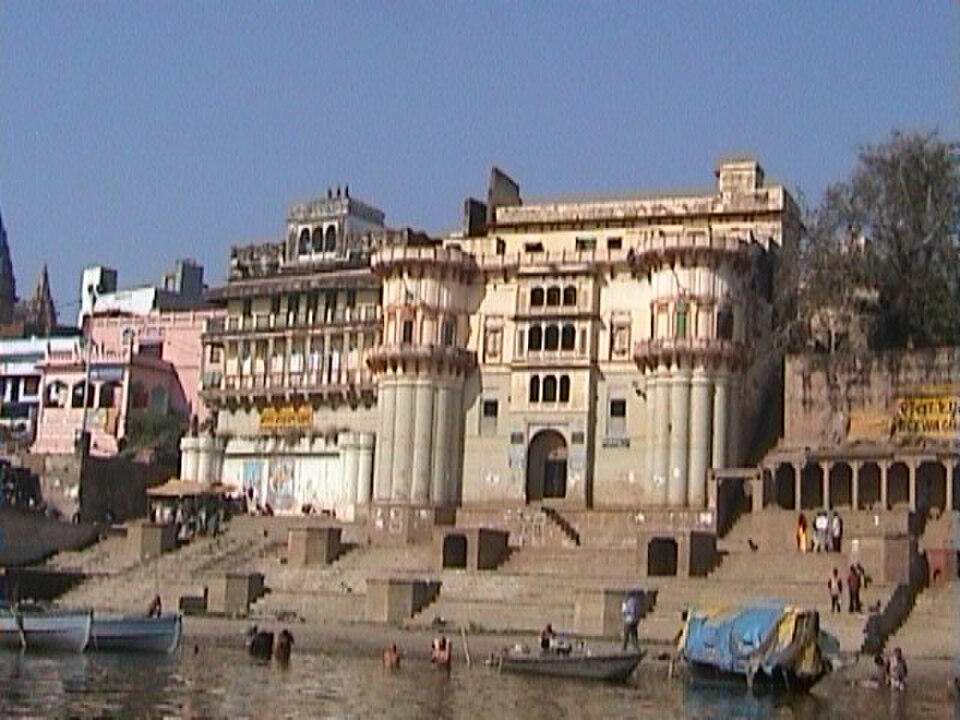
Heritage GhatRaja Ghat, built in the 18th century by Peshwa Amrut Rao. It features a beautiful Shiva temple and a famous public dining hall.


Type
Heritage Ghat
Boat Fare
1x base fare
Best Time
5-8 AM when the ghat is peaceful and uncrowded.
History
Originally called Raj Ghat, built in the 18th century by Peshwa Amrut Rao. The ghat name was later associated with Raj Ghat in Delhi where Gandhi was assassinated. Features a Shiva temple and a famous public dining hall (now in Mumbai).
Highlights
- Royal bathing tradition
- Historic significance
- Calm and clean ghat
Festivals & Events
How pricing works in the NaviX app
No haggling at the ghat — everything is fixed in the app first
- 1
Fixed price before you board
The fare is shown in the app upfront — no bargaining at the ghat
- 2
Sharing or private — your choice
Share with fellow travelers or take the whole boat for your group
- 3
Pay only after the ride
UPI, card or cash — with an instant receipt
Daily in the evening
Temples glow with lamps and the faithful gather; the flame passes hand to hand
Complete Guide
Raja Ghat — The Complete Guide
History, mythology, rites and practical details — everything in depth.
On this page
- 1.Raja Ghat — A Royal Staircase on the Northern Riverfront
- 2.The Name of a King — Raja Ghat and Its Royal Title
- 3.Royal Patronage — The Building of Raja Ghat
- 4.The Morning Bath — Dawn Rituals at Raja Ghat
- 5.Bathers, Boatmen and Priests — A Day on the Ghat
- 6.The River and the View — Ganga at Raja Ghat
- 7.Stone Steps and Old Structures — The Architecture of Raja Ghat
- 8.The Lanes of Bengali Tola — Around Raja Ghat
- 9.Narad, Mansarovar and Beyond — The Neighbouring Ghats
- 10.Festivals on the Northern Ghats — Celebrations at Raja Ghat
- 11.Conduct on the Sacred Steps — Etiquette at Raja Ghat
- 12.Reaching Raja Ghat — A Practical Guide for Visitors
📅 Updated: 21 Aug 2026 · Author: NaviX Field Team (field research 2024-26) · 12 sections · 12 photos
Raja Ghat — A Royal Staircase on the Northern Riverfront
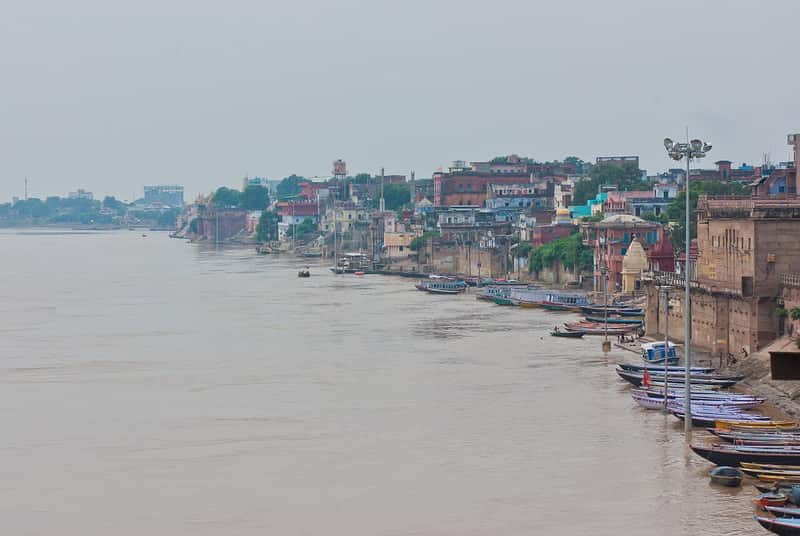
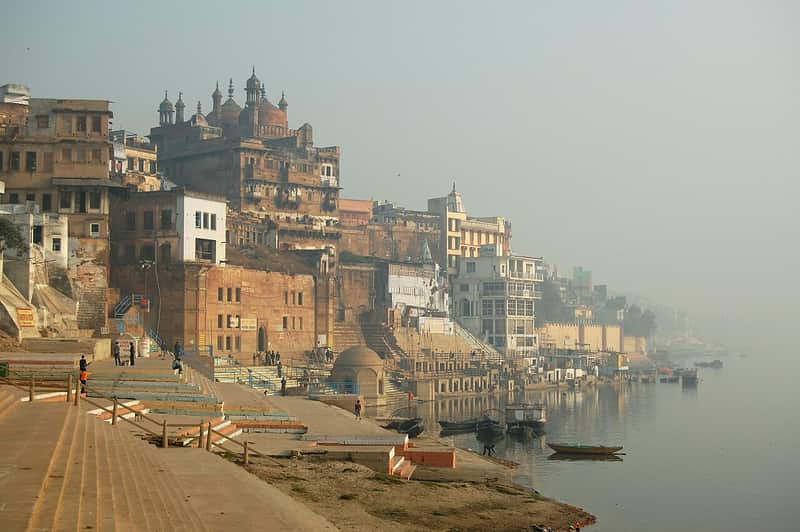
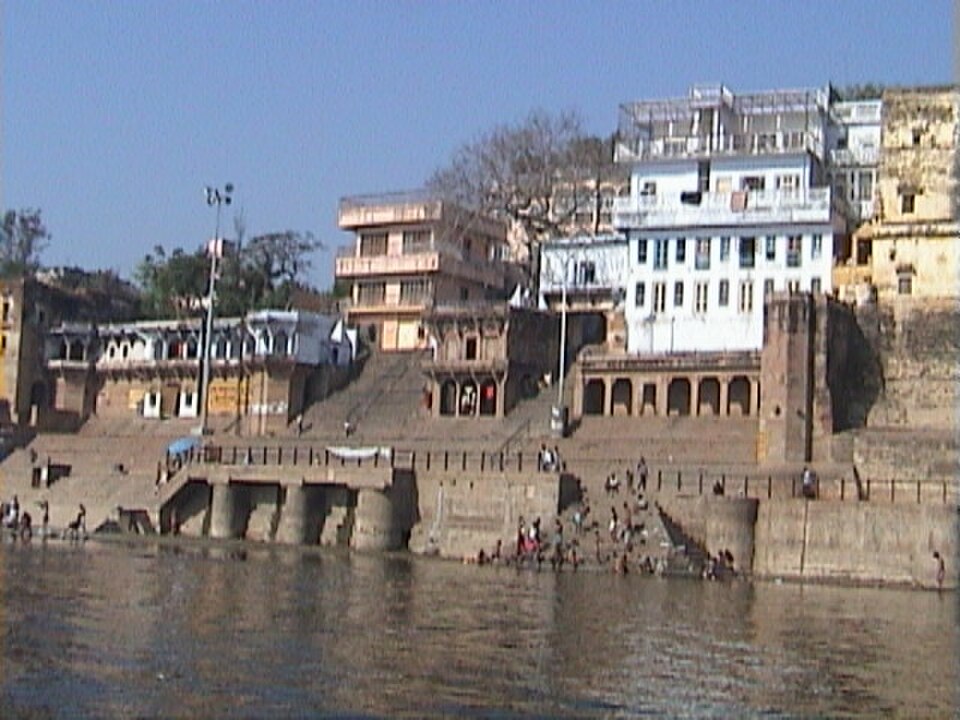
Raja Ghat stands on the northern stretch of Varanasi's famous riverfront, a broad and dignified staircase set into the high bank of the Ganga. It belongs to the long chain of old ghats that runs from the crowded steps of Panchganga toward the northernmost shore of Raj Ghat, and it sits close beside Narad Ghat in the neighbourhood of Bengali Tola. The name Raja means king, and everything about the ghat speaks of a royal past: solid stone steps, an old palace on one side, a temple cloister on the other, and a calm, unhurried character that has survived for nearly three centuries. While the great ghats of the centre of the city draw crowds and cameras, Raja Ghat keeps a quieter, more personal atmosphere, the kind of place where old Kashi piety is still practised without show, and where the river feels close enough to touch.
Local tradition associates the ghat with the royal house of Banaras, and travellers who come here are often struck by its well-kept stonework and its sense of order. The steps are wide and comfortable, built for old feet as much as young ones, and at the water's edge small boats bob gently at their moorings. On most mornings a thin crowd of bathers stands waist-deep in the cold river, murmuring mantras as the sun climbs over the eastern bank, while priests wait beneath umbrellas to mark foreheads with sandalwood paste and collect the modest fees of worship. Sadhus in ochre sit cross-legged on the upper platforms, and women in wet saris wring the water from their clothes with unhurried gestures that have not changed in a hundred generations. The rhythm of the ghat is slow, and that slowness is precisely its charm.
For the visitor, Raja Ghat offers an honest picture of the living riverfront. It is not a spectacle staged for tourists, but a working ghat where faith, commerce and daily life mingle on the same stones. Here one may watch a boatman mend his net, a pandit recite the morning prayers, a widow pour water from a brass pot, and a child dive laughing into the green water — all within a few minutes on the same staircase. The ghat rewards the unhurried traveller, and those who sit a while on its steps often find that the old royal dignity of the place seeps into their own mood, slowing the pulse and deepening the view. It is, in short, a perfect place to begin understanding the quieter half of Kashi, the half that the kings built and the river still rules.
The Name of a King — Raja Ghat and Its Royal Title
The name Raja Ghat is simple and old: raja means king, and the ghat is called the king's staircase because it was raised, improved and protected under royal patronage. In a city where every ghat carries a story, this one wears its title with unusual modesty. Some older residents still call it by a second name, Chauki Ghat, recalling the old river watch-posts, while the records of European travellers preserve yet another identity. The great scholar and antiquarian James Prinsep, who knew Varanasi in the 1820s and 1830s, referred to the ghat as Amrit Rao Ghat, after the exiled Maratha nobleman who rebuilt its steps. It was only later, in the writings of the twentieth-century historian Motichand, that the older and simpler title of Raja Ghat came back into common use, as if the memory of the kings had outlived the fame of their minister.
The royal connection runs deeper than a name. Raja Ghat belonged to the tradition of ghats built by princely houses, who saw the construction of stone stairways as an act of merit and of public duty. A ghat was a gift to the river, to the city and to the pilgrims; kings competed with one another to leave a handsome staircase behind them. Raja Ghat shows every sign of that ambition — broad platforms, carefully dressed stone, buildings of substance — and its position in the northern chain, close to the old palaces and temples of the upper city, places it among the ghats of the nobility rather than the lanes of the common folk. Yet its royal character never made it aloof; the king's ghat was, from the beginning, a public place where every bather stood equal before the river.
What gives the title its living meaning is the way the ghat behaves. A royal ghat in Kashi is expected to be orderly, well kept and generous — and Raja Ghat answers that expectation. Its stone is clean, its temples are tended, its refectory once fed Brahmins, ascetics and students of Sanskrit from the royal kitchens, and its steps have welcomed pilgrims of every caste and condition. The name is thus not a boast but a promise, a reminder that in the old city even the river was approached with the dignity of a court. To stand on Raja Ghat and speak its name is to hear three centuries of Kashi's history in a single word, and to understand why the kings of this city chose the river as the mirror of their glory.
Royal Patronage — The Building of Raja Ghat
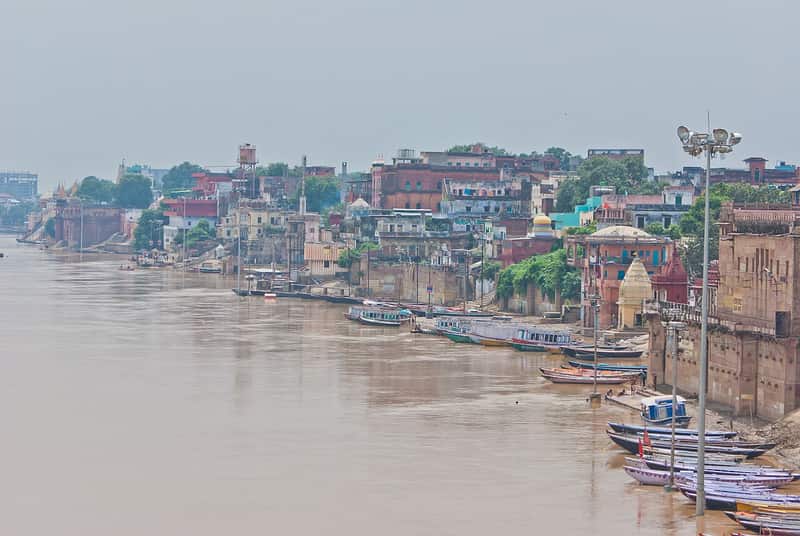
The history of Raja Ghat is written in the stones themselves, and it begins in the early eighteenth century. Around the year 1720 the Maratha nobleman Rajirao Balaji took the old earthen landing on this spot and had it levelled and built up, transforming a muddy bank into a proper ghat of dressed stone. This was an era when Maratha generals and princes were raising great staircases all along the riverfront of Kashi, and Raja Ghat was one of the fruits of that burst of patronage. The rough earth of the past gave way to a handsome construction, and the ghat entered history as a work of royal ambition, worthy of its name.
The ghat's most celebrated chapter came later, with a prince in exile. Between 1780 and 1807 the Peshwa Amrit Rao, driven from power by the British and permitted to live in Varanasi, made this ghat his own. He rebuilt the steps with stone slabs, renovated the neighbouring Prabhas Tirtha in 1780, and raised four temples — Amriteshvara, Vinayakeshvara, Narayaneshvara and Gangeshvara — together with four auxiliary shrines. So thorough was his work that the ghat became known for a time as Amrit Rao Ghat, a name recorded by James Prinsep and echoed by later writers. The temples stand to this day, and their weathered towers still carry the memory of the exiled nobleman who gave the ghat its finished form and made its stone a page of living history.
The story of Raja Ghat is also a story of feeding and learning. A two-storey refectory with a terrace rose beside the steps, reserved in earlier times for Brahmins and those who served the rituals, and the tradition grew of feeding Brahmins, ascetics and the students of the Sanskrit college from the ghat's kitchen. This charitable practice continued into living memory, right up to the year 1980, when the old feeding programme gave way to a new era of cultural activity aimed at welcoming visitors to the ghat. In 1965 the government of Uttar Pradesh rebuilt the stairway once more, adding a fine set of steps in purple stone. Layer upon layer, king after king, the ghat accumulated its history — and every layer is still visible to the eye that knows where to look.
The Morning Bath — Dawn Rituals at Raja Ghat
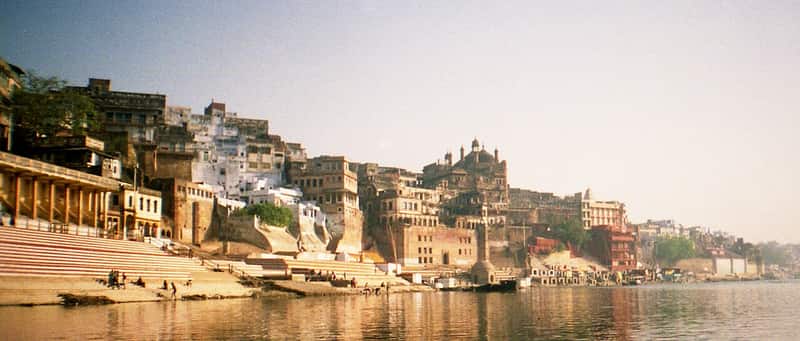
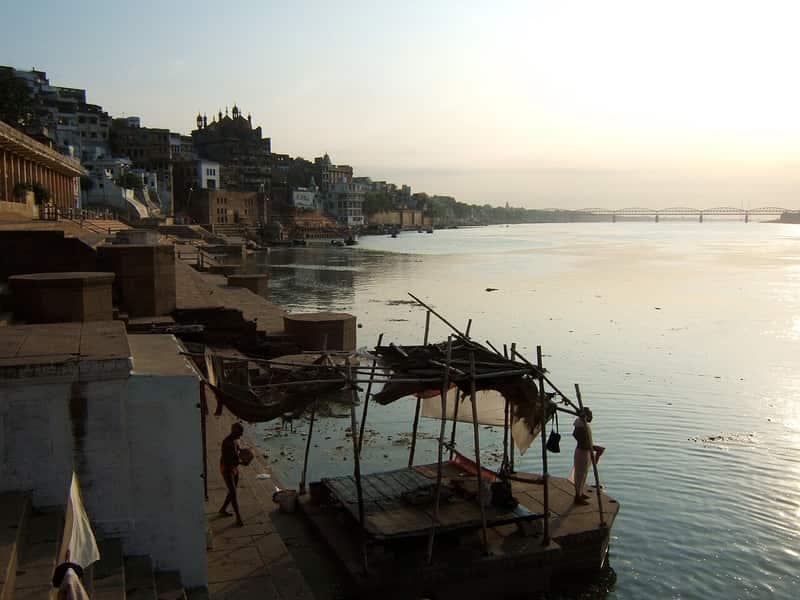
The day at Raja Ghat begins in darkness, long before the sun clears the eastern bank. Bathers arrive through the lanes of Bengali Tola wrapped in shawls against the chill, carrying brass lotas and small cloth bundles of clean clothes. They descend the wide stone steps with the careful tread of the devout, and at the water's edge they pause, fold their palms, and step into the cold green river. The first immersion is a shock of cold that wakes the body and sharpens the mind; then the morning ritual takes over — a mantra murmured with cupped hands, water poured toward the rising sun, three offerings of river water for the ancestors, and a final clean dive that rinses away the night.
By the time the sun lifts over the far shore, the ghat is alive with the quiet commerce of worship. Women in wet saris stand knee-deep, wringing their clothes and exchanging pleasantries; old men float gently with closed eyes; children shiver and laugh as they duck under the water. On the upper platforms, priests have set up their low wooden stalls, and pilgrims climb the wet steps dripping with the morning's merit to have their foreheads marked with red sandalwood paste and their names murmured in a blessing. Some bring flowers, some bring milk, some bring nothing but their faith; the river accepts all equally. The scene is repeated on a hundred ghats of Kashi, yet each one has its own tone — and Raja Ghat's tone is one of unhurried, old-fashioned reverence.
Bathing here is not merely a cleansing of the body; it is an act of renewal performed at a place of old sanctity. The Puranas of Kashi teach that a bath in the Ganga washes away the errors of the past and opens a clean page of life, and for that reason the bathers come with serious faces and hopeful hearts. The cold water, the first light, the chanting of names — all work together to produce the special clarity that pilgrims describe after the morning dip. Many return to the same ghat every day of their lives, and the steps of Raja Ghat are worn smooth by that devotion. To join them at dawn, to feel the river's cold embrace and the sun's first warmth, is to take part in the oldest ritual of this ancient city — a ritual that has been performed here, without interruption, for centuries.
Bathers, Boatmen and Priests — A Day on the Ghat
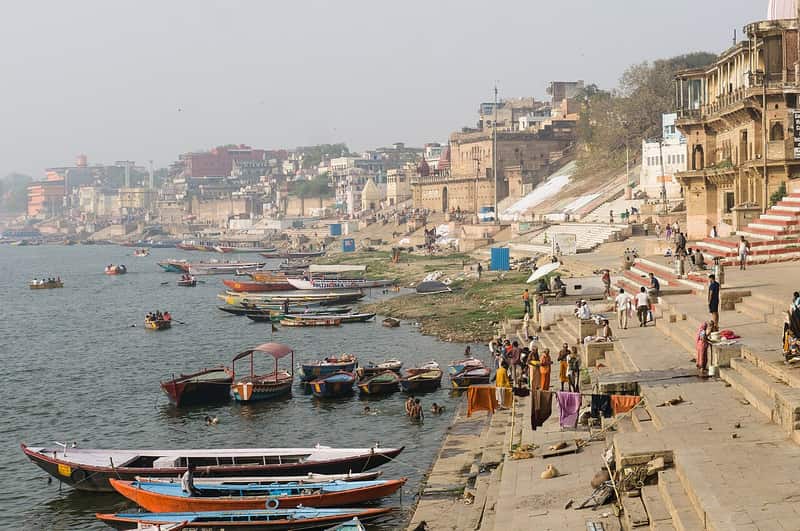
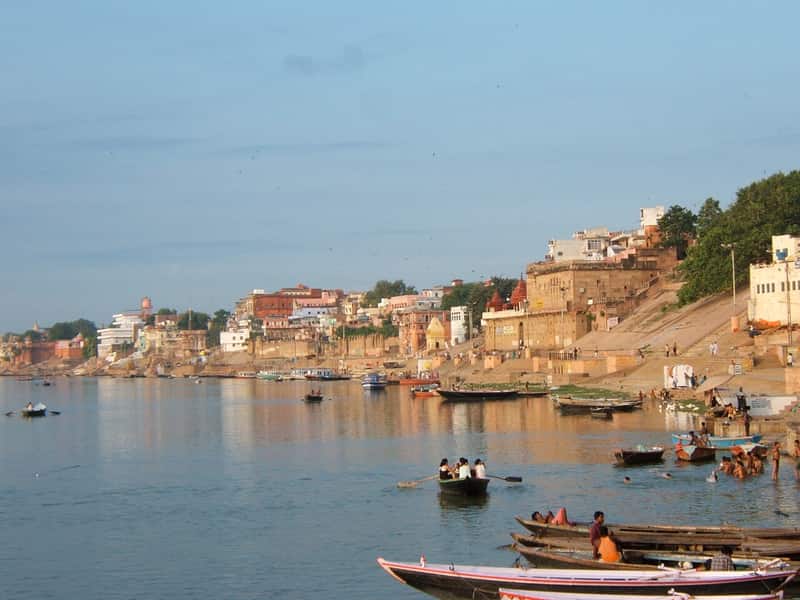
Between dawn and dusk, Raja Ghat lives the ordinary sacred rhythm of the Varanasi riverfront, and its daily cast is as steady as the river. The bathers come first, before the sun is fully up; then the priests settle into their stations; then the boatmen arrive to untie their long wooden boats, check the ropes, and call across the water to one another in the easy dialect of the river. These three communities — the faithful, the learned and the oarsmen — have shared these stones for as long as anyone can remember. The ghat is small enough that everyone knows everyone, and a stranger on the steps is greeted with curiosity but never with pressure.
The boatmen of Raja Ghat are its most visible characters. Some moor their craft here for the day, ferrying pilgrims across to the far bank or south toward the greater ghats; others squat on the gunwales repairing nets or smoking their pipes, their faces as weathered as the river stones. When a group of pilgrims gathers at the water's edge, a quiet negotiation begins — polite, unhurried, settled with a nod — and the boat is launched with a push of the oar. The priests, meanwhile, sit beneath their umbrellas with brass water pots and baskets of marigold, reading aloud or waiting in patient stillness. Between them flows the endless small commerce of the ghat: the milk seller, the flower woman, the boy with a tray of kumkum and betel leaves.
What makes daily life at Raja Ghat so affecting is its continuity. The gestures of the morning — the pouring of water, the marking of foreheads, the launching of boats — are the very gestures that were made on this bank three centuries ago, and the ghat's royal patrons would recognise their staircase at once. Here, time seems to move in a circle rather than a line; the same old man sits in the same corner, the same cow noses among the flower baskets, the same bells ring from the small temples at the top of the steps. For the traveller, this is the real treasure of Raja Ghat: not a monument to be photographed, but a way of life to be watched, and quietly joined.
The River and the View — Ganga at Raja Ghat
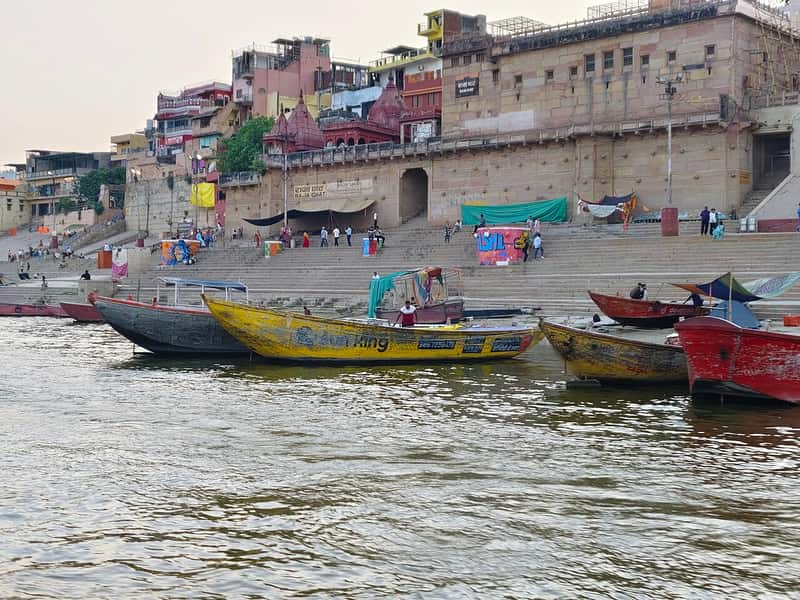
The Ganga at Raja Ghat is the true protagonist of the scene, and the ghat was built to frame her. From the upper platforms the eye travels south along the crescent of the old city's ghats, past the towers of Panchganga and the far-off crowd of Dashashwamedh, while to the north the river widens toward the northernmost shore and the long span of the Malviya Bridge. The water here runs broad and unhurried, carrying the silt of the Himalayas toward the plains, and on its surface move the whole slow traffic of the river — a wooden ferry, a string of passenger boats, a solitary fisherman standing in a flat-bottomed craft, paddling one-handed.
The view changes its character with the hours. At dawn the river is a sheet of rose and silver, with the mist standing in layers over the water and the first boats moving like shadows; at noon it turns to hammered gold, busy with the glare of the sun; at sunset the western bank darkens while the water holds the last light, and the aarti lamps begin to glimmer along the ghats to the south. The fishermen know the river's moods best, reading its currents for the morning catch, while the boatmen read the wind. There is a saying along this bank that the Ganga at Raja Ghat is the same river the kings knew — unchanged in three centuries, and as patient as the stone.
To sit on the steps of Raja Ghat and watch the river is to understand why Varanasi is called the city of light. The water is never still, yet it is never hurried; it reflects every change of the sky while remaining itself; and it receives, day after day, the flowers, the ashes, the prayers and the hopes of millions. From this ghat the river bends gently north, and on a clear evening the lights of boats and ghats string themselves out like a necklace along the water's edge. The traveller who gives the river time here — an hour, a day — will be repaid with the deepest pleasure of Kashi: the slow understanding that the city is a spectator, and the Ganga is the eternal actress.
Stone Steps and Old Structures — The Architecture of Raja Ghat
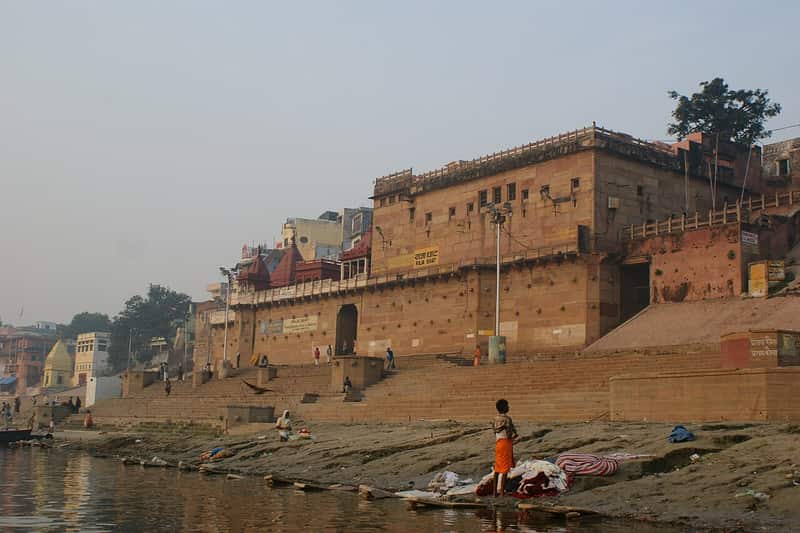
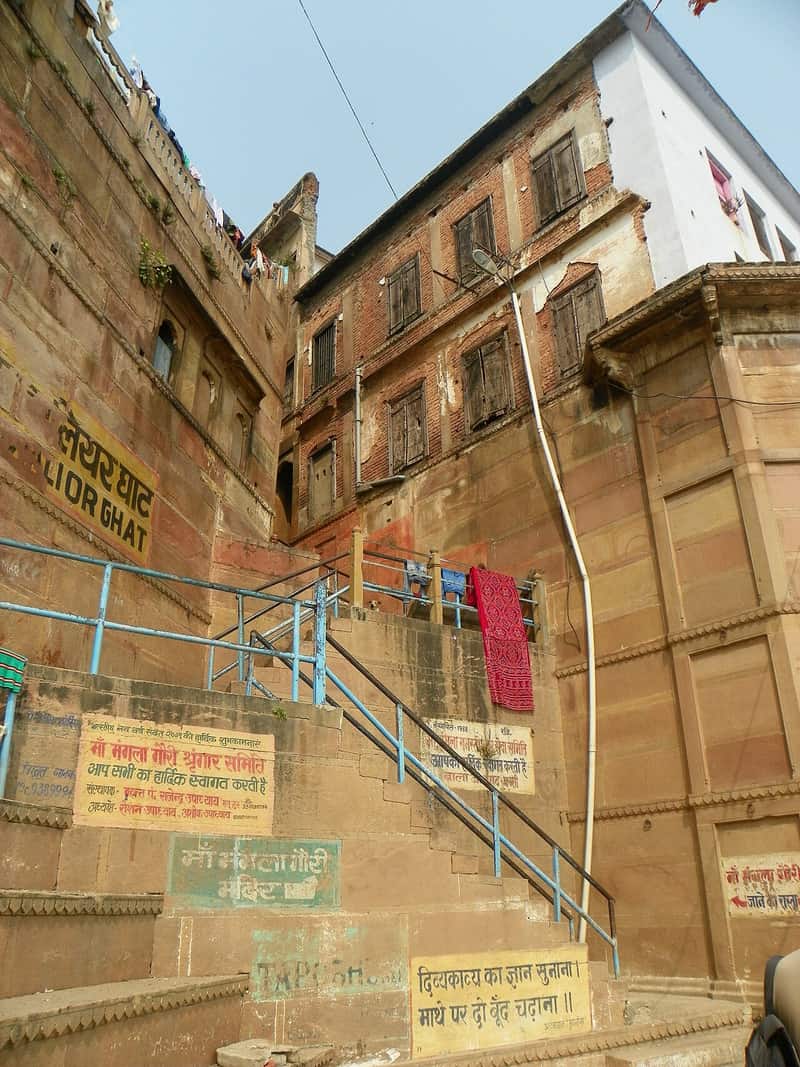
Raja Ghat is built in the solid, no-nonsense style of the old royal ghats, and its architecture tells the story of three centuries of construction. The present stairway, rebuilt in 1965 by the government of Uttar Pradesh, is a fine flight of purple stone that runs from the broad platform above to the water's edge, its steps deep enough to seat a family and worn smooth by the feet of bathers. The colour of the stone is unusual among the ghats of Kashi — a muted violet that glows softly in the low morning light — and it gives the ghat a character all its own. Above the steps, the masonry is massive and fortress-like, with thick walls and wide walking paths that echo the ghat's royal origins.
The ghat is crowned by two great structures that face each other across the stairway. On the northern side stands the old palace, a heavy building of balconies and high rooms whose shutters look out over the river; on the southern side rises the Annapurna Math, the cloister of the goddess of food, with its shrines and courtyards. Between them the stairway descends, dividing the two worlds of the ghat — the temporal and the sacred. The two-storey refectory with its terrace stands in front of the ghat, a building of arches and deep shade that once served as the royal kitchen of charity, feeding Brahmins, ascetics and students from its fire.
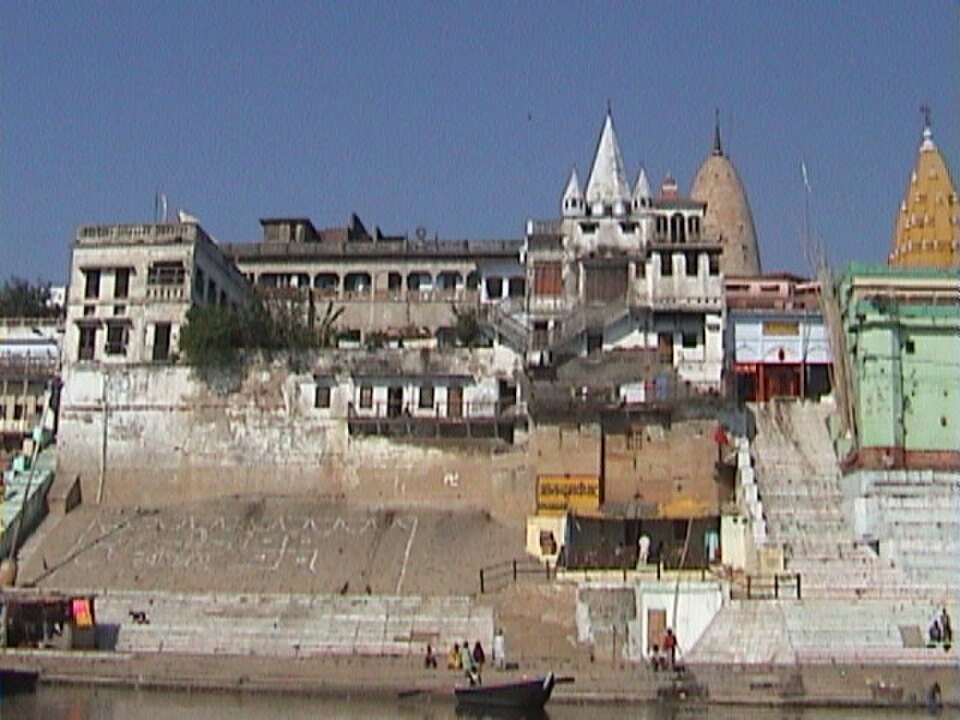
The temples that Amrit Rao raised here in the late eighteenth century complete the architectural picture. Amriteshvara, Vinayakeshvara, Narayaneshvara and Gangeshvara — four shrines dedicated to the old gods of the riverfront — cluster beside the steps with their four auxiliary shrines, their towers modest but gracefully proportioned, their doorways dark with incense smoke. Under the care of the Peshwa Temple Trust, these buildings have come down to the present in good condition, maintained with the same devotion with which they were raised. For the visitor who loves architecture, Raja Ghat is a quiet museum of Kashi's building traditions — royal, charitable and devotional all at once.
The Lanes of Bengali Tola — Around Raja Ghat
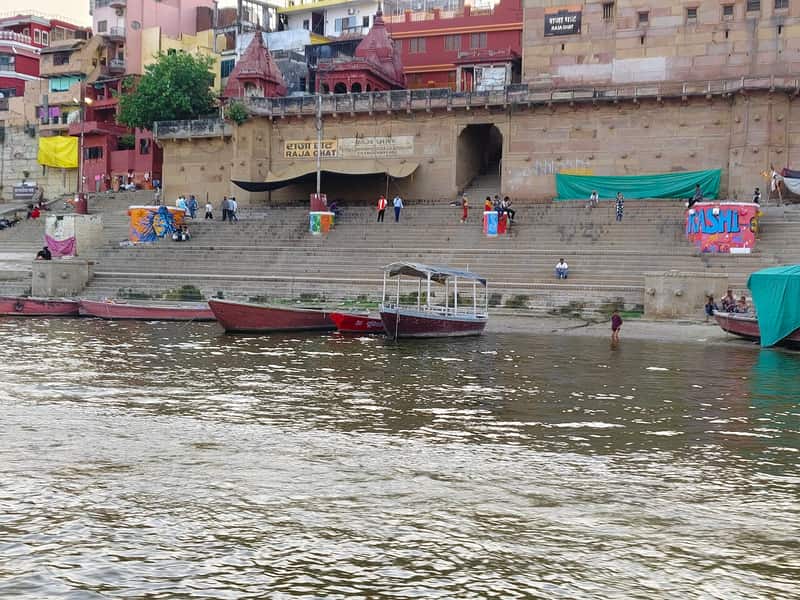
Behind Raja Ghat lies the old quarter of Bengali Tola, one of the most distinctive neighbourhoods of the northern city. Unlike the twisting, shoulder-width lanes that reach most ghats, the way to Raja Ghat is a wide road, broad enough for cars and carts, which makes it one of the most accessible ghats of Varanasi. The approach is lined with houses of brick and stucco, their facades painted in the cheerful colours of the old town, their upper storeys leaning toward each other across the street as if in conversation. Doorways open onto courtyards where women wash vessels and children play; the air carries the smells of frying spices, incense and river damp in equal measure.
Bengali Tola takes its name from the Bengali families who settled here over the centuries, drawn by the sanctity of Kashi, and the quarter still preserves a flavour of its own. Small temples stand at street corners, their bells ringing at every hour; shops sell brass vessels, marigold garlands, betel leaves and the black bangles of old-age mourning; and priests in silk dhotis move between houses carrying the tools of worship. The neighbourhood is a working part of the pilgrim economy, feeding, lodging and clothing the faithful who come to the northern ghats. In the lanes around Raja Ghat one can still hear the old Bengali of the grandmothers mixed with the Hindi of the street, a small reminder of the wide world that Kashi has always drawn to her river.
The life of the neighbourhood is bound to the ghat from morning to night. At dawn the lanes fill with bathers hurrying toward the water; by noon the steps echo with the calls of boatmen and the laughter of children; in the evening the temples glow with lamps and the faithful gather for aarti, the flame passed from hand to hand. The ghat and the mohalla are two halves of one living thing, and the traveller who explores the lanes behind Raja Ghat — past the old wells, the painted doorways, the cat on the wall — will feel the pulse of old Kashi more clearly than in any museum. It is a neighbourhood of quiet faith, unremarkable on the map, unforgettable in the memory.
Narad, Mansarovar and Beyond — The Neighbouring Ghats
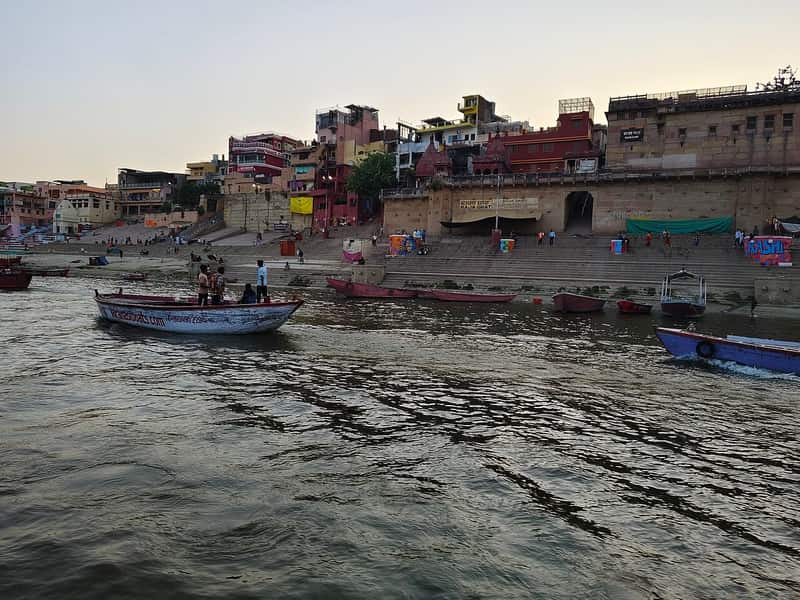
Raja Ghat stands at the heart of a chain of old ghats that the visitor can walk in a single morning. Immediately to its south lies Narad Ghat, a name that brings to mind the wandering sage of the Puranas; it is one of the livelier northern ghats, and local folklore gives it a curious specialty — bathing here is said to help those who wish to be released from unhappy relationships and ill-matched marriages. A little farther south lies Pandey Ghat, and beyond it the long, storied stairway of Panchganga, where five holy rivers are believed to meet. To the north of Raja Ghat the chain continues toward the wide, open shore of Raj Ghat, the northernmost landing of the old city.
Within easy walking distance to the south lies Mansarovar Ghat, another of the royal stairways of the northern riverfront, raised by the same princely energy that built Raja Ghat. Together these ghats form a district of the river where the crowds of the central city thin out and the riverfront takes on a calmer, older character. Here the bathers are mostly residents of the neighbourhood; the priests know their customers by name; and the boats move at a leisurely pace between the landings. Walking from Narad to Raja to Mansarovar, the traveller passes temples, wells, old palaces and painted houses without ever leaving the water's edge — a complete lesson in the architecture of faith.
The northern chain ends at Raj Ghat, below the high walls of the ancient fort, with the Malviya Bridge striding across the river above it and the open countryside on the far bank. Beyond Raj Ghat the city itself fades, and the Ganga runs free toward the north. For the visitor, this whole stretch — from Panchganga in the south to Raj Ghat in the north, with Raja Ghat at its quiet centre — is the best way to see how the old Kashi of the kings differs from the crowded bazaar of the central ghats. The walk is short, the pace is slow, and every step carries three hundred years of history.
Festivals on the Northern Ghats — Celebrations at Raja Ghat
Raja Ghat is not among the great festival stages of Varanasi — the grand aarti of Dashashwamedh does not take place here — but the festivals of the riverfront reach it all the same, and on those days the ghat takes on a festive warmth. Every evening, at the smaller shrines of the ghat and its neighbourhood, the simple aarti is performed: lamps are circled before the deities, bells ring, and the flame is passed to the gathered faithful. On the great festival nights, the same flame multiplies into hundreds, and the steps of Raja Ghat, lit with oil lamps and marigold, glow like a staircase of light descending to the water.
The great bathing festivals belong to this northern stretch as much as to any ghat of Kashi. On Makar Sankranti, when the sun begins its northward journey, bathers crowd the steps of Raja Ghat to take the auspicious dip, and the water's edge becomes a carnival of colour and chant. Kartik Purnima and Dev Deepawali, the festival of the gods' lamps, fall in the month of Kartik, when the whole riverfront — Raja Ghat included — is lined with little clay lamps set afloat on leaf boats, their flames trembling down the river like a moving constellation. On Ganga Dussehra, the day the river is said to have descended from heaven, the faithful gather again for a bath and an offering, and the old royal staircase fills once more.
What the traveller will remember most is the intimacy of the local celebrations. Here there is no vast crowd and no loudspeaker; there is a family bringing a basket of flowers, a priest lighting the evening lamp, a row of women singing as they pour water — small, sincere rituals performed as they have been for centuries. The festivals at Raja Ghat are the festivals of the neighbourhood, and the neighbourhood celebrates with the river as its temple. For the visitor, joining these quiet gatherings — a lamp floated on the dark water, a flower offered to the current — is to touch the true devotional heart of Kashi, far from the spectacle and close to the source.
Conduct on the Sacred Steps — Etiquette at Raja Ghat
Raja Ghat is a living place of worship, and the first rule of the visitor is simple respect. Bathers and worshippers come here for purposes far older than tourism, and the courteous traveller keeps a little distance, lowers the voice, and watches the rituals without intruding. Photography is best kept to the wide steps and open platforms, away from the priests at their work and the families at their prayers; a polite request with a smile will usually earn permission, while an unannounced camera will earn a frown. Dress modestly — shoulders covered, shorts left behind — and remember that the ghat is a home of the devout before it is a sight for visitors.
The small transactions of the ghat deserve the same courtesy. If a priest offers a tilak or a blessing, it is customary to give a modest donation; if a boatman quotes a price, it is fair to negotiate gently and then to honour the agreed sum. Bargaining is part of the river's culture, but hard-hearted haggling over a few rupees is not. Offerings — a handful of flowers, a coin, a diya floated on the water — should be made without fuss, and the water itself must be treated as sacred: nothing is thrown into the Ganga that would offend those who drink and bathe in her. At the cremation ghats downriver the same rule holds even more strictly, and silence is the highest courtesy there.
Finally, the visitor should understand the ghat's rhythm and dress the conduct accordingly. The busiest and most sacred hours are the early morning, when the bathing rites take place, and the evening, when lamps are lit and aarti is performed — these are the hours to be quiet, watchful and unhurried. Midday is the easy hour of the ghat, when the crowd thins and conversation flows. Whatever the hour, a greeting in Hindi — a simple namaste with folded hands — opens every door of this old neighbourhood, and gratitude shown to the boatman, the priest and the flower seller will be remembered long after the visitor has gone. Respect at Raja Ghat is not a rule imposed from outside; it is simply the language the ghat itself speaks.
Reaching Raja Ghat — A Practical Guide for Visitors
Raja Ghat is one of the easiest ghats of Varanasi to reach, thanks to the wide road that runs to its top from the Bengali Tola quarter. A taxi or auto-rickshaw can drop the visitor almost at the head of the steps, a luxury unknown at most of the city's ghats. From the railway station at Varanasi Junction the ghat is roughly four kilometres away; from Dashashwamedh Ghat, the tourist heart of the city, it is a pleasant walk of about twenty minutes along the road, or a short, scenic boat ride down the river. The ghat is open at all hours, with no entry fee, and it is safe to visit both at dawn and after dark, when the lights of the neighbourhood make the riverfront glow.
The best hours for visiting are the early morning and the late afternoon. At dawn the ghat shows its most beautiful face — the rising sun, the bathing rites, the boats moving out on the misty water — and the light is at its softest for photographs. Late afternoon brings the long shadows and the first lamps, and the sunset view toward the southern ghats is among the finest on the northern stretch. Midday is hot and quiet. The months from October to March offer the most comfortable weather, while the great bathing festivals of the winter — Makar Sankranti and Kartik Purnima — bring the ghat alive in a way no other season can.
The visitor should plan the visit as part of a longer riverfront walk. From Raja Ghat one can stroll south to Narad Ghat, Pandey Ghat and Panchganga, or north toward the old fort and Raj Ghat, with the Malviya Bridge looming overhead. A morning boat from Raja Ghat can carry the traveller past the great central ghats — Dashashwamedh, Man Mandir, the burning platforms of Manikarnika — before returning with the current. Carrying water, a hat and modest dress is wise; carrying patience is wiser still. Raja Ghat gives its best to those who sit down, look out at the river, and let three centuries of Kashi speak for themselves.
Raja Ghat — Gallery (12 Photos)
Image Credits
raja-01.jpg · raja-02.jpg · raja-03.jpg · raja-04.jpg · raja-05.jpg · raja-06.jpg · raja-07.jpg · raja-08.jpg · raja-09.jpg · raja-10.jpg · raja-11.jpg · raja-12.jpg — Wikimedia Commons, under free licenses.
Continue exploring
Similar Ghats Nearby
Book This Ghat — Get Notified
Download the app now and book a boat ride to Raja Ghat