

Nand Ghat
Neighbourhood GhatNand Ghat is a small ghat named after Lord Nand.


Type
Neighbourhood Ghat
Boat Fare
1x base fare
Best Time
5-8 AM
History
A small serene ghat for bathing in the north, carrying the joyful meaning of its name (nand — happiness).
Highlights
- Small peaceful ghat
- Local bathing in the north
- Stop near Trilochan
Festivals & Events
How pricing works in the NaviX app
No haggling at the ghat — everything is fixed in the app first
- 1
Fixed price before you board
The fare is shown in the app upfront — no bargaining at the ghat
- 2
Sharing or private — your choice
Share with fellow travelers or take the whole boat for your group
- 3
Pay only after the ride
UPI, card or cash — with an instant receipt
🕉️
Aarti details not available for this ghat yet
Complete Guide
Nand Ghat — The Complete Guide
History, mythology, rites and practical details — everything in depth.
On this page
- 1.Nand Ghat — An Introduction to a Quiet Northern Stretch
- 2.The Name of Nanda — Krishna's Foster Father and the Ghat's Patron
- 3.The Everyday Rhythm of the Ghat
- 4.Morning Bathing on the Simple Steps
- 5.The River Here — Water, Sand and Sky
- 6.Lanes and Mohalla — Life Behind the Ghat
- 7.Neighbouring Ghats — Telianala and the Northern Chain
- 8.Quiet and Unassuming — The Atmosphere of Nand
- 9.Everyday Piety at the Waterline
- 10.Festivals of the Quarter — Celebrations by the Water
- 11.Conduct at Nand Ghat — Respecting a Living Place
- 12.Reaching Nand Ghat — A Practical Guide
📅 Updated: 21 Aug 2026 · Author: NaviX Field Team (field research 2024-26) · 12 sections · 12 photos
Nand Ghat — An Introduction to a Quiet Northern Stretch
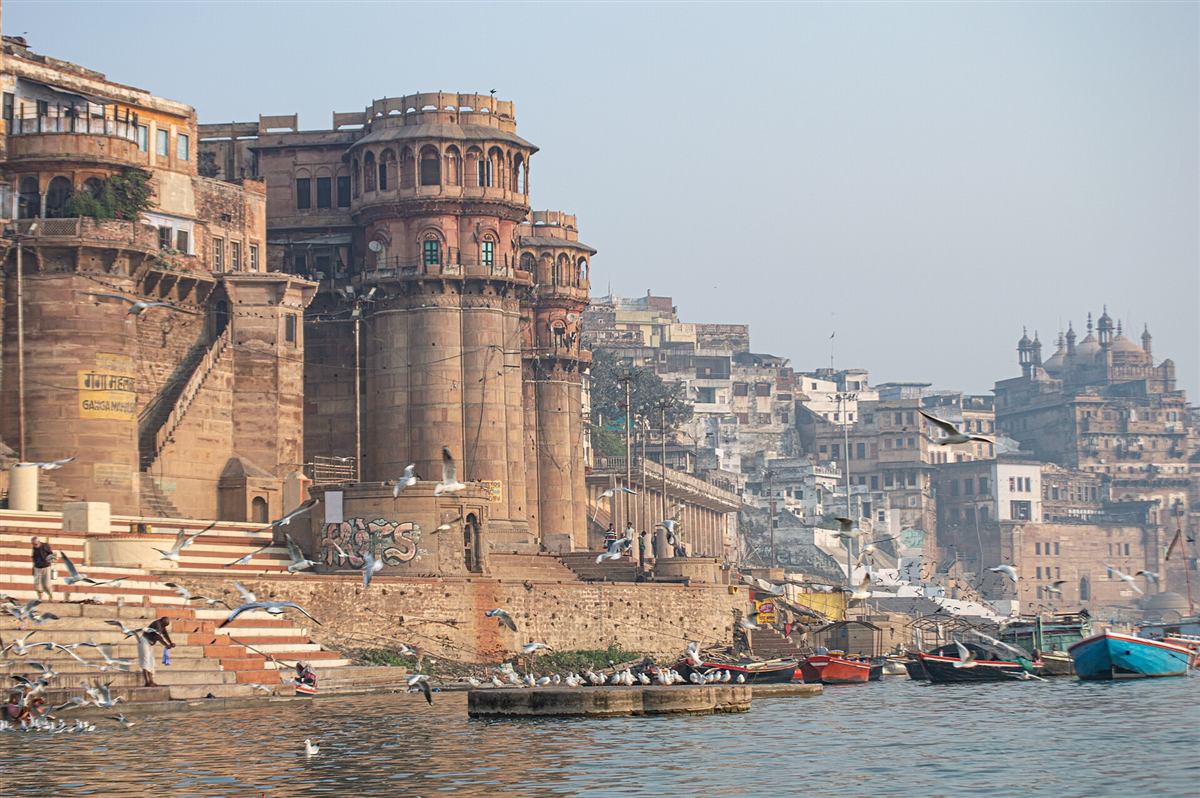
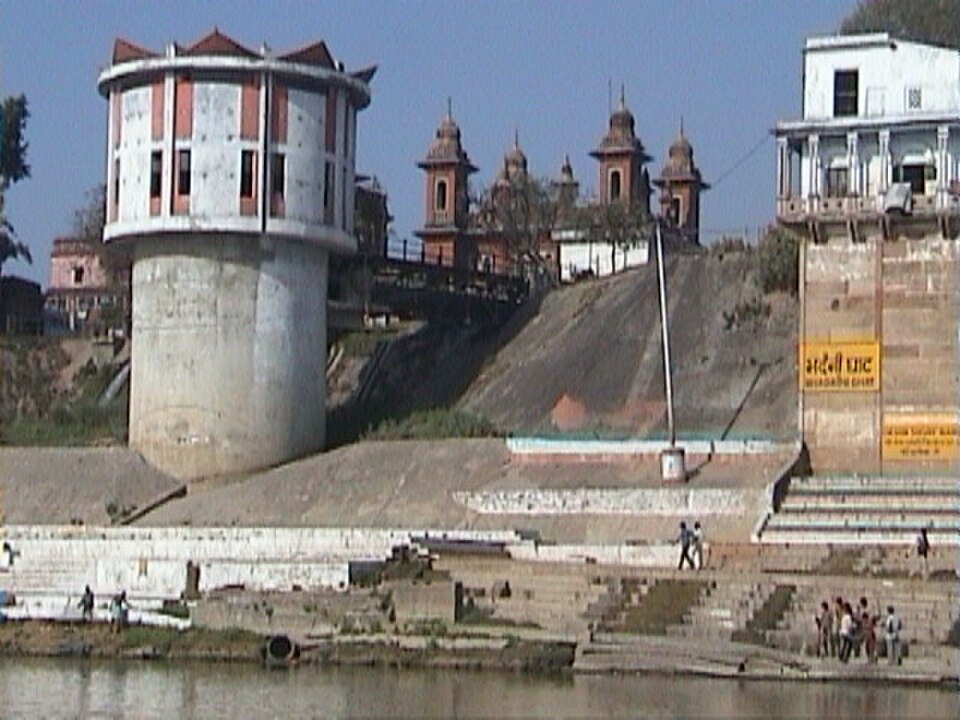
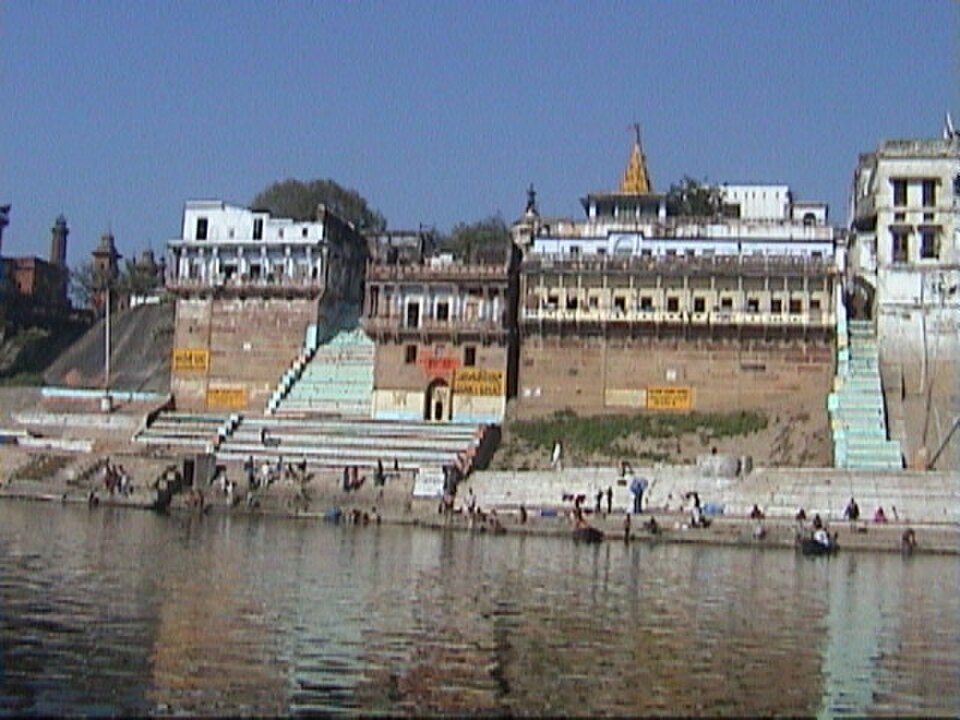
Nand Ghat is one of the smallest and quietest ghats of Varanasi, a modest spread of stone steps on the northern stretch of the riverfront, where the great staircase of the old city begins to thin into a chain of humble bathing places. It has no palace rising behind it, no famous shrine on its platform and no crowd pressing at its waterline. It is simply a ghat — a place where the Ganga meets the land and where the people of the neighbourhood come, as their ancestors did, to fill their pots, wash their clothes and offer the first prayers of the day. That plainness is precisely its virtue. In a city of astonishing monuments, Nand Ghat asks to be felt rather than photographed, and visitors who arrive expecting spectacle will find instead a quiet hour of ordinary river life.
The name of the ghat is its first small mystery. Some say it remembers Nanda, the cowherd king of Gokul and the foster father of Krishna, whose pastoral kingdom of milk and meadows is beloved across northern India; others say it came from a local family that once held this stretch of riverbank and built its steps. Either way, the name has the flavour of the countryside — frank, simple and without pretension. The ghat itself belongs to the chain of small bathing places that runs beyond the old fort at the northern end of the crescent, in the neighbourhood of Telianala Ghat, whose name recalls the oil pressers of the quarter. Few of these ghats have grand histories; their story is the ordinary story of Kashi, lived daily at the water's edge.
For the traveller, Nand Ghat offers something that the famous ghats of the centre cannot: anonymity and calm. Here there are no touts, no boatmen crying for custom at every step and no long lens of the world pressing in. The bathers are neighbours, the boatmen are men going about their trade, and the river flows past exactly as it has for thousands of years. To stand on these steps at dawn, when the water is the colour of old bronze and the first boat pushes out from the sand, is to see the real Kashi — a city of working people, of quiet faith and of a river that has always been more generous than it has been given credit for. This guide walks the length of the ghat, from its name and its daily life to the lanes behind and the festivals that light it once a year.
The Name of Nanda — Krishna's Foster Father and the Ghat's Patron
The most charming of the traditions attached to Nand Ghat links its name to Nanda Maharaj, the cowherd king of Gokul and the foster father of Krishna, the central figure of the Bhagavata Purana. In the great story of Krishna's childhood, Nanda and his wife Yashoda raised the infant god in a village of dairymen — a world of butter churns, cowherd girls, grazing herds and playful miracles — and the love of the simple foster parents became, in devotional poetry, a symbol of the purest form of devotion: uncalculating, tender and complete. Across the north of India, Nanda is remembered with affection wherever Krishna is loved, and in the lanes of Varanasi the two names are never far apart.
Some local accounts, however, give the ghat a more recent and more humble naming, remembering a family called Nand who owned this stretch of the riverbank and built its simple steps. Such family names are common along the northern ghats, where the grand donors of the centre gave way to merchants, pandits and householders of the quarter. The two explanations need not quarrel; both agree that the ghat is a neighbourly place, named after love rather than power. What matters for the visitor is that the name carries a pastoral innocence — Nanda, the lord of cows, the village patriarch, the man who raised the god of the world as his own son — and that innocence is still visible in the unhurried, unpretentious character of the ghat itself.
Every year the connection returns in festival form. On Janmashtami, when the city keeps the midnight vigil of Krishna's birth, the lanes of the northern quarter remember the ghat's namesake; and on the following day, in the celebration called Nandotsava, the joy of Nanda Maharaj is honoured in homes across Kashi with music and sweets. It is a small, local thing — not one of the great spectacles of the city — and that is exactly right for a ghat whose character is modest. Standing on the steps and repeating the name, Nand, one can almost hear the cowbells of Gokul at the water's edge, a legend worn soft by a thousand years of telling.
The Everyday Rhythm of the Ghat
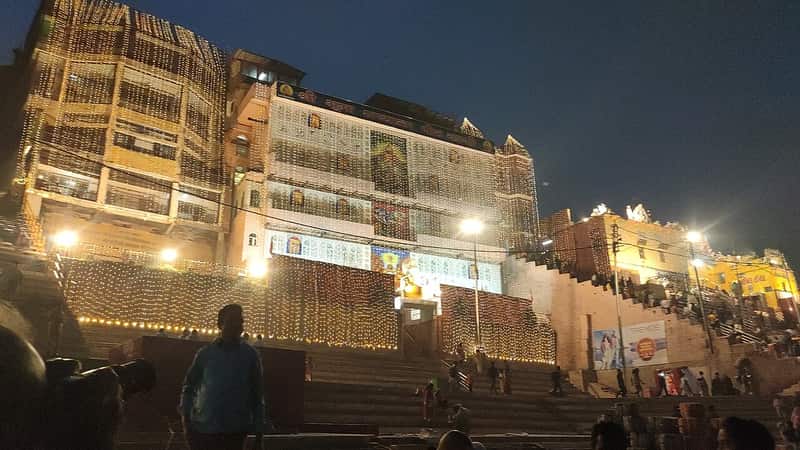
The true life of Nand Ghat is the life of the waterline, and it begins before sunrise. The first figures appear in the half-light: women from the lanes behind carrying brass pots and buckets, their saris hitched above the knee, kneeling at the edge to fill them for the day's chores; a boatman untying his craft and poling out into the current to fetch passengers from the far sandbank; two washermen slapping wet cloth against the stone steps; a straggle of bathers shivering at the water's edge before the first immersion. There is no announcement and no audience. The day simply begins, as it has begun here for centuries, with the sound of water poured from one vessel into another.
Through the morning the ghat keeps a slow, steady rhythm. Milk arrives in canisters on bicycles from the lanes; fish sellers from the northern villages lay out their catch on palm leaves; children are bathed at the steps and dried with rough towels before school; the barber sets up his mirror against a pillar; old men settle on the upper steps to talk, their voices rising and falling with the arguments of the quarter. The boats come and go all day — small, blunt-nosed craft that carry people, grain, fodder and sometimes a bicycle across the wide river. Nothing here is staged for the visitor; everyone is simply doing what the river and the day require.
Perhaps the most striking thing about daily life at Nand Ghat is how little it has changed. The vessels are plastic or steel now instead of brass, the milk comes in cans instead of clay pots, but the gestures are ancient: the tilt of a pot to take clean water, the careful wringing of a wet sari, the way a boatman stands and pushes his long pole against the riverbed. Visitors who sit quietly on these steps for an hour come away with a picture of Varanasi that no temple tour can give — the city as a working household, with the Ganga as its well, its laundry and its highway, and ordinary people performing, without thought of performance, the oldest rituals of daily life.
Morning Bathing on the Simple Steps
Morning bathing at Nand Ghat is a quiet, functional affair. The bathers arrive as the sky lightens — men first, wrapped in towels, then women in wet sarees who keep to one side of the steps, then children dragged by their mothers for the day's first immersion. There is none of the theatrical chanting of the big ghats; here the ritual is performed with economy and familiarity, as one might greet an old neighbour. The bather cups the water, pours it over the crown of the head, dips three times facing the rising sun, and murmurs the small prayers that were taught in childhood. Some bring a copper lota filled from the sacred stream; others simply let the river do the work.
What the bathing scene at Nand lacks in spectacle it makes up in sincerity. Old women who cannot swim stand chest-deep and pour jug after jug of water over their heads; a young man practises his strokes far from the shore, watched indulgently by the boatmen; a grandfather shaves at the water's edge, using the river for a mirror; and the priests of the small shrines nearby come down for their own ablutions, undistinguished among the crowd. The steps, wet and soapy in places, are scrubbed down by the dhobi later in the morning. No one hurries anyone, and no one lingers longer than needed; the waterline has its own gentle traffic discipline, and it works perfectly without a word spoken.
For the visitor, the invitation of the morning waterline is a modest one: to bathe, if you wish, in a way that disturbs no one. The etiquette is simple — ask before using the washing steps, keep your distance from those praying, and remember that the river is also the neighbourhood's water source. Those who prefer to watch will find the scene endlessly absorbing, for in the half-hour after sunrise the whole neighbourhood passes through the ghat: the young and the old, the healthy and the frail, the devout and the merely sleepy. Bathing at Nand Ghat is not an event; it is the plainest, most honest form of the city's oldest habit — beginning the day in the Ganga.
The River Here — Water, Sand and Sky
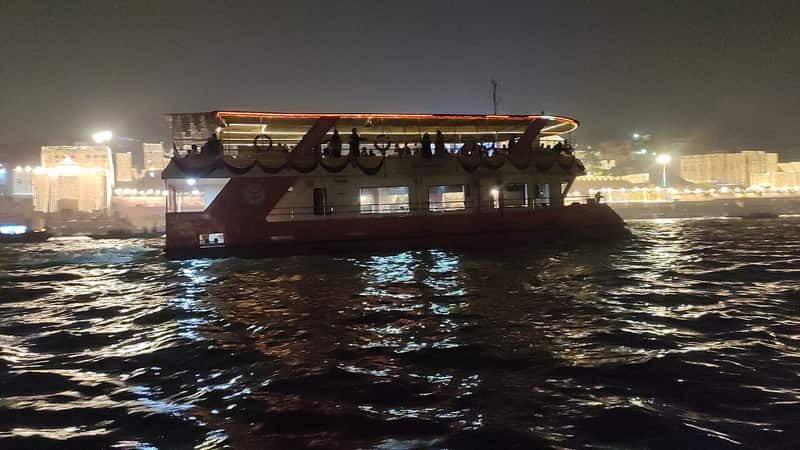
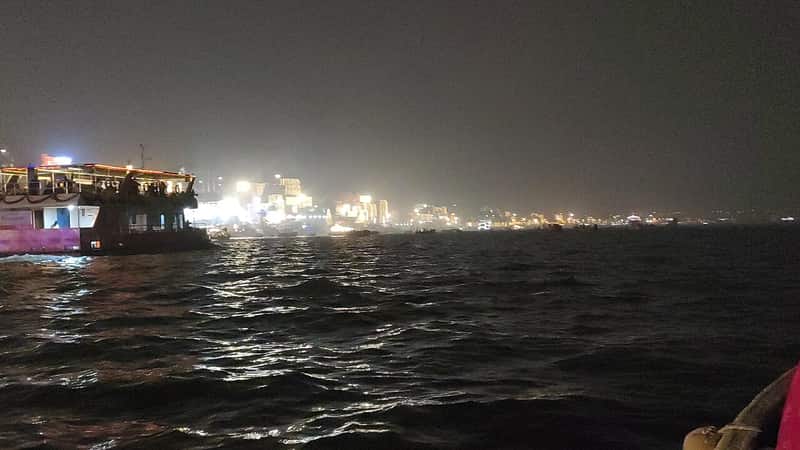
The Ganga at Nand Ghat is wide, slow and serene. In this northern stretch the river slides past the city in a great easterly curve, carrying the water of the Himalayas on a journey of more than two thousand kilometres, and here it shows a face quite different from the hurrying current near the central ghats. The water is a deep green-grey in the morning light, turning bronze at sunset; the far bank is a long strip of golden sand, with villages and cottonwood trees half-lost in haze. Between the two shores move the boats — ferries crossing with passengers, fishermen setting their lines, sand barges drifting south — and beyond them, on clear days, the towers of Ramnagar rise above the eastern bank.
The river's moods at Nand follow the seasons with a calendar older than any written one. In the dry months the water withdraws to a narrow channel, and the great sandbanks become fields of melons and grazing grounds for cattle, crossed by footpaths and bicycle tracks. Then, when the monsoon swells in July and August, the river rises to swallow the lower steps — bathers move up, boats are hauled to higher moorings, and the water turns a swift, muddy brown, carrying whole trees past the ghat. Fishermen know these moods better than anyone; they read the current as other men read books, and their nets are set and lifted according to the river's own changing whims.
To stand at the waterline of Nand Ghat and look across is to sense the scale of the river's life. It is not the Ganga of the hymns — that sacredness exists, but here it is worn lightly, without ceremony. The river is also a working waterway: the ferrymen's shouts, the slap of oars, the lowing of cattle on the sandbar and the far whistle of a train crossing the bridge are the sounds of this stretch. Morning mist, winter sun, monsoon rain — the ghat receives them all with the same flat stone patience. For the visitor, the river here is best appreciated slowly, as the boatmen appreciate it: not as a sight to be consumed, but as a companion that has seen everything and asks nothing.
Lanes and Mohalla — Life Behind the Ghat
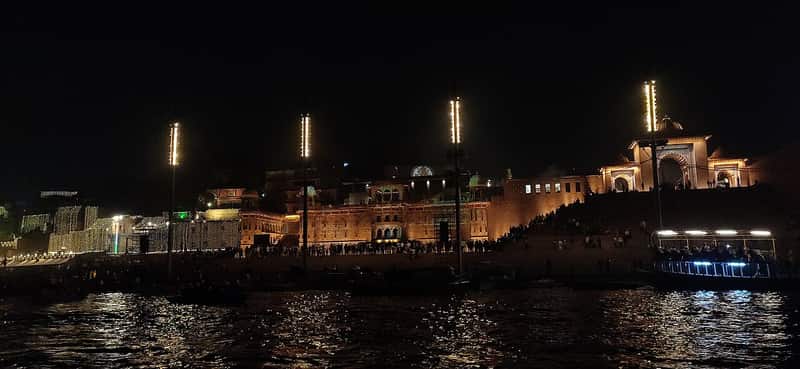
Behind Nand Ghat, the city rises in a huddle of narrow lanes that have the feel of a village pressed against the river. Brick houses with carved balconies lean toward each other across the passages; brass pots hang in doorways; electricity cables loop overhead like vines; and the smell of cooking oil, incense and wet lime drifts from the thresholds. This is a working neighbourhood — traders, boatmen, priests, washermen, petty shopkeepers — whose streets are a maze of small businesses: a bicycle repair shop no bigger than a cupboard, a pan shop with its brass paan box, a tea stall where the entire quarter seems to gather at seven in the morning.
The mohalla has the deep, unshakeable rootedness of old Kashi. Many families here have lived in the same houses for generations, and the lane itself is an extension of their homes: children play cricket against the walls, women sit on the thresholds shelling peas, old men play cards on a wooden board propped on stools. The neighbourhood is threaded with small shrines — a peepal tree with a trident painted on its trunk, a roadside Hanuman with a smear of vermilion, a Shiva lingam in a niche no bigger than a window. The ghat is the front yard of this settlement: it is where the lane ends, where the water begins, and where the whole quarter washes, prays and does business.
For the visitor, the lanes behind Nand Ghat are worth at least as much time as the steps themselves. A slow walk through the quarter reveals the texture of a Kashi that the central ghats have long outgrown: quiet courtyards with wells, sweet shops whose recipes are a century old, a small Sanskrit pathshala whose students chant in the afternoon, and doorways so narrow that furniture must be carried up through the windows. The neighbourhood is not arranged for tourists, and that is its gift. Smile, nod, let the children stare, buy a cup of tea from the stall where the boatmen drink — and the mohalla will open itself to you the way it opens every morning, slowly and without suspicion.
Neighbouring Ghats — Telianala and the Northern Chain
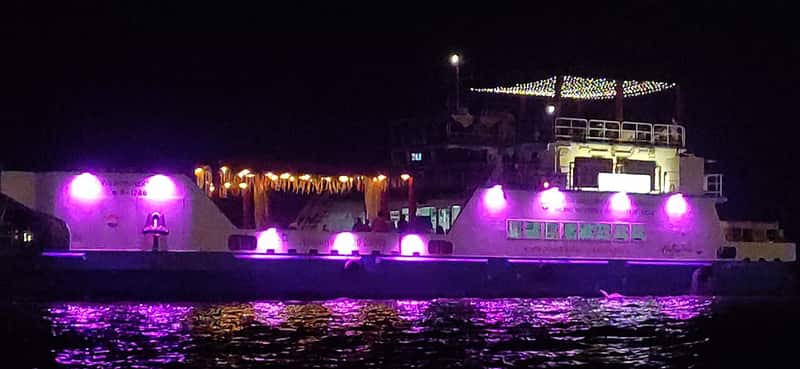
Nand Ghat belongs to the northernmost cluster of Varanasi's riverfront, a chain of small ghats that stretches beyond the old fort and the great bridge toward the open countryside. A short walk to the north lies Telianala Ghat, whose name preserves the memory of the oil pressers — teli — who once worked their mills along the little stream, the nala, that came down to the river here. Between and around them are other modest ghats of the same family, each with its own small community of bathers and boatmen, and together they form a necklace of plain, unpretentious steps that most visitors to the city never reach.
To the south, the walk along the water brings you back into the heart of old Kashi: past the massive ramparts of the fort at Raj Ghat, past the ghats named after families and guilds, and eventually to the great staircase of the central riverfront, with its crowds, its boats and its famous ceremonies. The contrast is instructive. Where the central ghats are theatre, the northern chain is conversation; where Dashashwamedh shouts, Nand murmurs. And across the water, on the far bank, the sandbars and villages of the eastern shore begin — the Ramnagar side, with its fort and its elephants — reachable from these northern ghats by a short, quiet ferry crossing that many travellers miss.
For anyone exploring the ghats seriously, the northern chain rewards patience. A morning spent walking from Raj Ghat to Telianala and beyond yields a portrait of Varanasi that no guidebook photograph captures: washermen's lines drying on every third step, boatyards where hulls are repaired with patient skill, small shrines squeezed between houses, and the whole rhythm of a river culture that the central ghats have turned into performance. Nand Ghat sits in the middle of this chain as a perfect resting point — close enough to the city's monuments to be reached in a half-hour walk, and far enough away to feel like another world. From here, the traveller may go north to the quiet water or south to the crowds, carrying the silence of Nand in memory either way.
Quiet and Unassuming — The Atmosphere of Nand
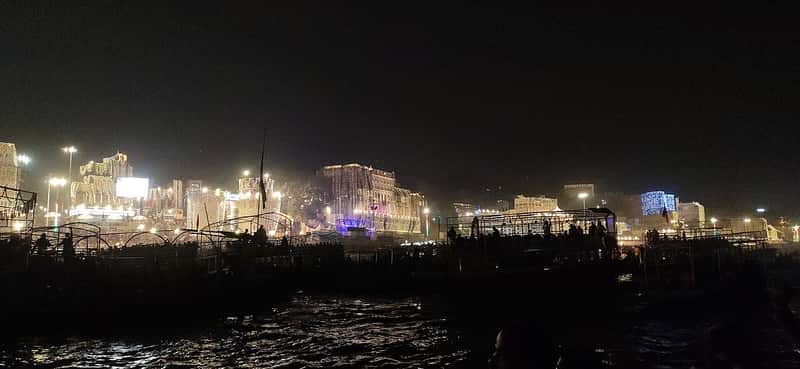
The atmosphere of Nand Ghat is best described by its negatives: not crowded, not noisy, not performed, not hurried. Where Dashashwamedh and Manikarnika press upon the senses with drums, bells, incense and the endless commerce of pilgrimage, Nand simply rests in the morning sun. The loudest sound is usually the water itself — a gentle lap against the steps, the creak of a rope, the hollow knock of a boat against its mooring. Voices carry but do not shout; a child's laugh rings clear across the water; temple bells drift from the lanes behind, softened by distance into a kind of music.
This quiet is not emptiness. It is the natural volume of a place that belongs to its residents rather than to the world, and it has a peculiar effect on visitors: people speak more softly here, walk more slowly, sit longer. The ghat seems to slow time down, as the old riverside places do, until an hour stretches like a whole morning. The boatmen doze on their boats with the casual authority of men who own their hours; the bathers perform their ablutions without haste; even the monkeys on the upper wall seem less frantic than their kin in the centre. The pressure of the famous city falls away, and what remains is river, stone, sky and people — in proportion, in balance.
For those who love Varanasi, Nand Ghat is one of the places that keeps the city honest. It is easy, at the grand ghats, to forget that Kashi is also a neighbourhood — a place where people live full lives beside the holiest river in the world, with debts and fevers, weddings and quarrels, and the ordinary texture of human days. The atmosphere of Nand Ghat restores that texture. A traveller who comes here at dusk, when the light turns amber and the waterline grows dark and quiet, may find themselves unwilling to leave — not because anything is happening, but precisely because nothing is, and the silence of the ghat has become, for a moment, the rarest luxury in the city.
Everyday Piety at the Waterline
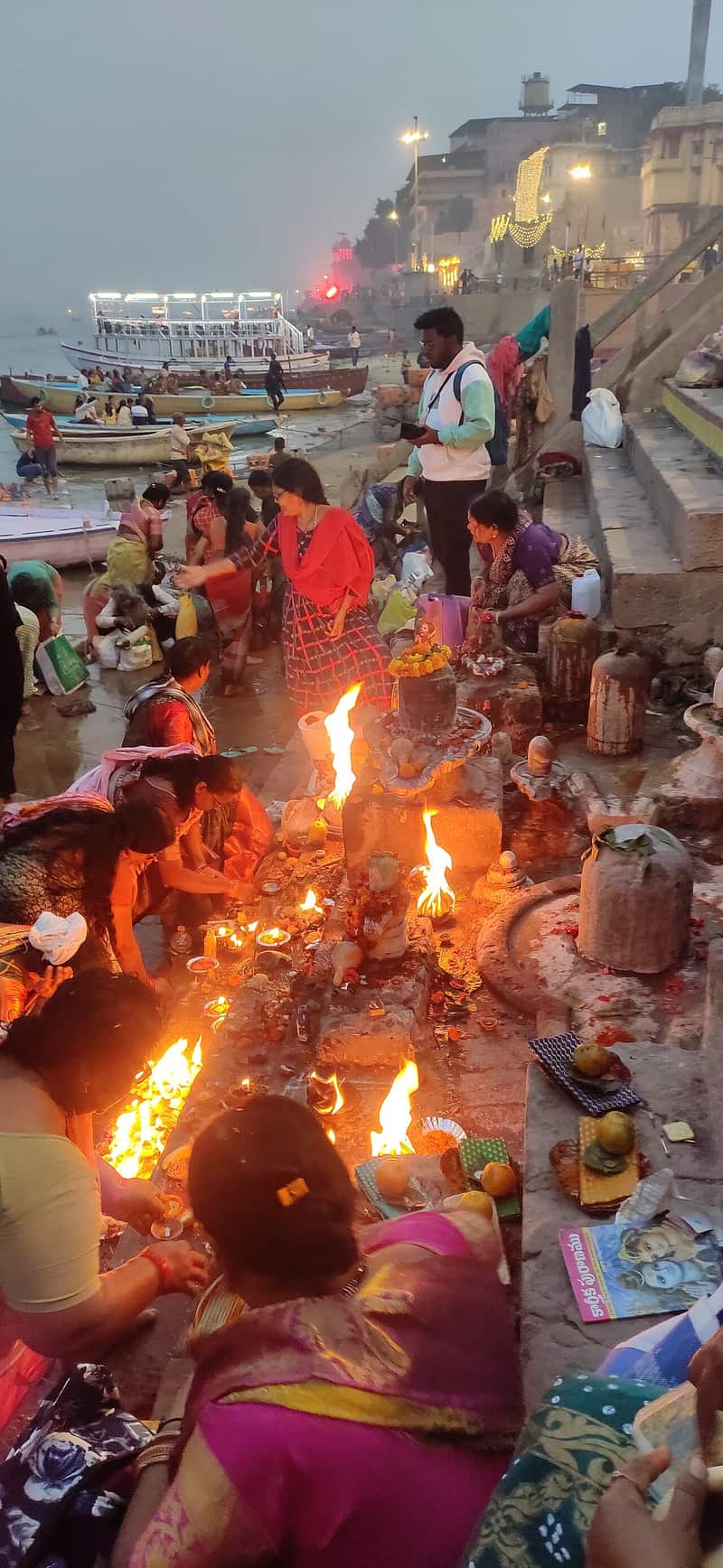
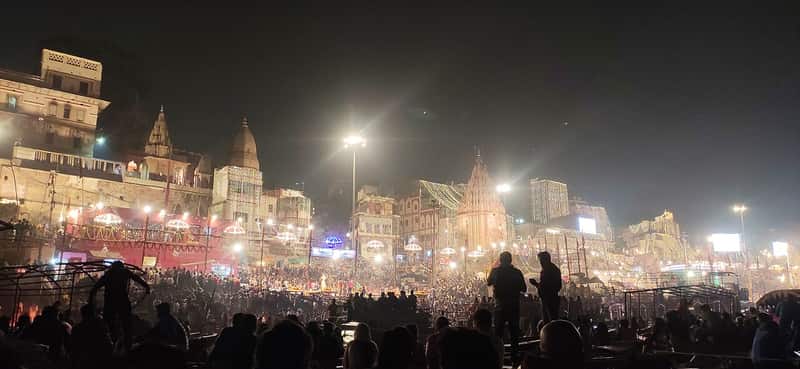
Devotion at Nand Ghat is not a spectacle; it is a habit, worn smooth as an old brass handle. The morning begins with small acts: a man pours a lota of water at the base of a roadside shrine as he passes, barely breaking stride; an old woman feeds crumbs to the pigeons on the upper steps and murmurs the name of the goddess; a boatman touches his forehead to the prow of his boat before poling out into the river. There is a small shrine on the ghat itself, a humble niche with a lingam and a painted image, where the neighbourhood's devotees stop on their way to the water. Nobody performs for anyone; the prayers are short, private and completely sincere.
The river itself is the great temple here, and the forms of worship reflect it. Bathers offer the water back to the sun, pouring it toward the east as the first light breaks; some release tiny leaf boats bearing a flower and a flame; others stand waist-deep, eyes closed, letting the current pull at them as if the river itself were praying. The tulsi plants in clay pots on the upper steps are watered every morning like children, and marigold petals, sprinkled by women at the waterline, drift slowly past the boats. On festival days the shrines of the quarter are dressed in fresh cloth, but on ordinary days the devotion is quieter — a touch of the hand, a bow of the head, a word spoken to the water.
What strikes the visitor is how private this all is. In a city where religion is often performed in public and at volume, the piety of Nand Ghat is a household matter — the same faith that fills the great ghats, but folded into the rhythms of work and rest. The washerman says a prayer as he wrings his cloth; the fishwife offers the first catch of the day back to the river; the child who learns to swim is dedicated to the goddess in a tiny ceremony by the water. This is the deep, unphotographed devotion of Kashi, the faith that keeps the city alive behind the scenes. At Nand Ghat it asks nothing of the visitor except to be left in peace, and that, in its own way, is the truest sight the ghat has to offer.
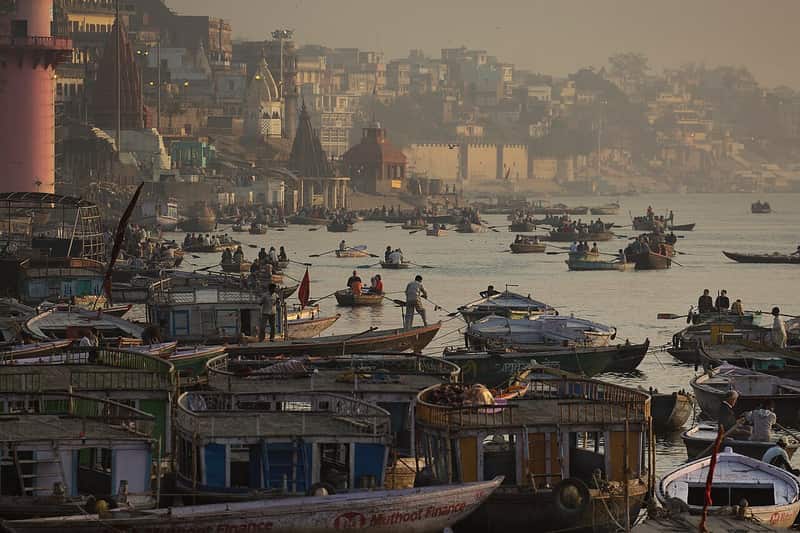
Festivals of the Quarter — Celebrations by the Water
Most days Nand Ghat is quiet, but the festivals of the quarter find their way to the waterline like the neighbourhood itself — in families, in colours, in food. Janmashtami, the birthday of Krishna, is the natural centre of the ghat's year, for the name of Nanda belongs to that story; the lanes behind fill with kirtan in the evening, and small tableaux of the infant Krishna in his cradle are set up in the courtyards. The day after, Nandotsava, celebrates the joy of the foster father, and sweets are distributed among the children of the mohalla with a generosity that would please the cowherd king himself. For these two days the ghat is visited by families who bathe and pray together, then return to the lanes for music and feasting.
Other festivals touch the ghat more lightly. On Nag Panchami, clay snakes are set out on the steps and worshipped with milk, a rite older than the city itself. Kartik Purnima brings the year's largest bathing day, when the full moon of late autumn draws crowds even to the northern ghats, and the waterline glows with thousands of tiny lamps set adrift in honour of the river. Ganga Dussehra, in early summer, marks the river's descent from heaven, and the faithful line the steps with offerings of fruit and flowers. And in the autumn, the neighbourhood's Durga Puja is celebrated with pandals and processions that spill down to the ghat, colouring the quiet waterline with drumbeats and laughter.
Most enchanting of all are the private festivals that never reach the guidebooks: a family's annual rite at the water's edge, the thread ceremony of a young boy conducted at dawn, a baby's first immersion, the shraddha of an ancestor honoured with sesame and rice offered to the current. The ghat receives these with the same even temper with which it receives the days. For the visitor, the lesson of festival time at Nand Ghat is to be present without intruding — to watch the celebrations with the warmth of a guest, to respect the sacred moments, and to understand that here, as in the whole of Kashi, worship is not a show for the traveller but the very pulse of the community's life.
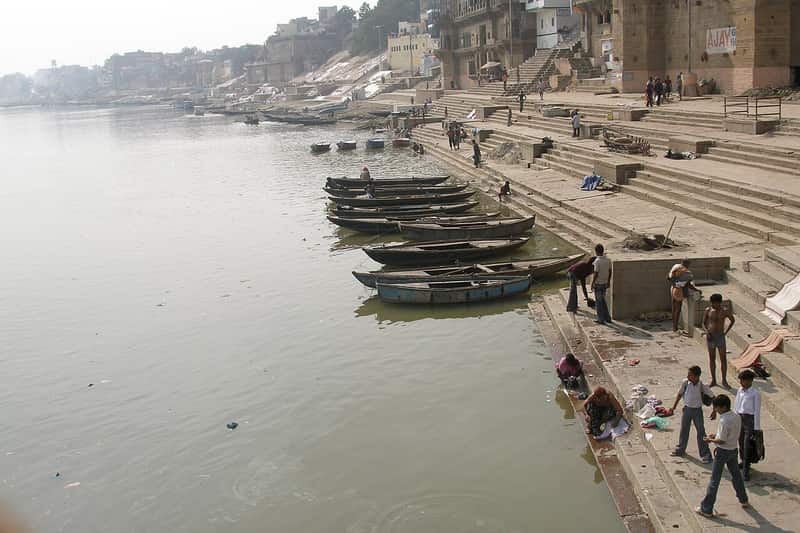
Conduct at Nand Ghat — Respecting a Living Place
Nand Ghat is a living place of work and worship, and the first rule of good conduct is to remember that. Treat the steps as you would the front yard of a home: keep your voice low, keep the space clean, and never leave anything behind — plastic, wrappers, even flowers belong in the bins or in your own hands. Do not bathe with soap or shampoo at the points where people fill their drinking and cooking water, and remember that the river is both a temple and a water supply. Photography deserves particular care: ask before pointing a camera at anyone, and never photograph a person in the middle of bathing, praying or mourning.
The waterline has its own manners. Those who pray do so with their backs to the crowd and should be given space; children playing in the shallows are best watched at a distance; and the washing steps, where the dhobis work, are not for tourists to rinse their feet. Boats at the moorings belong to working boatmen — never untie one, and bargain before you board, not after. The monkeys, the cows, the dogs of the ghat are part of the scene: do not feed them, and do not touch them, however charming they seem. Above all, move slowly. The whole character of the ghat is unhurried, and a visitor who rushes through it will see nothing but their own haste.
The deeper courtesy is one of attention. The people of Nand Ghat are neither actors nor exhibits; they are householders and workers who will welcome a respectful stranger warmly, offer tea, even invite you into the lanes. Accept their hospitality with grace, but do not presume on it — buy from the local stalls, hire the local boats, and let your presence add to the life of the ghat rather than consume it. And when the boatman asks a price that seems high, remember that these are not wealthy people and their river has grown crowded with visitors who sometimes forget. Patience, kindness and a soft voice will open more doors in the northern ghats than any amount of money.
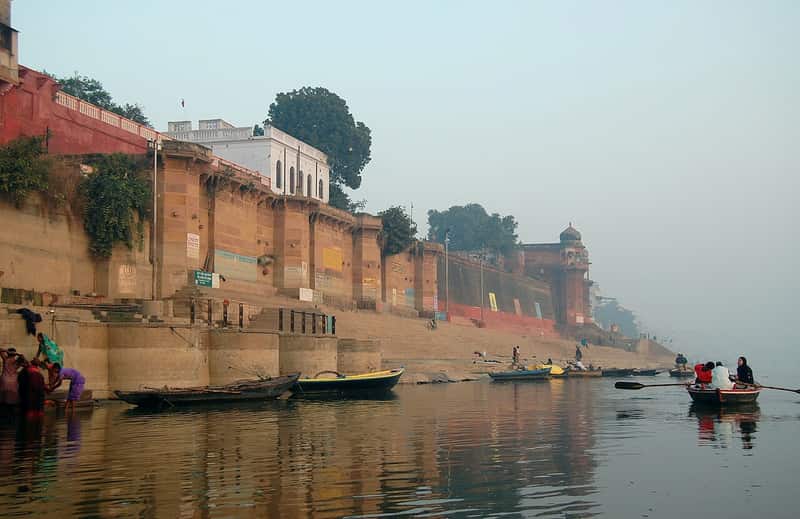
Reaching Nand Ghat — A Practical Guide
Reaching Nand Ghat is easy once you understand the geography of the northern riverfront. The ghat lies at the northern end of the great ghat chain, beyond the old fort at Raj Ghat, and the most pleasant approach is on foot: walk north along the riverbank from Raj Ghat — about fifteen or twenty minutes of easy walking past the small ghats of the northern stretch — and Nand will appear as a modest spread of steps among its neighbours. Alternatively, hire a boat from any of the central ghats and ask to be put ashore here; the boat ride itself, along the whole crescent of the riverfront, is one of the finest experiences Varanasi offers. From the lanes behind, the ghat is reached by a maze of passages that converge at the waterline.
The best time to visit is the early morning, between six and nine, when the bathing, the boats and the whole rhythm of the waterline are at their fullest, and the light is soft and golden. The cool months from October to March are the most comfortable, with crisp mornings and gentle sun; the summer is harsh at the exposed stone steps, and the monsoon, from July to September, brings flooding that can cover the lower steps entirely — check the river level before walking down, and enjoy the swollen river from the upper terrace. Evening, at sunset, is the ghat's second magic hour, when the boatmen come home and the water turns to bronze. Whatever the season, an hour here is best spent sitting still, watching, and asking nothing of the ghat.
Nand Ghat is best combined with a walk through its northern neighbours, and there is no charge for any of it. From here, continue north to Telianala Ghat and the quieter water beyond, or walk south through Gularia and the other small ghats back to Raj Ghat, where the old fort and the great bridge repay a look. Across the river, the Ramnagar side — with its fort, its museum and its sandbanks — is reachable by ferry from the northern ghats on clear mornings. Carry water, wear shoes that grip wet stone, keep your camera respectful and your voice low, and let the ghat do what it has always done: receive you with the calm, wordless hospitality of the oldest river in the world.
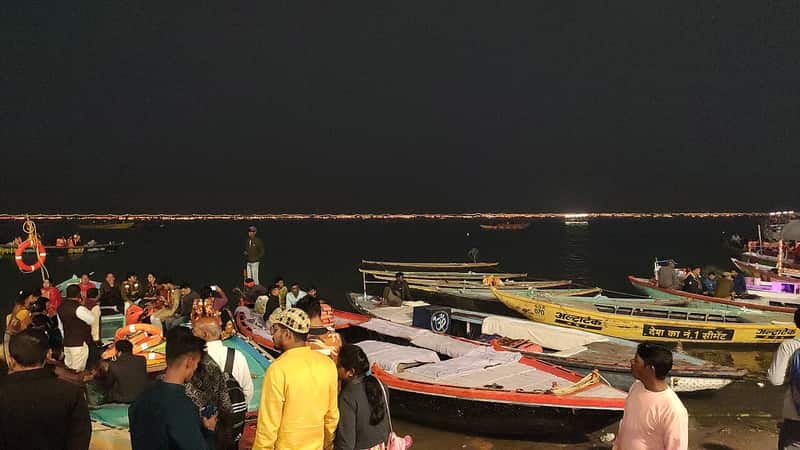
Nand Ghat — Gallery (12 Photos)
Image Credits
nand-01.jpg · nand-02.jpg · nand-03.jpg · nand-04.jpg · nand-05.jpg · nand-06.jpg · nand-07.jpg · nand-08.jpg · nand-09.jpg · nand-10.jpg · nand-11.jpg · nand-12.jpg — Wikimedia Commons, under free licenses.
Continue exploring
Similar Ghats Nearby
Book This Ghat — Get Notified
Download the app now and book a boat ride to Nand Ghat