

Jalasen Ghat
Neighbourhood GhatJalasen Ghat is a small ghat with a famous Shiva temple.


Type
Neighbourhood Ghat
Boat Fare
1x base fare
Best Time
5-8 AM
History
Built in the 19th century. A famous Shiva temple is at the ghat center.
Highlights
- Peaceful stop near Manikarnika
- Local bathing tradition
- Small and clean ghat
Festivals & Events
How pricing works in the NaviX app
No haggling at the ghat — everything is fixed in the app first
- 1
Fixed price before you board
The fare is shown in the app upfront — no bargaining at the ghat
- 2
Sharing or private — your choice
Share with fellow travelers or take the whole boat for your group
- 3
Pay only after the ride
UPI, card or cash — with an instant receipt
Daily morning
Draws the women of the quarter to the shrine
Complete Guide
Jalasen Ghat — The Complete Guide
History, mythology, rites and practical details — everything in depth.
On this page
- 1.Jalasen Ghat — An Ancient Landing on the Northern Riverfront
- 2.The Ancient Name — Jal, Sena and the Memory of Old Kashi
- 3.Layers of Old Kashi — A History Without Chroniclers
- 4.Morning Bathing — The First Ritual of the Day
- 5.Bathers, Boatmen and the Work of the River
- 6.The River — Wide Water and the View of Kashi
- 7.Behind the Ghat — Lanes of the Old City
- 8.Neighbours of the River — Manikarnika, Lalita and Beyond
- 9.The Ancient Quiet — Character of the Ghat
- 10.Festivals at the Ghat — Lights on the Holy Water
- 11.Walking with Respect — Etiquette of the Ghat
- 12.Practical Notes — Reaching Jalasen and the Best Hours
📅 Updated: 21 Aug 2026 · Author: NaviX Field Team (field research 2024-26) · 12 sections · 12 photos
Jalasen Ghat — An Ancient Landing on the Northern Riverfront
Jalasen Ghat is one of the smallest and oldest landings on the northern stretch of the Varanasi riverfront, squeezed between the solemn intensity of Manikarnika Ghat and the quiet courtyards of Lalita Ghat. It has no royal palace, no towering temple, no famous festival to draw the crowds. Its ancient stone steps, worn smooth by centuries of bare feet, descend directly into the Ganga, and its daily life belongs entirely to the river — bathers at dawn, boatmen mending their ropes at midday, widows and pilgrims performing small rituals at the water's edge while the smoke of the nearby cremation ghats drifts across the current. The name itself is old and obscure, a word from the deep layers of Kashi's memory, and that very obscurity is part of the ghat's charm. Here there is nothing theatrical, nothing arranged for the camera; only the patient, unbroken rhythm of daily river life that has continued on these same steps for longer than the oldest written records can tell.
Jalasen sits within the dense chain of minor ghats that rings the cremation stretch, a modest link in one of the longest and most sacred riverfronts in the world. Each of these small ghats has its own character, its own families, priests and boatmen, and together they form the everyday texture of the old city's relationship with the Ganga. For the traveller in a hurry, Jalasen is easy to miss — a few worn steps between two better-known neighbours. But for those who pause, it offers something increasingly rare in the tourist quarters of Banaras: a place untouched by the marketplace, where the holy river is approached with the simple, unselfconscious faith of ordinary people. Standing here, with the water lapping at the stone and the cries of the boatmen behind you, you understand why the faithful say that Kashi is not a city of monuments but a city of living devotion — and this small, quiet ghat is one of its truest witnesses.
The ghat's position in the pilgrim geography of Kashi is quietly significant. It belongs to the northern group of landings that every Hindu hopes to visit in a lifetime, lying in the shadow of the most sacred burning ground in the world and within sight of the white towers of Lalita. Pilgrims completing the sacred circuit of the river, whether on foot or by boat, pass these steps; many pause to fill their lotas here, to sit for a moment in the sun, or simply to let the river's current carry their prayers. For the people who live and work around it, Jalasen is simply home — the place where their grandfathers bathed and their grandchildren will learn to swim. That double life, at once sacred and domestic, is the essence of the ghat, and it is why this small stair between two famous neighbours remains one of the most authentic faces of the oldest living city on earth.
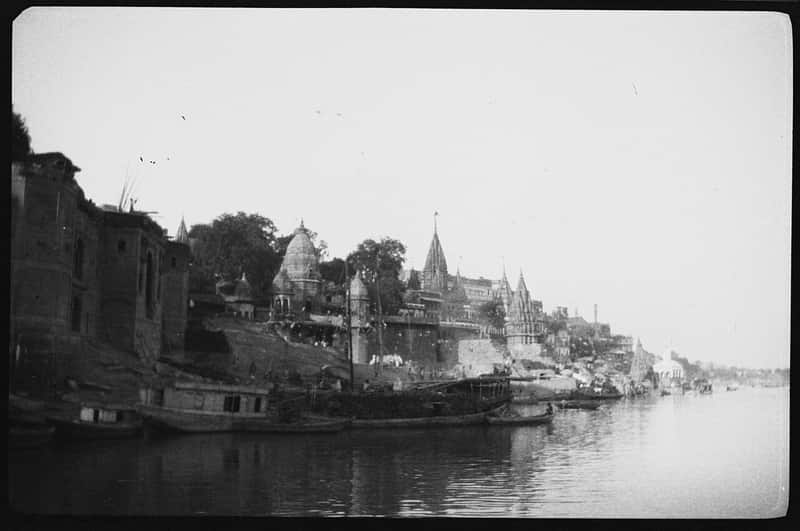
The Ancient Name — Jal, Sena and the Memory of Old Kashi
Unlike the great ghats of Varanasi, whose names are tied to kings, temples and famous legends, the name Jalasen carries no royal chronicle and no well-known story. It is simply an old name, and its very age is its mystery. The first part, jal, means water, and the second, sena, means army or host; together the word has been read as the host of waters, a phrase that suits a landing where the Ganga herself is the only sovereign. Some scholars have suggested the name may remember an ancient general or warrior of Kashi, while others hear in it a folk memory of river deities and water spirits honoured at the ford long before the city's great dynasties left their inscriptions. Nothing is certain, and the ghat keeps its secret the way it keeps everything else — quietly, without ceremony, as it has done for centuries.
Names of this kind are common along the northern stretch of the riverfront, where dozens of small ghats carry old, unexplained words that have drifted down the generations like pebbles in the current. This obscurity is not a loss but a patina — the genuine sign of a place that has never needed to advertise itself. Jalasen does not appear in the grand lists of the tourist handbooks with a famous founder and a date of construction; it exists in the older memory of the city, the memory of washermen and boatmen, of pilgrims who simply knew that here, too, one could descend to the holy water. To climb down these steps is to touch a name older than almost anything written about it, and in a city of eight thousand years of worship, that quiet antiquity is its own kind of glory.
The mystery of the name is preserved in the way the ghat is spoken about by the people of the neighbourhood. Ask an old boatman who Jalasen was, and he will shrug, laugh, and say that the name is as old as the stones themselves; ask a priest, and he may offer a dozen learned guesses; ask a grandmother, and she will tell you that the water remembers. That the ghat needs no explanation is precisely what makes it venerable — it belongs to the category of things in Kashi that are simply there, older than memory, accepted on faith like the river itself. In a city where every stone has a story, Jalasen's story is the rarest kind: one that has been worn smooth by the passing of centuries, until nothing remains but the name, the steps, and the endless water — which is to say, everything that truly matters.
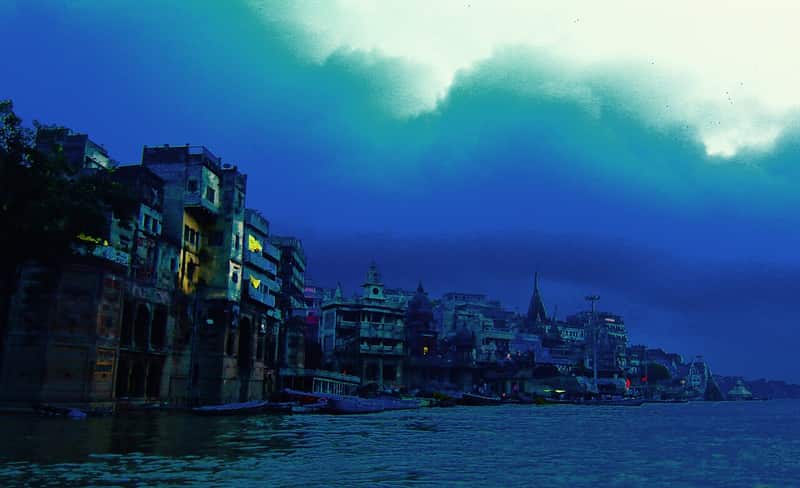
Layers of Old Kashi — A History Without Chroniclers
Most of what is known about Jalasen Ghat is not written in books but carried in the fabric of the place itself. The northern riverfront, where the ghat stands, is among the oldest inhabited stretches of the city, and the dense chain of small landings around it grew up over many centuries as the cremation ground at Manikarnika drew pilgrims, priests, wood sellers and mourners from every part of India. These minor ghats were the work of no single patron; they were built and rebuilt piece by piece, step by step, by local families, merchants and small kingdoms, each adding their stones to the common stair that descended to the Ganga. Jalasen is part of that collective building, and its worn steps are a record of that long, anonymous labour.
The city's turbulent history passed over these steps again and again. Armies crossed the river during the struggles of medieval kingdoms; Mughal governors, Maratha rulers and British administrators all held sway in Kashi, and each age rebuilt what the last had worn away. Through all of it, the small ghats of the cremation stretch endured, because the need that created them never changed: the dead must be brought to the fire, and the living must wash in the Ganga. In the twentieth century the ghat received practical modern additions — bathing platforms, drainage, a widened stair — yet its essential character, an unpretentious working landing, remained untouched. Standing here today, with the smoke of Manikarnika rising close by, you stand in a line of continuity that no chronicler recorded but that every stone confirms.
Scholars of the city's riverfront note that the northern ghats, unlike their grander southern neighbours, were seldom rebuilt by royal decree; their history is the history of necessity, maintained by the families who used them. This gives Jalasen a peculiar authenticity: its steps are not a reconstruction of the past but a continuation of it, each repair an honest scar rather than a restoration. In the old records of the city's temples and trusts, the ghat appears from time to time in lists of properties, boundary markers and endowments — small mentions that confirm its existence centuries ago without ever explaining its origins. That is the nature of the minor ghats of Kashi: they are too old for biography, too essential for legend, and too woven into daily life to need either. Their history is written in the wear of the stone and in the unchanged rhythm of the people who use them.
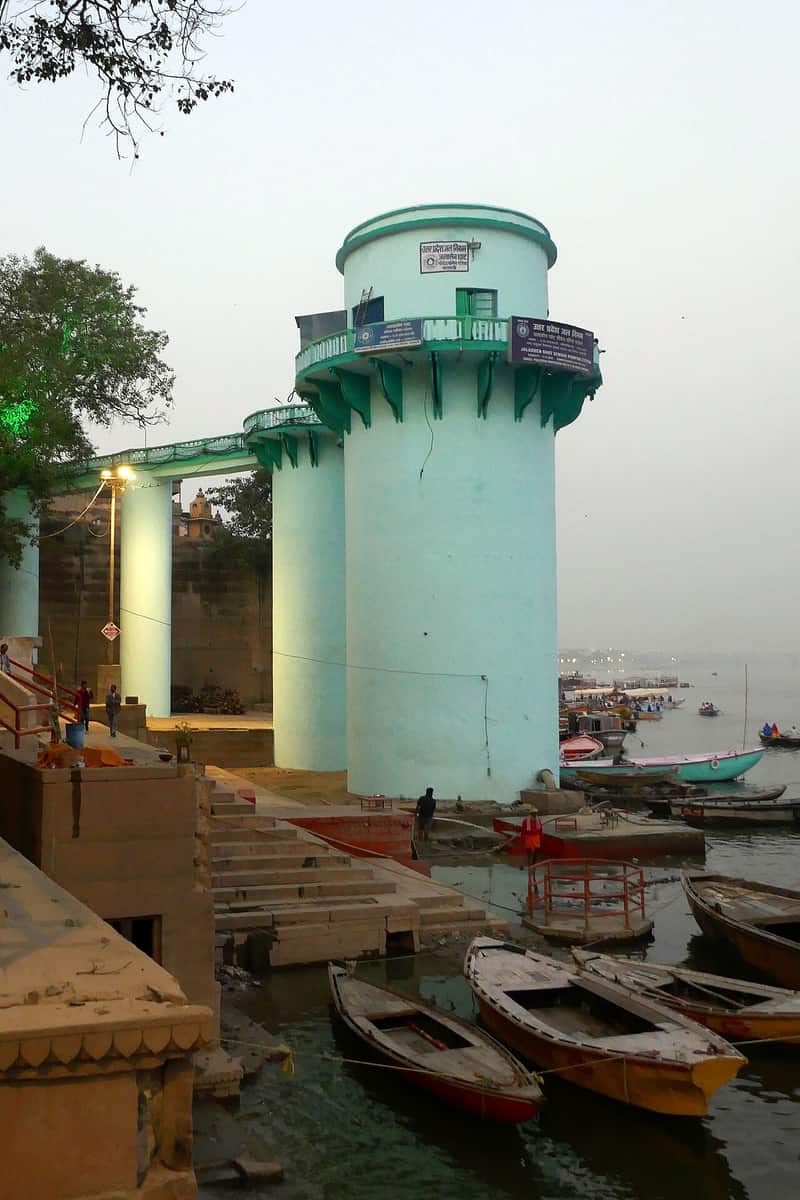
Morning Bathing — The First Ritual of the Day
At Jalasen, as at every ghat of the northern stretch, the day begins in the dark water. Long before sunrise the first pilgrims come down the steps — old women with brass vessels, young men with prayer beads, families with children still heavy with sleep — to perform the ritual bath that opens the day of a devout Banarasi. The bath is a precise affair: water is cupped in the hands and poured toward the rising sun, offered with a whispered mantra; the body is immersed three times, or dipped nine times for the most auspicious baths of the year; and then the pilgrim stands, dripping and shivering, to perform the morning prayers while the sky turns from grey to gold. For the people of the old city, bathing here is not a holiday pleasure but a duty of the spirit, the oldest and most important action of the day.
The ghat's modest facilities give the scene its particular character. There is no grand stone architecture to frame the ritual, no crowds of tourists with cameras; there is only the worn stair, the broad river, and the timeless choreography of the bath — cloths spread on the steps to dry, brass lotas being filled, marigold petals scattered on the water, the chants of the faithful rising and falling with the current. Women and men bathe in separate, modest sections of the ghat, and the water itself, grey-green in the early light, takes on a brilliance as the sun climbs. In winter the bathers hurry through their rituals, wrapped in shawls the moment they step out; in summer they linger in the cool water. Through all seasons the pattern holds — Jalasen remains a true bathing ghat, faithful to the purpose for which its ancient steps were cut.
Bathing at Jalasen carries a special meaning because of what lies next door. The faithful believe that water touched by the smoke and the sanctity of Manikarnika carries an added blessing, and many bathers here make a point of bathing first, then walking the short distance south to offer prayers at the burning ghat's shrines. In the festival months, when the river itself is said to become the goddess, the number of bathers multiplies; on the great bathing days of the Hindu calendar the steps are crowded from waterline to street, and the air is loud with chants and the ringing of bells. Yet even on an ordinary morning, the scene is moving in its simplicity — ordinary men and women, with ordinary worries, placing themselves in the cold embrace of the holy river and rising from it renewed, as their ancestors did before any temple stood on these banks, and as their descendants will long after these stones are dust.
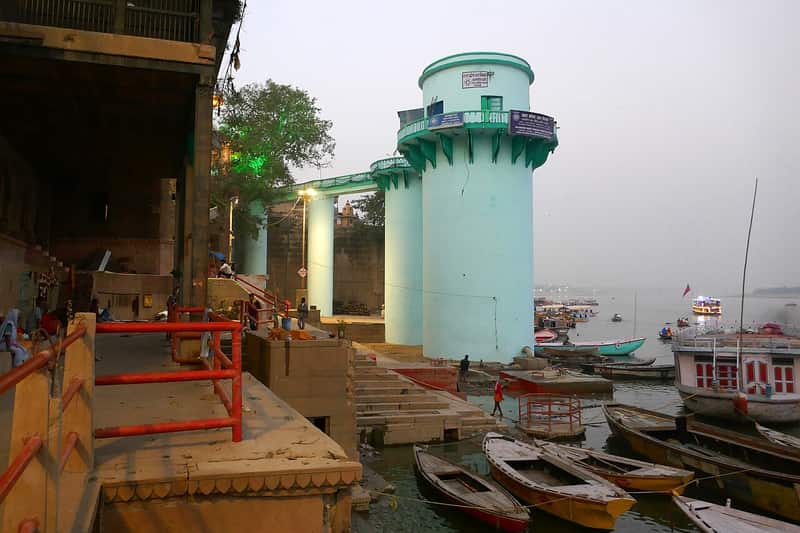
Bathers, Boatmen and the Work of the River
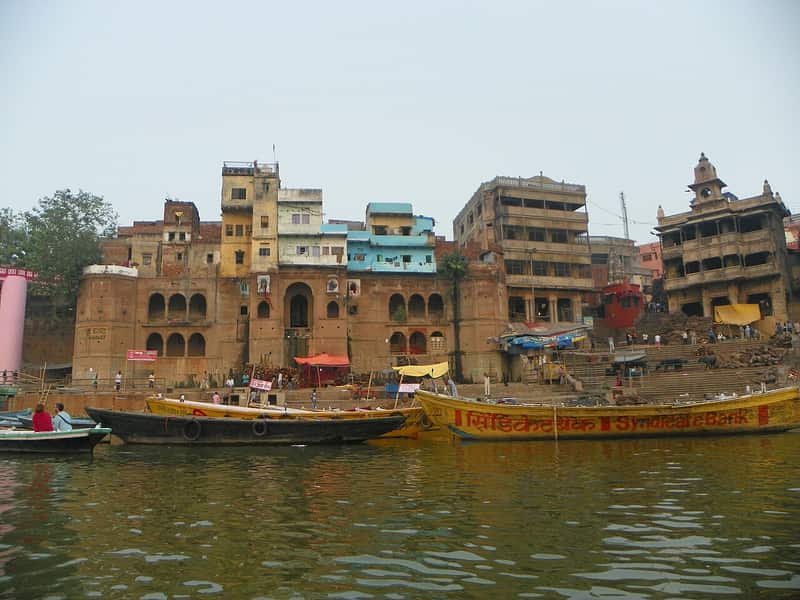
The life of Jalasen Ghat is the life of its river workers. At the foot of the steps, the boatmen of the northern stretch keep their craft in a long, bobbing line — heavy wooden boats for ferrying pilgrims and firewood, small skiffs for fishing, and a few bright painted launches that carry visitors upriver toward the burning ghats at dusk. The day of a boatman begins before the pilgrims arrive: ropes are checked, water is baled from the hulls, oars are laid out, and the morning's first fares are negotiated in the easy, laughing Banarasi dialect that has always greased the commerce of the river. Between trips the men mend nets, eat their breakfast from brass plates, and trade gossip with the washermen who beat their laundry on the stone slabs at the water's edge.
Higher up the steps, the domestic rhythm of the neighbourhood unfolds. Women from the lanes behind the ghat come down with stacks of copper and brass pots to scour them in the sand of the riverbed, a daily rite that keeps the family's vessels gleaming. Children run errands, splash at the waterline and dive from the moored boats; a tea stall in the alley above sends its smoke curling down the stair, and the sound of a temple bell drifts through the morning air. Pilgrims on their way to Manikarnika pause here to catch their breath, and the priests and Dom helpers of the cremation quarter pass up and down the steps all day long. Nothing at Jalasen is staged for the visitor — the ghat is simply the front porch of an old and crowded quarter of Kashi, doing its daily work beside the holiest of rivers.
The ghat's economy is small but complete, and watching it work is a lesson in the resilience of old Kashi. Around the boatmen gather the supporting trades of the riverfront: rope makers with their twisted coils, sellers of brass lotas and clay diyas, the washermen who have their own stone slabs by the water, and the women who spread fish and vegetables to dry in the sun. Every item needed for river life is available within fifty steps of the landing, traded in the casual, honest manner of a community that has known one another for lifetimes. Above all, the ghat is a meeting place. Pilgrims exchange news from their villages, priests give blessings for a handful of rice, children grow up between the steps and the water, and the elderly sit in the shade and watch the river — the same river their mothers watched, carrying the same boats, the same smoke, the same unhurried life of the northern waterfront.
The River — Wide Water and the View of Kashi
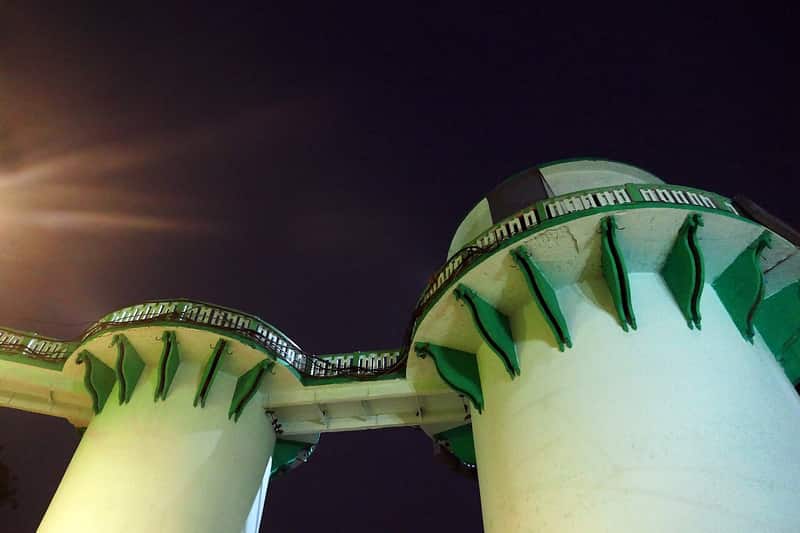
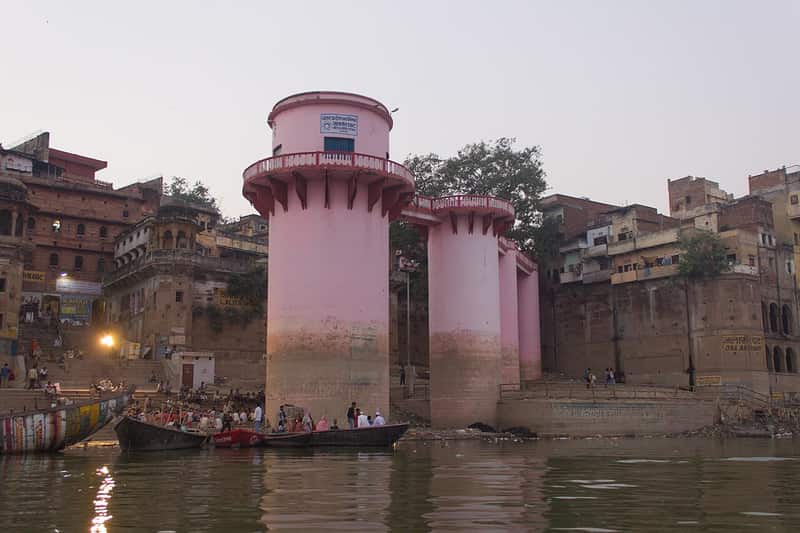
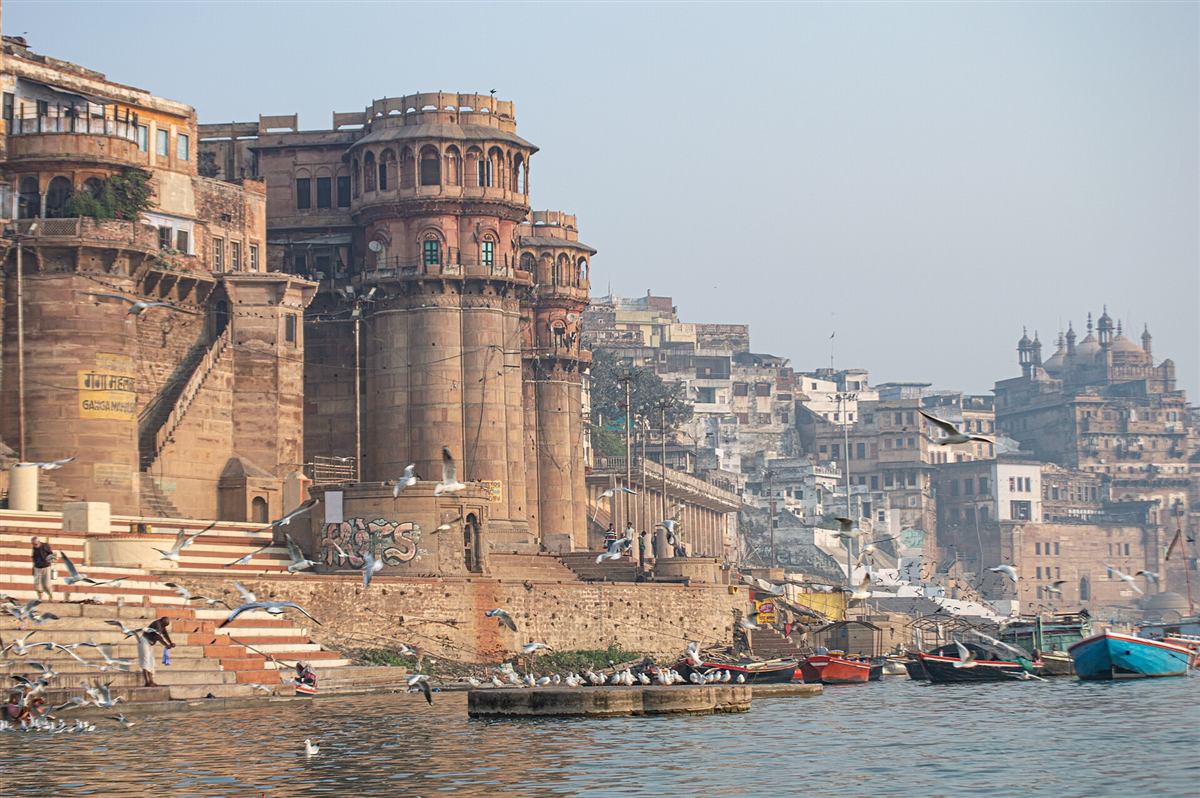
From the steps of Jalasen the Ganga opens out in one of the finest wide views on the northern riverfront. Here the river runs broad and powerful, its current sliding past the ghats in long, smooth sheets of grey-green water that catch the light differently at every hour. Across the water, on the eastern bank, stretches the flat, pale floodplain of the far shore — fields, sandbanks and villages that seem to belong to another, quieter world, and at sunrise the sun lifts out of that horizon in a great red ball, turning the whole river to molten copper. On this stretch of the waterfront the great river shows its full majesty, and the small ghats along the bank are the perfect places from which to watch it.
The river here is also a working road. Boats ply constantly up and down the current: pilgrims heading north to the burning ghats, ferrymen carrying firewood, fishermen casting their nets at the sandbanks, and in the evenings the pleasure boats that row out into mid-stream so that passengers can watch the lights of the cremation ghats flicker against the darkening sky. Above the water, the skyline of old Kashi rises in a jumble of temples, palaces and dense lanes, and the smoke of Manikarnika, drifting lazily over the current, carries the city's oldest message down the river. For those who take a boat from Jalasen, the ghat itself becomes part of that skyline — a small stair among many, humble from the water as it is on land, yet unmistakably one of the ancient gates through which the faithful have approached the Ganga for centuries.
The river's moods give the ghat its changing face through the year. In the dry months the water retreats, exposing broad sandbanks where cattle graze and fishermen dry their nets, and the steps run down to a lazy, shallow current. In the monsoon the river swells, brown and powerful, lapping at the highest steps and turning the ghat into a grandstand for one of nature's greatest spectacles — the great floods that have shaped the city's history arriving with a roar that is heard, the old people say, before it is seen. In the winter mornings a thin mist lies over the water, and the far shore disappears into silver light; in the summer evenings the reflection of the burning ghats stretches across the current in long, wavering lines of fire. To stand on Jalasen's steps at any of these seasons is to watch the eternal river play out its endless performance of rise and fall, of destruction and renewal.
Behind the Ghat — Lanes of the Old City
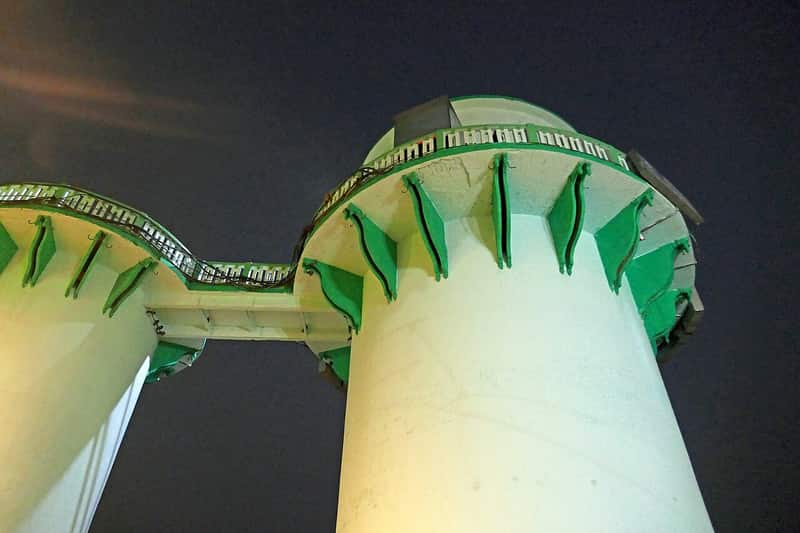
Behind Jalasen Ghat, the old city begins at once. A few steps up from the river, the stair joins a narrow gali — one of the countless lanes that thread the northern quarter of Kashi — and the world changes from water to stone, from open sky to the close, cool shadow of ancient buildings leaning toward each other overhead. These lanes are the true streets of old Banaras: brick and plaster walls weathered by two centuries of monsoon, doorways barely wide enough for a man to pass, small shrines tucked into every corner, and above, the tangled wires and laundry lines that give the city its signature sky. Here the ghat's quiet gives way to the roar of daily commerce — vegetable vendors, sweet shops, betel stalls, and the smoke of countless kitchens.
The neighbourhood around the ghat is one of the oldest residential quarters of the city, home to Brahmin families who have served the ghats for generations, weavers and silk merchants, and the many trades that serve the cremation economy nearby. Wandering these lanes, the visitor encounters a Banaras that has changed little in a hundred years: courtyards where water is drawn from old wells, shrines where morning aarti draws the women of the quarter, roofs from which neighbours call to one another in the affectionate dialect of the city. The lanes eventually wind back to the main streets and the famous ghats, but the detour through this quarter is its own reward — a walk through the living rooms of old Kashi, where the river's devotion meets the daily grind of urban life in a balance as old as the city itself.
The lanes behind Jalasen also hold some of the oldest devotional sites of the northern quarter. Small temples and shrines stand at almost every turning — to Shiva, to Hanuman, to the goddess in her many forms — many of them unmarked in any guidebook, known only to the families who have worshipped there for generations. Here and there a carved doorframe or an inscribed slab hints at a history of five or six centuries, and the masonry of the old havelis tells of the merchants and nobles who once lined these streets. Walking without a map is the best way to find them; the quarter rewards the wanderer with chance encounters — a courtyard full of marigold petals, a doorway where a priest sits reading, a rooftop where the river suddenly appears between the buildings. This is the old city at its most genuine, and it surrounds Jalasen on every side like a warm, breathing garment.
Neighbours of the River — Manikarnika, Lalita and Beyond
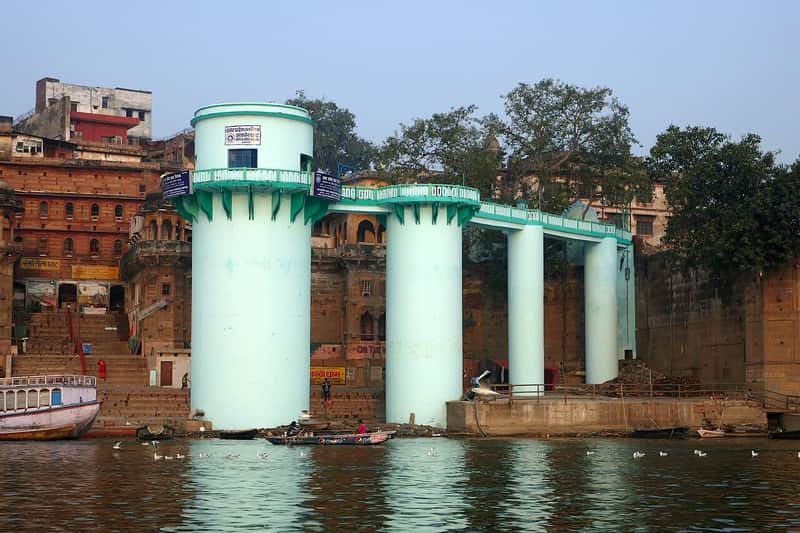
Jalasen sits at the heart of one of the most extraordinary stretches of the Varanasi riverfront. Immediately to its north lies Lalita Ghat, a small, peaceful landing dominated by the white Nepali palace and its temples, one of the most distinctive buildings on the entire river; and immediately to the south stands Manikarnika, the great burning ghat, whose towers and temples rise above the eternal flame. The three ghats together — the sacred fire, the everyday stair and the Himalayan palace — make a compact circuit of the river's oldest meanings: death and liberation, daily devotion, and the pilgrim traffic of a whole kingdom. A short walk along the water connects them all, and no visitor should leave the stretch without seeing each one.
Beyond these two famous neighbours, the chain continues in both directions. North of Lalita, the riverfront curves through a string of minor ghats toward Tripura Bhairavi Ghat, named for the fearsome goddess who is worshipped there, and then toward the great bends of the river where the city opens into fields and villages. South of Manikarnika, the procession of major ghats begins — Scindia with its sunken temple, Dashashwamedh with its evening aarti, and the long parade of grand landings that runs to Assi. Standing on the steps of Jalasen, a traveller can plan a day of walking or boating that touches almost every face of Kashi: the burning ghats, the bazaars, the palaces, the great ceremonies. The small ghat is the perfect base and starting point for that long, unforgettable circuit of the holiest riverfront in the world.
For the traveller who wants to understand the ghats, the walk from Jalasen southward is an education in contrasts. Within a hundred paces the character of the riverfront changes utterly: the quiet stair gives way to the wood yards, the smoke and the intense, purposeful activity of Manikarnika, where the eternal flame and the chant of Ram Naam Satya Hai fill the air. Just beyond, the ghats grow grander and more famous, each with its palace or its legend, until the riverfront reaches its ceremonial climax at Dashashwamedh, with its evening aarti and its crowds. Returning north from that spectacle to Jalasen's quiet steps is like stepping from a festival into a memory. The contrast explains, better than any guidebook, the true geography of Kashi: a city where the most intense sacred drama and the most ordinary daily life stand within minutes of each other, joined by the same water and the same unbroken devotion.
The Ancient Quiet — Character of the Ghat
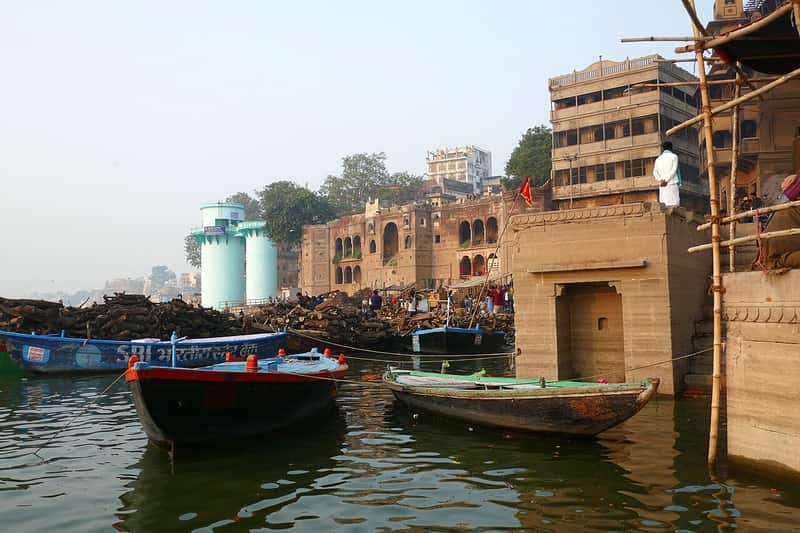
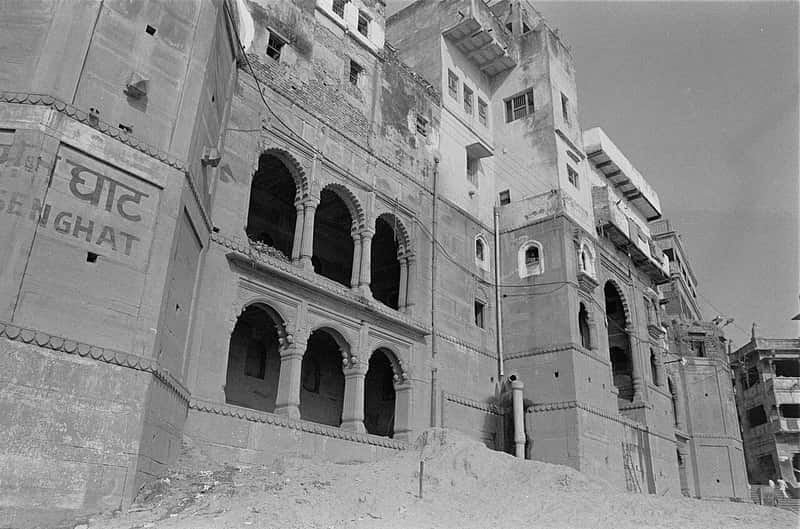
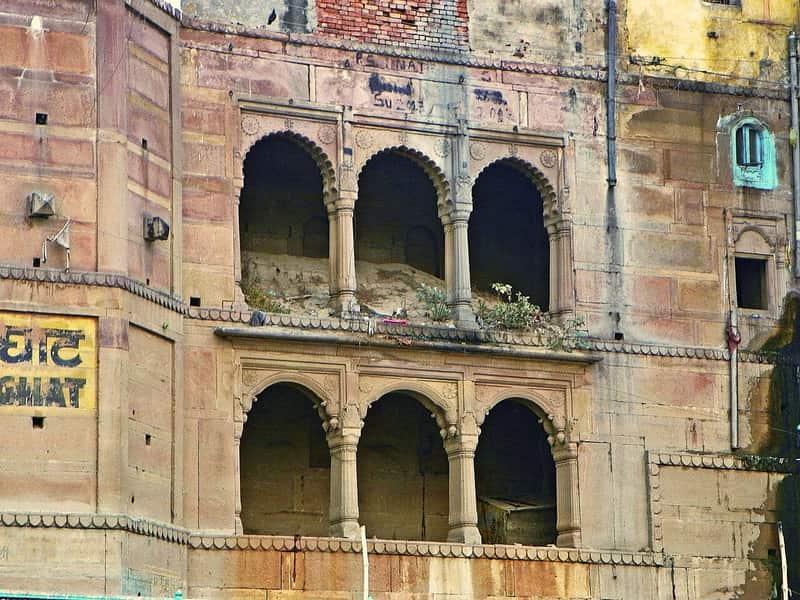
The dominant quality of Jalasen Ghat is an ancient quiet — not the silence of emptiness, but the hush of a place that has seen everything and learned to be still. The steps are worn, the stone is patched, the paint has faded from the small shrines; nothing here is polished for display, and that unpretentiousness is the ghat's deepest charm. Sounds arrive one at a time: the slap of water against the stair, the creak of a moored boat, a chant rising from a distant temple, the call of a boatman answered across the water. Time seems to move differently on these steps — slower, more forgiving — and visitors who sit for a while often feel the city's frantic energy draining out of them, replaced by something older and calmer.
Part of this atmosphere comes from the ghat's position in the shadow of Manikarnika. The smoke of the burning ghats, drifting over the water, lends the scene a gravity that few places on earth possess — a reminder that this is a stretch of river where the great questions of life and death are lived out daily, without drama or display. Yet Jalasen itself is not sombre. Children play in the shallows, pilgrims laugh as they splash each other with holy water, boatmen share jokes in the shade of their upturned craft. The genius of the place is its balance: it stands at the very edge of the city's most intense ground, yet keeps the ordinary, human warmth of daily life. That blend of gravity and warmth, of age and life, is what makes sitting on these steps one of the most quietly memorable experiences Kashi offers.
Photographers and painters have long been drawn to the stretch of river around Jalasen, and the reason is easy to see. The light here is remarkable: at dawn it is soft and rose-coloured, laying the long shadows of the steps across the water; at noon it is white and harsh, bleaching the stone and flattening the river into a sheet of light; at dusk it turns amber and violet, and the silhouettes of the ghats stand black against the burning sky. The composition is endlessly satisfying — the worn stair, the moored boats, the smoke, the figures of bathers in white — and yet no photograph fully captures the atmosphere, because the atmosphere is a feeling as much as a sight. It is the feeling of being in a place that has outlived empires and will outlive the viewer too, and of standing, for a moment, inside the oldest continuous civilisation of the river that made it.
Festivals at the Ghat — Lights on the Holy Water
Though Jalasen has no famous festival of its own, it shares fully in the great celebrations of the northern riverfront. On Kartik Purnima, the full moon of autumn, the whole stretch of ghats is transformed for Dev Deepawali — the festival of the lamps of the gods — when every landing, Jalasen included, is lit with thousands of earthen diyas set along the steps and floated on the water, their flames flickering in long, trembling lines that double themselves in the dark river. Families gather on the ghat with sweets and marigolds, boats crowd the water, and the smoke of incense mingles with the river mist. For a few nights the old ghat glows like a jewel, and the same steps that know the daily rituals of bathing become the setting for the city's most beautiful spectacle.
The other great festivals of the river touch the ghat in gentler ways. On Ganga Dussehra, the day of the river's descent to earth, the women of the neighbourhood bring lamps and offerings to the water's edge, performing small ceremonies for the health of their families. During the monsoon month of Sawan, the ghat sees processions of Shiva devotees — long lines of saffron-clad pilgrims carrying water from the Ganga to offer at temples across the city. And at every full moon, on a smaller scale, families climb down the steps with their diyas and flowers, keeping alive a custom older than the ghat's name itself. For the visitor, joining these quiet celebrations — buying a diya from the stall, placing it on a leaf, setting it adrift — is one of the most moving ways to enter the devotional life of the river.
The smaller rhythms of the festival year are just as visible at Jalasen as the great celebrations. Every Monday, the day sacred to Shiva, the ghat sees an extra stream of worshippers on their way to the temples of the quarter, and the little shrines at the top of the steps fill with offerings. On the full moon of every month, the purnima, families perform the rite of the moonlit bath, and the water at the foot of the steps turns silver under the light of the rising moon. During the nine nights of Navratri, the women of the neighbourhood gather at the ghat for songs and prayers to the goddess, their voices carrying over the water in the old folk melodies of the region. For the visitor these smaller celebrations are often more moving than the grand festivals — they show the ghat not as a stage for spectacle but as a living home of faith, where the calendar of devotion turns with the same quiet constancy as the river itself.
Walking with Respect — Etiquette of the Ghat
Jalasen Ghat is a working place of worship, not a museum, and the visitor who walks its steps with respect will be welcomed by the warmth of the old city. Dress modestly — shoulders and knees covered — and remove your shoes before approaching the small temples on the ghat. Bathing and prayer are private acts of devotion for the people of the neighbourhood; keep a respectful distance, avoid photographing bathers closely, and never walk between a worshipper and the river during puja. Children are adored here, and pilgrims will often smile and invite you to join the ritual; a folded palm and a gentle Namaste answer every question of intent far better than words.
Because Manikarnika, the great cremation ghat, lies only a few minutes' walk away, the stretch of river around Jalasen carries a special gravity. Photography near the burning ghats is strictly forbidden and deeply offensive; from the steps of Jalasen itself the smoke is visible, and even here a courteous visitor turns the camera away from mourning families and focuses instead on the river, the boats and the architecture. Offering money to mourners or Dom helpers is not appropriate; if you wish to contribute, the ghat's priests accept voluntary donations for rituals. Finally, remember that the river is sacred — no litter, no alcohol, no waste in the water. Follow these simple courtesies, and the ghat will open itself to you with the unmatched hospitality of Kashi, the city that has welcomed pilgrims for eight thousand years.
A few practical habits will make any visit to Jalasen smoother and more welcome. Carry your own drinking water, and dress for the river — you may want to remove shoes at the temples, and the steps can be wet and slippery at dawn. Ask before photographing people; most will gladly pose, but the request itself is the courtesy that matters, and portraits taken this way often become the treasured memories of a trip. Be patient with the boatmen and the vendors, whose prices are part of the friendly negotiation that animates every ghat of the city; a smile and a little humour go further than bargaining. And above all, leave the ghat as you found it — take your rubbish away, respect the water, and step gently around the rituals of the faithful. In a city that has received pilgrims for millennia, the deepest courtesy is simply to arrive as a pilgrim yourself: with open hands, quiet steps and a heart ready to be moved.
Practical Notes — Reaching Jalasen and the Best Hours
Jalasen Ghat lies on the northern stretch of the riverfront, close to Manikarnika, and is most easily reached on foot through the lanes of the old city. From Godowlia, the main square, follow the crowd toward the famous ghats, then turn north along the river past Manikarnika; the ghat appears as a modest stair shortly before Lalita Ghat. Alternatively, a boat from Dashashwamedh or Assi delivers you to the ghat's steps in about twenty minutes, giving you the finest possible approach — the ghat unfolding from the water, framed by the smoke and towers of its great neighbour. Auto-rickshaws reach the edge of the old quarter, but the last stretch is always on foot, which is how every pilgrim of the last thousand years has arrived.
The best hours are early morning, from first light to about nine, when the bathing rituals and the river's morning beauty are at their height, and again at dusk, when the lamps of the nearby ghats begin to glimmer. The winter months, from October to March, offer cool, clear days ideal for walking and boat rides; the monsoon months bring the river up almost to the steps and are best admired from the shore. Combine Jalasen with the nearby ghats — Manikarnika for the eternal fire, Lalita for the Nepali palace, Tripura Bhairavi for its fierce goddess — and allow a full morning for the circuit. Modest food and tea stalls sit in the lanes behind the ghat, and simple guesthouses of the old city are a short walk away, making Jalasen not only a beautiful stop but a sensible base for exploring the northern riverfront of Kashi.
One final piece of planning will enrich the visit. Read a little about the ghats before you come — the story of Manikarnika's eternal flame, the legend of Lalita's goddess, the rituals of Tripura Bhairavi — because the northern riverfront is a place where knowledge transforms sight: a stair that was merely old becomes five hundred years of pilgrim feet, and a wisp of smoke becomes the oldest fire in the world. A dawn visit followed by a slow boat back to the centre of the city is the classic route, and those who walk the full circuit from Jalasen to Dashashwamedh will have seen in a single morning the entire spectrum of sacred Kashi. The ghat asks little of its visitors — a few hours, a respectful manner, an open eye — and gives in return a memory that, like its name, grows richer the longer it is kept. Jalasen is not the most famous landing on the Ganga; it is simply one of the truest.
Jalasen Ghat — Gallery (12 Photos)
Image Credits
jalasen-01.jpg · jalasen-02.jpg · jalasen-03.jpg · jalasen-04.jpg · jalasen-05.jpg · jalasen-06.jpg · jalasen-07.jpg · jalasen-08.jpg · jalasen-09.jpg · jalasen-10.jpg · jalasen-11.jpg · jalasen-12.jpg — Wikimedia Commons, under free licenses.
Continue exploring
Similar Ghats Nearby
Book This Ghat — Get Notified
Download the app now and book a boat ride to Jalasen Ghat