

Bhonsale Ghat
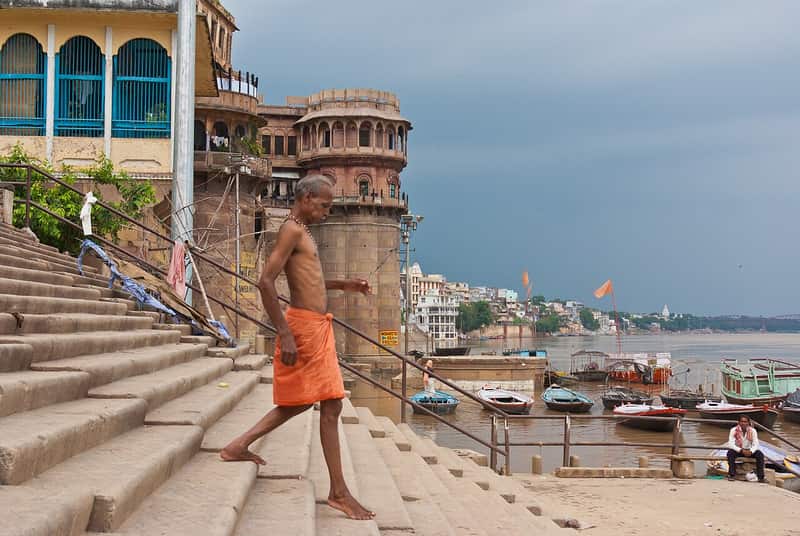
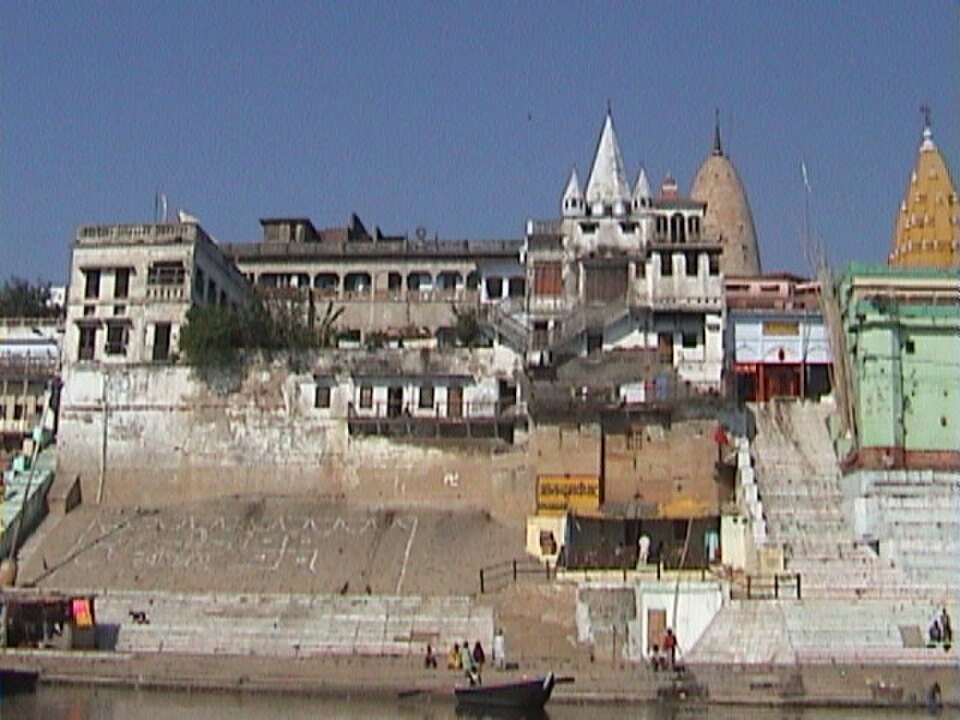
Heritage GhatBhonsale Ghat is a small, solid ghat built by the Bhonsle kings in the 18th century. It has a beautiful Shiva temple.


Type
Heritage Ghat
Boat Fare
1.1x base fare
Best Time
6-10 AM when morning light illuminates the temple.
History
Built by the Bhonsle kings in the 18th century. A beautiful Shiva temple stands in the center of the ghat, built in the Bada imambara style. The ghat is now recognized as a beautiful ghat with a local temple.
Highlights
- Bhonsale palace architecture
- Memory of the Maratha royal family
- Historic glory
Festivals & Events
How pricing works in the NaviX app
No haggling at the ghat — everything is fixed in the app first
- 1
Fixed price before you board
The fare is shown in the app upfront — no bargaining at the ghat
- 2
Sharing or private — your choice
Share with fellow travelers or take the whole boat for your group
- 3
Pay only after the ride
UPI, card or cash — with an instant receipt
6:00 AM & 6:00 PM
Complete Guide
Bhonsale Ghat — The Complete Guide
History, mythology, rites and practical details — everything in depth.
On this page
📅 Updated: 21 Aug 2026 · Author: NaviX Field Team (field research 2024-26) · 9 sections · 9 photos
Bhonsale Ghat: An Introduction
Bhonsale Ghat is one of the most atmospheric and photogenic ghats on the northern riverfront of Varanasi. It stands between Mir Ghat and Ganesh Ghat, on the long crescent of the Ganges that bends toward the cremation ground at Manikarnika. What makes the ghat unforgettable is the palace: a grand, weathered Maratha residence whose walls rise almost directly out of the water. Its crumbling balconies, shuttered windows, and broad stone steps carry the memory of a royal household, yet today the structure stands half abandoned, wrapped in foliage and the patina of centuries. Pilgrims climb and descend these steps at dawn, boatmen moor their wooden vessels against the worn stone, and the atmosphere hovers between grandeur and melancholy. Photographers come from all over the world to capture its peeling facades and the play of light on the water, making the ghat one of the most haunting sights in the holy city.
The ghat belongs to the northern cluster of the Panchakroshi pilgrimage route, an old quarter where temples, cremation activity, and daily life intermingle on the same stones. Unlike the crowded spectacle of Dashashwamedh, Bhonsale is relatively quiet; the sounds here are the slap of water against the steps, the call of boatmen, and the distant ringing of temple bells. The name of the ghat honors the Bhonsle dynasty of Nagpur, who purchased the land and built the palace in the eighteenth century as a riverside residence for their family and visiting dignitaries. Over the centuries the building passed through hands and neglect, yet it remains a proud landmark on the Varanasi skyline, its silhouette visible for a long distance along the river. Standing at the edge of the burning ghats, the palace seems to watch over both the living and the departed, a stoic witness to the endless cycle of life and death that defines this stretch of the Ganges.
For the traveler, Bhonsale Ghat offers something rarer than spectacle: an authentic, unpolished face of Kashi. The morning light on its ochre walls, the smoke from funeral pyres drifting upstream, the women washing clothes on the steps, and the herds of goats that wander the lane above all combine into a living tableau. The ghat is best reached on foot through the narrow lanes of Bhainsasur or by boat from the south, and it rewards those who linger. This guide walks through its history, its architecture, and its everyday rhythms, and it points the way to the neighboring ghats of Mir and Ganesh. Whether you come for photography, for pilgrimage, or simply for the melancholy beauty of a dynasty gone silent, Bhonsale leaves an impression that few ghats can match.

The Maratha Patrons of Kashi
The story of Bhonsale Ghat is inseparable from the story of the Maratha empire in the eighteenth century. As Mughal authority weakened, Maratha chieftains emerged as the dominant power across much of India, and few places attracted their devotion more than Kashi. For the Bhonsle rajas of Nagpur, pilgrimage to the Ganges was both a spiritual duty and a political statement; to be seen bathing at a grand ghat was to claim legitimacy, wealth, and piety in one gesture. The dynasty traces its origin to the Bhosale family of the Deccan, the same clan from which the great warrior king Shivaji arose, though the Nagpur branch established itself as an independent power in the central provinces of India. Between roughly 1730 and 1760, under rulers such as Raghuji Bhonsle I, the family consolidated its hold over the eastern Deccan and turned its attention to the holy cities of the north, where building a ghat was regarded as one of the highest acts of merit.
Maratha patronage of Kashi was not confined to the Bhonsles; it was a family competition of generosity that reshaped the whole riverfront. The Scindias built at Scindia Ghat, the Holkars at Ahilyabai Ghat, and the Peshwas endowed temples and akharas throughout the city. This rivalry was rooted in the belief that a ghat built on the Ganges would earn the builder and his descendants immense religious merit, so kings competed to commission the grandest structures. The Bhonsle palace was part of this pattern, but its builders also had a practical motive: a secure riverside mansion where the family could stay during the long bathing festivals, hold court, and receive ambassadors. The choice of location, close to the cremation ground and the sacred temple of Kashi Vishwanath, was deliberate, for the Marathas considered the northern stretch of the river particularly auspicious for both worship and the performance of ancestral rites.
The legacy of the Marathas in Varanasi survives in more than stone. They patronized Sanskrit learning, funded the schools of astrology and the panchang calendar makers who still function near the palace, and supported the great religious fairs of the city. The Nagpur Bhonsles maintained a permanent establishment in Kashi well into the nineteenth century, and members of the family were frequent visitors during festivals such as Kartik Purnima and Makar Sankranti. Today the palace may be crumbling, but the bond it represents remains alive: pilgrims from the Maratha-speaking regions of central India still come to the ghat, and the boatmen and priests of the neighborhood remember the family name with a kind of hereditary respect. The Bhonsale Ghat is thus a chapter of empire written in stone and water, a monument to a dynasty that built its immortality not in tombs but in the living city of Kashi.
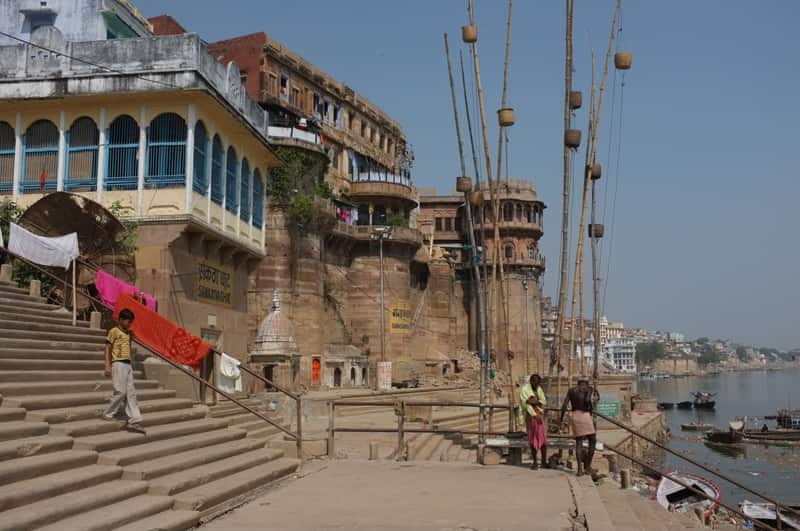
The Bhonsale Palace
The Bhonsale palace is the heart of the ghat, a riverside mansion that rises in three or four storeys above the water with a confidence that time has not fully erased. It was constructed in the eighteenth century, at the height of Bhonsle influence, and its design follows the conventions of a Maratha courtly residence adapted to the peculiar geography of the Ganges. Because the river level changes by many metres between the dry and the flood seasons, the building was raised on high plinths, with the principal apartments looking out over the water through carved balconies and jharokha windows. The ground floor, now partly submerged or silted, once housed storerooms, kitchens, and the chambers of servants, while the upper floors contained the living quarters of the family, decorated with plasterwork and painted panels that can still be glimpsed through broken shutters.
The history of the building after the decline of the Bhonsles is a story shared by many princely structures in Kashi: gradual neglect, fragmentation, and adaptive reuse. Sections of the palace were sold or leased over the decades; some rooms became residences for families, others were let to shopkeepers and godowns, and the great halls fell silent under layers of dust and bat droppings. The Archaeological Survey of India has at times taken an interest, and the building is protected under state heritage legislation, but funds for full restoration have never been adequate. Despite this, the palace retains an extraordinary dignity. Its ochre and cream walls, its deep verandas, and the lattice screens that filter the morning sun make it one of the most painted and photographed buildings along the entire riverfront, beloved by artists precisely because it is imperfect.
In recent years the palace has found new life as a backdrop for cultural activity. A portion of the complex houses a guesthouse, allowing travelers to sleep within earshot of the Ganges, and the courtyards occasionally host concerts, weddings, and film shoots drawn by the building's cinematic decay. Walking through its corridors is like stepping into a museum of memory: hooks where oil lamps once hung, faded frescoes of lotus and peacock, a well in the inner courtyard, and staircases that spiral into darkness. The palace asks to be explored slowly, with imagination, because what it offers is not restoration but atmosphere — the sense that one has wandered into a chapter of history that is still, somehow, being written. Every crack in its plaster, every balcony that leans toward the river, tells a story of a family that once commanded armies and yet chose to leave its most intimate memory in this quiet bend of the Ganges.
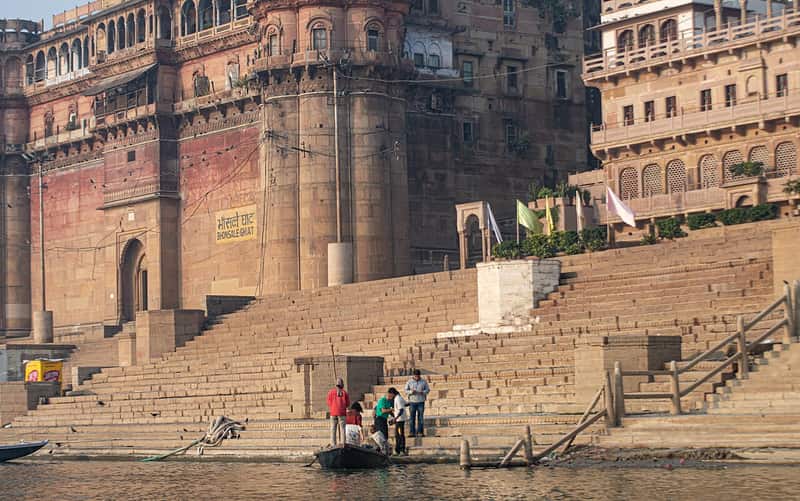
Architecture of Walls, Balconies, and Steps
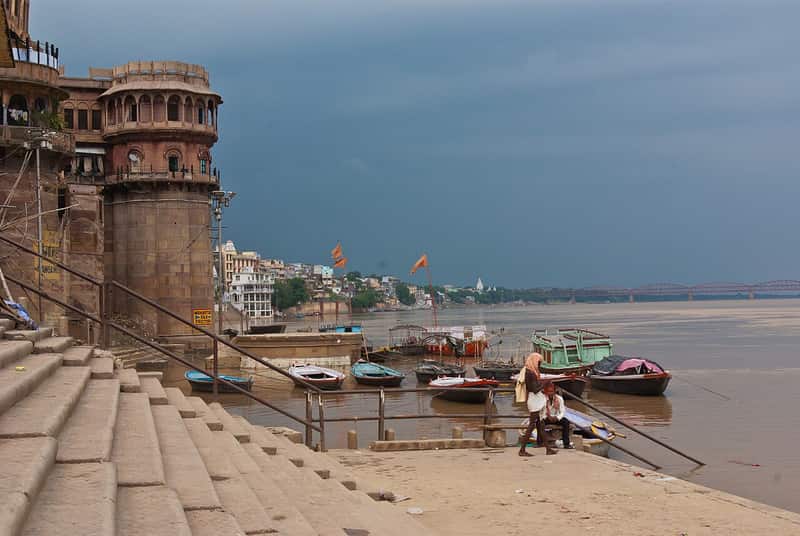
The architecture of Bhonsale Ghat is best understood in layers, from the waterline upward. At the base lie the ghat steps themselves, cut from the hard sandstone and quartzite of the Chunar region, worn smooth by two and a half centuries of bare feet, monsoon floods, and the constant rubbing of boat ropes. The steps are not uniform; they widen and narrow, break into platforms, and disappear beneath the river during high water, reappearing silted and refreshed when the floods recede. A stone pal that juts into the water serves as a landing point for boats, while the lower courses carry the deep notches carved by the mooring ropes of generations of boatmen. This is working architecture, built not for display but for the daily traffic of pilgrims, porters, washerwomen, and water-bearers who have moved up and down these stones in an unbroken rhythm for centuries.
Above the steps rises the palace facade, a composition of plain walls pierced by balconies that belong to different periods and repairs. The most striking elements are the jharokha windows, projecting bays of carved stone and wood where the ladies of the household once sat screened from public view, watching the festivals and the river traffic below. Cornices of moulded brick, arched doorways, and the remnants of lime plaster painted in ochre and faded indigo give the facade its painterly quality. Several balconies lean outward at angles that make engineers nervous, supported by iron struts and centuries of faith; their wooden floors have buckled, yet they remain charming, draped in creepers and used by pigeons and parrots. The overall impression is of a building that has been lived in, patched, and loved, its architecture a palimpsest of Maratha grandeur and later improvisation.
Behind the riverfront facade, the architecture continues into a warren of courtyards, corridors, and rooftops that few visitors ever see. The inner courtyard is open to the sky, ringed by double-storey verandas whose timber columns and brackets show the Deccan influence of the original builders. A disused well, a small shrine of Ganesha, and crumbling stairways lead up to flat roofs from which the entire sweep of the northern ghats unfolds like a map. On the land side, the palace merges with the dense fabric of the old city, its rear walls shared with neighboring houses, its passages connecting to the network of lanes that climb toward Bhainsasur. The architecture of Bhonsale is thus a hinge between two worlds: the open, luminous world of the river and the hidden, shadowed world of the Kashi streets.
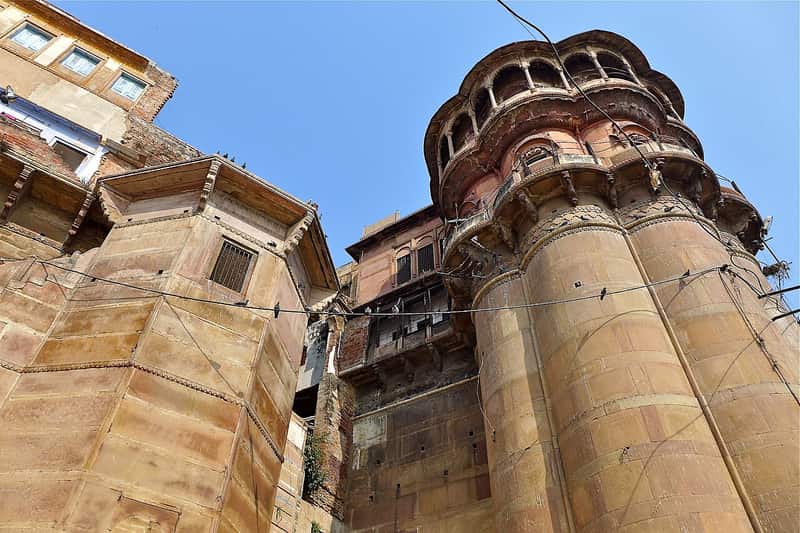
Daily Life at the Water
Bhonsale Ghat comes alive before sunrise, when the first pilgrims arrive with brass lotas and plastic buckets to perform their ablutions in the Ganges. The water here is cleaner than at the southern ghats, away from the main discharge of the city, and the current is strong enough to feel alive beneath the skin. Men wrap themselves in dhotis and duck under the surface three times, facing the rising sun; women, modestly screened by cloth held between them, repeat the same ritual in a quieter corner of the steps. Chanting mingles with the splash of water, and the priest of a small shrine on the upper level raises his voice in prayer. For the devout, this is the purpose of Kashi itself: a bath in the holy river at a ghat whose stones have absorbed the prayers of millions before them.
As the morning advances, the bathing ritual gives way to the ordinary business of the river. Washerwomen kneel at the water's edge, beating cotton saris against the stone in a rhythm as old as the city, while their children dry and fold the white fabrics that flutter along the steps like flags. Boatmen arrive to untie their vessels and ferry pilgrims across to the far bank or downstream to the other ghats; some sit mending nets or chewing paan while they wait for passengers. Water-carriers, sadhus, and tea sellers move through the crowd, and the smoke of a cremation on the adjoining stretch drifts across the scene as a reminder of the cycle of life in which this ghat participates. Despite the solemn associations of the neighborhood, the mood on the steps is brisk and cheerful, filled with the banter of people who have lived their whole lives on this patch of stone.
In the late afternoon the ghat belongs to the children and the bathers of the second shift. Schoolboys leap from the boat-landing into the green water; women of the neighboring lanes descend for their evening dips; and elderly men, who have bathed at this very spot for six decades, perform the sandhya rituals with unhurried concentration. Pilgrims sometimes light small lamps in the evening, setting them adrift on leaf boats so that the river twinkles with moving lights near the ghat's edge. For the visitor, the spectacle is less dramatic than the great aarti of Dashashwamedh but far more intimate — a real community conducting its most personal devotions in public, with the palace looming overhead like a silent ancestor. To bathe here, or merely to sit and watch, is to touch the enduring pulse of Varanasi itself.
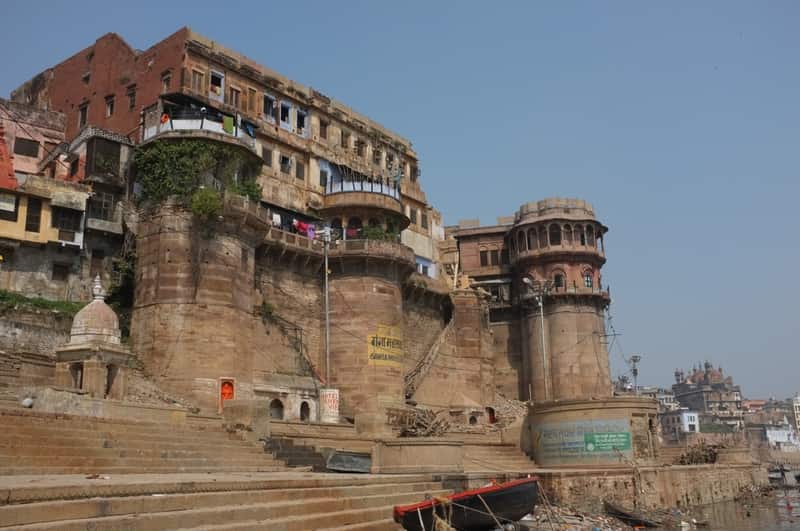
The River and the View
From Bhonsale Ghat the Ganges unfolds in one of its most beautiful northern reaches. Across the water lies the low sandbank of the far shore, changing shape with every monsoon, where herons stand motionless and buffaloes wallow in the shallows. Upstream, the ghats curve away toward Raj Ghat and the great new bridge that spans the river; downstream, the golden spire of the Kashi Vishwanath temple and the masts of the boat fleet rise above the rooftops of the old city. In the morning, the low sun paints the water gold and lays long shadows from the palace across the steps; in the evening, the reflected lights of the city quiver in the current like liquid candles. The river here is broad, slow, and immense, carrying the whole weight of the city's faith toward the sea.
The view is also a lesson in the geography of holiness. Just south of Bhonsale stand the cremation ghats of Manikarnika and Harishchandra, where the smoke of funeral pyres rises throughout the day, and to the north the sequence of residential ghats continues toward the unbuilt sands of the riverfront. Boats crossing from this ghat usually angle upstream first, fighting the current, then drift down past the burning ground, their passengers falling silent as they pass the flames. Fishermen cast their nets close to shore, and the occasional dolphin, one of the few remaining in the Ganges, surfaces in the deeper channel midstream. From the water, Bhonsale appears in its full majesty: the palace standing over the worn steps like a giant at the edge of the world, magnificent, ruined, and utterly at peace with its fate.
For those who prefer to watch from the steps, the river offers an endless, gentle spectacle. Boatmen ferry pilgrims and tourists in painted wooden vessels; barges loaded with sand crawl past under the power of sail and pole; and during festivals the water becomes a moving city of lamps and flags. Monsoon is the most dramatic season, when the swollen Ganges climbs the lower steps, swirls around the palace plinth, and carries the debris of the city's gardens downstream — a time when the ghat's fragile grandeur is most apparent. In the dry winter months, the river retreats, exposing mudbanks where children play cricket and sadhus practice their breathing. To sit at Bhonsale and watch the water is to understand why this river, among all rivers, is called the mother of the world.

The Lanes Behind the Ghat
Behind Bhonsale Ghat the city climbs steeply through one of the oldest and densest quarters of Varanasi. The lanes begin at the ghat's upper landing and rise through a labyrinth of staircases, overhanging houses, and tiny shrines to the market streets of Bhainsasur and beyond. These gullies are narrow enough that the balconies of facing houses almost touch, and daylight arrives as a pale stripe overhead; the walls are painted in the faded colors of the city — temple red, turmeric yellow, faded blue — and punctuated by centuries-old doorways with carved wooden frames. Here cows and goats share the stone-paved passages with porters carrying baskets of flowers, and the smells of incense, frying sweets, and open drains mingle in a perfume that is uniquely Kashi.
The neighborhood is a living museum of trades that have operated here for generations. Brass workers hammer out lotas and temple bells; flower-sellers string marigold garlands for the pilgrims heading to the river; and the small shops sell the paraphernalia of cremation and mourning — sandalwood, ghee, and simple cotton cloth — in an unflinching commerce that supports the burning ghats nearby. There are sweet shops famous across the city, their jalebis and barfis stacked in glowing pyramids, and tea stalls where boatmen argue about the river's moods over cutting chai. Small temple after small temple appears around every corner: Ganesha beneath a peepal tree, Hanuman in a recess of a wall, Shiva in a window niche, each with its own priest, its own oil lamp, and its own flock of devotees.
This quarter is also where the rhythms of death and devotion meet most closely in all of Kashi. Families carrying flower-draped biers move through these lanes toward the cremation ground; water-bearers fill their vessels at the ghat for the last rites; and yet children play, marriages are celebrated, and life continues with extraordinary resilience just metres from the pyres. The residents are used to visitors — photographers, filmmakers, and researchers drawn by the neighborhood's raw authenticity — and extend to them a matter-of-fact hospitality. To wander these lanes is to see Kashi without ornament: a city of extraordinary age still conducting its oldest habits, where the sacred and the ordinary are so thoroughly interwoven that neither can be imagined without the other. For the visitor, a few hours among these gullies reveal more of the city's soul than any temple tour, for here the divine is not visited but inhabited, shared at the doorstep and the stall as much as at the shrine.

Mir Ghat and Ganesh Ghat
Bhonsale Ghat is the centerpiece of a small cluster of ghats that share a single personality, each worth a few quiet minutes of exploration. Immediately to the south lies Mir Ghat, a modest bathing ghat that preserves the older, simpler character of the riverfront: plain stone steps, a small temple of Krishna, and a steady traffic of neighborhood bathers undisturbed by tourism. The ghat takes its name from a Mughal noble or saint remembered in local tradition, and its upper terrace offers one of the best angles for photographing the Bhonsale palace facade at sunset. Between Mir and Bhonsale a narrow lane descends to the water, busy with porters and water-bearers, and the boundary between the two ghats is so subtle that only the temple marks the change.
To the north, beyond a short stretch of crumbling embankment, lies Ganesh Ghat, named for the elephant-headed deity who is invoked at the beginning of every undertaking. The ghat is small and charming, its principal monument a neat shrine of Ganesha painted in vivid saffron, with a smaller image of Shitala Devi, the goddess of smallpox and skin diseases, tucked beside it. Worshippers stop here on their way to the cremation ground, for Ganesha is the remover of obstacles, and his blessing is sought before the final journey of the dead is begun. The ghat also supports a modest cremation platform used by the neighborhood, so the atmosphere, while not sombre, carries a particular gravity. Its steps are kept clean by volunteers, and in the winter sun it is one of the most pleasant spots along this stretch of the river to sit and idle.
Beyond these two neighbors the sequence continues to some of the most storied places in Kashi. A short walk or boat ride south brings the traveler to Manikarnika Ghat, the chief cremation ground of the city, where pyres have burned without interruption for millennia, and where the faithful believe a dying person is granted liberation. Slightly further lies the Jain temple of Chintamani Parshvanath, an island of sculpted calm in the cremation quarter, and then the great spread of Dashashwamedh Ghat, the center of the city's public ritual life. Walking or boating from Bhonsale through this progression is an education in the geography of the sacred, moving from palace grandeur to burning grounds to the great theater of the ghats. Taken together, Bhonsale, Mir, and Ganesh form a trio that shows the quieter, older Kashi — the city before the crowds, the stone before the tourists.
Reaching Bhonsale Ghat: Practical Notes
Bhonsale Ghat lies in the northern half of Varanasi's riverfront, about twenty minutes on foot from the great Dashashwamedh Ghat and rather longer from Godowlia crossing, depending on the crowd. The simplest approach is by boat: every morning and evening, shared and private vessels ply the water between the ghats, and a boat from Dashashwamedh to Bhonsale takes twenty-five to thirty minutes and reveals the entire northern riverfront in one sweep. By land, the traveler should aim for the Bhainsasur market and follow the lanes downhill toward the river, asking for bhonsale ghat at every turn; the path is part of the experience. Avoid vehicles in this quarter; the lanes are too narrow for cars, and the walk from the nearest road point is short. Boatmen charge a modest fee and may expect a little bargaining, while a longer boat excursion can combine Bhonsale with the burning ghats and the northern ghats beyond.
The best time to visit is early morning, between sunrise and nine o'clock, when the light falls softly on the palace walls and the ghat is alive with bathers and boatmen; photographers will find the hour after sunrise and the hour before sunset the richest for color. The winter months from October to February are the most comfortable, with clear skies and mild temperatures; summer is punishing but the river, and the shade of the palace, offer some relief. Monsoon, from July to September, floods the lower steps and makes boat landings unpredictable, though the spectacle of the swollen Ganges is memorable. Carry modest clothing, remove footwear before entering shrines, and be aware that the ghat sits near the cremation ground, where silence and respect are expected — photography of funeral rites is not appropriate.
For a fuller visit, combine Bhonsale with its neighbors and the sights above the ghat. Begin at Mir Ghat in the south, walk north through Bhonsale to Ganesh Ghat, and then climb through the lanes to the Manikarnika cremation ground and the temple of Chintamani Parshvanath; the loop can be done comfortably in two to three hours. Nearby attractions include the celebrated Kashi Vishwanath temple and the Banaras Hindu University beyond the old city, reachable by rickshaw or taxi from the main road. Allow time simply to sit on the steps: the ghat rewards idleness with glimpses of daily life that no guidebook can summarize. Whatever your purpose — photography, pilgrimage, or curiosity — Bhonsale Ghat asks only for time and attention, and gives back the deepest atmosphere the old city has to offer.
Bhonsale Ghat — Gallery (9 Photos)
Image Credits
bhonsale-01.jpg · bhonsale-02.jpg · bhonsale-03.jpg · bhonsale-04.jpg · bhonsale-05.jpg · bhonsale-06.jpg · bhonsale-07.jpg · bhonsale-08.jpg · bhonsale-09.jpg — Wikimedia Commons, under free licenses.
Continue exploring
Similar Ghats Nearby
Book This Ghat — Get Notified
Download the app now and book a boat ride to Bhonsale Ghat