
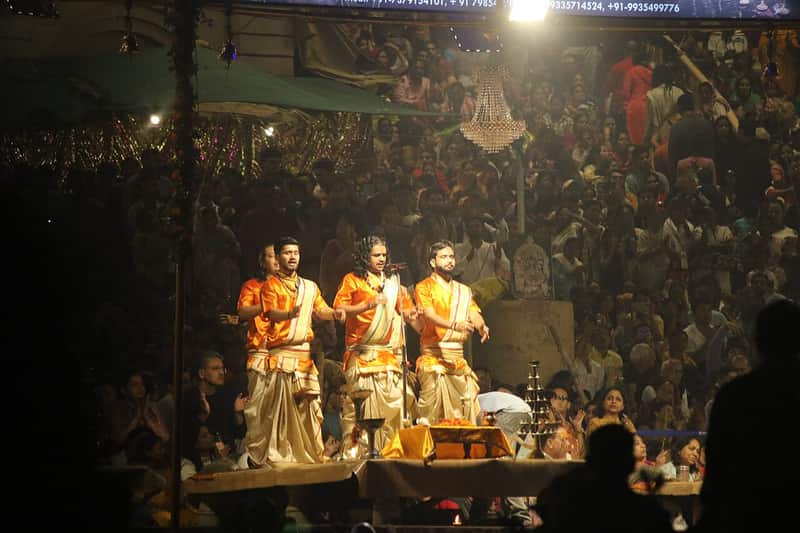
Every evening at Dashashwamedh Ghat the city gathers for the Ganga Aarti — the great sunset worship with as many as seven priests raising tiered brass lamps towards the river. It runs about forty-five minutes, the conch, bells and incense rising together over the water, and the whole crescent of ghats joins in. There is no entry fee for the steps and no bad seat from the river; it is simply the most famous nightly ceremony of India, and a full-hearted welcome for anyone who comes.
What the aarti is
The ceremony is a fire offering — literally an aarti — that the priests perform with plates of flame, circling the lamps in slow, synchronised arcs above the water. Behind them, chanters, conch-shell blowers and a bell masala of percussion keep a deep rhythm going through the whole forty-five minutes.
Around them, rings of thousands of watchers clap, chant and cup their hands towards the flame; the light of the lamps travels off the water, and the noise of the city falls away. Its equality is the point: priest and pilgrim, all in the same tide of sound.
Dashashwamedh: the show at the centre
The Dashashwamedh Aarti is the biggest and the most theatrical performance on the ghats: upto seven priests in matching waist-cloths, a seven-tiered brass lamp each, and the fire placed at the very feet of the river. Dashashwamedh catches the evening light first, and its steps are the most famous in Asia.
The proper name is Dashashwamedh — from the legend of Brahma sacrificing ten horses here — and it sits at the start of the great evening aarti centuries old. Around 6 PM, hour by hour, the crowds begin to fold in.
Where to stand, what to pay
| The steps | Free. Arrive 60-90 minutes early for a step with a view; bring a mat or shawl. |
| VIP benches | ₹150-500 per seat, near the platform — book at the booth beside the stage. |
| Shared boat | ₹200-400 per person, the best water seat, arranged at any ghat boat line. |
| Private boat | ₹1,200-2,000 per boat for the family — rows facing the platform, no elbows. |
The seasonal clock
| April-September | 7 PM start — long days, later dusk. |
| October-March | 6 PM start — the winter schedule, the prettiest international. |
| Dev Deepawali | Nov 24, 2026 — the big one: a million lamps on all 84 ghats and the aarti at full scale; book boats 4-6 weeks ahead. |
To the steps like a local
Arrive early, always
The steps fill fast; 60 minutes ahead for a place, 90 for a place with a view.
Avoid the touts
Official boat lines and the VIP booth are marked; anyone pulling you aside is a commission hunter.
No waterfront cash
Pay for VIP and boats in advance, carry small fold for tea; keep wallets dry and dock-safe.
Quick Takeaway
- ✓ Evening: 7 PM Apr-Sep, 6 PM Oct-Mar, 45 min.
- ✓ Steps free — arrive 60-90 min before.
- ✓ Shared boat ₹200-400 / private ₹1,200-2,000.
- ✓ Dev Deepawali on Nov 24, 2026: book boats early.
Quick Answers
What time does the evening aarti start?
7 PM April through September, 6 PM October through March, lasting about 45 minutes. Arrive well ahead for the steps.
Do I need to pay to watch?
The steps are free for everyone. Paid: VIP benches at ₹150-500 and boats ₹200-400 shared, ₹1,200-2,000 private.
Where do I find the boats?
Rent from the boatmen at Dashashwamedh itself, or better, walk five minutes to the quiet ghats like Assi and row up with the aarti.
Can I join the ceremony?
You can stand and pray with the crowd anywhere on the steps, and respectfully watch the priests at work. The inner ritual circle itself is reserved for the performers.
Is the Dev Deepawali aarti more special?
Yes — it is the annual festival of the ghats: over a million lamps line all 84 ghats, the aarti goes full scale, and the city bursts into light. Book accommodation and boats weeks early.
What time is the morning aarti?
The morning version is Assi Ghat's Subah-e-Banaras: 5 AM in summer, 5:30 AM in winter, running till about 7 — a quieter, smaller look at the rite.
More Guides in explore
📅 Last updated: 21 Aug 2026 · Author: NaviX Field Team (field research 2024-26)
Sources: UP Tourism, Varanasi Smart City, IIT-BHU, GI Registry · Emergency Contacts