
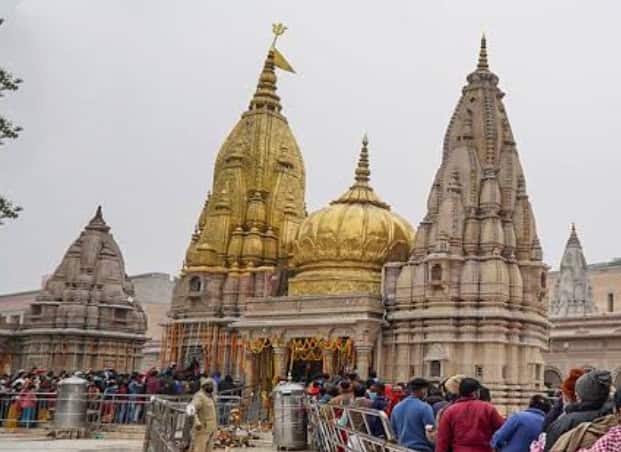
Shri Kashi Vishwanath is one of the twelve jyotirlingas and the religious heart of Varanasi, a gold-spired temple buried in the oldest lanes of the city. General darshan is free and runs from 4 AM to 11 PM, while the Mangla Aarti at 3-4 AM is the first and most wanted ticket of the day, priced at ₹350 and rising to ₹1,800 on Mahashivratri. The temple runs on a rhythm: light crowds in the 4-6 AM window, calm after 8 PM, and Mondays, Fridays and the whole Shravan month as the heavy days.
The jyotirlinga
Kashi Vishwanath is one of the twelve jyotirlingas, the sites where Shiva is worshipped as a column of light. The temple sits in the middle of the old city, and nearly every lane of Varanasi leads here sooner or later. The golden spire you see from the ghats is this temple, and the whole neighbourhood hums around it from first light to the last aarti.
The structure standing today took shape in the 18th century under Rani Ahilyabai Holkar, and the gold plating arrived in 1835 from Maharaja Ranjit Singh. Walk the old lanes before the darshan and the arrival feels earned, not rushed.
The Mangla Aarti ladder
Normal days
₹350 at 3-4 AM, the first aarti of the day and the most wanted seat.
Shravan month
₹600 across July-August, the whole month of Shiva.
Shravan Monday
₹1,200; the most crowded aarti of the month.
Mahashivratri
₹1,800, and the tickets are gone a day ahead.
The counter
official counters inside the complex only; online booking and the help desk near Shapuri Mall cover the special dates.
The aarti clock
| Bhog Aarti | ₹180, 11:15 AM to 12:20 PM, the midday offering of food. |
| Saptarishi and Sandhya Aarti | ₹18, 7:00 to 8:15 PM, the first evening aarti. |
| Shringar Aarti | ₹180, 9:00 to 10:15 PM, the night aarti. |
| Shayan Aarti | free, 10:30 to 11:00 PM, when the deity is put to rest. |
| General darshan | free, 4 AM to 11 PM, every day. |
| Sugam fast darshan | ₹300, 6 AM to 6 PM, through a separate corridor. |
General darshan and the Sugam pass
General darshan is free and runs from 4 AM to 11 PM — a slow, respectful line through the corridors. On an ordinary day it moves well; on Mondays, Fridays and Shravan days it stretches, so pick the window when you can.
The Sugam fast darshan costs ₹300 and runs from 6 AM to 6 PM through its own corridor, which cuts the waiting sharply. At peak hours it is the best ₹300 you can spend in the city; on slow mornings the normal queue is perfectly fine.
The best windows
4 to 6 AM
the calmest darshan of the day, right as the temple settles into its morning.
After 8 PM
the night window, with the shortest evening lines before the Shayan aarti.
Mondays and Fridays
the two crowd peaks; come only if the aarti is the goal.
Shravan month
festival hours 6 AM to 11 PM and crowds that fill the whole corridor.
Night darshan
The temple stays open until 11 PM, and the night hours are a different place: the lanes calm down, the corridor cools, the queues shorten. The Shayan Aarti at 10:30 PM is free, and watching the deity being put to rest is the quietest way to close the day.
The 8 to 10 PM stretch is the best evening window for the general line. Combine it with a slow walk of Vishwanath Gali, when the shops thin out and the temple bells carry farther.
The ticket desk
Reaching the temple
Vishwanath Gali
pedestrian-only; autos stop at the edge of the lane.
The corridor
a no-vehicle zone; vehicles stop about 1.5 km away.
The drop point
Godowlia or the corridor gate, then a short walk through the lanes.
Bookings
the help desk near Shapuri Mall handles tickets and special darshan passes.
Phones, leather and the dress code
The Vishwanath Corridor
The corridor opened in December 2021 and connects the temple to the river at Lalita Ghat through marble galleries and carved walls. It changed the approach completely: visitors now enter through a clean, guarded stretch instead of the old squeeze of the lanes.
Inside the temple core, only Hindus are allowed, and photography and phones are not permitted at all. Phones and jewellery go into the lockers before you join the inner line.
Sacred lines
One line, one pace
keep the queue moving quietly; no stopping for selfies.
Minimum things
no phone, no bag, no jewellery in the inner line.
The volunteers
uniformed staff guide the queue; follow them, not the touts at the gate.
Donations
voluntary, at the official counters only — the touts are not the temple.
Annapurna and the neighbours
| Annapurna Temple | 5 AM to 9:30 PM, the goddess of food right beside Kashi Vishwanath, a ten-minute visit; the flower-seller lanes cluster around it. |
| Tulsi Manas Mandir | 5:30 AM to 9 PM; marble walls, air-conditioned, the Ramcharitmanas read aloud through the day. |
| Durga Temple | 5 AM to 9:30 PM, red walls and resident monkeys; Navratri brings the heaviest rush. |
| Sankat Mochan | about 5 AM to 10 PM; founded by Tulsidas, famous for besan laddus, crowded on Tuesdays and Saturdays, wheelchair-accessible. |
The wider temple map
| Bharat Mata Temple | 9:30 AM to 8 PM, free; a marble relief map of India inside the BHU campus; Gandhi visited in 1936. |
| Swarved Mahandir | 6 AM to 8 PM; seven floors in Umraha with 20,000+ verses on the walls. |
| Markandey Mahadev | 5 AM to 10 PM; a serene, quiet riverside temple with almost no crowd. |
| BHU New Vishwanath | a marble temple on the BHU campus with a tall shikhara; serene and low on crowds. |
Festival timings
| Shravan month | extended hours 6 AM to 11 PM; Mangla at ₹600, ₹1,200 on Mondays. |
| Mahashivratri | Mangla at ₹1,800 at 3-4 AM, the festival of the long night. |
| Mondays and Fridays | the crowd peaks; the general line moves slow. |
What to carry
The practiced morning
Quick Takeaway
- ✓ General darshan 4 AM to 11 PM, free entry.
- ✓ Mangla Aarti ₹350; ₹1,800 on Mahashivratri.
- ✓ Sugam fast darshan ₹300, 6 AM to 6 PM.
- ✓ Best windows: 4-6 AM and after 8 PM.
Quick Answers
Can non-Hindus enter the temple?
The inner sanctum is open only to Hindus. The temple courtyard, the corridor and the river side stay open to everyone, and the lanes around carry the atmosphere anyway.
Where do I buy the Mangla Aarti and Sugam tickets?
At the official counters inside the temple complex, online, or at the help desk near Shapuri Mall — cash or UPI. Special darshan bookings need an ID; for Shravan Mondays and Mahashivratri buy a day ahead because the aarti seats sell out first.
What do I do with my phone, shoes and leather items?
Shoes stay at the counter near the gate. Phones, bags and jewellery go into the paid lockers — nothing electronic enters the inner sanctum. Leather is completely banned inside the temple.
What is the calmest time for darshan?
The 4-6 AM window right after opening is the calmest, and the evening queues thin out again after 8 PM. Mondays, Fridays and the whole Shravan month are the heavy hours.
Is photography allowed inside?
No photography inside the temple or the inner sanctum, and phones stay out of the inner Line. The corridor, the ghats and the temple exterior are all photographable from outside.
What should I wear?
Modest, covered clothing — shoulders and knees covered. Remove your shoes at the gate, carry no leather, and remember that the 4 AM winter darshan needs a warm layer while summer mornings warm up fast.
Is the temple open late?
Yes — general darshan runs till 11 PM and the free Shayan Aarti at 10:30 PM is one of the quietest moments of the day. The temple proper opens at 2:30-3 AM for its priests.
What changes on festival days?
In the easy month the temple keeps extended hours 6 AM to 11 PM and the Mangla price rises to ₹600, or ₹1,200 on a Monday. On Mahashivratri the charge is ₹1,800. Book the Sugam pass early anytime your visit falls on such days.
More Guides in explore
📅 Last updated: 21 Aug 2026 · Author: NaviX Field Team (field research 2024-26)
Sources: UP Tourism, Varanasi Smart City, IIT-BHU, GI Registry · Emergency Contacts