

Photography Tips
Varanasi Street Photography Guide
Capture the soul of the world's oldest living city through your lens with expert guidance on locations, timing, and technique.
Why Varanasi is a Photographer's Paradise
Varanasi is arguably the most photogenic city in India. The ancient ghats, narrow winding lanes, colorful temples, and vibrant daily life create a rich visual tapestry that attracts photographers from every corner of the globe. The unique combination of sacred rituals, bustling markets, and intimate human moments makes every corner of Varanasi a potential photograph waiting to happen.
The city's visual appeal comes from its layers of history and contemporary life existing side by side. Ancient stone steps meet modern signage, traditional boats share space with floating markets, and the timeless rituals of worship continue against a backdrop of daily commerce. This juxtaposition creates powerful visual narratives that define Varanasi's unique photographic character. From the grand ceremonial scenes at Dashashwamedh Ghat to the quiet, contemplative moments in hidden temple courtyards, the range of subjects is unparalleled.

Best Time of Day for Photography
Golden Hour - Sunrise (5:30-7 AM)
The absolute best time for Varanasi photography. Warm, soft light bathes the east-facing ghats, creating golden tones on ancient stone. Fewer tourists mean cleaner compositions and more authentic street scenes. Fishermen cast nets, priests perform morning rituals, and the city slowly awakens. The mist rising off the Ganga adds an ethereal quality that disappears by 7:30 AM.
Golden Hour - Sunset (4:30-6 PM)
Evening golden hour offers dramatic warm light on the west-facing ghats and temple silhouettes. The golden dome of Kashi Vishwanath glows spectacularly at sunset. The ghats fill with people enjoying the evening - families, sadhus, flower sellers - creating rich street photography opportunities. The transition from golden hour to blue hour adds a magical quality to the final 30 minutes.
Blue Hour - Twilight
The 30-minute windows just before sunrise and just after sunset produce a cool blue tone that creates mood and atmosphere. Temple lights begin to glow against the deepening blue sky. The combination of warm artificial light and cool natural light creates a cinematic quality. Tripod essential - exposures range from 2-15 seconds. Best for ghats and architectural shots.
Midday (10 AM-3 PM)
Harsh overhead light makes most outdoor photography challenging, but Varanasi's narrow lanes turn this into an advantage. The tall buildings create dramatic shafts of light and deep shadows that work beautifully in black and white. Midday is also perfect for indoor photography - temple interiors, artisan workshops, and market scenes with their own light sources and rich colors.
Top 15 Photography Locations
These locations are arranged in no particular order. Each offers something unique. Visit at the recommended time for the best results. All locations are accessible on foot or by a short auto-rickshaw ride.
1. Dashashwamedh Ghat - Evening Aarti
Best at 6-7 PM. The grand aarti ceremony is the most photographed event in Varanasi. Use a telephoto from the upper steps for priest portraits, or wide-angle from the water for the full scene. The fire creates spectacular long exposures.
2. Assi Ghat - Sunrise
Best at 5:30-6:30 AM. People meditating, doing yoga, and performing morning puja. The gentle east-facing light is perfect for portraits. Look for the iconic shot of a lone figure sitting on the ghat steps with the river stretching behind them.
3. Manikarnika Ghat - Life and Death
Operates 24/7. India's most sacred cremation ghat. Approach with extreme respect and sensitivity. Ask permission before photographing. The smoke, fire, and rituals create powerful, contemplative images that speak to the cycle of life.
4. Narrow Lanes of Old City
Any time of day. The winding alleys between the ghats reveal hidden courtyards, colorful doorways, cats sleeping on ledges, and vendors calling out their wares. The tall buildings create dramatic light shafts - follow the light for the best shots.
5. Kashi Vishwanath Corridor
Best in early morning. The modern corridor features carved stone walls with mythological scenes. The grand entrance gates and the approach to the golden dome create powerful symmetrical compositions. Crowds thin out before 8 AM.
6. Ramnagar Fort - Sunset
Best at 4-6 PM. Cross by boat for the journey itself (photograph the ghats receding). The fort walls, Mughal arches, and vintage car collection offer diverse subjects. The view back toward the city at sunset is spectacular.
7. Tulsi Manas Temple - Architecture
Morning light best. White marble temple with carved scenes from the Ramcharitmanas on its walls. The clean, bright interior is perfect for detail shots. The surrounding gardens add a peaceful element to compositions.
8. Durga Kund - Colors and Monkeys
Best in morning or late afternoon. The red sandstone temple reflected in the sacred kund creates mirror images. The resident monkey population adds dynamic, unpredictable elements. Watch your gear closely around the monkeys.
9. BHU Campus - Campus Life
Best during golden hour. Students, the massive New Vishwanath Temple, tree-lined avenues, and a relaxed atmosphere away from the old city crowds. Cultural events during university festivals provide rich photography opportunities.
10. Sarnath - Ruins and Museum
Best at 8-10 AM. The Dhamek Stupa, monastery ruins, and archaeological museum offer a change of pace. Buddhist monks in meditation, ancient stone carvings, and the peaceful park setting provide contemplative subjects.
11. Godowlia Market - Street Life
Best in morning or evening. Bustling market scenes, flower sellers creating garlands, sweet shops displaying mithai, and the chaotic beauty of an Indian bazaar. The narrow covered market creates interesting light patterns.
12. Nepali Temple (Lalita Ghat)
Morning light best. The pagoda-style wooden temple is architecturally unique. Carved wooden struts, multi-tiered roofs, and the contrast with surrounding stone temples offer diverse compositions.
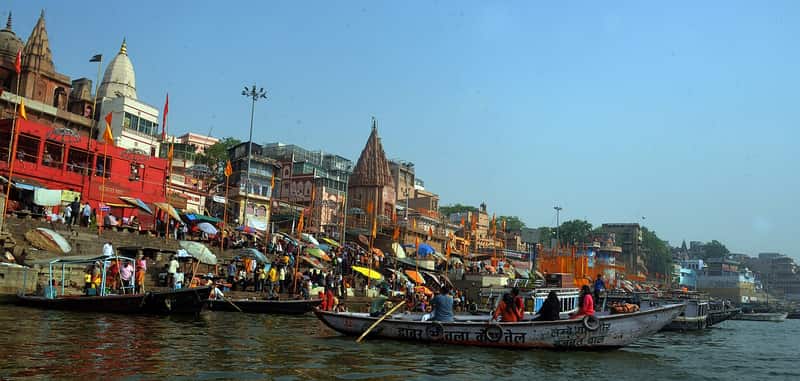
13. Boat Photography - The Ganga
Sunrise or sunset. Hire a boat and photograph the ghats from the water. The receding perspective of the ghat steps, the boatmen rowing, and the river life offer unique vantage points unavailable from land.
14. Evening Chai Stalls
Evening. The glowing tea stalls with warm light, clay cups (kulhads), and steam rising in the cool evening air create atmospheric shots. The kulhar chai culture is quintessentially Varanasi.
15. Ashram Steps - Daily Life
Any time. Small ashrams along the ghats have daily rhythms - morning prayers, evening bhajans, monks in discussion. The steps outside ashrams are social spaces where philosophy meets chai. Candid moments happen naturally.
Photography Image Gallery




Camera Settings for Different Scenarios
Evening Aarti (Handheld)
Mode: Manual or Shutter Priority. ISO: 1600-3200. Aperture: f/2.8. Shutter: 1/125s minimum to freeze priest movement. Metering: Spot meter on the fire to preserve flame detail. Shoot in RAW. White balance: Auto or Daylight. Continuous autofocus with face detection if available. Burst mode for the climax when diyas are released onto the Ganga.
Evening Aarti (Tripod Long Exposure)
Mode: Manual. ISO: 400. Aperture: f/8. Shutter: 10-30 seconds. Use a remote release or 2-second timer. The long exposure creates flowing fire trails and smooth water reflections. Experiment with 2-5 second exposures to balance fire detail with light trail effects. The floating diyas create beautiful light streams in 15+ second exposures.
Street Portraits
Mode: Aperture Priority. ISO: 200-800. Aperture: f/2.8-f/4 for subject isolation. Shutter: 1/250s minimum. Focus: Single point on the nearest eye. If the subject is backlit, use +1 to +1.5 exposure compensation. Always ask permission first - a smile and Namaste go further than any camera setting.
Narrow Lanes (Black and White)
Mode: Manual or Aperture Priority. ISO: 400-1600. Aperture: f/2.8-f/5.6. Set camera to monochrome picture style to visualize contrast in real-time. Expose for highlights to create deep shadows. The high-contrast light shafts in Varanasi's narrow alleys are made for dramatic black and white compositions.
Ghat Scenes (Sunrise)
Mode: Aperture Priority. ISO: 100-400. Aperture: f/8-f/11 for deep depth of field. Use a polarizing filter to reduce river glare and enhance sky color. Bracket exposures (+/- 1 EV) for high-contrast scenes with bright sky and dark ghats. The warm golden light at sunrise requires minimal white balance adjustment.
Night Photography
Mode: Manual (tripod essential). ISO: 400-800. Aperture: f/5.6-f/8. Shutter: 5-30 seconds. Use live view for precise focus in low light. Manual focus with magnified live view ensures sharp results. The illuminated ghats against dark skies require careful exposure to balance bright highlights with deep shadows.
Photography Ethics and Cultural Sensitivity
Asking Permission
While there is no legal requirement for permission in public spaces, it is respectful to ask before photographing individuals closely, especially at religious sites. Learn basic Hindi: "Photo le sakta hoon?" (May I take a photo?). Many locals are happy to be photographed. Show them the result on your screen - this builds trust and often leads to more natural, relaxed portraits.
Religious Sensitivity
Never photograph cremation ceremonies at Manikarnika Ghat without explicit permission. Do not use flash inside temples. Avoid photographing women at prayer without asking. During aarti, keep your camera below the level of the performing priests as a sign of respect. Some sadhus may expect a donation (50-100 rupees) in exchange for photographs.
Respecting Subjects
If someone says no, respect their wishes immediately and graciously. Never photograph children without parental consent. The best street photography comes from genuine human connections, not from exploiting subjects. Build rapport first - share chai, have a conversation, then ask for the photo. Patience and respect always produce better images.
Giving Back
Consider sharing your photos with the subjects. If you plan to publish or sell your Varanasi photographs, consider donating back to the community. Some photographers return with printed photos for their subjects - a meaningful gesture that builds lasting connections between photographer and community.
Photographing Children
Varanasi's children are often eager to be photographed. Always seek permission from a parent or guardian first. Show the children their photos - they love seeing themselves on the screen. Avoid staged shots that exploit poverty. The most respectful approach is to photograph children playing, learning, or helping their families in natural, dignified contexts.
Monsoon Photography Tips
Monsoon (July-September) offers dramatic skies, reflections on wet ghats, and moody atmosphere. Carry a rain cover for your camera. Humidity can fog lenses - keep silica gel packets in your bag. The overcast light during monsoon is excellent for portraits as it acts as a natural softbox, creating even, flattering light without harsh shadows.
Gear Recommendations
Varanasi rewards versatile, lightweight gear. You will be walking 10-15 km daily on uneven ghat steps and through narrow lanes. Here is what to bring and what to leave behind:
Essential Kit
- Camera body: Any mirrorless or DSLR. Mirrorless preferred for lighter weight and silent shooting.
- 24-70mm f/2.8: The workhorse lens - covers landscapes, street scenes, and environmental portraits.
- 50mm f/1.8: Affordable, lightweight, and excellent for portraits and low-light street work.
- Sturdy tripod: Essential for night and aarti photography. Carbon fiber for weight savings.
- Extra batteries (3+): Cold nights and long days drain batteries faster than expected.
- Memory cards (128GB+): You will shoot more than you think. RAW files are large.
Optional but Useful
- 16-35mm wide-angle: For tight lanes and architectural details where 24mm is not wide enough.
- 70-200mm telephoto: For ghat scenes from a distance and candid portraits without intruding.
- Circular polarizer: Reduces river glare, enhances sky contrast, deepens colors.
- Rain cover: Monsoon-proof your gear. A simple plastic bag works in a pinch.
- Lens cleaning kit: River humidity creates condensation. Microfiber cloth essential.
- Headlamp: For navigating ghat steps at night while keeping hands free for camera.
Where to Buy Gear in Varanasi
Camera shops are concentrated in Godowlia and Thatheri Bazaar areas. You can find memory cards, batteries, cleaning kits, and basic accessories. For serious gear repairs, shops near Dashashwamedh Ghat can handle minor fixes. The main electronics market near BHU also has camera accessory shops. For high-end gear, consider ordering online before your trip.
What to Leave Behind
Avoid heavy studio equipment. Leave flashguns at home (natural light is more authentic and less intrusive). Skip the drone - flying drones near temples and ghats is restricted and culturally inappropriate. Keep your kit to two lenses maximum. The best camera in Varanasi is the one you have with you, ready to shoot.
Photography Walking Routes
Three curated routes designed to maximize your photography output while covering the most photogenic areas of Varanasi. Each route is timed for specific lighting conditions.
Route 1: Sunrise Ghat Walk (5:00-8:00 AM)
Start at Assi Ghat (5:00 AM) for pre-dawn blue hour shots. Move north through Tulsi Ghat, Hanuman Ghat, and Traivenu Ghat as the sun rises, capturing morning rituals, yoga practitioners, and the city awakening. End at Dashashwamedh Ghat (8:00 AM) as the morning bustle begins. Distance: 3 km. Time: 3 hours. This route faces east, catching the full golden hour.
Route 2: Old City Lane Exploration (10:00 AM-1:00 PM)
Start at Godowlia market (10:00 AM) for bustling market scenes. Navigate the narrow lanes toward Kashi Vishwanath Temple, capturing flower sellers, sweet shops, and hidden doorways. Continue through the old city to Manikarnika Ghat area, then loop back through different alleys. Focus on high-contrast black and white in the dramatic lane light. Distance: 4 km. Time: 3 hours.
Route 3: Evening Aarti and Night Walk (4:30-9:00 PM)
Start at Durga Kund (4:30 PM) for late afternoon temple shots. Walk to Sankat Mochan Temple, then continue to Assi Ghat for sunset. Walk the ghat promenade north to Dashashwamedh Ghat for the 6:45 PM aarti. Capture the ceremony from multiple angles. After the aarti, photograph the floating diyas and night scenes of the ghats. Distance: 5 km. Time: 4.5 hours.
Common Mistakes to Avoid
Over-Touristing the Ghats
Most photographers stick to Dashashwamedh and Assi ghats. The real magic lies in the lesser-known ghats - Tulsi, Chausathi Ghat, or Rajendra Prasad. These offer more authentic scenes with fewer tourists and more genuine local life. Wander beyond the obvious for unique images.
Shooting Too Fast
Varanasi overwhelms the senses, and photographers often rush from scene to scene. Slow down. Spend 20 minutes at one ghat, observe the patterns, wait for the right moment. The best photographs come from patience, not from clicking rapidly. Quality over quantity, always.
Ignoring the Human Element
Architecture and landscapes are stunning, but the soul of Varanasi is its people. A portrait of a flower seller, a priest preparing for aarti, or a boatman rowing at dawn tells a deeper story than any building alone. Do not be shy - most Varanasi locals are warm and welcoming to respectful photographers.
Over-Processing in Post
It is tempting to crank up saturation and contrast to make Varanasi photos pop. Resist. The city's natural colors - the saffron of temple flags, the gold of the Ganga, the terracotta of the ghats - are already vivid. Over-processing destroys the authentic atmosphere that makes Varanasi special. Subtle, natural edits always look better.
Frequently Asked Questions
What are the best times for street photography in Varanasi?
Do I need permission to photograph people in Varanasi?
What camera settings should I use for the evening aarti?
What is the best lens for Varanasi street photography?
Where can I buy camera gear in Varanasi?
Is monsoon a good time for photography in Varanasi?


Capture Varanasi
Download the Navix Kashi app for photography spot guides, walking routes, and golden hour alerts.
Download the App