
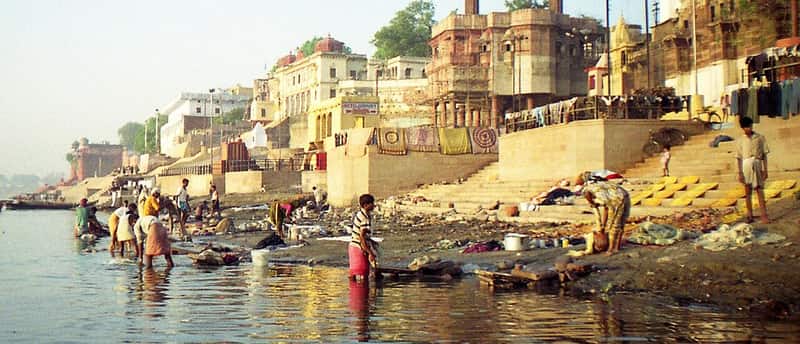
The ghats of Varanasi form the longest riverside stairway in the world: 90 stone landings strung along a seven-kilometre crescent of the Ganga, each with its own name, story and mood. Walking them is the truest way to see the city — every few hundred metres the world changes, from sandalwood smoke to temple bells, boatyards to kirtan. The classic walk is the three kilometres from Assi to Manikarnika, and it can take a hurried hour or a long, lazy morning. This guide walks it with you, stretch by stretch.
The shape of the crescent
Number 1 is Assi Ghat at the mouth of the Assi stream, and number 84 is Adi Keshava, up near the Raj Ghat bridge in the northern part of the city. Between them the ghats carry a thousand years of riverbank life: royal masonry, temples standing half in the water, cremation platforms of great age, and the daily business of a city whose front door is made of stone steps.
The southern stretch — Assi to Dashashwamedh — is where the postcards are made. The northern half, past Manikarnica, turns quieter and rougher, where the wood for the fires, the fishermen and the city laundry take over.
Assi to Dashashwamedh: the classic stretch
Assi Ghat
Number 1. Sunrise concerts, yoga mats and the pipal tree with the Shiva lingam that marks the start of the walk.
Tulsi Ghat
Where the poet-saint Tulsidas lived and wrote; at festival time the classical music evenings happen on its pavements.
Kedar Ghat
A rising tier of painted houses and the yellow-towered Kedareshwar temple, with strong South Indian connections.
Scindia Ghat
The half-sunk Shiva temple leaning into the water — the most photographed frame of the city, best in evening light.
Man Mandir Ghat
The old stone observatory of Raja Man Singh of Jaipur, with carved dials and instruments on the rooftops.
Dashashwamedh Ghat
The nerve centre of the evening aarti — crowded, bright and alive every single day.
How the aarti works
The priests stand on a raised platform as many as seven at a time, some with snake flutes, some with fifteen-tiered brass lamps. The soundtrack is percussion as old as the ghats: conch, bells, shankh, a hypnotic chant in reply. The ceremony runs about forty-five minutes, and it ends when the aarti plate sweeps the darkness — a wave of movement like the river itself.
The skill is in the plate: each priest sweeps a huge lamp in slow circles — the flame writing patience into the smoke. Watch one priest all the way through; the full arc of arm, lamp and fire is the actual prayer.
Where to stand and what things cost
| The steps | Free — but arrive 60 to 90 minutes early and bring something to sit on. |
| VIP seats | ₹150 to ₹500 per person, booked at the booth near the platform — a pillar view without the shove. |
| Boat, shared | Around ₹200 to ₹300 per person — the most popular ring-side view from the water. |
| Boat, private | ₹1,200 to ₹2,000 for the boat — room for the family, a steady railing and no elbows. |
Winter and summer, aarti by aarti
| April to September | 7 PM start — the summer formula, with short evenings. |
| October to March | About 6:00 PM — the winter briefing, so the full dark spectacle fits the evening. |
| The morning surprise | The Subah-e-Banaras concert at Assі, 5 AM in summer / 5:30 AM in winter — the aarti of the dawn, smaller, quieter and free. |
Etiquette in the crowd
If this is your first aarti
Arrive very early
Sixty to ninety minutes before start for the steps; a little later for a poolside boat — but they sell off fast.
Respect the fire
The area around the lamps is fire-blessed; stay a safe distance and let the priests do their work.
Take the water view
If the crowd offends you, the only better view is from the water — the whole row of ghats light up at once.
Quick Takeaway
- ✓ Evening aarti: 7 PM Apr-Sep, 6:30 PM Oct-Mar, 45 min.
- ✓ Steps free; arrive 60-90 min early.
- ✓ Shared boat ₹200-300; private ₹1,200-2,000.
- ✓ Morning aarti at Assi: 5 AM summer / 5:30 AM winter.
Quick Answers
What time does the Dashashwamedh aarti start?
About 7 PM from April to September and about 6:30 PM from October to March, lasting roughly 45 minutes. Arrive an hour earlier for a step with a view.
Is the aarti free to watch?
Yes — the steps are completely free. Paid options are VIP seats (₹150-500) and boats (shared ₹200-300, private ₹1,200-2,000).
Which is better for photos, land or boat?
The boat gives you the whole mirror — the golden sherwar going to the lights. From the steps you get the closer drama of the flames and the crowd. Both worth one night.
Can I take photos during the aarti?
Yes, with respect — phones and cameras are everywhere, but keep the flash off and do not block others. The mirrors in the crowd slice equally.
What should I bring?
A light mat or shawl for the steps, a warm layer in winter, water, and patience. Leave your bag zipped and your chhand busy.
Is there a morning aarti too?
Yes — the Subah-e-Banaras at Assi Ghat, 5 AM in summer and 5:30 AM in winter: a small aarti with sunrise songs that runs about an hour. Fewer crowds, extra soul.
More Guides in explore
📅 Last updated: 21 Aug 2026 · Author: NaviX Field Team (field research 2024-26)
Sources: UP Tourism, Varanasi Smart City, IIT-BHU, GI Registry · Emergency Contacts