
Ten kilometres north-east of the ghats, the clamour of Kashi fades into something older and quieter. Sarnath is where the Buddha, after his enlightenment at Bodh Gaya, preached his first sermon in the deer park of Isipatana — setting in motion a teaching that would circle the world. A day trip from Varanasi takes you through red-brick ruins, the greatest Buddhist museum in India, and temples built by countries the Buddha never knew existed.
Key Takeaways
- The Deer Park and the First Sermon
- Dhamek Stupa: The Great Brick Mound
- The Sarnath Museum: The Lion Capital and Its Treasures
- Temples of Many Nations: Thai, Chinese and Tibetan
The Deer Park and the First Sermon
The story begins with five ascetics. After Siddhartha Gautama attained enlightenment under the Bodhi tree, he walked to the deer park at Isipatana, where his former companions were still practising austerities. There, on the full moon of Ashadha, he delivered the Dhammacakkappavattana Sutta — the sermon that set the wheel of dharma in motion — and the five men became his first disciples. That single afternoon, in a quiet grove near a royal deer park, became the founding moment of the Buddhist sangha, and the park has been sacred ever since. The name Sarnath itself descends from Saranganatha, the Lord of the Deer.
To walk the same ground is to feel the weight of that beginning. The deer are still here — a herd lives in the enclosures near the museum, descended from the deer of the legend, tame enough to approach. Monks from Thailand, Tibet, Japan and Sri Lanka walk the same paths, and the lawns carry the same hush that a first sermon deserves. For visitors who know the story, the park is not simply an archaeological site; it is the physical address of a moment that changed the intellectual history of Asia. Stand by the central garden, close your eyes for a minute, and the sermon feels twenty-five centuries fresh.
Dhamek Stupa: The Great Brick Mound
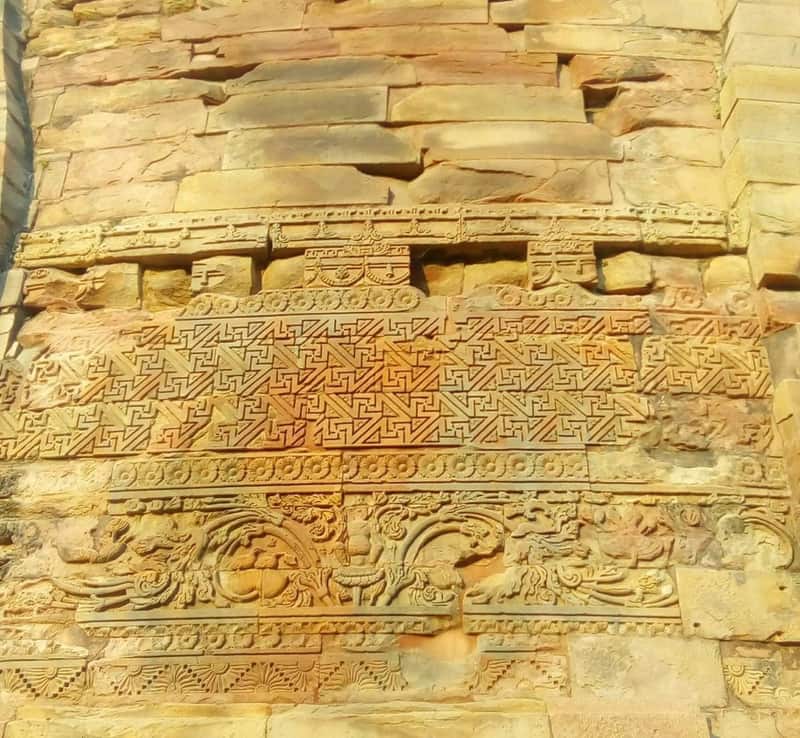
Dhamek Stupa dominates the park the way a mountain dominates a plain. Rising about 43 metres over the lawns, it is a massive cylinder of red brick and stone built around the 5th century on the site where the Buddha is believed to have given that first sermon. Its lower face is ringed with ornate bands of carved stone — delicate lotus motifs and geometric patterns that have survived fifteen centuries — while the upper body, once taller still, has worn into a smooth, weather-beaten mound. Pilgrims circle it clockwise, some touching its base with their foreheads; the whole structure feels less like a ruin than a presence.
The brickwork is the astonishment. The stones of Dhamek's base are fitted with a precision that would make a modern mason pause, and the lotus friezes — carved when Gupta sculptors were at the peak of their craft — remain crisp enough to photograph in detail. What the site has lost is instructive too: early accounts describe a stupa much larger, with wooden railings and umbrellas, and its original dome was once crowned by a stone finial now gone. Climb the low platform around the base, and look out over the park; from here the whole story of Sarnath — the first sermon, the monastic city that grew around it, and the silence that remains — sits in a single frame.
The Sarnath Museum: The Lion Capital and Its Treasures
The Sarnath Museum is small, dusty in the most affectionate sense, and the richest little building in Uttar Pradesh. Its prize is the Ashokan Lion Capital — the four lions back-to-back on a lotus abacus, carved around 250 BCE — which India adopted as its national emblem and which stands here in the same hall where it has rested for over a century. Around it are the treasures the excavations raised: the exquisite Bodhisattva of Sarnath, a Gupta sculpture so refined it is called one of the finest pieces of Indian art; seated Buddhas in dhammachakra mudra; fragments of the original Ashokan pillar; and hundreds of carved panels, coins and household objects from the monastic city.
The museum asks for time and silence, and gives back layers. Photographs are restricted inside — a small price for the privilege of standing before the capital with your own eyes. The galleries follow the site's history: Mauryan fragments from the 3rd century BCE, Kushan sculptures, the Gupta golden age, and the medieval decline when the city was abandoned and buried. An inscription hall holds Buddhist relics and a model of the ancient university city, which by the 7th century was one of India's great centres of learning. Plan ninety minutes here; plan more if you are a student of sculpture, because the Bodhisattva alone deserves a slow hour.
Temples of Many Nations: Thai, Chinese and Tibetan
Around the park, the Buddhist world has built itself a meeting place. The Thai temple is the most striking — a golden-tiered wat with a reclining Buddha and colourful murals of the Buddha's life, its grounds kept immaculate by resident monks. Nearby, the Chinese temple offers a different silence: carved dragons, red pillars and a hall with a serene golden Buddha, built to honour the Chinese pilgrims who followed the same dharma path. The Tibetan temple is a burst of colour — prayer flags snapping in the wind, butter-lamp flames, thangka paintings and the deep sound of chanting that drifts across the lawns.
Each temple is open, welcoming, and free — a gentle education in how one teaching became many homes. Walk between them and the distances feel devotional: ten minutes of calm road separating a Thai stupa from a Tibetan prayer wheel. The monks are used to visitors and rarely object to respectful observation; some temples hold short prayer sessions in the late afternoon that travellers may watch from the entrance. Do not rush this circuit. Between the museums and the stupas, these temples are the living proof that Sarnath is not a monument but a neighbourhood — the deer park of the sermon still hosts the whole world's dharma.
Walking the Park: Ruins, Gardens and Peace
Give the ruins at least an hour, and let them be a walk rather than a checklist. The main site spreads across lawns dotted with the foundations of the ancient monastic city — squares of brick that were once rooms, courtyards and meditation halls where thousands of monks lived. The Dharmarajika Stupa, built by Ashoka and now reduced to a low mound, was the park's oldest monument, its broken dome a reminder of how much is still buried under the green. Signboards tell the story of each excavation; the lawns themselves tell the better story of what the place must have felt like — a city of practice, study and stillness.
The gardens complete the pilgrimage. Between the monuments, flowering trees and tidy hedges keep the site green even in summer, and the benches fill with pilgrims and travellers who have simply stopped to sit. Watch the squirrels, the monks on their rounds, and the families picnicking near the deer enclosure; this is a sacred site that also knows how to be an ordinary park, and that humility is part of its power. Finish your walk at the Chaukhandi Stupa, a brick tower at the park's edge marking the place where the Buddha is said to have first met his five disciples on his way from Bodh Gaya — a quiet bookend to the day's story.
Practical Guide: How to Reach, Timing and Tickets
Reaching Sarnath is easy and part of the pleasure. An auto-rickshaw from the ghats takes thirty to forty minutes; a taxi is faster and more comfortable; and city buses run from the Cantt station and parts of the old city, dropping you near the park entrance. Most visitors make it a half-day trip, leaving after breakfast and returning by mid-afternoon — but the site deserves a full morning, and the light over the brick ruins is at its most beautiful in the first hours after opening. Entry to the park and stupas carries a modest fee for foreigners and a smaller one for Indian visitors; the museum ticket is separate and equally modest.
Timing is everything in the details. The park generally opens around sunrise and closes by sunset; the museum keeps its own hours, usually 9:00 am to 5:00 pm, and is closed on Fridays and gazetted holidays — check at the ticket window rather than trusting memory. Wear shoes you can kick off at temple entrances, carry water, and expect to walk: the circuit of park, museum and temples is a comfortable four to five kilometres. To combine with the day: most travellers start with the museum, move to the stupas, and finish with the international temples before returning to Varanasi in time for the evening aarti at Dashashwamedh Ghat — the perfect bookend to a sermon and a city.
How to reach
Auto (30 to 40 min) or taxi from the ghats; city buses from Cantt and the old city stop near the park.
Timing
Park: sunrise to sunset. Museum: about 9:00 am to 5:00 pm, closed Fridays and gazetted holidays.
Tickets
Modest entry fee for the park; separate, equally modest ticket for the museum. Photography inside the museum is not allowed.
What to wear
Comfortable shoes for walking; remove footwear at the temples; modest dress is appreciated.
Duration
Half a day is comfortable; a full morning if you want the light and the pace to sink in.
Combining the day
Return by late afternoon and catch the evening aarti at Dashashwamedh Ghat for a perfect finish.
Quick Tips
Go early — the park opens at sunrise, the light on the brick ruins is golden in the first hour, and the museum queues stay short before 10 am.
Frequently Asked Questions
Was this article helpful?
Your feedback helps us improve
Enjoyed this article?
Get the latest Varanasi travel tips delivered to your inbox.
Related Articles
 Travel
 Best Time to Visit Varanasi: Season-by-Season Guide
When to go for perfect weather, the best festivals, and the fewest crowds
Travel Varanasi Hostels Guide: Best Budget Hostels & Dorms
Complete guide to hostels in Varanasi — dorm prices, best locations, amenities, and tips for budget travelers.
Travel Varanasi Luxury Hotels Guide: 5-Star & Heritage Stays
Guide to the best luxury and heritage hotels in Varanasi — prices, amenities, ghat views, and booking tips.