
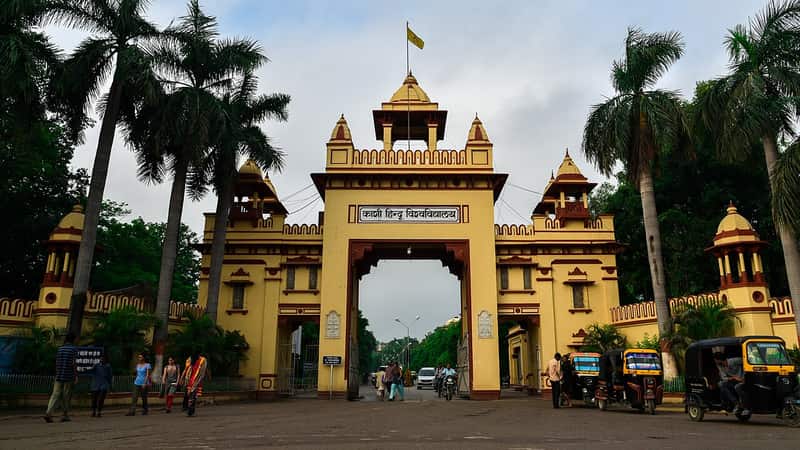
Twelve kilometres from the crowded ghats lies another Kashi — a green, sprawling campus where twenty-five thousand students live, study and argue philosophy under neem trees. Banaras Hindu University was founded in 1916 by Pandit Madan Mohan Malaviya as a modern Indian university built on ancient values. Today it is Asia's largest residential university, and one of Varanasi's most surprising day trips.
Key Takeaways
- A University Built as a Dream: Malaviya's Vision
- The Sri Vishwanath Temple: The White Marble Landmark
- Bharat Kala Bhavan: A Museum of India's Art
- The Campus Experience: Halls, Gardens and Canteens
A University Built as a Dream: Malaviya's Vision
Malaviya's idea was revolutionary for its time. In 1916, after years of fundraising and appeals, he gathered the support of maharajas, merchants and ordinary pilgrims to found a university where modern science and ancient Sanskrit scholarship could sit side by side. His vision was Kashi itself — a city of learning in the literal sense — and he chose the name Banaras Hindu University to signal that it belonged not to any sect but to the idea of India. The campus he laid out runs to more than 1,300 acres, which makes it the largest residential university in Asia — a green city with its own roads, buses, police, hospital and post office.
Walking the campus today, you feel the scale of the dream. The main avenue is lined with flowering trees; students cycle between faculty buildings in white and sandstone; the air smells of rain-washed leaves and hostel canteens. Malaviya believed education should be open to all, regardless of caste or means — a conviction that shaped the university's most famous building, the Sri Vishwanath Temple, which he insisted must be open to every Hindu, including those from castes traditionally barred from temple entry. The gesture was radical in 1931; the temple remains the moral heart of the campus today.
The Sri Vishwanath Temple: The White Marble Landmark
You see it long before you reach it. The Sri Vishwanath Temple on the campus is the tallest temple tower in India — 250 feet of white marble rising over the treetops like a lighthouse for the surrounding neighbourhoods. It was built by Malaviya with funds raised largely from ordinary donors, and its design follows the Nagara style with a twist: the main shrine, dedicated to Shiva, is open on all four sides so that no one stands at the back — a quiet architectural statement of equality. The marble came from Rajasthan, and in the afternoon light the whole building seems to glow from within.
The temple is not a copy of its older namesake near Dashashwamedh Ghat — it is its own place, and in many ways more democratic. Bathers here do not crowd; the temple complex includes a Ganga tank and lawns where families picnic on holidays. The priests perform regular aartis through the day, and the sound of bells and conch drifts across the campus lawns. Unlike the narrow lanes of the old city, you approach the shrine along wide paths past fountains and flower beds. Dress modestly, leave footwear at the counter, and give yourself half an hour — the atmosphere is serene in a way the crowded ghats never are.
Bharat Kala Bhavan: A Museum of India's Art
Few visitors expect a world-class museum inside a university campus, but Bharat Kala Bhavan is exactly that. Founded in 1920, it grew around Malaviya's personal collection and now holds more than 100,000 objects — miniature paintings from the Mughal, Rajput and Pahari schools, sculptures from the Gupta era, Banarasi textiles, terracotta toys, masks, coins and rare photographs. The building itself is a low, elegant structure of verandas and courtyards, and its galleries are arranged like a journey through Indian art history, from ancient stone to modern canvas.
The highlights reward a slow walk. Look for the miniature paintings — jewel-bright Mughal court scenes and Rajput romances with gold-leaf skies — and the collection of Banarasi saris and brocades that explains why the city's weavers are celebrated worldwide. There are Buddhist sculptures from Sarnath that echo the museum there, and a fascinating archive of photographs of old Banaras, including early views of the ghats before the city grew. The museum is small enough to see properly in ninety minutes and cheap to enter; ask at the desk for the current fee and for guidance if a special exhibition is running.
The Campus Experience: Halls, Gardens and Canteens
BHU is a city with a rhythm of its own. Students in saffron and white, engineering lab coats, and medical interns on bicycles cross paths on the main avenue; the library — one of the largest in Asia — hums from early morning; and the grand auditoria, including the famous Swatantrata Bhawan with its vast pillared lobby, host concerts, lectures and plays that are often open to the public. The campus gardens are another quiet pleasure: the lawns around the temple, the green belt near the university hospital, and the tree-lined roads that make cycling across the campus one of the best ways to see it.
Food on campus is cheap, honest and deeply local. The hostels run canteens serving thalis of dal, rice, roti and seasonal sabzi for a few rupees; the most famous institution is the Dham thali — a massive, refillable platter of Banarasi specialties served with a quiet efficiency that regulars compare to a ritual. Outside the hostels, small tea stalls brew strong cutting chai, and the university's shops sell books, stationery and souvenirs. Visit during term time to feel the campus alive; during holidays it is a calm, leafy retreat. Either way, the experience is a glimpse of the city's other soul — the one that thinks, argues and dreams.
Visiting as a Tourist: Entry, Guides and Timing
Getting in is simpler than most visitors fear. BHU has several gates; the main ones — Lanka Gate on the eastern side and Malviya Gate to the north — are used by visitors daily, and pedestrians are welcome. Vehicles from outside are restricted, so most people take an auto-rickshaw to a gate and walk or use the campus buses and cycle-rickshaws inside. An official guide is not required, but the university's information centre can point you toward the temple, the museum and the auditoria; alternatively, students are famously friendly and will happily direct you across the 1,300 acres.
Timing shapes the experience. The temple opens early for aarti and the morning is the most atmospheric time to visit; the museum generally opens around 9:30 to 10:00 am and closes by 5:00 pm, so plan the museum first and the gardens later. Allow half a day — three hours for temple and museum, and another hour or two for lunch at a canteen and a slow stroll. The campus is a working institution, so expect modest security checks at gates and respect the rules of the library and laboratories. Dress modestly, carry water, and remember that you are a guest in twenty-five thousand students' home.
Entry
Pedestrian entry is free through the main gates; private vehicles are restricted inside, so use autos and campus cycle-rickshaws.
Timing
Temple: early morning is best. Museum: roughly 9:30 am to 5:00 pm, closed on Mondays and public holidays — check on arrival.
Getting around
Campus buses and cycle-rickshaws cover the big distances; cycling is the nicest way between temple, museum and gardens.
Guides
No official guide is needed; the information centre and friendly students will point the way.
Etiquette
Dress modestly, remove footwear at the temple, and keep noise down near libraries and examination halls.
Best months
October to February for pleasant weather; term time (July to May) makes the campus feel truly alive.
Around BHU: Nearby Markets and Eateries
The campus spills into neighbourhoods worth an hour of wandering. Lanka, the student township at the eastern gate, is a festival of bookshops, second-hand stalls, cheap eateries and evening chai corners; its lanes hold the kind of youthful energy that the old city hides. Opposite the main gate, the small food street known for chaats and samosas fills with students every evening. And just beyond, the Assi road runs toward the ghats, letting you glide from university calm to riverside chaos in one short auto ride.
For a proper meal beyond the campus canteens, the nearby areas reward exploration. Try the thalis at modest family-run restaurants around Lanka, the fresh juices and kulfi stalls near the gates, and the sweet shops where Banarasi mithai — malaiyyo in winter, pedas and barfis year-round — sits in gleaming rows. Ask any student for their favourite cheap eats and you will be pointed to some small counter that no guidebook lists. The area is safe and lively until late evening; come hungry, leave with a full heart, and treat the university and its neighbourhoods as one long, unhurried day.
Quick Tips
Arrive by 8:30 am — do the temple first while it is quiet, the museum after it opens, and save the gardens and a Dham thali for a long, unhurried lunch.
Frequently Asked Questions
Was this article helpful?
Your feedback helps us improve
Enjoyed this article?
Get the latest Varanasi travel tips delivered to your inbox.
Related Articles
 Travel
 Best Time to Visit Varanasi: Season-by-Season Guide
When to go for perfect weather, the best festivals, and the fewest crowds
Travel Varanasi Hostels Guide: Best Budget Hostels & Dorms
Complete guide to hostels in Varanasi — dorm prices, best locations, amenities, and tips for budget travelers.
Travel Varanasi Luxury Hotels Guide: 5-Star & Heritage Stays
Guide to the best luxury and heritage hotels in Varanasi — prices, amenities, ghat views, and booking tips.