
For over a thousand years, the looms of Varanasi have produced what many consider the finest brocade in the world. The Banarasi saree — woven with real silver and gold thread, raised by hand, and finished with the patience of generations — is the city's most enduring art, a garment that outlives its owner and grows softer with every generation. This guide tells you how to understand it, where to buy it honestly, and how to tell the difference between a treasure and a tourist trap.
Key Takeaways
- The Loom and the Gold
- Types of Banarasi
- Real Zari vs Imitation
- The Weaving Quarters
The Loom and the Gold
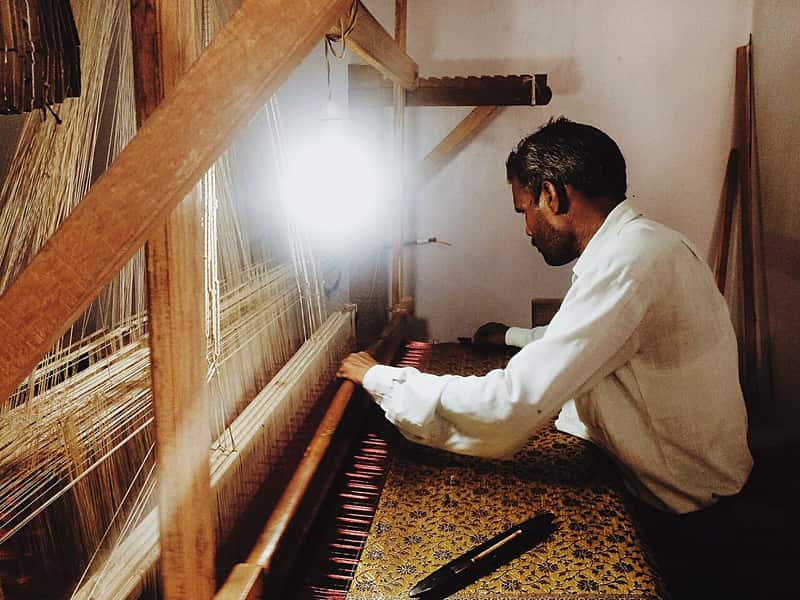
Brocade weaving came to Varanasi more than a thousand years ago, carried by weaver families who migrated from Gujarat and settled along the Ganga. Under the patronage of the Mughal emperors, who prized the city's kinkhab and gold-shot silks above all others, the craft grew into a royal industry, and temples and courts across India ordered their ceremonial cloth from Banaras. Some of the oldest surviving pieces now rest in museums in Delhi, Kolkata and London, and their designs are still being woven on the same kind of looms today. The heart of the craft is the jala system, a complex arrangement of knotted threads that hangs above the loom and guides the weaver's hands, allowing an elaborate design to be repeated across the entire length of the saree with perfect accuracy.
Weaving a single Banarasi saree is measured not in hours but in weeks. The warp is dressed by hand, the zari threads are laid with brass shuttles, and the jala boy sits above the loom pulling the pattern strings with every pass of the weft. A fine kinkhab or a heavily brocaded wedding saree can take three to six months of eight-hour days — which is why a genuine handloom piece costs what it does, and why machine-made copies can sell for a tenth of the price. Even today, tens of thousands of looms in the city and its surrounding villages are still at work, and the craft supports lakhs of people, from the weaver at the loom to the woman who finishes the fringes by hand.
Types of Banarasi
The word Banarasi covers a whole family of weaves. Kinkhab, the most royal, is so densely worked in metal thread that the silk barely shows — it was made for kings and for the deities of temples, and its weight alone speaks of its value. Amru, a cousin weave, is softer and slightly lighter, named after the weavers who once served the Mughal court. Tanchoi is the most delicate, woven in fine silk with self-coloured patterns, while georgette and organza are the modern, lighter Banarasis that drape beautifully for evening wear, often carrying zari borders and butis worked in the traditional way. There is also the pure mulberry katan silk Banarasi, the connoisseur's choice, whose dense, supple body holds its folds for a lifetime.
Within these families the design language is endless: the mango or paisley buti, the lotus, the peacock, the rose, the leafy bel that runs along the border, and the finely striped jangla. Weavers name the sarees after their dominant motif, so a keri-buti piece is covered with mangoes and a mor-buti with peacocks; the older connoisseurs can read a saree's family, era and even its loom from a single buti. Wedding sarees favour dense reds, maroons and gold, while everyday Banarasis in soft pastels are lighter on both pocket and shoulder. Whatever the design, a true Banarasi reveals itself in the fall — the cloth moves like water, folds like silk and carries light in its thread. Hold it up to the window and the gold wakes against the sun; that single gesture has convinced more buyers than any salesman's speech.
Real Zari vs Imitation
Real zari is not paint or plastic; it is actual metal — fine silver wire, often plated with gold — wound around a silk core. Test it by holding a loose thread end to a flame for a second: real zari turns black, stays as a metallic bead and gives the smell of hot metal, while imitation zari burns, melts or crumbles. Check the reverse of the saree as well; genuine handloom zari is woven into the fabric, while machine zari is often glued or printed, and the difference shows clearly on the wrong side. Run your palm over the surface too — real zari is cool to the touch and slightly raised, while printed imitation is flat and warm.
Silk, too, can be tested simply. Pull a few threads from the selvage and burn them: real silk burns slowly, smells like burnt hair and leaves a soft black bead, while synthetic yarns melt into hard plastic globules. The government's Silk Mark label is your best official guarantee, and genuine stores display it proudly; the Handloom Mark is a second, equally reassuring tag. Remember also that not every Banarasi is pure silk — good quality georgette Banarasis are blended by design — but the price should always match the fibre, and honest sellers name their mix without hesitation. Ask, too, about the zari count: the denser the weave of the metal thread, the heavier the saree and the longer it took to make.
The flame test
Real zari and real silk char into soft beads; synthetics melt or burn away. One second of flame tells the truth.
The feel test
Handloom silk is supple and warm to the touch; machine cloth feels stiff and slippery.
The labels
Look for the Silk Mark and Handloom Mark tags, and read them — genuine tags carry a woven serial number.
The price
If the price sounds too good for handloom, it is machine-made — fine weaves never sell cheaply.
The Weaving Quarters
The real Banarasi is born not in showrooms but in the dense lanes of Madanpura, Alaipura, Lohta and the villages around Sarnath. Here, in tiny rooms lit by a single bulb, the family loom stands beside the cooking hearth, and the rhythm of the jala is the rhythm of the house. Madanpura is the most famous quarter — a warren of narrow alleys where every doorway opens on the clack of shuttles — while Alaipura is the heart of the zari and finishing trade, where the fringes are tied and the folds are pressed. Sarnath and Lohta, with their weaving villages, are where the great wedding-saree orders are filled. The quarters have their own economy and their own clock: work begins before dawn, pauses for the afternoon heat, and continues by electric light deep into the night.
Visiting a weaving quarter is the single best education in the craft. Walk with a guide or a weaver cooperative's representative, ask before photographing, and do not be surprised if the jala boy at the top of the loom is the weaver's ten-year-old son learning the family grammar of knots. The looms themselves tell a story of change: many are now partly mechanised, with a motor lifting the warp so the weaver's hands stay free for the shuttle. But the true Banarasi, the piece made for a wedding or an heirloom, is still tied to hands, memory and the patient week-by-week passing of the shuttle — and the weaver who takes your order will ask you which festival the saree is for, because in Kashi every great cloth is woven for an occasion.
Where to Buy
The honest market runs from the famous showrooms near Godowlia and the Thatheri Bazaar area to the weavers' cooperatives and the state-run handloom emporiums, where a fixed price protects both buyer and weaver. For heirloom quality, buy from a cooperative store or directly from a trusted weaving family in Madanpura, where you can sit with the weaver, choose the design and see the cloth on the loom before it is cut. The annual Banaras Brocade Fair, usually held in the winter months, gathers hundreds of looms under one roof and is the single best place for variety, with weavers demonstrating at live looms and selling directly. Whichever door you choose, the first half hour should be spent looking and touching, not buying; let the cloth speak before the salesman does.
Whatever you choose, follow the golden rules: check the zari and the silk yourself with the small tests above, ask the shop to write the fibre content on the bill, and remember that a handloom Banarasi of even modest quality rarely sells for under a few thousand rupees. Bargaining is normal in the bazaars, but the skill is in knowing what you are bargaining for. And buy from the person who shows you the cloth, not the tout who promises to take you to his brother's shop — the touts' commissions are added to your price, invisibly but certainly. If the piece is a gift, tell the seller; good weavers will wrap it in the traditional cotton cloth and add a hand-written note on the loom and the weaver's name, which is the most honest receipt of all.
Godowlia showrooms
The famous names are here — convenient, but compare prices across three shops before deciding.
Weavers' cooperatives
Fair prices, honest fibre, and the largest share of your money reaching the weaver.
Government emporiums
Fixed prices and certified stock — a dependable first stop to learn what quality looks like.
Banaras Brocade Fair
Held in winter — the widest variety of weaves, looms and prices anywhere in the city.
Madanpura looms
Buying directly from a family loom — the most authentic, most personal, and often the best value.
Caring for a Banarasi
A Banarasi saree is an investment in years, and it repays simple care. Store it folded in a clean cotton or muslin wrap, never on a wire hanger and never in plastic, which traps moisture and dulls the zari. Refold it along different lines every few months so the creases do not become permanent, and slip a small pouch of silica gel or neem leaves into the cupboard — both keep away the insects that love silk and cotton alike. Twice a year, on a dry sunny morning, take it out and air it in the shade for an hour; the light and breeze keep the metal thread bright without fading the gold. Keep the cloth away from moth-repelling naphthalene balls that touch the silk directly, for the crystals can tarnish the zari wherever they rest.
For cleaning, dry-cleaning is the rule for heavily worked pieces; gentle hand-washing in cold water with a mild detergent suits lighter georgette and organza Banarasis, but test a small corner first. Never scrub the zari, never wring, and dry the saree in shade, because direct sun fades the gold. Iron it while still slightly damp, on the reverse side, on a low heat, and keep the perfume away from the zari — the alcohol in fragrance dulls metal thread over time. With that care, a Banarasi outlives fashion cycles and often outlives its owner — passed on, in Kashi's custom, as a memory of weddings and winters, glowing softly in candlelight for a second generation. And if the saree ever needs a new border or a fresh hem, use a tailor who knows silk — the old tailors of the market lanes handle a Banarasi with the same care a weaver gives it.
Quick Tips
Do the flame test on zari and silk before you buy, buy from the weaver or a cooperative rather than a tout, and always keep the written bill with the fibre content.
Frequently Asked Questions
Was this article helpful?
Your feedback helps us improve
Enjoyed this article?
Get the latest Varanasi travel tips delivered to your inbox.
Related Articles
 Markets
 Vishwanath Gali Shopping Guide
Vishwanath Gali is the busiest shopping lane in Varanasi, leading to the famous Kashi Vishwanath Temple. The narrow lane is packed with shops selling religious items, silk, and souvenirs.
Markets Thatheri Bazaar: Brass and Beyond
Thatheri Bazaar is famous for its brass and copper utensils, from cooking pots to decorative items. This heritage market has been the center of metalwork trade for centuries.
Markets Godowlia Market: The Bustling Hub
Godowlia Market is the commercial heart of Varanasi, where everything from vegetables to electronics is sold. The market is an assault on the senses with its colors, sounds, and energy.